What Is a Sawbuck? How to Choose and Use a Log Cutting Stand
What a sawbuck is, how the X-frame cutting stand holds logs steady off the ground, how to choose the right weight capacity and how to use a log stand safely for firewood.

On this page
Top picks at a glance
As an Amazon Associate I earn from qualifying purchases.
- 1
 Oregon Steel Log Saw Horse9.4/10View on Amazon
- 2
 Log Saw Horse9.3/10View on Amazon
- 3
 Olympia Tools 80-934 Forest Master Ultimate Sawhorse9.0/10View on Amazon
When asking what is a sawbuck, the answer is straightforward: a sawbuck is an X-frame stand built to hold logs securely at waist height while cutting firewood with a chainsaw or handsaw. Elevating timber off the dirt keeps saw chains out of abrasive soil, stops logs from rolling during cuts, and reduces lower back strain by letting you stand upright.
FirewoodGearHQ earns a small commission if you buy through links on this page. The price you pay stays the same. Read our affiliate disclosure.
What is a sawbuck: the quick answer
A sawbuck is a dedicated wood-cutting stand designed for bucking felled logs into stove-length firewood rounds. Its structure uses intersecting legs that cross in an X shape, forming a deep V-cradle along the top where rough timber rests under its own weight. The name derives from the Dutch word zaagbok (sawing goat), referring to a trestle whose splayed legs resemble the stance of a goat or buck.
While traditional sawbucks were built from timber posts, modern models use alloy steel or tubular iron. Contemporary metal stands feature serrated teeth along the cradle arms to grip bark, with select designs adding adjustable width settings or folding frames that collapse flat for storage. Placing timber in the elevated cradle keeps logs motionless while you slice downward with a chainsaw, letting cut rounds fall cleanly away.
Sawbuck specifications and capacity comparison
| Model | Rated capacity | Working dimensions | Stand weight | Key features |
|---|---|---|---|---|
| Oregon 584145 | 176 lbs | 41.4 x 6.7 x 34.32 inches (10.6 inch log capacity) | 15 lbs | Painted steel frame, serrated teeth, limited lifetime warranty |
| VEVOR SL-005 | 330 lbs | 33.07 x 32.28 x 31.5 inches | 12.6 pounds | Alloy steel frame, six thickened legs, serrated grooves |
| YARDMARIS ym48 | 330 lbs | Adjustable top width 8.6 to 10.6 inches | 8.91 lbs (9.53 pounds in spec table) | 195MPa steel, orange powder coating, serrated teeth |
| Kapler KSH-02 | 260 lbs | Not stated | Not stated | Alloy steel, painted finish, serrated teeth with fixed spring |
| Sharellon | 260 lbs | 32 x 29.5 inches | Not stated | Steel frame, 3 adjustable ranges, spring-loaded support |
| Mini Tang | 260 lbs | 30 x 41 x 32 inches part size | Not stated | Thickened iron tubes, 3-level width adjustment, reinforced chains |
| Goplus SU-36019BK-LT | 220 lbs | Width settings of 31, 27.5, and 24.5 inches with matching heights of 36, 37.5, and 39 inches | 12.5 pounds | Reinforced metal tubes, serrated teeth, non-slip foot pads |
| IRONMAX HY33845LT | 220 lbs | 32 x 32 x 31.5 inches | 14.5 pounds | Alloy steel frame, 3 levels of adjustment, serrated teeth |
| Generic JH3T2D56WMVMYHDHGNJ | 220 lbs | 32 x 35 x 30 inches (folded: 33.4 x 39 inches) | 13 pounds (13.27 pounds in spec table) | Iron frame, triangular structure, serrated teeth |
Rated load capacities for dedicated log sawbucks range from 176 lbs on the Oregon steel stand (on Amazon) to 220 lbs on Goplus, Generic, and IRONMAX models, 260 lbs on Kapler, Sharellon, and Mini Tang frames, and up to 330 lbs on VEVOR and YARDMARIS. Working log widths also vary: Oregon lists a 10.6 inch maximum log capacity in its bullet points (its title states 10 inches and product type name states 10.5 inches), while YARDMARIS specifies an adjustable top width from 8.6 inches to 10.6 inches. Stand weights range from 8.91 lbs for YARDMARIS (9.53 pounds in its spec table) and 12.5 pounds for Goplus, up to 15 lbs for Oregon.
What makes a sawbuck effective for cutting firewood
X-frame geometry and stability
Crossing the support legs creates a triangular base on the ground and an open V-shaped cradle above. Centering a log in the cradle uses gravity to wedge timber securely between the steel uprights. To ensure dependable footing on uneven woodlot ground, VEVOR includes six thickened legs, while IRONMAX reinforces each side with steel plates.
Serrated teeth and log clamping
Chainsaw chains exert strong pulling force that can cause unsecured logs to spin or slide. Dedicated sawbucks prevent this with serrated teeth along the cradle arms that bite into bark. To secure awkward branches further, Kapler and Sharellon incorporate fixed spring fixtures, while Mini Tang uses reinforced chains to secure logs during cutting.
Adjustable width and working height
On folding X-frames, drawing the legs inward narrows the cradle while increasing height. For example, Goplus specifies width settings of 31 inches, 27.5 inches, and 24.5 inches with matching heights of 36 inches, 37.5 inches, and 39 inches. The narrowest 24.5-inch setting raises the stand to 39 inches for taller operators, while the 31-inch width lowers it to 36 inches for broader logs. Sharellon and Mini Tang each provide 3 adjustable ranges, and IRONMAX provides 3 levels of adjustment via locking knobs.
Folding frames and portability
Foldable steel sawbucks collapse flat for transport in vehicle trunks or wall storage. Generic specifies folded dimensions of 33.4 x 39 inches, with stand weights starting at 8.91 lbs for YARDMARIS (9.53 pounds in its spec table), 12.5 pounds for Goplus, and 12.6 pounds for VEVOR. Assembly is rapid: Sharellon states assembly takes less than 5 minutes, and Mini Tang states setup takes 3 minutes with its included wrench.
Durable steel construction
Manufacturers build frames using tubular iron and alloy steel to resist heavy impacts and weather. YARDMARIS specifies 195MPa steel with orange powder coating, VEVOR uses rust-resistant alloy steel, and Oregon provides painted boxed steel backed by a limited lifetime warranty.
How to use a sawbuck safely with a chainsaw
Operating a chainsaw around a steel cutting frame requires disciplined habits:
- Firm ground setup: Place the stand on level ground clear of debris. Non-slip foot pads, like those on the Goplus model, help maintain footing on dirt or turf.
- Balanced log placement: Center the log across the cradles. Cut only on the cantilevered end extending outside the frame, never between uprights where the log can sag and pinch the bar.
- Proper operator stance: Stand with balanced footing to the side of the saw, outside the guide bar plane, holding both chainsaw handles firmly.
- Guide bar clearance: Keep the guide bar nose clear of the steel uprights. Striking metal teeth ruins cutters and can trigger kickback.
- Protective equipment and assistance: Always wear certified chainsaw gear, including chaps, a helmet with face screen and hearing protection, leather gloves, and steel-toe boots. Check starting controls using our guide on how to start a gas chainsaw. Maintain kickback awareness and never cut alone, following the OSHA logging eTool.
What happens if you cut logs on bare ground
Cutting logs on bare dirt damages equipment and creates hazards. When timber rests on soil, finishing a cut frequently causes the chain to strike abrasive dirt and stones. Even momentary contact dulls cutter edges, slowing work and overheating the guide bar. While dull teeth can be filed using the best chainsaw sharpener, elevating timber on a sawbuck avoids dirt strikes entirely.
Ground cutting also increases kickback hazards when the bar nose strikes hidden stones or roots beneath the trunk. In addition, logs supported on uneven ground sag, closing the kerf and trapping the bar. On a sawbuck, cutting the cantilevered overhang allows severed rounds to drop freely, keeping the kerf open. Moving heavy trunk sections to the stand with log carriers for firewood with wheels prevents back strain.
Sawbucks compared to standard carpentry sawhorses
Standard carpentry sawhorses elevate flat workpieces but are unsuited for round firewood. Folding contractor sawhorses, such as IRONMAX model IR-TJ10030, feature flat top beams, 2×4 brackets, 4 detachable side hooks, and capacities of 1,100 lbs each or 2,200 lbs per pair. These flat rails support sheet goods and lumber, but round logs offer only a narrow contact point that easily rolls under chainsaw pull.
A dedicated sawbuck solves this with a V-cradle and serrated teeth that clamp round logs securely. While bucking, attaching a firewood measuring tool for chainsaw ensures rounds match firebox length before splitting with a best splitting axe or a best splitting maul. For high volumes, the best log splitter for home use speeds up production.
Turn a stack's length, height and depth into full and face cords, and estimate how much wood a winter takes.
FAQ: wood, fire and gear
Can I use a chainsaw on a sawbuck?
Yes. Steel sawbucks are designed for bucking logs with chainsaws or hand saws. Maintain guide bar clearance from the metal uprights and cut only on the overhanging log end so rounds drop cleanly.
What is the difference between a sawbuck and a sawhorse?
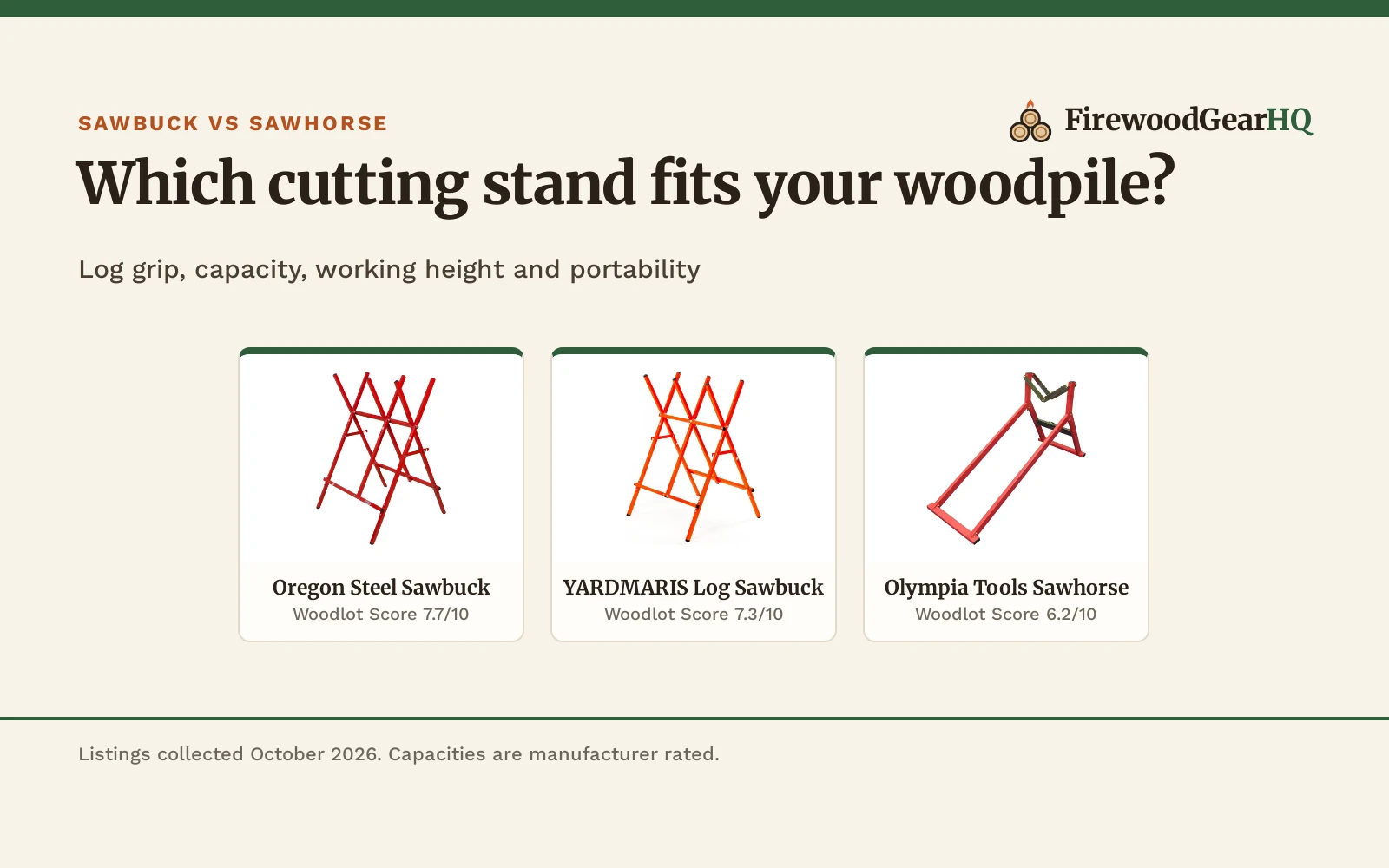
A sawbuck has crossed X-legs forming a V-cradle with serrated teeth to lock round logs in place. A carpentry sawhorse features a flat horizontal top beam designed for flat dimensional lumber and plywood.
How much weight can a steel sawbuck hold?
Ratings vary by build. Examined models range from 176 lbs on the Oregon stand, to 220 lbs on Goplus, Generic, and IRONMAX, 260 lbs on Kapler, Sharellon, and Mini Tang, and up to 330 lbs on VEVOR and YARDMARIS.
What size log fits in a folding sawbuck?
Capacity depends on frame design. Oregon lists a maximum log capacity of 10.6 inches (stating 10 inches in its title and 10.5 inches in its type name), and YARDMARIS specifies an adjustable top width from 8.6 inches to 10.6 inches.
Why do sawbucks have serrated teeth?
Chainsaws pull aggressively against timber. Serrated metal teeth along the cradle bite into bark, preventing the log from rolling, spinning, or sliding lengthwise during the cut.
Do I need a sawbuck to cut firewood?
While not mandatory, a sawbuck prevents chain dulling from ground strikes, eliminates pinched bars on overhanging cuts, and reduces lower back strain by raising timber to waist height.
More firewood guides
Explore our firewood handling hub for more woodlot tools. Choosing a saw for bucking? Read our guide to the best chainsaw for firewood, compare cordless models in our best battery chainsaw for homeowners review, or explore corded options in our best electric chainsaw guide. For timber advice, visit our chainsaws hub, store split wood on a best firewood rack with cover, verify dryness with the best firewood moisture meter, and check drying times in how long to season firewood. Also see our how to move heavy logs safely. Also see our how to start a firewood business. Also see our how much to charge for a cord of firewood. Also see our best firewood to burn. Also see our hardwood vs softwood firewood.
More related guides (130)
- firewood btu chart
- woods you should never burn
- cant hook vs peavey
- oak vs maple firewood
- ash vs oak firewood
- best log carrier
- best cant hook
- best log tongs
- best log lifter
- what is a firewood processor
- best length for pickaroon
- best log carrier under 40
- best log tongs under 50
- log tongs for tractor front ends
- how to use a cant hook
- how to use log tongs
- sawbuck vs sawhorse
- how to use a pickaroon
- pickaroon vs peavey
- best log carrier for large loads
- logox 3-in-1 forestry multitool review
- log cart vs wheelbarrow for firewood
- cant hook vs log tongs
- best log carrier for dirty firewood
- gorilla carts 800 lb dump cart review
- pulp hook for firewood
- log tongs vs log lifter
- cant hook vs pickaroon
- canvas log carrier vs leather log carrier
- cant hook vs log jack
- cherry vs oak firewood
- oak vs beech firewood
- best firewood cart for muddy yards
- pulp hook vs cant hook
- poplar vs pine firewood
- best gloves for carrying firewood
- log carrier vs firewood rack
- best firewood gloves for women
- best work gloves for splitting firewood under 15
- best log carrier for camping
- best firewood gloves for men
- best firewood gloves for winter
- best log tongs for a homeowner
- best log carrier for women
- log lifter vs log arch
- hickory vs maple firewood
- cedar vs pine firewood
- best log tongs for seniors
- best firewood for camping
- poplar vs oak firewood
- best firewood gloves for wet weather
- best firewood gloves for big hands
- best peavey for firewood
- best chainsaw safety kit for beginners
- log lifter vs log carrier
- best firewood gloves for small hands
- garden cart vs firewood cart
- compressed logs vs firewood
- log tongs vs peavey
- best firewood gloves for seniors
- leather vs cotton firewood gloves
- best hand truck for firewood
- pneumatic vs solid tire firewood cart
- firewood bags mesh
- cottonwood vs poplar firewood
- poly vs steel firewood cart
- best cant hook for firewood
- best firewood cart for seniors
- aspen vs birch firewood
- best log carrier for stairs
- walnut vs cherry firewood
- maple vs elm firewood
- ash vs cherry firewood
- best firewood gloves under 20
- cherry vs pine firewood
- maple vs pine firewood
- hand truck vs firewood cart
- walnut vs hickory firewood
- pickaroon vs pulp hook
- aspen vs cottonwood firewood
- best wheelbarrow for firewood
- firewood bag carrier
- firewood tote bag
- log lifter vs cant hook
- firewood gloves vs garden gloves
- best firewood bag carrier under 30
- firewood bag vs firewood basket
- hand truck vs wheelbarrow for firewood
- mesquite vs hickory firewood
- mesh vs plastic firewood bags
- log dolly vs hand truck
- best log tongs under 40
- apple vs oak firewood
- ironclad gug vs rwg2
- gorilla carts 600 vs 800
- best log carrier for an apartment
- best firewood for a bonfire
- log tongs vs log dolly
- pecan vs hickory firewood
- log grapple vs log tongs
- best firewood cart under 100
- chainsaw mill mini saw board
- log dolly vs log sled
- log dolly vs firewood cart
- log pulling winch
- best log pulling winch under 200
- log lifter vs log grapple
- best log lifter under 100
- firewood gloves vs work gloves
- beech vs walnut firewood
- log jack vs log lifter
- best log pulling winch under 150
- firewood trailer vs firewood cart
- two wheel vs four wheel firewood cart
- firewood moisture content chart
- cordwood saw blade
- juniper vs cedar firewood
- manual firewood bundler
- best cordwood saw blade under 20
- bow saw uses
- come along vs log winch
- electric vs gas log winch
- gorilla carts 600 vs 1200
- log tongs vs firewood gloves
- walnut vs birch firewood
- cherry vs maple firewood
- log arch vs log tongs
- best come along winch
- cant hook dimensions
- best 4 ton come along