What Is a Firewood Processor?
What a firewood processor is, how it cuts and splits logs in one continuous operation, key components to look for and how to choose the right machine.

On this page
Top picks at a glance
As an Amazon Associate we earn from qualifying purchases.
- 1
 Sunnydaze Metal Firewood Carrier with Wheels9.7/10View on Amazon
- 2
 Readywares Firewood Carrier9.7/10View on Amazon
- 3
 FEED GARDEN Firewood Carrier Bag Heavy Duty Waxed Canvas Log9.7/10View on Amazon
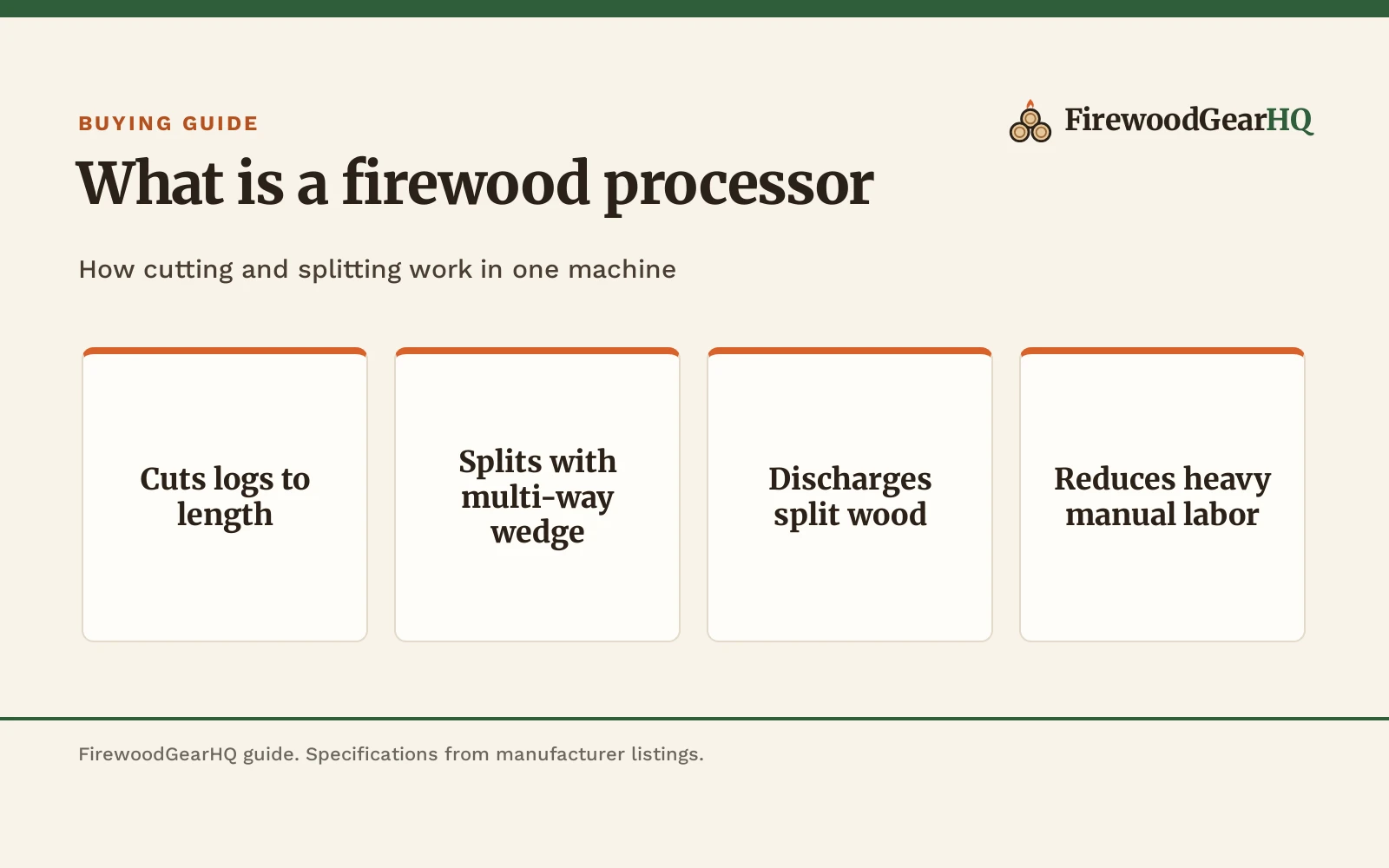
If you produce firewood for home heating or commercial sales, you might wonder what is a firewood processor. A firewood processor is an integrated forestry machine that combines log cutting and splitting into a continuous mechanical cycle. Instead of bucking logs on the ground with a handheld chainsaw and lifting heavy rounds onto a splitter, an operator uses hydraulic machinery to advance full logs, cut them to firewood lengths, and split them through a multi-way wedge, often conveying split wood directly into a truck bed or trailer.
FirewoodGearHQ may earn a small commission if you buy through links on this page. The price you pay stays the same. Read our affiliate disclosure.
What is a firewood processor
Understanding what is a firewood processor starts with recognizing the labor bottlenecks of traditional wood cutting. Standard firewood harvesting requires moving timber repeatedly: dropping logs, bucking each log into individual rounds with a chainsaw, rolling heavy rounds to a splitting station, hoisting each piece onto a hydraulic beam, and throwing split pieces into a transport pile. A processor automates these separate tasks on a single rigid steel frame.
Operating from a manual valve station or wireless remote control, the machinery pulls whole tree lengths along an infeed chute. A high-speed hydraulic chainsaw cuts each log to a chosen length, dropping the freshly cut round directly into a splitting trough. A hydraulic cylinder immediately drives the block against steel splitting wedges, discharging split firewood onto an outfeed conveyor or discharge chute. By eliminating manual lifting and bending, a processor transforms log processing into an efficient, continuous workflow for farms, woodlots, and commercial firewood producers.
Firewood processor specifications comparison
| Model and configuration | Splitting force | Chainsaw bar | Maximum log diameter | Power source |
|---|---|---|---|---|
| MechMaxx HLS20 compact processor | 20ton | 18-inch | 15 inches | 459cc (15hp) gas engine |
| QEEKA 27T hydraulic processor | 27-ton | 20-inch | 17.3 inches | 739cc RATO gas engine |
| YIHUITONG YHT27T processor | 27-ton | 20-inch | 17.32 inches | 739cc gas engine |
| Dvsripa 30TSS skid steer attachment | 30-ton | Not stated | 17.72 inches | Skid steer hydraulics |
| QEEKA 35T skid steer attachment | 35-ton | 25-inch | 17.72 inches | 35 HP loader hydraulics |
| YIHUITONG YHT45T500 commercial processor | 45-ton | 25-inch | 19.6 inches | 20HP GX630 gas engine |
Specifications above reflect published manufacturer listing data. Splitting tonnages represent hydraulic cylinder ratings, while maximum log diameters show the physical capacity of the cutting throat and log clamps.
How a firewood processor works step by step
Log loading and infeed
The production cycle begins at the log deck. Heavy tree trunks are loaded onto an infeed trough using tractor forks, a skid steer grapple, or an integrated hydraulic log lift. For example, commercial configurations listed by QEEKA incorporate a hydraulic log lift designed to hoist logs measuring up to 17.3 inches in diameter and 4.5 meters in length directly from the ground. Once resting in the feed cradle, powered hydraulic rollers or chain conveyors advance the log forward toward the cutting area.
Hydraulic chainsaw bucking
When the advancing log reaches an adjustable length stop, a clamp secures the timber firmly against the frame. A hydraulic chainsaw bar pivots downward across the wood grain to buck the round. Unlike handheld saws, processor saws utilize heavy-duty hydraulic drive motors that deliver constant torque without engine stalling. Specifications vary across listed models: MechMaxx listings specify an 18-inch chainsaw bar on the HLS20, 27-ton models from QEEKA and YIHUITONG utilize a 20-inch chainsaw bar, and larger configurations like the QEEKA 35T and YIHUITONG 45-ton processor feature a 25-inch bar capable of slicing logs up to 19.6 inches (500mm) in diameter.
Hydraulic ram and splitting wedge
As soon as the saw bar finishes its cut and retracts, the severed round drops into the splitting chamber. An automated or hand-operated hydraulic valve triggers the main cylinder, ramming the block through stationary splitting knives. A dedicated cylinder exerts immense mechanical force, such as the 4.5-inch hydraulic cylinder on the QEEKA 27T that operates alongside a 21 GPM hydraulic pump to complete a 10-second cycle time. To increase hourly production, processors commonly utilize multi-way wedges. Machines listed by YIHUITONG and QEEKA feature interchangeable 4-way and 6-way steel wedges that divide a round into 4 or 6 split pieces in a single push, multiplying production efficiency.
Conveyor elevation and discharge
On conveyor-equipped systems, split firewood does not accumulate beneath the splitting wedge. Instead, split pieces slide directly onto an outfeed conveyor belt. For example, YIHUITONG listings specify a 3-meter (9.84ft) conveyor with a 2.55-meter discharge height, while QEEKA includes a 118-inch adjustable conveyor. The belt moves finished firewood upward into waiting pickup beds, dump trailers, or bulk storage bins, eliminating manual handling.
Standalone units vs tractor and skid steer attachments
Firewood processors generally fall into distinct mechanical categories based on how they receive operating power. Selecting between standalone units and machinery attachments depends on existing farm or logging equipment:
- Standalone processors: These self-contained machines feature an integrated gas powerplant mounted on a stationary frame, wheeled cart, or towable trailer. For example, MechMaxx lists entry models with a 459cc (15hp) gas engine weighing 545 pounds, while larger YIHUITONG units utilize a 739cc engine or a 20HP GX630 engine on heavy towable chassis. Standalone processors operate completely independent of tractors.
- Skid steer and tractor attachments: Attachment processors do not contain an internal combustion engine. Instead, they mount directly to the quick-attach plate of a skid steer, front bucket loader, or forklift. Hydraulic hoses connect to the auxiliary hydraulic circuits of the host machine, which supplies the hydraulic fluid flow required to run the saw motor and splitting ram. Dvsripa lists a 30-ton skid steer attachment with automated controls, while QEEKA lists a 35-ton attachment engineered for loaders with 35 HP or greater. Attachments reduce engine maintenance requirements and allow an operator to pick up and process logs from inside an enclosed machine cab.
Firewood processor vs standard log splitter: which do you need?
Determining whether to invest in a firewood processor or remain with standard equipment depends primarily on production volume, physical requirements, and budget. Homeowners cutting firewood for occasional weekend fireplace burning typically find that a standalone log splitter for home use or a gas machine from our guide to gas log splitters provides ample capacity without excessive machinery footprint. Pairing a standard splitter with a dedicated chainsaw for firewood and safe timber handling equipment like a cant hook or log lifter handles modest annual heating supplies.
However, when managing large acreage, supplying an outdoor wood boiler, or operating a commercial firewood enterprise, manual cutting becomes unsustainable. The physical exertion of running a chainsaw for hours on end, combined with picking up heavy logs from muddy soil, introduces fatigue and safety risks. According to manufacturer data published for Dvsripa and QEEKA attachments, processing capacity can reach up to 12 CBM/hour, which equals approximately 3 cords per hour under ideal operating conditions. Operators looking to start a firewood business or calculate commercial pricing in our guide on how much to charge for a cord of firewood benefit substantially from the rapid output, mechanical consistency, and reduced labor overhead that a processor delivers.
Safe operation and maintenance guidelines
Operating heavy log processing equipment safely requires strict adherence to workshop practices and manufacturer protocols. Because processors combine high-tonnage hydraulics with high-speed cutting chains, safety discipline is essential:
- Single operator rule: Reviewing core log splitter safety rules establishes that processing machinery must remain a one operator machine. Never allow helpers to position logs near the cutting bar or reach into the splitting chamber while the engine or hydraulic pump is engaged.
- Protective equipment: Operators should consult a comprehensive chainsaw safety gear checklist, wearing eye protection, hearing protection, heavy leather gloves, and steel-toe forestry boots during operation.
- Built-in machine safety guards: Listings from YIHUITONG and QEEKA incorporate a protective safety net or steel mesh cage covering the chainsaw bar to deflect wood debris, along with emergency stop buttons on the control panel to kill machine power instantly.
- Hydraulic system care: Monitor hydraulic fluid levels and select correct fluid weight per our guide on what hydraulic fluid for a log splitter. Keep hydraulic hoses free of kinks and inspect cylinder fittings regularly to prevent pressure drops.
- Cutting chain maintenance: A dull chain increases hydraulic cutting motor load and slows down production. Follow guidance on how often should you sharpen a chainsaw chain to keep cutting teeth keen, maintaining steady bar lubrication at all times.
Turn a stack's length, height and depth into full and face cords, and estimate how much wood a winter takes.
Frequently Asked Questions
What is the best firewood processor on the market?
The ideal machine depends on timber diameter, target production volume, and your equipment setup. For operators with a loader or tractor, hydraulic skid steer attachments eliminate a separate small engine. For remote woodlots without auxiliary equipment, a self-contained processor powered by a dedicated gas engine provides complete independence. Compare stated maximum log diameters, splitting cylinder tonnage, and conveyor discharge heights before selecting a model.
How many cords per hour can a firewood processor produce?
Output depends on log straightness, species, and equipment design. Under ideal conditions, high-capacity skid steer attachments listed by Dvsripa and QEEKA state processing ratings up to 12 CBM/hour, which equals approximately 3 cords per hour. Compact standalone processors operate at lower hourly volumes suited for small farms and seasonal heating needs.
Can a single operator run a firewood processor?
Yes. Modern firewood processors are engineered for single-operator use. Hydraulic control levers or wireless remote controls allow an operator to advance the timber, engage the saw bar, trigger the splitting cylinder, and discharge split wood without additional manual assistance.
What is the difference between a log splitter and a firewood processor?
A standard log splitter only splits wood rounds that have already been cut to length with a chainsaw. A firewood processor performs log infeed, cutting, splitting, and conveying in one continuous machine cycle, eliminating the physical labor of bucking logs on the ground and lifting heavy rounds.
What size logs can a firewood processor handle?
Capacity varies across machine classes. Compact models such as the MechMaxx HLS20 list a maximum log diameter of 15 inches and a maximum cut length of 24 inches. Mid-size models list cutting capacities up to 17.3 inches or 17.32 inches, while heavy commercial units from YIHUITONG handle logs up to 19.6 inches (500mm) in diameter and 22.83 inches (580mm) in split length.
Do firewood processors require a tractor or skid steer?
Not all models require auxiliary equipment. Standalone processors include dedicated gasoline engines, ranging from 15hp (459cc) up to 20HP (GX630) or 739cc RATO powerplants, allowing them to run independently. Skid steer and tractor attachments do not contain an engine and rely entirely on the auxiliary hydraulic system of the host loader.
Related guides
See the firewood handling hub, explore our guide to the best log splitter for home use, and compare hydraulic options in our review of gas log splitters. For manual cutting prep, check the best chainsaw for firewood and maintain your equipment with the best chainsaw sharpener. Also see our guide on how to move heavy logs safely. Also see our log splitter safety rules. Also see our breakdown of kinetic vs hydraulic log splitters. Also see our comparison of horizontal vs vertical log splitters. Also see our analysis of renting vs buying a log splitter. Also see our guide to cycle time on a log splitter. Also see our instructions on how to buck firewood safely with a chainsaw. Also see our timber moving tools including the best cant hook, the best log lifter, and the best log tongs. Also see our guides on firewood volume in how much is a cord of wood and face cord vs full cord. Also see our business guide on how to start a firewood business and how much to charge for a cord of firewood.