What Hydraulic Fluid for a Log Splitter: Oil Types and Viscosity Guide
What hydraulic fluid a log splitter needs, including AW32 and AW46 oil types, viscosity ratings, operating conditions and when to change hydraulic oil.
 By FirewoodGearHQ Editorial
Updated October 9, 2026
By FirewoodGearHQ Editorial
Updated October 9, 2026
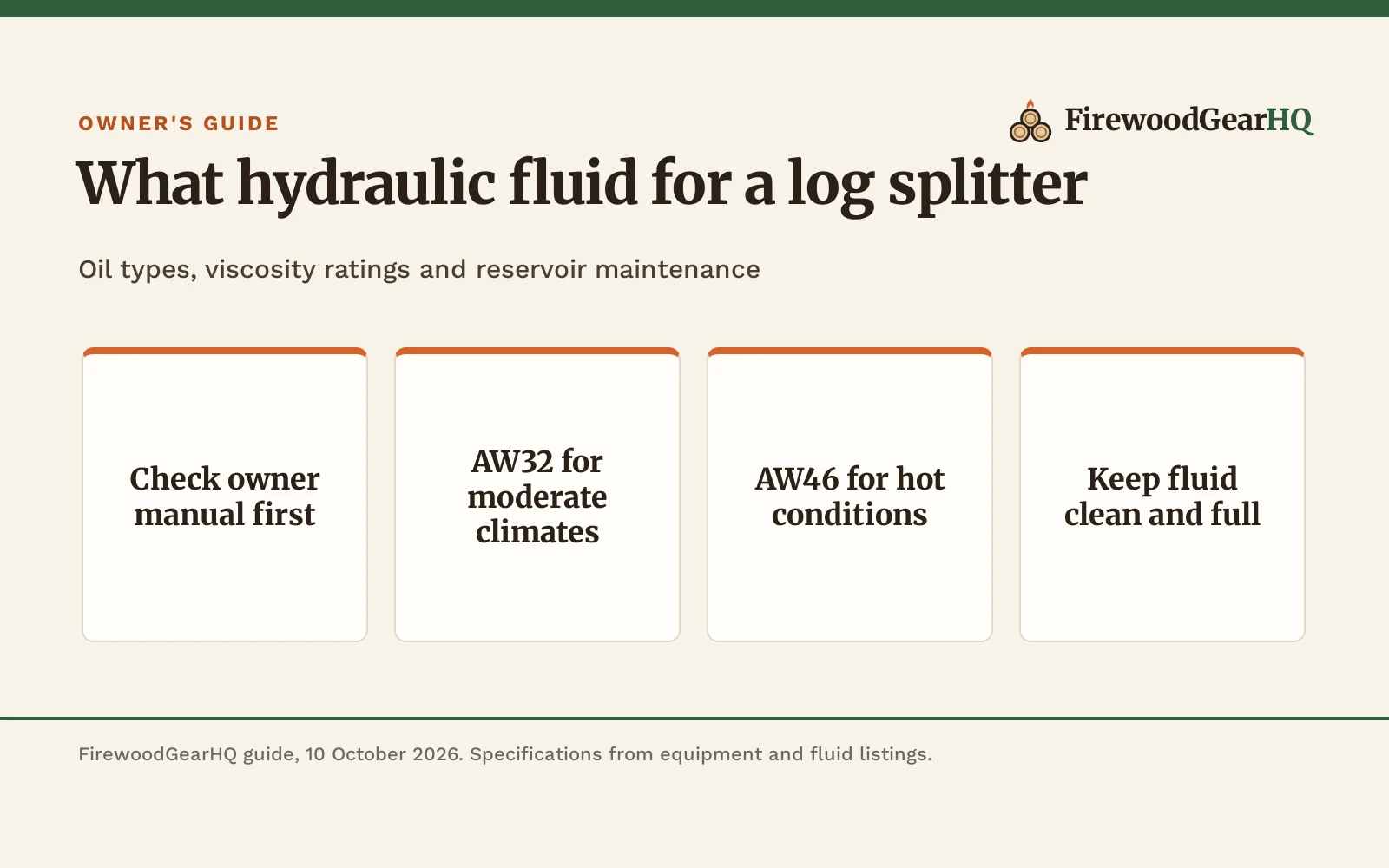
When deciding what hydraulic fluid for a log splitter to use, the standard choice for most machines is an ISO VG 32 or ISO VG 46 anti-wear hydraulic oil, though you must always check the owner’s manual for your specific machine. Most splitter manufacturers specify an anti-wear fluid such as AW32 for general conditions, while AW46 provides thicker protection in hot climates and universal tractor fluid works across many agricultural systems. Checking the manufacturer specification ensures the hydraulic pump and cylinder operate smoothly without premature wear.
FirewoodGearHQ earns a commission when you buy through links on our product pages, at no extra cost to you. Read our affiliate disclosure.
The quick answer
For most log splitter owners, an ISO VG 32 anti-wear hydraulic oil, labeled AW32, is the standard choice for year-round splitting in moderate climates. If you split wood in hot summer conditions, an ISO VG 46 oil, labeled AW46, offers higher viscosity to maintain pump pressure under heat. Commercial fluid suppliers package anti-wear hydraulic oils in convenient container sizes; for instance, SuperS lists its AW32 hydraulic oil in a 1 gallon jug, and Cam2 lists both AW 32 and AW 46 in 1 gallon jugs and 5 gallon pails. Always confirm the builder’s recommendation before pouring, because using the wrong viscosity can lead to sluggish cycling or pump damage.
Hydraulic fluid comparison chart
| Fluid type | Viscosity grade | Recommended use |
|---|---|---|
| AW32 / ISO VG 32 | ISO VG 32 | General splitting in moderate and cool weather |
| AW46 / ISO VG 46 | ISO VG 46 | Heavy splitting in warm summer conditions |
| Universal Tractor Fluid | Not stated | Shared tractor reservoirs and versatile farm equipment |
| Automatic Transmission Fluid | Not stated | Severe cold winter operation when specified by the builder |
Use the chart to understand general fluid categories, but always confirm the exact specification in your owner’s manual before filling.
What hydraulic fluid for a log splitter
AW32 anti-wear hydraulic oil
AW32 is the most widely specified log splitter oil type across residential and commercial machines. The designation indicates an anti-wear additive package formulated within the ISO 32 viscosity range. Fluid makers formulate AW32 to circulate readily at startup while maintaining adequate film strength at operating temperature. For example, Cam2 lists its AW 32 hydraulic oil with a published viscosity of 32.0 centistokes in a 1 gallon container weighing 7 pounds. The anti-wear additives coat the internal metal components of the pump and valve, shielding them from friction as pressure builds.
AW46 anti-wear hydraulic oil
AW46 is a heavier hydraulic oil engineered for equipment operating under sustained loads or in higher ambient temperatures. Formulated in the ISO 46 viscosity range, AW46 resists excessive thinning when operating temperatures rise during long splitting sessions. Brand listings reflect these thermal requirements; ULTRA 1PLUS lists an AW ISO 46 hydraulic oil with a flash point of 205 °C in a 1 gallon container weighing 7.5 pounds, and Cam2 lists AW 46 in a 5 gallon pail weighing 40 pounds. If you run your machine in hot summer weather, AW46 provides the necessary hydrodynamic lubrication.
Universal tractor hydraulic fluid
Universal tractor fluid is formulated to serve multiple agricultural functions from a single reservoir, combining hydraulic fluid properties with transmission lubrication. Many landowners who operate tractor-mounted splitters powered by tractor hydraulics use tractor fluid throughout their equipment. Stand-alone splitters should only use universal tractor fluid if the equipment manufacturer specifically lists it as an approved alternative.
Automatic transmission fluid
Automatic transmission fluid contains anti-wear and anti-foaming additives with a low viscosity profile that flows readily in freezing conditions. Some splitter manufacturers permit using automatic transmission fluid when operating in severe winter weather where standard hydraulic oils become too thick for the pump to draw freely. Never add transmission fluid unless your owner’s manual explicitly approves it for cold weather use.
How hydraulic fluid powers the splitter
A log splitter relies on hydraulic fluid to convert engine power into splitting force. The engine turns a hydraulic pump, which draws oil from the reservoir and forces it under high pressure through a control valve into the cylinder. Component listings demonstrate the forces involved; RYFT lists a 2-stage pump delivering 16GPM at up to 3000 PSI maximum working pressure with 1/2 in and 1 in ports, while INPANOLS lists a control valve with 6 ports rated for 11GPM and 3600 PSI. That pressurized fluid pushes against the piston inside the cylinder, advancing the ram through tough logs. Replacement cylinder listings show the scale of these assemblies: AMRAP HYDRAULICS lists a cylinder with a 5 in bore, a 24 in stroke and a 2 in rod rated at 3500 PSI for 27 to 28 ton splitters, while Sunluway lists a 4.5 in bore by 24 in stroke cylinder operating at 3500 PSI for 26 to 27 ton machines. If the fluid is aerated or contaminated with moisture, pump cavitation and internal leakage prevent the cylinder from generating its rated splitting force.
How to check and maintain hydraulic fluid
Regular hydraulic maintenance prevents pump cavitation and valve sticking. Keep these inspection practices in mind during the firewood season:
- Fluid level: check the dipstick or sight glass before starting, with the cylinder fully retracted. Low fluid draws air into the pump.
- Fluid clarity: healthy hydraulic oil is clear amber. Milky fluid indicates water contamination, while dark oil indicates overheating.
- Foam and aeration: bubbles on the dipstick suggest an air leak on the pump suction line or low reservoir fluid.
- Filter condition: change the spin-on hydraulic return filter at the interval specified in your manual to trap metal particles and dirt.
- Leaks and fittings: inspect hoses and port connections for weeping fluid, and never use bare hands to search for pinhole leaks under pressure.
Maintaining proper fluid levels ensures consistent cycle times. If you notice your ram hesitating or moving sluggishly, reviewing why is my log splitter slow helps diagnose whether fluid aeration or valve bypass is the root cause. For smaller wood splitting tasks around the yard, choosing the best log splitter for home use provides a reliable machine with straightforward maintenance requirements.
What happens if you use the wrong fluid
Using incorrect fluid in a log splitter leads to mechanical issues that shorten the life of expensive components:
- Pump cavitation: oil that is too thick in cold weather cannot flow freely into the pump intake, causing cavitation, whining noises and rapid pump wear.
- Internal leakage and loss of power: oil that is too thin in hot weather allows pressurized fluid to bypass cylinder seals and valve spools, causing the splitter to stall in tough rounds. If your machine fails to split logs that previously gave no trouble, check our guide on why wont my log splitter split to trace pressure loss.
- Seal degradation: incompatible fluids can soften, swell or harden synthetic rubber O-rings and rod seals, producing external oil leaks.
- Foaming and sluggish cycle times: oils lacking anti-foam additives trap air bubbles, making cylinder motion spongy and slow. Reviewing what is cycle time on a log splitter explains how fluid flow and aeration directly alter ram speed.
Reservoir capacity and fluid changes
How much hydraulic fluid a log splitter holds depends on machine size, tonnage and reservoir design. Compact splitters hold modest fluid quantities, while heavy-duty commercial splitters require large reservoirs to keep oil cool during all-day operation. Suppliers provide oil in multiple packaging sizes to match maintenance needs; for example, WARREN DISTRIBTUTIO lists log split hydraulic oil in a 2 gallon container, while Cam2 lists a 5 gallon pail and SuperS lists a 1 gallon jug. When refilling after a fluid change, pour fresh oil through a clean funnel into the reservoir, start the engine at low throttle, and cycle the control lever back and forth several times to purge trapped air from the cylinder and lines. Finally, retract the cylinder completely and check the dipstick or sight glass to verify the fluid reaches the full mark.
Log splitter operation demands strict adherence to safety rules: splitters require one operator at all times, keeping hands clear of the wedge and splitting zone, and wearing protective eye protection throughout work.
One operator only, with hands well clear of the wedge and the ram. Wear eye protection and gloves, set the splitter on stable, level ground, and keep kids and pets away from the work area. Run gas splitters outdoors only, and never reach in to clear a jammed log while the ram can move. Read our Safety Disclaimer.
Frequently Asked Questions
Can I use motor oil in a log splitter?
Motor oil is not recommended unless the manufacturer specifically calls for it in the owner’s manual. Motor oils contain detergent additives designed to suspend combustion byproducts, whereas hydraulic systems require anti-wear oils formulated to separate water and release trapped air quickly. Using motor oil can cause excessive foaming, reduced pump pressure and accelerated seal wear.
What is the difference between AW32 and AW46 hydraulic fluid?
The primary difference is viscosity at operating temperature. AW32 is a lighter ISO 32 grade oil that circulates easily at startup in moderate and cool conditions, making it the common all-season choice. AW46 is a heavier ISO 46 grade oil designed to resist thinning under high heat and heavy workloads, helping maintain full splitting force during hot summer days.
Can I use automatic transmission fluid in a log splitter?
Automatic transmission fluid can be used in some log splitters when specifically permitted by the owner’s manual, particularly for operation in cold winter conditions. Transmission fluid flows easily at low temperatures and contains anti-wear additives. However, it should only be used when recommended by the machine builder, as seal compatibility varies.
Can I mix different hydraulic fluids in my log splitter?
You should avoid mixing different types and brands of hydraulic fluid. Blending fluids with different additive packages or mixing standard anti-wear oil with transmission fluid can lead to chemical incompatibility, foaming, cloudy oil and degraded lubrication. If you are switching fluid types, drain the reservoir completely and refill the system with fresh fluid.
How often should log splitter hydraulic fluid be changed?
You should change log splitter hydraulic fluid according to the schedule in your owner’s manual or whenever the fluid appears cloudy, milky or contaminated. Moisture condensation, wood debris and thermal breakdown degrade hydraulic oil over time. Draining the reservoir and replacing the hydraulic filter at the end of each splitting season helps keep the pump and valves clean.
How do I know if my log splitter needs hydraulic fluid?
Low hydraulic fluid causes jerky cylinder motion, unusually loud pump whining, slower cycle times and reduced splitting power. You can verify the fluid level by checking the reservoir sight glass or dipstick while the cylinder is fully retracted. If your log splitter hesitates under load, checking fluid level and inspecting for suction line leaks are the primary troubleshooting steps.
Related guides
See the log splitters hub, the why is my log splitter slow guide and the why wont my log splitter split guide. Learn about ram performance in what is cycle time on a log splitter, explore sizing in what size log splitter do i need, and compare drive types in gas vs electric log splitter. Looking for heavy-duty options? Compare best vertical log splitters and explore troubleshooting tips in electric log splitter troubleshooting. Cutting your own wood? Start with the best chainsaw for firewood, split stubborn rounds with the best splitting maul, verify dryness with the best firewood moisture meters, and store your split cords with the best firewood racks with covers. Also see our how many tons log splitter do i need. Also see our best cheap wood splitter. Also see our battery log splitter vs electric log splitter. Also see our best kindling splitter. Also see our best splitting axe. Also see our best splitting wedge.
About the author
The FirewoodGearHQ editorial team researches firewood and wood heating equipment from published specifications, ratings and warranty terms, and scores every pick the same way. We do not run our own product trials.