Battery Log Splitter vs Electric Log Splitter: Differences Explained
Battery and corded electric log splitters compared on splitting force, cycle time, log capacity, power cords and upkeep, with four examples from reviewed listings.
 By FirewoodGearHQ Editorial
Updated October 9, 2026
By FirewoodGearHQ Editorial
Updated October 9, 2026
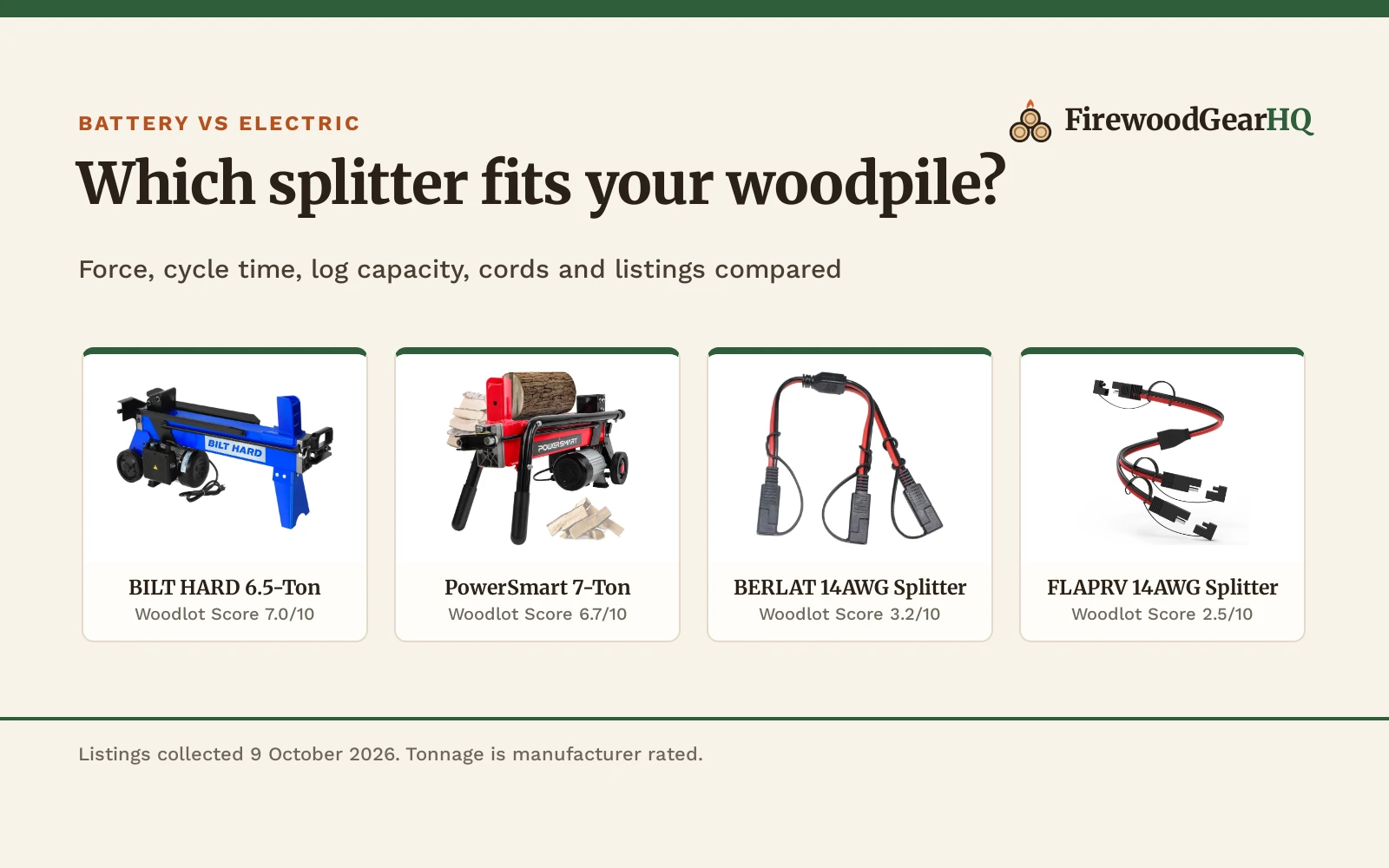
Verdict: Choose an electric log splitter if you want a functional hydraulic machine to split firewood rounds near a dedicated electrical power supply. Do not purchase current marketplace listings tagged as a battery log splitter expecting a cordless wood splitter, as the examples reviewed under that term are 14AWG automotive wiring cables rather than firewood-splitting machinery.
When comparing a battery log splitter vs electric log splitter, the main divide is between plug-in hydraulic machines and cordless power options. Corded electric splitters rely on household power to drive a hydraulic ram, while shoppers searching for battery log splitters encounter a mix of emerging cordless tools and automotive wiring adapters. This comparison covers how both categories differ, followed by four examples from the listings we reviewed.
FirewoodGearHQ earns a commission when you buy through links on this page, at no extra cost to you. Affiliate disclosure.
Side by side
| Factor | Battery log splitter | Electric log splitter | Verdict |
|---|---|---|---|
| Rated force | Not stated on reviewed listings | 6.5 to 7 tons (manufacturer rated) | Electric provides manufacturer-rated force; battery listings state no splitting tonnage |
| Cycle time | Not stated on reviewed listings | 18 to 20 seconds | Electric cycles in 18 to 20 seconds; cables have no ram |
| Max log length | Not stated on reviewed listings | 20 to 20.5 inches | Electric splits 20 to 20.5 in logs; cables state no log capacity |
| Max log diameter | Not stated on reviewed listings | 9.8 to 10 inches | Electric handles 9.8 to 10 in rounds; cables cannot split wood |
| Power connection | Below 36V, 20 Amps (SAE wire cables) | 15 Amp motor plugged into household power | Electric runs a 15 Amp motor; battery listings are low-voltage wires |
| Where it runs | Outdoors or indoors (wire cables) | Garage, shed or near an outlet | Electric runs indoors or garage; wire splitters are portable cords |
| Upkeep | Dust caps and wire inspection | Hydraulic fluid only | Electric needs hydraulic fluid; cables need dust caps only |
| Example: PowerSmart 7-Ton (electric) | Not applicable | 7 tons, 20 sec, 20 x 10 in | Electric pick with 10 in diameter capacity |
| Example: BILT HARD 6.5-Ton (electric) | Not applicable | 6.5 tons, 18 sec, 20.5 x 9.8 in, 90-day warranty | Electric pick with two-hand safety controls and 18-second cycle |
| Example: BERLAT 14AWG (battery side) | 14AWG wire, 11.8 in, 20 Amps, 24-month warranty | Not applicable | Battery side listing with 24-month warranty but no splitting force |
| Example: FLAPRV 14AWG (battery side) | 14AWG wire, 12 in, 1.63 mm, no warranty stated | Not applicable | Battery side listing with copper core and no stated warranty |
Ranges are typical of the listings we reviewed; example figures are manufacturer rated, collected 9 October 2026.
Battery log splitter vs electric log splitter: key differences
The central difference between these two sides comes down to machine design and power supply. A corded electric log splitter uses an electric motor to run a hydraulic pump, giving homeowners steady power as long as they stay within reach of an outlet. Battery-powered options promise independence from cords for remote woodlots. However, in our review of marketplace listings, products tagged as battery log splitters were 14AWG SAE wire harness splitters designed for battery chargers and solar panels rather than hydraulic wood-splitting machinery. For anyone who needs to split firewood today, corded electric splitters provide stated mechanical force, while shoppers seeking cordless battery wood splitters must verify whether a listing offers an actual splitting ram or an automotive wire adapter.
Force: tons and what they split
Splitting force determines whether a machine can push through tough, fibrous rounds or stalls out. The electric listings publish manufacturer-rated hydraulic force: the PowerSmart example lists 7 tons with a stated capacity of 10 inches in diameter, while the BILT HARD example lists 6.5 tons for logs up to 9.8 inches across. In contrast, the battery-side listings reviewed state no hydraulic pressure or splitting tonnage because they are electrical connector cables. If you need measured splitting pressure to process firewood, consult our tonnage sizing guide and splitter capacity chart before buying.
Speed: cycle time
Cycle time measures how many seconds a hydraulic ram takes to complete a splitting stroke and reset. The BILT HARD electric example lists an 18-second cycle time reset, and the PowerSmart electric example lists a 20-second cycle time. For processing under 1 cord of firewood, these stated speeds allow steady home work. The battery-side listings state no cycle times because they have no hydraulic cylinders or mechanical splitting components.
Log size
Log capacity depends on the length of the horizontal beam and the stroke of the ram. The PowerSmart electric example accommodates logs up to 20 inches in length and 10 inches in diameter. The BILT HARD electric example accepts logs up to 20.5 inches in length and 9.8 inches in diameter. On the battery side, the BERLAT and FLAPRV listings state no log diameter or length ratings. The BERLAT example lists a physical cable length of 11.8 inches (30 cm), and the FLAPRV example lists a 12-inch length with a 1.63-millimeter wire diameter, which describes wire harness dimensions rather than firewood capacity.
Where you can use it
Corded electric log splitters produce zero exhaust fumes and run quietly, allowing wood burners to work inside a garage, shed or sheltered porch. However, they require access to an electrical outlet. The BILT HARD listing recommends an extension cord no longer than 15m with a cross-section of at least 3.3mm², alongside a 40-amp circuit breaker. A cordless battery machine could run anywhere on a woodlot without extension cords, but buyers must inspect product details to avoid purchasing battery wiring accessories. When operating any log splitter, operators must maintain a clear work area, keep hands clear of the wedge, wear eye protection, and ensure only one operator controls the machine during splitting.
Upkeep and storage
Electric log splitters require minimal routine upkeep compared to gas equipment, with no spark plugs, carburetors or engine oil changes to manage. Owners need only maintain hydraulic fluid levels and keep electrical connections clean. The PowerSmart example measures 37.4 x 10.6 x 18.5 inches, and the BILT HARD example features 5.7-inch wheels for maneuvering across the yard. For the wire splitter listings, upkeep is limited to keeping rubber dust caps over the SAE terminals to keep out moisture and dust.
Four examples
| Award | Product | Woodlot Score About the HQ ScoreThe Woodlot Score runs from 0 to 10 and weighs performance (35%), build (25%), value (25%), safety (10%, where it applies) and warranty (5%), using only what the manufacturer and the listing publish. How we pick › | |
|---|---|---|---|
 BILT HARD Log Splitter 6.5 Ton
|
7.0/10 | Buy | |
 PowerSmart Electric Log Splitter 7-Ton
|
6.7/10 | Buy | |
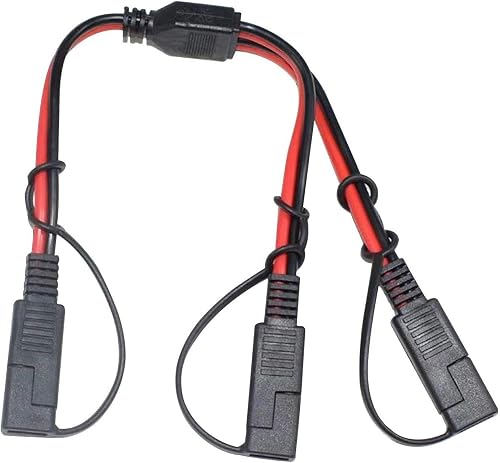 14AWG SAE DC Power Automotive Connector Cable Y
|
3.2/10 | Buy | |
 14AWG SAE Y Splitter Cable
|
2.5/10 | Buy |
BILT HARD Log Splitter 6.5 Ton
A 6.5-ton horizontal electric log splitter with a 15 Amp motor, 3,400 RPM, a stated 18-second cycle, two-hand controls, 5.7 inch wheels and a 90-day warranty.
Pros
- Manufacturer rated 6.5 tons with an 18-second reset cycle
- Two-hand safety controls stated for operator safety
- Handles logs up to 20.5 inches long and 9.8 inches across
- 5.7 inch transport wheels for moving across the yard
Cons
- Short 90-day warranty term from purchase
- Listing recommends a 40-amp circuit breaker
- Cord length limited to 15m per manufacturer recommendation
- 6.5 tons struggles on seasoned hardwood over 9.8 inches
PowerSmart Electric Log Splitter 7-Ton
A 7-ton horizontal electric log splitter with a 15 Amp motor, 3500 rpm, a stated 20 second cycle, 37.4 x 10.6 x 18.5 inch dimensions and durable steel construction.
Pros
- Manufacturer rated 7 tons of splitting force
- Stated 20 second cycle time for home firewood
- Handles logs up to 20 inches long and 10 inches in diameter
- 15 Amp induction motor running at 3500 rpm
Cons
- Ground level horizontal operation with no elevated stand
- Safety certification and two-hand controls are not stated
- 7 tons can stall on tough knots and stringy wood
- Needs an outlet and cannot run away from power cords
14AWG SAE DC Power Automotive Connector Cable Y
A 14AWG SAE DC connector cable Y splitter measuring 11.8 inches with 20 Amps rated current, 36V maximum voltage, weatherproof caps and a 24-month warranty.
Pros
- 24-month warranty stated by manufacturer
- Weatherproof cover design on SAE connector and fuse holder
- Pure copper core rated for 20 Amps and 36 volts
- Compact 11.8-inch length stores in any toolbox
Cons
- Automotive electrical wire cable with no log-splitting capacity
- Zero tons of hydraulic splitting force stated
- Cannot split firewood logs or kindling
- Misleadingly listed under battery log splitters on the marketplace
14AWG SAE Y Splitter Cable
A 12-inch 14AWG SAE Y splitter cable with 1.63 mm wire diameter, pure copper core, 2-pin polarized molded connectors and rubber dust caps.
Pros
- Pure copper 14 AWG core with 1.63 mm wire diameter
- Rubber dust caps protect 2-pin quick-disconnect plugs
- Compact 12-inch length for solar and battery charger setups
- Polarized molded connectors resist bending
Cons
- No warranty term is stated
- Wire connector cable that does not split wood
- No hydraulic pressure, motor or log capacity stated
- Appears under battery log splitter searches despite being an electrical cord
How we scored them
Each example is scored out of 100 on performance, build, value, safety and warranty, using only what the listing publishes. The weights are on our How We Pick page.
| Product | Woodlot Score | Perf. /35 | Build /25 | Value /25 | Safety /10 | Warranty /5 |
|---|---|---|---|---|---|---|
| BILT HARD 6.5-Ton | 7.0 | 27 | 19 | 19 | 4 | 2 |
| PowerSmart 7-Ton | 6.7 | 28 | 19 | 20 | 0 | 0 |
| BERLAT 14AWG Splitter | 3.2 | 6 | 12 | 10 | 0 | 3 |
| FLAPRV 14AWG Splitter | 2.5 | 5 | 11 | 9 | 0 | 0 |
Pick the wood species, the biggest round you split and its condition to get the splitter tonnage to shop for.
One operator only, with hands well clear of the wedge and the ram. Wear eye protection and gloves, set the splitter on stable, level ground, and keep kids and pets away from the work area. Run gas splitters outdoors only, and never reach in to clear a jammed log while the ram can move. Read our Safety Disclaimer.
Frequently Asked Questions
Can an electric log splitter handle hardwood?
Whether an electric splitter can handle hardwood depends on the species, grain and dryness. The reviewed listings state capacities of 9.8 inches in diameter for the BILT HARD model and 10 inches for the PowerSmart model, but knotty, dense hardwood can stall compact electric hydraulic rams.
What is a battery log splitter?
A battery log splitter uses rechargeable battery packs to power a motor without an extension cord, such as emerging 40V kinetic designs that use a flywheel mechanism. However, buyers should check listings carefully because current marketplace search results frequently show SAE battery cable splitters instead of wood-splitting equipment.
Can I run an electric log splitter indoors?
Yes. Electric log splitters produce zero emissions and operate quietly, making them suitable for use inside a garage or shed where ventilation is limited.
What extension cord is needed for an electric log splitter?
Electric splitters draw significant amperage. For example, the BILT HARD listing recommends keeping the cord length under 15m with a cross-section of at least 3.3mm² to prevent voltage drop.
Are two-hand controls required on electric log splitters?
Two-hand controls require operating the switch and lever together, keeping hands clear of the moving ram and wedge. The BILT HARD model lists two-hand controls, whereas other listings leave safety controls unstated.
Related guides
See the log splitter hub, our comparison of gas vs electric log splitters, our guide to the best log splitters for home use, our safety advice on log splitter recalls, and our electric log splitter troubleshooting guide. Splitting by hand? See the best splitting maul.
About the author
The FirewoodGearHQ editorial team researches firewood and wood heating equipment from published specifications, ratings and warranty terms, and scores every pick the same way. We do not run our own product trials.