Foot Operated vs Electric Log Splitter: Which One Should You Buy?
Foot operated vs electric log splitter: manual foot-powered splitting against electric hydraulic and kinetic machines on force, speed, log size and noise.

On this page
Top picks at a glance
As an Amazon Associate we earn from qualifying purchases.
- 1
 PROYAMA 7T Electric Log Splitter9.6/10View on Amazon
- 2
 7 Ton Electric Log Splitter9.6/10View on Amazon
- 3
 Electric Log Splitter 16 Ton9.6/10View on Amazon
- 4
 BILT HARD Log Splitter 6.5 TonView on Amazon
- 5
 Scheppach Lying Log Splitter HL760LS Firewood SplitterView on Amazon
- 6
 YARDMAX YS0650 6.5 Ton Electric Log SplitterView on Amazon
- 7
 6Pcs Wood Splitter Drill Bits SetView on Amazon
- 8
 PowerSmart Electric Log SplitterView on Amazon
- 9
 Ironton Horizontal Electric Log SplitterView on Amazon
Foot operated vs electric log splitter is the choice between your leg and a motor doing the work. A foot-operated splitter is a manual tool: you step on a ratchet that drives the wedge, with no fuel, no cord and no noise. An electric splitter uses a motor and hydraulics or a kinetic flywheel to split logs far bigger than any person could. For kindling and a few armloads of firewood, the foot-operated splitter is simple and costs nothing to run; for heating a home with wood, the electric machine is the only realistic pick.
More options to compare
 BILT HARD Log Splitter 6.5 TonCheck price on Amazon
 Scheppach Lying Log Splitter HL760LS Firewood SplitterCheck price on Amazon
 YARDMAX YS0650 6.5 Ton Electric Log SplitterCheck price on Amazon
 6Pcs Wood Splitter Drill Bits SetCheck price on Amazon
 PowerSmart Electric Log SplitterCheck price on Amazon
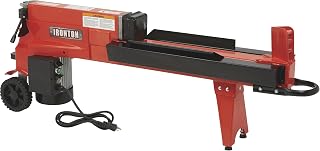 Ironton Horizontal Electric Log SplitterCheck price on Amazon
FirewoodGearHQ may earn a small commission if you buy through links on this page. The price you pay stays the same. Read our affiliate disclosure.
The reference listings for this guide include one manual foot-operated splitter and three electric splitters. Every figure below comes from the listings cited by brand, and where no figure is available we explain without one.
Foot operated vs electric log splitter: the short answer
The Timber Tuff TMW-84 is the foot-operated side: a step ratchet splitter that handles logs up to 18 inches long and 10 inches in diameter at 23 lb, built for kindling. The electric side runs from the ROCKCUB 7-ton with a 3 HP motor, 28 MPa hydraulics and 22 inch capacity at 95 lb, to the Ezasin 16-ton with a 1600 W motor splitting 20.5 inch logs at 124 lb, to the FORESTWEST 18-ton kinetic machine with a 2 to 3 second cycle at 246 lb. Buy the foot-operated splitter for kindling and light duty; buy electric when the woodpile is measured in cords.
What a foot-operated splitter gives you
The Timber Tuff TMW-84 is about as simple as splitting gets: a step ratchet drives the wedge through the log using your foot, so your arms and back stay out of it. It handles logs up to 18 inches long and 10 inches in diameter, weighs 23 lb, and folds into a corner of the garage with a powder-coat finish and a spring steel blade. There is nothing to plug in, nothing to fuel, and nothing to maintain beyond keeping the blade clean.
The limits are yours. Every split costs leg effort, and 10 inch diameter kindling-size wood is the ceiling; this is not a tool for rounds. It shines as the second splitter: the electric machine does the heavy rounds, the foot-operated splitter turns splits into kindling by the fireplace.
There is also the question of where you split. The Timber Tuff needs no outlet, no fuel and makes no noise, so it works at a campsite, on a porch or in a shed with no power. At 23 lb you carry it one-handed. The powder-coat finish and spring steel blade ask only to be kept dry and clean, which is the entire maintenance routine.
What an electric splitter gives you
Electric splitters replace muscle with tonnage. The ROCKCUB 7-ton pairs a 3 HP motor with a 28 MPa (4060 PSI) hydraulic system, takes 22 inch logs, and cycles in 18 seconds at 95 lb, with a foot pedal for the motor and a bonus 4-way cross wedge for kindling. The Ezasin 16-ton steps up to a 1600 W, 17.4 amp motor splitting 20.5 inch logs up to 16 inches in diameter, with an 18 second cycle, overload protection that trips past 20 amps, and 65 dB operation at 124 lb. The FORESTWEST 18-ton is a kinetic machine: a 2.0 HP (1500 W) motor spins flywheels for an 18 ton strike with a 2 to 3 second cycle, taking 16 inch logs at 246 lb.
The deeper split in the electric class is hydraulic against kinetic. The ROCKCUB and Ezasin are hydraulic: steady, relentless pressure, 7 and 16 tons, with an 18 second cycle and automatic ram return. Hydraulics rarely stall on knotty wood; they just keep pushing. The FORESTWEST is kinetic: flywheels store energy and release it in one 18 ton strike, cycling in 2 to 3 seconds. Kinetic is dramatically faster on straight-grained wood but asks for consistent technique, since the strike is all or nothing.
What they share: standard outlet power, no exhaust, and less noise than gas. What they demand: the logs come to the machine, and 95 to 246 lb is not something you carry far. The FORESTWEST’s pneumatic wheels and the ROCKCUB’s towing handle help, but plan the splitting station once and leave the machine there.
Foot operated vs electric compared
| Feature | Foot-operated splitter | Electric splitter |
|---|---|---|
| Power source | Your foot; step ratchet | Electric motor, outlet powered |
| Force cited | Leg power; kindling duty | 7 to 18 tons |
| Log size cited | 18 in long, 10 in diameter | 16 to 22 in long, up to 16 in diameter |
| Cycle time cited | As fast as you step | 2 to 3 s kinetic; 18 s hydraulic |
| Weight cited | 23 lb | 95 to 246 lb |
| Noise cited | Silent | 65 dB on the Ezasin |
| Best for | Kindling, light duty, no power | Heating with wood, big rounds |
Which one should you buy?
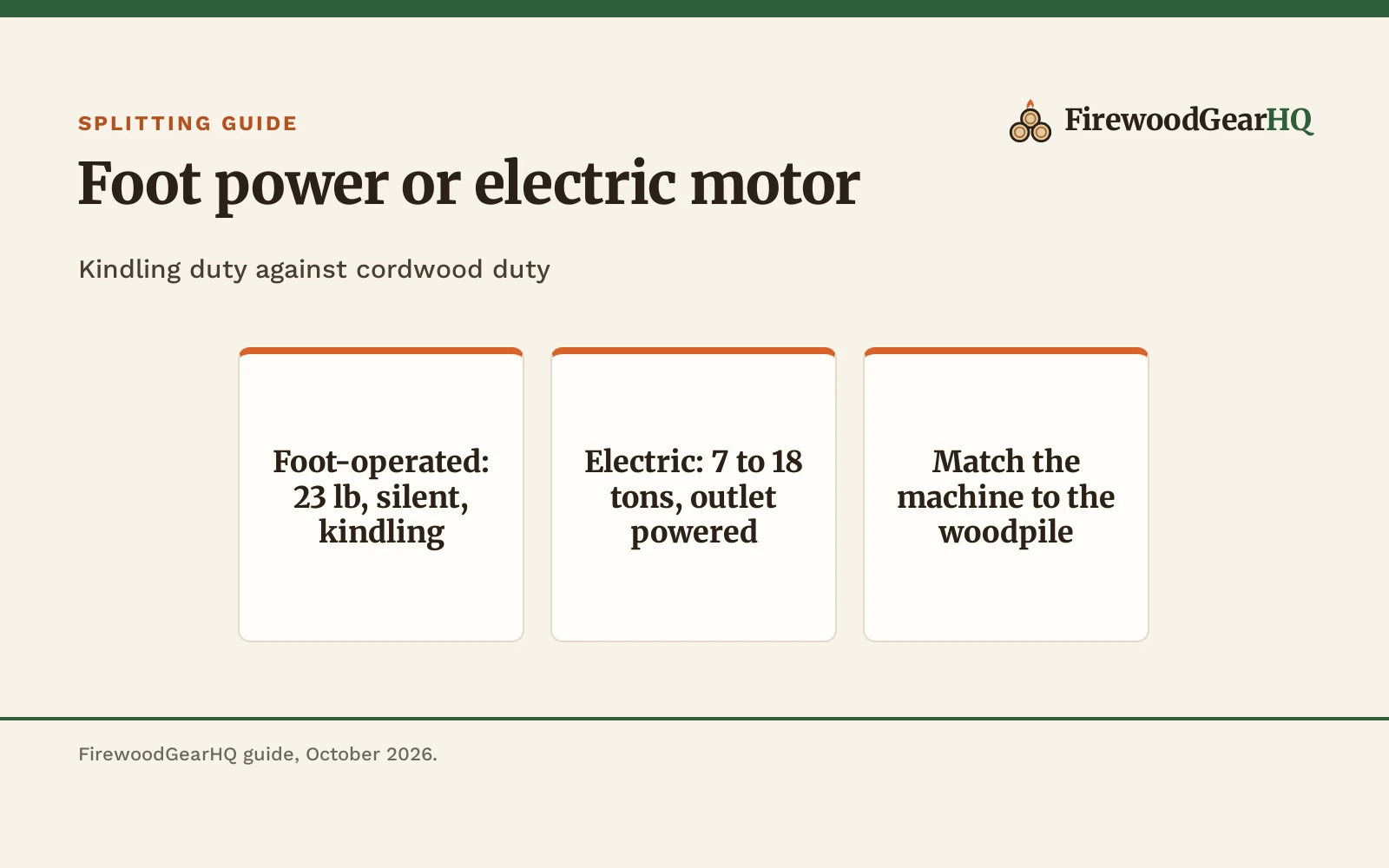
Buy foot-operated if you split kindling, process a few armloads at a time, or want a splitter that works anywhere with no cord: by the fire pit, at camp, in a shed with no outlet. The Timber Tuff’s 23 lb and 18 inch capacity cover that job.
Buy electric if you heat with wood or process rounds regularly. The 7-ton ROCKCUB suits the homeowner with a fireplace; the 16-ton Ezasin suits bigger rounds and longer days; the 18-ton kinetic FORESTWEST suits volume, with its 2 to 3 second cycle turning a woodpile into an afternoon’s work.
Buy both if you run an electric splitter already: the foot-operated splitter lives by the wood stove and turns splits into kindling without firing up the big machine.
Common mistakes to avoid
- Expecting foot power to split rounds. The Timber Tuff tops out at 10 inch diameter kindling wood. Full-size rounds need the 7 to 18 tons of the electric class.
- Ignoring cycle time. The kinetic FORESTWEST cycles in 2 to 3 seconds against 18 seconds for the hydraulic listings; over a cord of wood, that difference is hours.
- Forgetting the outlet. Electric splitters need a real outlet and, at 17.4 amps on the Ezasin, a circuit that can feed them. The foot-operated splitter needs nothing.
- Skipping the wedge choice. The ROCKCUB’s bonus 4-way wedge turns one split into four pieces of kindling; match the wedge to the job instead of splitting twice.
Frequently Asked Questions
Can a foot-operated splitter handle full-size logs?
No. The Timber Tuff listing rates it for logs up to 18 inches long and 10 inches in diameter, which is kindling and small firewood. Full-size rounds need a powered splitter.
How fast is an electric log splitter?
The hydraulic listings cite an 18 second cycle with automatic ram return; the kinetic FORESTWEST cites 2 to 3 seconds. Your pace loading logs matters as much as the machine’s cycle.
Are electric splitters loud?
The Ezasin lists 65 dB, quieter than gas and fine for residential areas. The foot-operated splitter is silent. Neither listing gives a figure for the other electrics, so treat 65 dB as the one data point.
Do electric splitters need a special outlet?
They need a grounded outlet on a circuit that can supply their draw; the Ezasin draws 17.4 amps and trips its overload protection past 20 amps. Check your circuit before you buy, especially for the bigger motors.
What is the difference between hydraulic and kinetic electric splitters?
Hydraulic splitters like the ROCKCUB and Ezasin push with steady tonnage, 7 and 16 tons here, on an 18 second cycle. Kinetic splitters like the FORESTWEST spin flywheels and strike with 18 tons in 2 to 3 seconds. Hydraulic is steadier on knotty wood; kinetic is faster on straight wood.
Which is better for kindling?
The foot-operated splitter: it is built for kindling, needs no fuel or power, and lives by the stove. The ROCKCUB’s 4-way wedge is the electric answer to the same job.
Related guides
Related: our electric vs kinetic log splitter, axe vs wood splitter, do electric log splitters need hydraulic fluid and log splitter comparison guides.