Best Splitting Wedge: 5 Steel Wedges for Stubborn Firewood
Five steel splitting wedges compared by weight, length, steel and design, striking face, where they are made and the warranty, for rounds an axe or maul will not finish.
 By FirewoodGearHQ Editorial
Updated October 6, 2026
By FirewoodGearHQ Editorial
Updated October 6, 2026
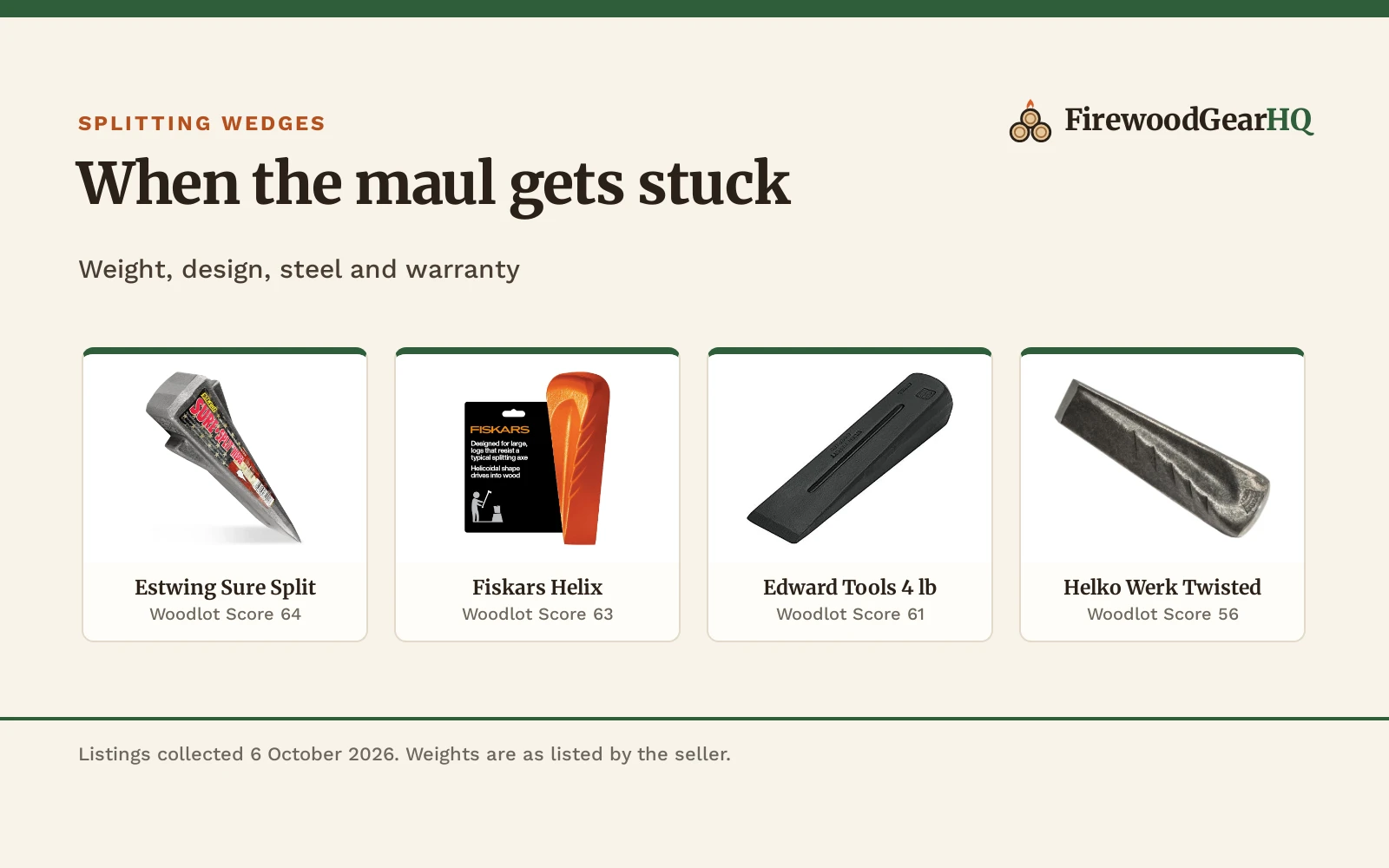
A splitting wedge is the tool you reach for when a round beats an axe or a maul. You start it in a crack or an end-grain check, drive it with a sledgehammer or a maul with a striking face, and it pushes the wood apart as it goes in. This guide compares five steel splitting wedges by listed weight, length, steel, design, where they are made and the warranty.
FirewoodGearHQ earns a commission when you buy through links on this page, at no extra cost to you. Affiliate disclosure.
Quick picks
- Best Overall Estwing Sure Split: Estwing Sure Split: 5 lb solid steel with fins on both sides, a hand-sharpened edge and American-made steel. Check price
- Best for Big Knotty Rounds Fiskars Helix: Fiskars Helix: a twisted profile for oversized rounds, 36 to 42 HRC steel and a rounded striking head. Check price
- Best Warranty Edward Tools 4 lb: Edward Tools 4 lb: drop forged head with a sharpened edge and a lifetime warranty stated. Check price
- Best Hand-Forged Helko Werk Twisted: Helko Werk Twisted: 4.5 lb C50 steel at 53 to 56 HRC, forged by hand in Germany. Check price
Compare the picks
| Model | Woodlot Score | Weight (listed) | Length | Steel | Design | Made in | Warranty (stated) |
|---|---|---|---|---|---|---|---|
| Estwing Sure Split E-5 | 64 | 5 lb (item weight listed as 4.1 lb) | 9 in | Alloy steel | Fins on both sides | USA | Not stated |
| Fiskars Helix 379010 | 63 | 4.8 lb | 8.5 in | Forged steel, 36 to 42 HRC | Helicoidal (twisted) profile | Not stated | Limited |
| Edward Tools ET-WSW3 | 61 | 4 lb (3.98 lb listed) | Not stated | Drop forged steel | Classic, sharpened edge | Not stated | Lifetime |
| Helko Werk Twisted 13421 | 56 | 4.5 lb | 8.25 in | C50 carbon steel, 53 to 56 HRC | Twisted, notched | Germany | Not stated |
| Truper 33040 Super Splitter | 47 | 4 lb (3.87 lb listed) | Not stated | Drop forged, heat treated | Classic | Not stated | Not stated |
Specifications are as listed by the seller, collected 6 October 2026. Where a listing gives two weights we show both; plan on the lower figure.
The picks
| Award | Product | Woodlot Score About the HQ ScoreThe Woodlot Score runs from 0 to 100 and weighs rated performance, build, value, safety listing and warranty, using only what the manufacturer and the listing publish. How we pick › | |
|---|---|---|---|
 ESTWING Sure Split Wedge
|
64/100 | Buy | |
 Fiskars 8.5" Helix Splitting Wedge for Large Logs
|
63/100 | Buy | |
 Edward Tools Classic Log Splitting Wedge (4 LB)
|
61/100 | Buy | |
 1844 Helko Werk Germany Twisted Forged Steel Log
|
56/100 | Buy | |
 Truper 33040 Super Splitter Wood Splitting Wedge
|
47/100 | Buy |
ESTWING Sure Split Wedge
A 5 lb solid steel wedge with fins on each side that add outward force as it is driven in, a hand-sharpened edge and American-made steel from Rockford, Illinois.
Pros
- Fins on each side add outward force as the wedge goes in
- 5 lb weight is enough to drive with a sledge or maul
- Hand-sharpened edge sits in an existing crack and drives straight
- Made in the USA from American steel since 1923
Cons
- Warranty is not stated on the listing
- Weight appears as both 5 lb and 4.1 lb
- Finish may vary between blasted and painted
- Needs a separate sledge or maul to drive
Fiskars 8.5" Helix Splitting Wedge for Large Logs
A 4.8 lb forged steel wedge with a twisted helicoidal profile built to burst large, knotty rounds, 36 to 42 HRC hardness, a rounded striking head and a limited warranty.
Pros
- Twisted profile is designed to burst large, stubborn rounds from the inside
- Rounded striking head designed to reduce fragmentation when hit with a sledgehammer
- Forged steel hardened to 36 to 42 HRC
- Limited warranty with details published by Fiskars
Cons
- Hardness is lower than the Helko's 53 to 56 HRC
- No safety standard is named for the striking head
- Country of origin is not stated
- A twisted design is less established than the plain taper
Edward Tools Classic Log Splitting Wedge (4 LB)
A classic 4 lb drop forged steel wedge with a sharpened edge, listed at 3.98 lb, with a lifetime warranty stated.
Pros
- Lifetime warranty is stated on the listing
- Drop forged steel head
- Sharpened edge for starting the split quickly
- Lighter and easier to carry than the 5 lb wedges
Cons
- Length and steel grade are not stated
- Country of origin is not stated
- Plain design with no fins or twist
- The listing says little beyond forged steel and a sharpened edge
1844 Helko Werk Germany Twisted Forged Steel Log
A hand-forged German wedge of C50 high carbon steel at 53 to 56 HRC, 4.5 lb and 8.25 in long, with a twisted, notched design and a wide striking face.
Pros
- Hardest steel here: C50 carbon steel at 53 to 56 HRC
- Twisted, notched design grips the wood and resists slipping
- Wide striking face on the back
- Hand forged in Wuppertal, Germany, with a bottle of axe guard oil included
Cons
- Warranty is not stated
- Costs several times more than the plain wedges
- Carbon steel needs oiling to resist rust
- Listing wording mixes wedge and axe terms
Truper 33040 Super Splitter Wood Splitting Wedge
A 4 lb drop forged, heat-treated steel wedge listed at 3.87 lb, with very little else stated.
Pros
- Drop forged and heat treated
- 4 lb weight is easy to carry
- Keeps a spare wedge cheaply in the shed, truck or cabin
- Plain shape that works in any crack
Cons
- The listing gives almost no specifications
- Length, steel grade and warranty are not stated
- Country of origin is not stated
- Plain design with no fins or twist
How we scored them
Each wedge is scored out of 100 on performance, build, value, safety and warranty, using only what the listing publishes. No listing names a safety standard, so safety credit is partial and goes only to a stated design for reducing chipping or fragmentation. The weights are on our How We Pick page.
| Product | Woodlot Score | Perf. | Build | Value | Safety | Warranty |
|---|---|---|---|---|---|---|
| Estwing Sure Split | 64 | 28 | 19 | 17 | 0 | 0 |
| Fiskars Helix | 63 | 22 | 16 | 13 | 4 | 8 |
| Edward Tools 4 lb | 61 | 18 | 13 | 17 | 0 | 13 |
| Helko Werk Twisted | 56 | 25 | 19 | 8 | 4 | 0 |
| Truper Super Splitter | 47 | 18 | 12 | 17 | 0 | 0 |
Buying guide: choosing a splitting wedge
When a wedge beats an axe or a maul
Use a wedge when a maul bounces or sticks: big rounds, knots, crotches and stringy wood like elm. Start the split with a splitting maul or a splitting axe, then drive a wedge into the crack and follow it with a second wedge if the round only opens part way.
Weight
Most wedges weigh 4 to 5 lb. A heavier wedge holds its place better and takes the blow more solidly; a lighter one is easier to carry. For very big rounds, having two wedges lets you keep one in the split while you reposition the other.
Fins and twisted designs
A plain taper widens the crack only as far as it goes in. Fins and twisted profiles push the wood outward along more of the wedge, which can open a stubborn round with fewer blows. They cost more than plain wedges.
Steel and hardness
A wedge has to be hard enough not to mushroom at the head but not so brittle that it chips. Where a listing gives hardness, 36 to 42 HRC is a tougher, more forgiving steel and 53 to 56 HRC is harder. Plain wedges rarely publish a figure.
Strike a wedge with the right tool
Drive a wedge with a sledgehammer or a maul with a striking face. Never strike a wedge with the blade of an axe. Wear eye protection, because a worn, mushroomed wedge head can throw chips; retire a wedge whose head has spread or cracked.
Pair it with the right splitter
If you are splitting rounds that need a wedge most days, a powered splitter may be the better tool. Read how many tons of log splitter you need and our comparison of gas vs electric log splitters, and use the log splitter tonnage calculator to size one.
Pick the wood species, the biggest round you split and its condition to get the splitter tonnage to shop for.
Clear the swing area (overhead too), split on a solid chopping block at a comfortable height, keep your feet apart with the block in front of you, and wear eye protection and sturdy boots. Replace a cracked or loose handle before you swing again. Read our Safety Disclaimer.
Frequently Asked Questions
How do you use a splitting wedge?
Start it in a crack or an end-grain check with the thin edge down, then drive it with a sledgehammer or a maul with a striking face. If the round only splits part way, drive a second wedge into the crack and keep going.
What size splitting wedge do I need?
A 4 to 5 lb wedge about 8 to 9 in long suits most firewood. Bigger rounds are easier with a heavier wedge or a pair of wedges.
Can I hit a wedge with an axe?
No. Never strike a wedge with the blade of an axe, which can chip. Use a sledgehammer or a maul with a striking face.
Do I need a wedge if I have a maul?
Not for every round. A maul handles most seasoned wood. A wedge helps with knotty, large or stringy rounds where the maul sticks.
Are twisted wedges better than plain wedges?
On big, tough rounds they can open the wood with fewer blows because they push outward along more of the wedge. On easy wood a plain wedge does the job for less.
Related guides
See the axes and mauls hub. Compare the best splitting mauls and the best splitting axes, make fire-starting wood with a kindling splitter, and cut your rounds first with the best chainsaw for firewood. Compare woods in our firewood species guide, from oak to hickory.
About the author
The FirewoodGearHQ editorial team researches firewood and wood heating equipment from published specifications, ratings and warranty terms, and scores every pick the same way. We do not run our own product trials.