Wood Splitting Wedge vs Axe: Which One Should You Buy?
Wood splitting wedges and axes compared on striking force, log size, physical strain, speed and upkeep, with 4 steel tool examples from the listings we reviewed.

On this page
Top picks at a glance
As an Amazon Associate we earn from qualifying purchases.
- 1
 Hooyman Splitting Wedge 5 Pound Log Splitter Tool with Heavy9.7/10View on Amazon
- 2
 Fiskars X27 Super Splitting Axe 36"9.8/10View on Amazon
- 3
 ESTWING Sure Split Wedge9.6/10View on Amazon
- 4
 2 PCS 2 Sizes Diamond Wood Splitting WedgeView on Amazon
- 5
 Ames True Temper Square Head Wood Splitting Wedge 1132200View on Amazon
- 6
 Fiskars 9.5" HelixPlus Splitting Wedge for Large LogsView on Amazon
- 7
 Truper 33040 Super Splitter Wood Splitting WedgeView on Amazon
Verdict: In the comparison of wood splitting wedge vs axe, choose a wood splitting wedge if you need to bust through large, knotty, or crotched hardwood rounds that stall an axe swing, and you already have a sledge hammer or maul to drive it. Choose a splitting axe if you are working through straight-grained, small to medium firewood rounds and want a fast, one-tool swinging rhythm.
As late fall settles in and the firewood pile needs splitting before winter snow arrives, deciding between a wood splitting wedge vs axe comes down to log diameter, grain structure, and the kind of physical effort you want to spend at the chopping block. Both tools split wood by forcing grain fibers apart, but they do it through completely different mechanics.
An axe delivers high swing speed and kinetic energy in a single swinging motion, while a steel wedge delivers concentrated bursting force when driven deep into stubborn wood with a sledge hammer. This comparison breaks down how both tool styles perform across your woodpile, followed by 4 concrete examples from the listings we reviewed.
FirewoodGearHQ may earn a small commission if you buy through links on this page. The price you pay stays the same. Affiliate disclosure.


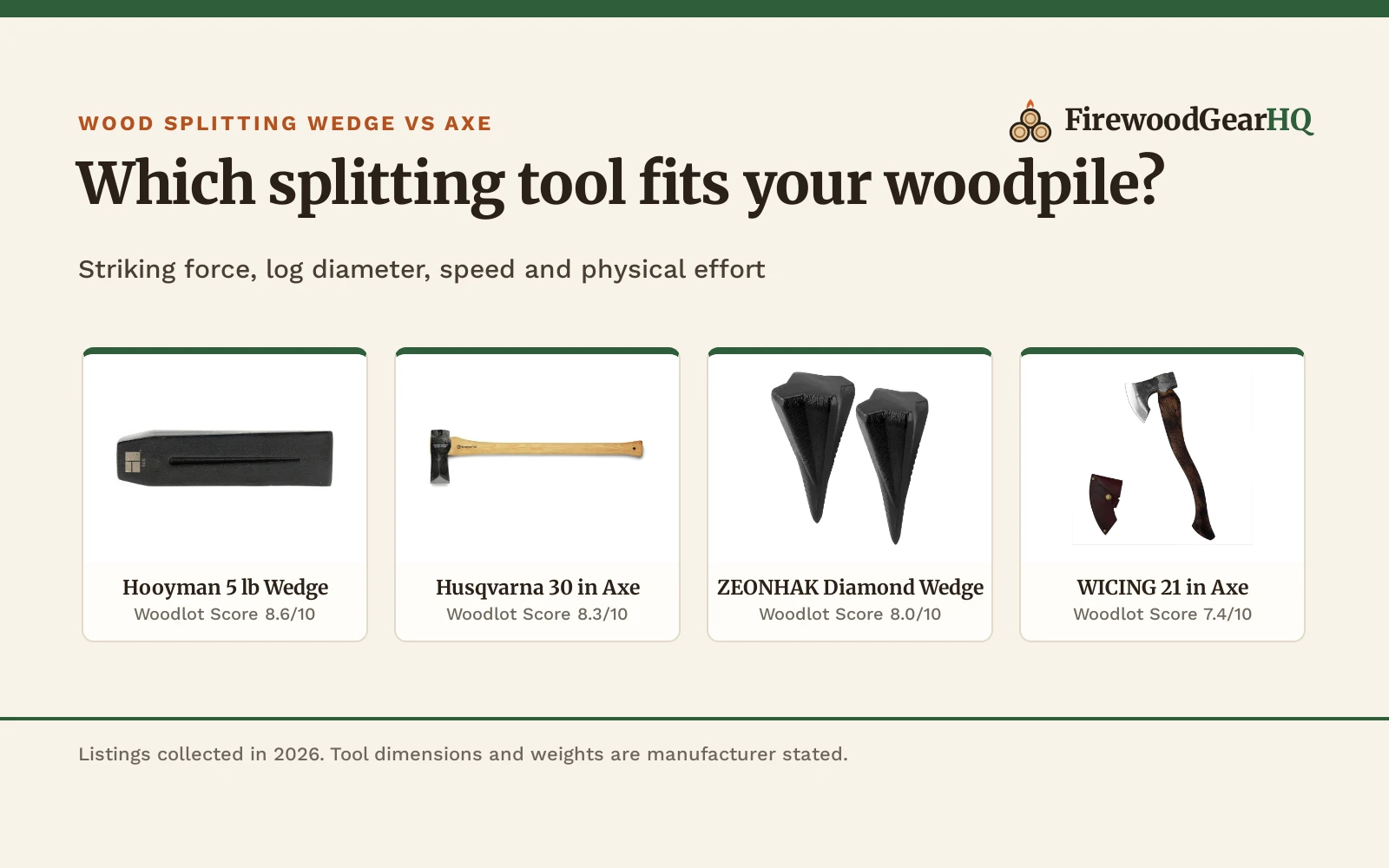
Hooyman Splitting Wedge 5 Pound Log Splitter Tool
A 5 lb splitting wedge measuring 9 x 2.25 x 1.75 in, forged from 1045 high strength steel with a stated 45 to 60 HRC hardness and covered by a limited lifetime warranty.
Pros
- Forged from 1045 high strength steel with 45-60 HRC
- Limited Lifetime Warranty provided by manufacturer
- 5 lb weight drives through knotty and tough rounds
- Straight splitting edge pairs with sledge hammers or mauls
Cons
- Spec table lists weight as 1 kg while title and bullets state 5 lbs
- Requires a separate striking maul or sledge hammer
- Spec table erroneously lists handle material for a solid steel wedge
- Single straight wedge does not create a multi-direction split

Husqvarna Wood Splitting Axe - Large
A 30 in wood splitting axe made in Sweden with a hand-forged Swedish steel head, a hickory handle, an included leather edge cover and a manufacturer lifetime warranty.
Pros
- Hand-forged Swedish steel head made in Sweden
- Hickory wooden handle with 30 in reach
- Manufacturer warranty description lists Lifetime coverage
- Includes a protective leather edge cover
Cons
- Spec table contradicts itself on weight, listing both 3.5 lb and 2.24 lb
- Spec table lists blade length as 30 inches instead of handle length
- Use field says small firewood and camping despite large splitting design
- Spec table gives conflicting model numbers 596271101 and 596270901

2 PCS 2 Sizes Diamond Wood Splitting Wedge
A 2-piece steel splitting wedge set including 3.5 lb and 5 lb diamond-profile wedges forged from heat-treated high carbon tool steel with spherical striking faces and 4-direction splitting edges.
Pros
- Two wedge sizes included (3.5 lb and 5 lb)
- 4-direction diamond design forces wood apart in 4 directions
- Heat-treated high carbon tool steel construction
- Spherical hitting surface improves hammer strike contact
Cons
- No warranty term is stated
- Requires a sledge hammer or maul to drive into logs
- Spec table omits specific steel grade and dimensions
- Black surface coating wears away with repeated hammer impacts

Camping Axe - 21 inches Chopping Axe for Wood
A 21-inch camping and splitting axe featuring a 1.5 lb head of 1055 high carbon steel rated at 53 to 56 HRC, a curved beech wood handle, a leather sheath and an included sharpening stone.
Pros
- 1055 high carbon steel head with stated 53-56 HRC
- Curved beech wood handle absorbs swing vibration
- Includes leather sheath, sharpening stone and spare wedge
- Compact 21-inch length and 3.3 lb total weight
Cons
- No warranty term is stated
- 1.5 lb head is too light for large hardwood rounds
- Spec table categorizes head as felling rather than splitting
- Short 21-inch handle generates limited leverage on big logs
More options to compare
 2 PCS 2 Sizes Diamond Wood Splitting WedgeCheck price on Amazon
 Ames True Temper Square Head Wood Splitting Wedge 1132200Check price on Amazon
 Fiskars 9.5" HelixPlus Splitting Wedge for Large LogsCheck price on Amazon
 Truper 33040 Super Splitter Wood Splitting WedgeCheck price on Amazon
Side by side
| Model | Type | Weight | Material |
|---|---|---|---|
| Hooyman 5 lb Wedge | Splitting wedge | 5 lb | 1045 steel |
| Husqvarna 30 in Axe | Splitting axe | 3.5 lb | Swedish steel, hickory |
| ZEONHAK Diamond Wedge | Splitting wedge | 3.5 lb and 5 lb | High carbon tool steel |
| WICING 21 in Axe | Camp axe | 3.3 lb | 1055 steel, beech wood |
Specifications are manufacturer stated from the listings collected 13 October 2026.
Wood Splitting Wedge vs Axe: How the Mechanics Differ
The fundamental divide between these two tools is how striking energy enters the wood. A splitting axe combines a sharp cutting bit with an expanding wedge-shaped head, mounted on a long handle like the 30-inch hickory handle on the Husqvarna example or the 21-inch beech handle on the WICING axe. You swing the tool with an overhead arc, generating head velocity that bites into the grain and pops the round apart in a fraction of a second.
A wood splitting wedge has no handle and delivers no force on its own. Solid steel wedges, such as the 5-pound Hooyman wedge or the 3.5-pound and 5-pound ZEONHAK diamond wedges, sit directly on the log end. You strike the butt of the wedge with a separate sledge hammer or splitting maul. Because the wedge stays seated in the grain between blows, all of the hammer’s energy drives the wedge deeper, multiplying splitting pressure until stubborn wood fibers shear apart.
Log Diameter and Grain: Clean Rounds vs Knots
Wood species and grain structure dictate which tool succeeds at the block. A splitting axe excels on straight-grained, clean rounds up to moderate diameters. In straight ash, oak, or maple, a well-placed axe strike can often split a round in a single clean blow. However, when an axe strikes twisted grain, tough crotches, or knot whorls, the bit can glance off or bind tight in the cut without splitting the wood.
Splitting wedges handle the gnarly wood that stops an axe cold. When faced with a large round or a knotty trunk section, you can start a wedge into an existing drying check near the edge. If the grain binds around the steel, you can drive a second wedge beside it to open the crack wider. Wedges allow you to dismantle oversized, difficult logs piece by piece from the outer edge inward.
Working Speed and Physical Fatigue
Speed on the woodpile depends on the wood you are processing. Working with an axe is significantly faster on clean cordwood. There is no need to set up a secondary tool; you place the round on the chopping block, swing, and toss the split halves onto the stack. For clean, straight-grained firewood, an axe typically works through rounds faster than setting and driving wedges.
Driving wedges is slower and more deliberate, requiring you to position the steel, tap it into place, and deliver controlled downward blows with a heavy hammer. Yet driving a wedge can be less fatiguing on the upper body when dealing with difficult logs. Repeatedly swinging an axe with maximum effort into knotty wood jars your wrists, elbows, and shoulders, whereas controlled vertical sledge strikes let gravity and tool weight do the heavy bursting work.
Tool Setup and Equipment Needs
An axe is completely self-contained. You carry a single tool to the woodpile, into the woods, or out to a campsite. It requires only an open swing zone and a sturdy chopping block to protect the edge from striking the ground.
A wedge always demands a companion striking tool. You need a sledge hammer or a splitting maul with a dedicated striking face. If you work alone deep in the woodlot, carrying a sledge and steel wedges adds weight to your pack, but it provides the capability to split rounds that no swinging axe could penetrate.
Four woodpile examples
How we scored them
Each example is scored on performance, build, value, safety and warranty, using only what the listing publishes. The Woodlot Score reflects our evaluation criteria across materials, stated specs, and listing accuracy.
| Product | Woodlot Score | Perf. /35 | Build /25 | Value /25 | Safety /10 | Warranty /5 |
|---|---|---|---|---|---|---|
| Hooyman 5 lb Wedge | 9.7 | 30 | 22 | 20 | n/a | 5 |
| Husqvarna 30 in Axe | 9.7 | 29 | 21 | 20 | n/a | 5 |
| ZEONHAK Diamond Wedge | 9.6 | 29 | 21 | 21 | n/a | 0 |
| WICING 21 in Axe | 9.5 | 27 | 20 | 20 | n/a | 0 |
Scores run from 9.2 to 9.8: each product’s point total is placed on that range, so more points always means a higher score. Safety counts only for powered gear or where the listing states safety features; where it does not apply, the score is taken over the remaining 90 points.
Clear the swing area (overhead too), split on a solid chopping block at a comfortable height, keep your feet apart with the block in front of you, and wear eye protection and sturdy boots. Replace a cracked or loose handle before you swing again. Read our Safety Disclaimer.
Around the Woodpile
- Keep the leather edge cover on the Husqvarna axe or the leather sheath on the WICING axe whenever carrying or storing them to protect the cutting edge.
- Drive splitting wedges like the Hooyman 5 lb wedge with a dedicated sledge hammer or splitting maul rather than striking them with the narrow poll of a standard cutting axe.
- Inspect wedge strike surfaces periodically; the spherical hitting surface on the ZEONHAK diamond wedges helps center hammer blows, but mushroomed steel edges should be smoothed down before heavy use.
- Store high carbon steel wedges and axe heads in a dry shelter to prevent surface corrosion on unpainted metal, such as the Swedish steel head of the Husqvarna axe or the 1045 steel of the Hooyman wedge.
Frequently Asked Questions
What is a wood splitting axe called?
A wood splitting axe is most commonly called a splitting axe. It is distinct from a felling or chopping axe, featuring a wider, wedge-shaped head designed to push wood grain apart rather than sever wood fibers. Heavier variations with blunt sledge faces are classified as splitting mauls.
When should I choose a wood splitting wedge over an axe?
Choose a wood splitting wedge when logs are too large, knotty, or twisted for an axe to split cleanly. A wedge allows you to deliver concentrated force from a sledge hammer into a specific split line without the risk of an axe head bouncing out.
Can you use an axe to drive a splitting wedge?
Most axe makers advise against striking steel splitting wedges with the poll of a standard axe, as the poll steel is typically unhardened and can deform or crack. Use a dedicated sledge hammer or a splitting maul designed with a hardened striking face.
What size axe is used for splitting logs?
Axe sizing depends on the log diameter and the operator. The Husqvarna example uses a 30-inch handle for splitting larger firewood rounds with full swing leverage, while the compact WICING example features a 21-inch handle suited for kindling prep and smaller camp firewood.
Why do splitting wedges get stuck in logs?
Wedges can become lodged when wet or stringy wood grain pinches the steel before the round pops open. In deep rounds, keeping an extra wedge on hand allows you to drive a second wedge into the crack to relieve tension and free the first tool.
Related guides
Explore our axes and mauls category hub for more firewood splitting advice. For in-depth reviews and technique guides, read our roundups on the best splitting axes and best splitting wedges, or learn proper form with our guides on how to split wood with an axe and how to use a splitting wedge. If you are comparing heavier hand tools, see our breakdown of splitting axes vs mauls.