How to Use a Splitting Wedge: A Step-by-Step Guide
How to use a splitting wedge to split stubborn firewood rounds, including starting the cut, driving the steel with a sledge, freeing stuck wedges and safety.

On this page
Top picks at a glance
As an Amazon Associate we earn from qualifying purchases.
- 1
 KABIN Kindle Quick Log Splitter9.7/10View on Amazon
- 2
 PROYAMA 7T Electric Log Splitter9.6/10View on Amazon
- 3
 Timber Tuff Manual Log Splitter with Steel Slide Hammer9.6/10View on Amazon
- 4
 2 PCS 2 Sizes Diamond Wood Splitting WedgeView on Amazon
- 5
 Ames True Temper Square Head Wood Splitting Wedge 1132200View on Amazon
- 6
 Fiskars 9.5" HelixPlus Splitting Wedge for Large LogsView on Amazon
- 7
 ESTWING Sure Split WedgeView on Amazon
- 8
 Truper 33040 Super Splitter Wood Splitting WedgeView on Amazon
- 9
 SuperHandy Portable 25 Ton Gas Log Splitter with 7HP EngineView on Amazon
Splitting stubborn rounds on the chopping block is a familiar chore as autumn turns cold and the woodpile needs building for winter. When knotty oak or twisted elm bounces an axe blade back, learning how to use a splitting wedge is the standard manual solution. Setting a steel wedge into a grain check near the edge of the wood and driving it deep with a sledgehammer focuses mechanical force directly through the fibers until the log parts cleanly.
More options to compare
 2 PCS 2 Sizes Diamond Wood Splitting WedgeCheck price on Amazon
 Ames True Temper Square Head Wood Splitting Wedge 1132200Check price on Amazon
 Fiskars 9.5" HelixPlus Splitting Wedge for Large LogsCheck price on Amazon
 ESTWING Sure Split WedgeCheck price on Amazon
 Truper 33040 Super Splitter Wood Splitting WedgeCheck price on Amazon
 SuperHandy Portable 25 Ton Gas Log Splitter with 7HP EngineCheck price on Amazon
FirewoodGearHQ may earn a small commission if you buy through links on this page. The price you pay stays the same. Read our affiliate disclosure.
The quick answer
To use a splitting wedge, stand the log upright, locate a natural check near the bark, and set the wedge near the outer perimeter rather than dead center. Tap the wedge with a hammer or maul until it stands firmly on its own. Step into a balanced stance, then strike the head squarely with deliberate downward blows. If the tool sinks flush without parting the wood, drive an additional wedge into the crack beside it.
Splitting wedge styles and specifications
Manual wedges rely on distinct shapes and steel formulations to part stubborn wood. Blade geometry, weight and steel hardness determine how effectively the wedge enters dense rounds without dulling, chipping or rebounding under heavy strikes.
| Brand and Model | Design Style | Dimensions and Weight | Material and Hardness |
|---|---|---|---|
| Hooyman 1112261 | Straight splitting wedge | 9 inches L x 2.25 inches W x 1.75 inches D, 5 lbs | 1045 high strength steel, 45 to 60 HRC |
| Fiskars 379000 HelixPlus | Helicoidal spiral design | 9.5 inches L x 2.5 inches W x 2.5 inches D, 5.3 lbs | Forged steel body, 36 to 42 HRC |
| Bozeman 86045 | Twisted wedge design | 4 lb forged steel body, 4.2 pounds | Forged steel |
| Collins by Truper WG-5-C/32448 | Square head wedge | 9.5 inches L x 2.25 inches W, 4.5 pounds (5 lb head rating) | Forged steel |
| ZEONHAK 10141639 | Diamond 4-direction wedge | 3.5 lb and 5 lb sizes, 8.61 pounds set | High carbon tool steel |
| Otoolling HUU-Otoolling-4141 | Sharpened straight wedge | 8.07 inches L x 1.57 inches W x 1.18 inches D, 3 lbs | 45 carbon steel |
Straight wedges like the Hooyman 1112261 and Otoolling HUU-Otoolling-4141 offer slim profiles that start easily in tight grain. The Fiskars 379000 HelixPlus uses a helicoidal spiral body to part oversized rounds, the Bozeman 86045 listing notes a twisted shape to force fibers apart, and ZEONHAK provides diamond designs intended to distribute impact force outward.
How to use a splitting wedge
Follow this sequential approach to split stubborn firewood rounds safely and efficiently.
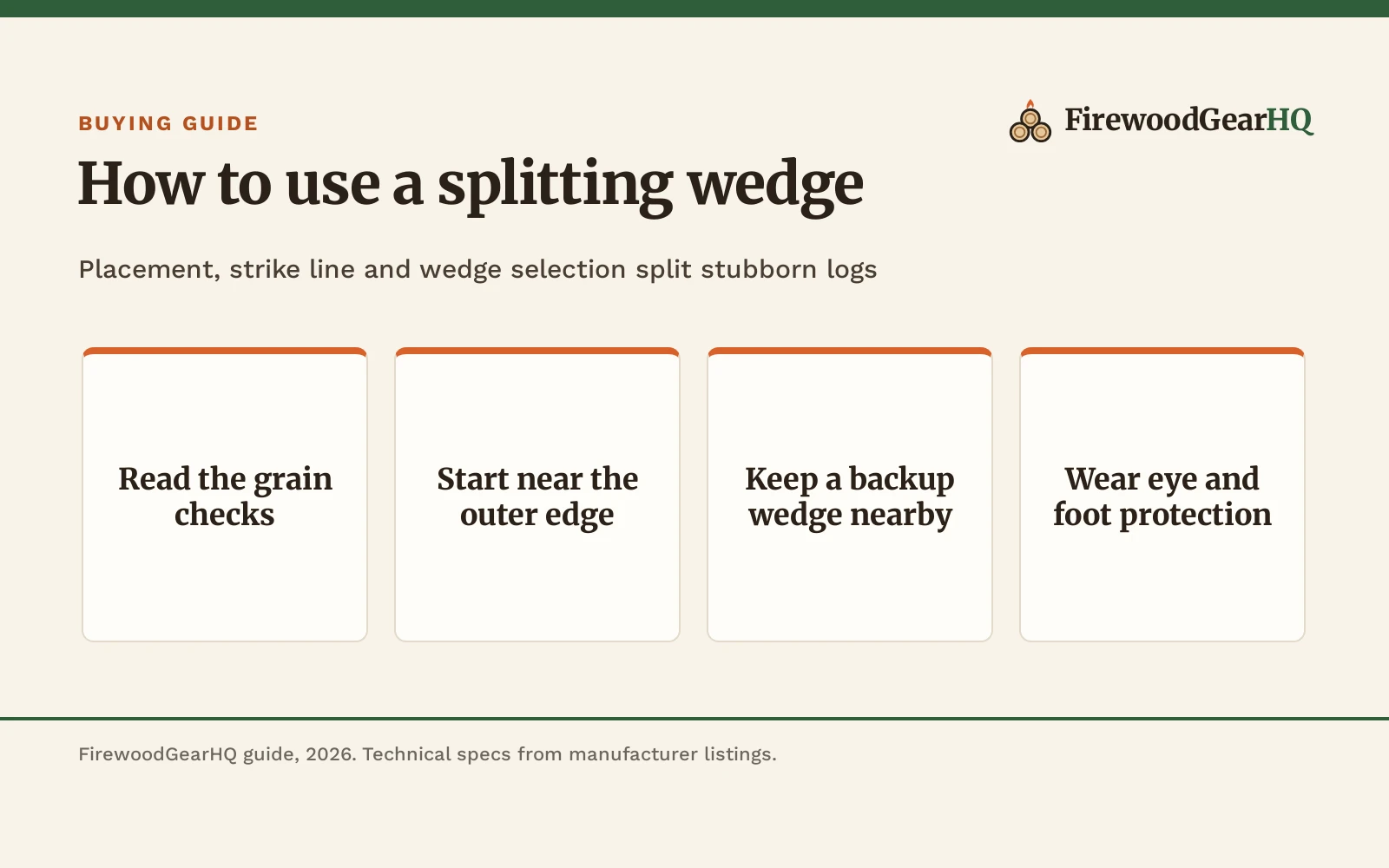
Inspect the round and read the grain
Look closely at the end grain. As cut wood dries, natural stress cracks known as checks often develop across the face. Setting a wedge along a clear check line avoids knots and swirls, reducing the effort needed to part the wood.
Position the wedge near the outer edge
Avoid placing the wedge dead center, where the heartwood is dense and tight. Set the cutting edge near the outer perimeter, just inside the bark along an existing check line to maximize mechanical leverage.
Set the wedge with deliberate taps
Hold the wedge upright with a gloved hand and tap the head gently with a hammer or maul until the blade bites firmly into the grain. Once the tool stands unsupported, remove your hand before swinging.
Drive the wedge with controlled swings
Stand in a balanced stance with feet shoulder-width apart. Swing the sledgehammer straight down onto the center of the wedge head with smooth, controlled strokes, allowing the hammer weight to drive the steel through the fibers.
Follow through with an additional wedge
If a wedge sinks flush without popping the round apart, do not pound the buried head deeper into the wood. Place an additional wedge into the open crack line further along the seam to finish the split.
How to free a stuck splitting wedge
Grain can pinch tightly around a tapered wedge, burying it flush. To free a trapped tool, place a backup wedge further along the crack line. Driving the second wedge expands the split and releases clamping pressure on the stuck tool, allowing you to lift it out by hand. Alternatively, strike along the split line with a splitting maul to jar the grain loose. Never strike the side of a stuck steel wedge with a hammer, as side impacts can crack the tool.
Safety rules when striking steel wedges
Striking steel against steel generates intense impact forces that require strict precautions:
- Wear eye and face protection: Hammer impacts can shear metal flakes or spalls from wedge heads. Always wear safety glasses or a face shield.
- Wear heavy boots and gloves: Leather work gloves dampen shock, and steel-toe boots protect feet if a round rolls or a tool glances off.
- Maintain a clear swing zone: Keep bystanders well outside the swing area. Review our log splitter safety rules for safe site planning.
- Inspect striking heads for mushrooming: Hammer blows flare steel edges over time. Grind mushroomed rims flat to prevent metal shards from breaking off.
- Never strike a wedge with an axe: Traditional chopping axes and splitting axes have unhardened polls that deform or shatter on steel. Use only a sledgehammer or a maul with a striking face rated for wedges.
Splitting wedges versus splitting mauls and axes
For straight-grained wood and smaller logs, a splitting axe delivers speed with minimal fatigue. On larger rounds, a heavier splitting maul adds mass to blast wood apart. Learn more in our guides on splitting axe vs maul and how to split wood with an axe.
Wedges handle the gnarly, knotty rounds that stop a maul cold. Driving steel directly into tough grain focuses force where swinging tools bounce. For heavy firewood cords, pairing manual wedges with the best log splitter for home use or exploring our log splitters hub saves effort.
Moisture also affects splitting behavior. Green wood can pinch tightly, while seasoned wood often splits along dry checks. Read our guide on whether it is easier to split wood green or seasoned, and check seasoned rounds with a firewood moisture meter.
Turn a stack's length, height and depth into full and face cords, and estimate how much wood a winter takes.
Frequently Asked Questions
What hammer or maul should I use with a splitting wedge?
Use a sledgehammer or a splitting maul with a striking face rated for steel impact. Never use a standard axe or hatchet, as soft axe polls deform and chip against hardened steel.
Where should I place the wedge on a log?
Set the wedge near the outer edge along an existing radial check. Splitting inward from the bark requires less striking force than driving into the dense center heartwood.
How do I free a splitting wedge that is stuck in a log?
Drive an additional wedge into the open crack line further along the wood. As the crack widens, clamping pressure releases and the stuck tool lifts free.
Do I need more than one splitting wedge?
Yes. Keeping multiple wedges on hand allows you to leapfrog tools along tough cracks when an initial wedge sinks flush without parting the log.
Can I use an axe to strike a steel splitting wedge?
No. Axe polls are unhardened and can deform, loosen on the handle, or send dangerous steel fragments flying when struck against a steel wedge.
Why does my splitting wedge bounce out of the wood?
A wedge bounces when struck on unbroken grain without seating. Tap the cutting edge lightly into a natural check to seat it firmly before taking full swings.
Related guides
Explore our woodlot guides, including comparisons of the best splitting wedges, best splitting mauls, and best splitting axes. Compare manual options in log splitter vs splitting maul and splitting axe vs maul. For higher volume, see the best log splitter for home use, review log splitter safety rules, and browse the log splitters category. Cut firewood with the best chainsaw for firewood and check dryness with the best firewood moisture meter.