Oak vs Beech Firewood: Which One Should You Buy?
An oak vs beech firewood guide: how the two dense hardwoods compare on heat, burn time, splitting and seasoning, with concrete figures from oak listings.

On this page
Top picks at a glance
As an Amazon Associate we earn from qualifying purchases.
- 1
 Smoak Firewood 12inch Length Premium Cooking Wood & Firewood9.6/10View on Amazon
- 2
 Sunnydaze Metal Firewood Carrier with Wheels9.7/10View on Amazon
- 3
 Smoak Firewood Cooking Wood Mini Splits9.6/10View on Amazon
- 4
 Oak Mini Split 8" CookingView on Amazon
- 5
 Kiln Dried Oak Firewood Bark Free Hardwood Logs for PizzaView on Amazon
- 6
 Smoak FirewoodView on Amazon
- 7
 Wilson Split FirewoodView on Amazon
- 8
 Firewood Central Kiln-Dried PA OakView on Amazon
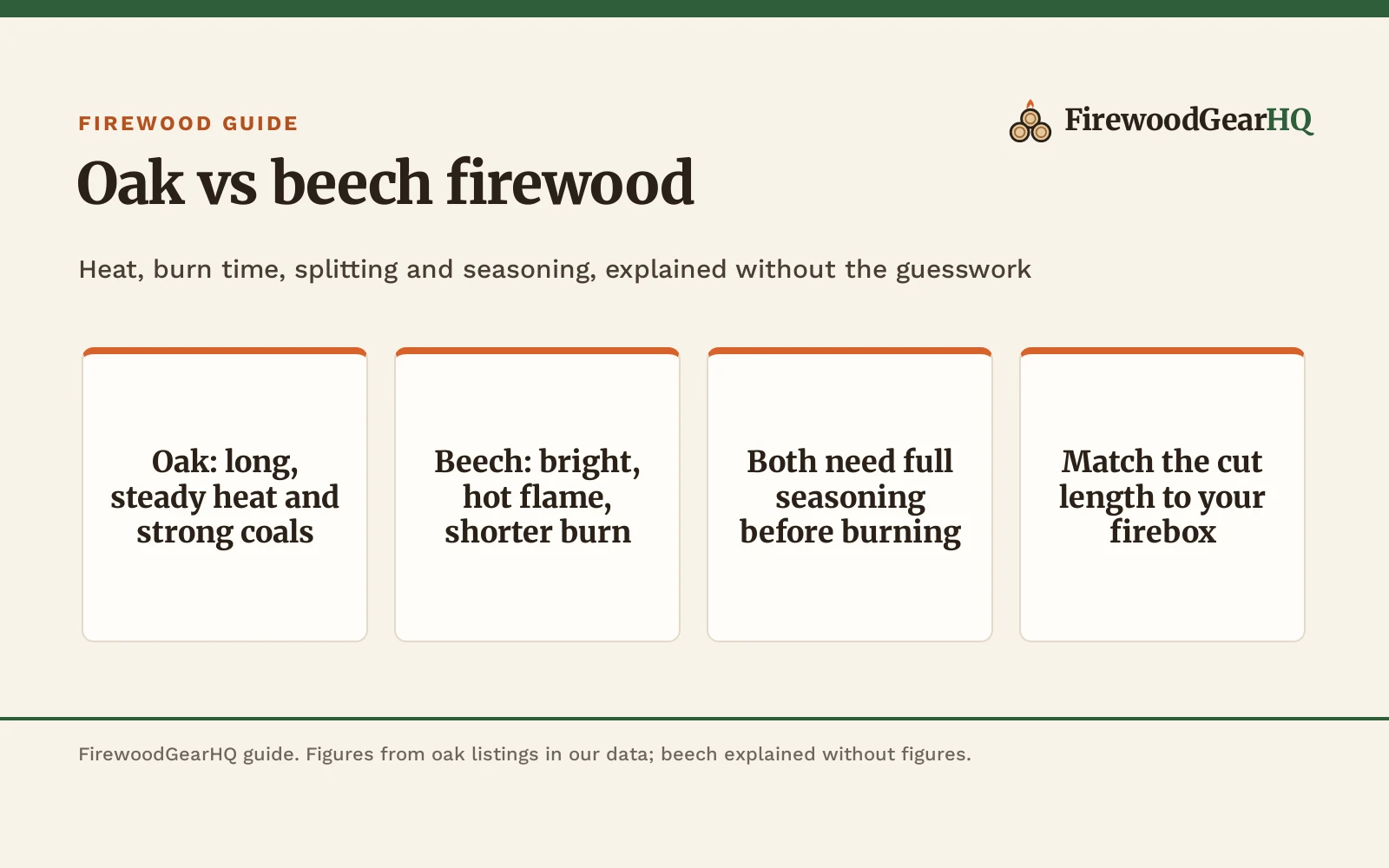
Stacking season is the time to settle the woodshed lineup, and the oak vs beech firewood question comes up whenever both are on offer. The short answer: pick oak for the longest, steadiest heat and the strongest coal bed, and pick beech for a bright, hot flame that lights easily and looks good in an open fireplace. Both are dense hardwoods, both need full seasoning, and the right choice depends on your stove or fireplace and how you like to burn.
More options to compare
 Oak Mini Split 8" CookingCheck price on Amazon
 Kiln Dried Oak Firewood Bark Free Hardwood Logs for PizzaCheck price on Amazon
 Smoak FirewoodCheck price on Amazon
 Wilson Split FirewoodCheck price on Amazon
 Firewood Central Kiln-Dried PA OakCheck price on Amazon
FirewoodGearHQ may earn a small commission if you buy through links on this page. The price you pay stays the same. Read our affiliate disclosure.
The quick answer: oak vs beech firewood
Oak and beech are both dense hardwoods, so both can heat a home well once dry. Oak is the marathon runner: long, steady heat with a deep coal bed that carries the fire between loads. Beech is the sprinter: a bright, lively flame that throws strong heat quickly but does not coal up the way oak does. Neither is the wrong choice; the mistake is burning either one before it is properly seasoned. Note that the listings in our data cover oak only, so every figure below comes from an oak listing and beech is explained without figures.
Heat and burn time
Density is what sets both woods apart from softwoods, and it is why both give long, satisfying burns. The oak reputation rests on endurance: it settles into steady heat and leaves coals that relight the next load with little fuss. The listings back the heat claim in concrete terms: FiveOaks Firewood states its kiln-dried oak splits burn at 750 to 1000 degrees F, and the Smoak Firewood white oak listing claims longer-lasting, hotter fires in the maker wording.
Beech burns hotter and brighter in the moment, with tall, cheerful flames that suit an open fireplace or a fire pit where you watch the fire. What it gives in flame it gives up in coals: a beech fire dies down to less of a coal bed than oak, so it suits evenings when you tend the fire rather than loading the stove and walking away. If overnight burns are the job, oak has the edge; if you want quick, bright heat for a gathering, beech earns its place.
Splitting and handling
Oak splits relatively straight along the grain, which is one reason it is a favorite for hand splitting. Beech is tougher customer: its grain is interlocked and stringy, so rounds can be stubborn with a maul and many burners reach for a splitter. If you buy split wood, this matters less, but it is worth knowing when you see beech rounds for sale.
Cut length matters more than species for day-to-day handling. The listings show the range: Smoak sells white oak in 12-inch lengths averaging 3 to 4 inches wide in a 17x13x13 box weighing 45 to 50 pounds, while VERSAWOOD sells oak in 8-inch, 6-inch, 5-inch and 3.5-inch logs weighing about 15, 12, 12 and 10 pounds respectively. Old Potters sells 6-inch by 1 to 1.5-inch oak pieces, about 12 pounds with 790 cubic inches of volume. Match the length to your firebox first; species comes second. For a closer look at the splitting question, see is it easier to split wood green or seasoned.
Seasoning and storage
Both oak and beech are dense, and dense wood needs full seasoning before it burns well. Oak is famously slow to give up its moisture; beech is no faster. Split the wood, stack it off the ground with air moving through the rows, and cover the top while leaving the sides open. Kiln-dried wood skips the wait: several oak listings in our data are USDA certified kiln dried with no chemicals, including the Smoak white oak box and the Old Potters mini logs, and FiveOaks notes that kiln dried firewood is free from mold and pests.
Do not guess at dryness. A firewood moisture meter reads a fresh split face in seconds, and the signs of seasoned firewood are worth learning: cracked ends, loose bark and a hollow knock. Wet oak or beech burns sluggishly, smokes and coats the flue; dry wood of either species burns clean and hot.
Telling them apart
When you buy from a seller, the bark tells the story. Oak bark is thick, rough and furrowed, and the split wood shows a warm tan to brown heartwood. Beech bark is smooth and gray, almost like an elephant leg, and the wood is pale cream throughout. If the stack is barkless, look at the end grain: oak shows bold open grain with visible rays, while beech is fine and even. Knowing which is which matters because the two season and split differently, and a seller who mixes them should price and label the load honestly.
Cooking with oak and beech
Oak is the workhorse cooking wood in the listings: Old Potters sells oak mini logs for pizza ovens, grills and smokers, and VERSAWOOD sells kiln-dried oak sized for Ooni, Gozney and Solo Stove ovens. It gives steady heat and a clean, mild smoke that suits long cooks. Beech has a long tradition as a smoking wood too, with a mild flavor that suits fish, poultry and vegetables; it burns hot and clean once seasoned, which is what you want under food.
For fire starting, the Superior Trading oak kit includes fire starter pods that burn for 15 to 20 minutes to get 4 to 5-inch oak sticks going. Small splits catch quickest: the Superior Trading sticks run 4 to 5 inches long in a 10 to 11 pound box, and FiveOaks sells 5-inch splits, half an inch to 2 inches wide, in a 14-pound box of 1,000 cubic inches. Start small, build up, and add the bigger splits once the fire is established.
Turn a stack's length, height and depth into full and face cords, and estimate how much wood a winter takes.
Frequently Asked Questions
Which burns longer, oak or beech?
Oak. Both are dense hardwoods, but oak settles into a longer, steadier burn with a stronger coal bed, while beech gives a brighter flame that dies down sooner. For overnight heat, oak is the pick.
Is beech good firewood?
Yes, once fully seasoned. It burns hot with a bright, attractive flame and splits of beech are a pleasure in an open fireplace. Its downsides are tougher splitting and a smaller coal bed than oak.
Can I burn oak and beech together?
Yes. Many burners mix them: oak for the long base heat and coals, beech for bright flames on top. Both must be dry; mixing does not fix wet wood.
What size firewood should I buy?
Match the length to your firebox. The listings show 12-inch oak lengths for stoves and fireplaces, 8-inch, 6-inch and 3.5-inch oak logs for pizza ovens, and 4 to 5-inch sticks for small stoves and fire starting. Measure your firebox before you order.
Is kiln-dried oak worth it?
It burns right away with no seasoning wait. Several listings are USDA certified kiln dried with no chemicals, and kiln dried wood arrives free from mold and pests. You pay for the convenience, so it suits small stoves and pizza ovens more than whole-house heating.
Related guides
Compare more species in ash vs oak firewood and oak vs maple firewood. Also see the best firewood cover for keeping the stack dry.