Come Along vs Log Winch: Which One Should You Buy?
Come along vs log winch, compared: the portable 2-ton come-along for short pulls and lifts, and the log winch for dragging logs, with cable, capacity and hook figures from the listings.

On this page
Top picks at a glance
As an Amazon Associate I earn from qualifying purchases.
- 1
 Come Along Winch9.6/10View on Amazon
- 2
 VEVOR Come Along Winch9.5/10View on Amazon
- 3
 ZeLang Come Along Winch with Sling9.4/10View on Amazon
Fall cutting leaves logs where they fell, and come along vs log winch is the choice between a portable hand puller and a winch made for dragging logs. A come-along is the tool you carry to the log, and a log winch is the tool that drags the log to you. Every puller in this guide is a come-along, so the come-along side is covered in full, and the log winch side is the tool to look for when the drag would take repeated resets with a hand puller.
FirewoodGearHQ earns a small commission if you buy through links on this page. The price you pay stays the same. Read our affiliate disclosure.
The quick answer
Pick a come-along when the job is a short pull, a lift, a stretch or a rescue: every puller here is rated at 2 tons, with cables from 7 to 12 ft, dual gears, and most with safety latches on the hooks. Pick a log winch when the job is dragging logs to a landing over a long drag that would take repeated resets with a hand puller. The four pullers below are all come-alongs.
Come along vs log winch: how they differ
A come-along is a hand ratchet puller: you hook one end to an anchor and the other to the load, then work the handle back and forth while the gears and the locking pawls hold each gain. It needs no power, so it works wherever you can carry it, and each pull ends when the cable runs out, so a longer drag means resetting the rigging and pulling again. A log winch is built for the drag itself: it stays anchored while it pulls a log over ground to a landing, a longer drag than a hand puller covers in one pull.
That difference decides the pick. Short pulls, lifts, fence straightening, wire stretching and vehicle rescue belong to the come-along: the listings here name all of those jobs. Dragging a log a long way across the woodlot belongs to the log winch. If the log only needs to move a short way to the truck or the splitter, a come-along does it; if the log has to travel, look for a winch made for skidding.
The come-alongs in this guide
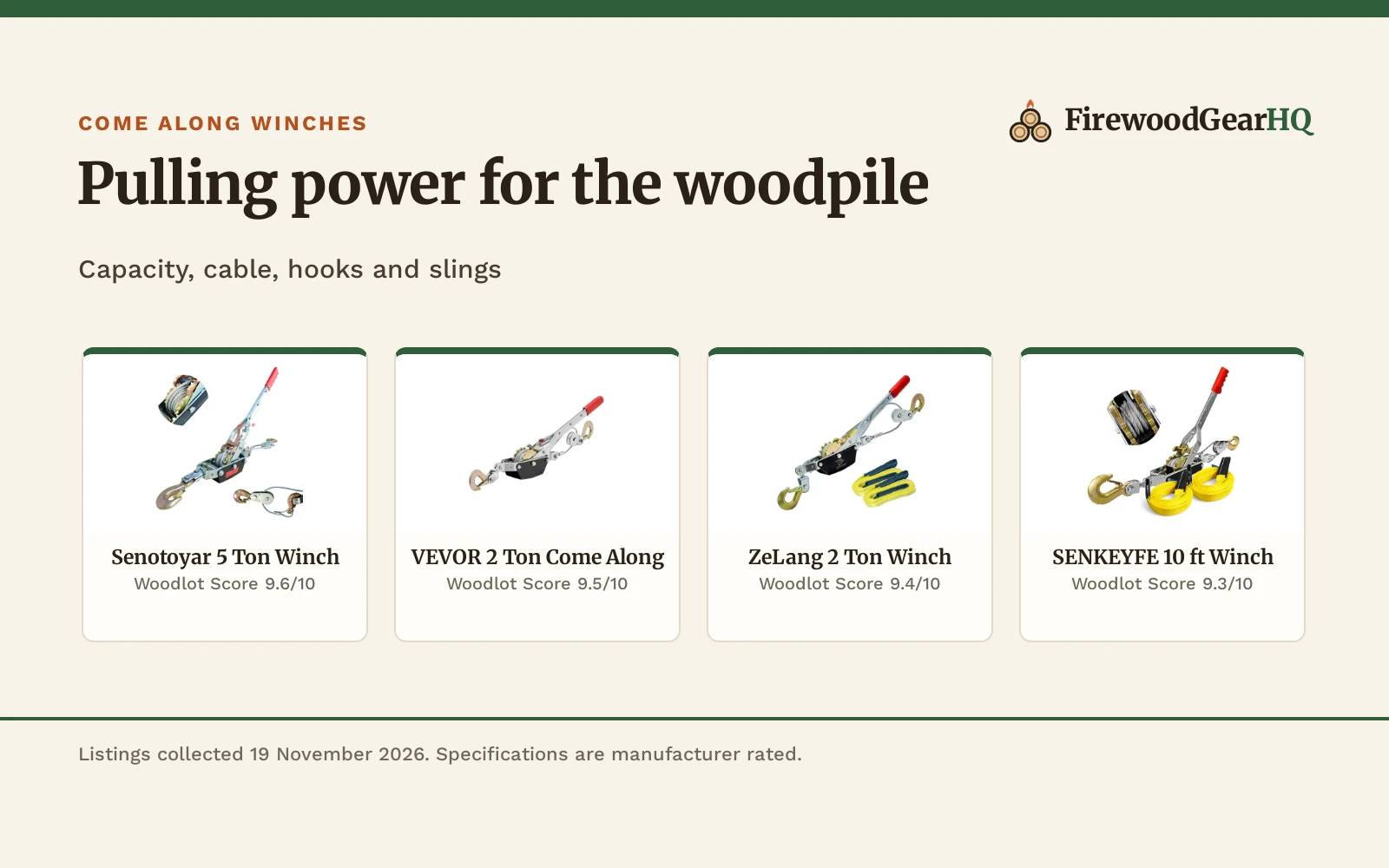
All four pullers below are 2-ton come-alongs with dual-gear ratchets. Each one says what part of the job it handles, and the table shows the capacity, cable and hooks side by side.
| Product | Capacity | Cable | Hooks and slings |
|---|---|---|---|
| VEVOR Come Along 2 Ton | 2 ton (4,409 lbs) | 12 ft steel cable | 2 hooks with spring latches |
| ZeLang Come Along with Sling | 2 tons (4,400 lbs) | 12 ft, 5 mm steel cable | 2 drop-forge hooks with safety latches; 2 slings, 1 inch by 8 feet |
| SENKEYFE 7 FT Come Along | 2 ton (4,400 lbs) | 7 ft anti-twist steel cable | 2 hooks with safety latches |
| SENKEYFE 10 FT Come Along | 2 ton (4,400 lbs) | 10 ft steel cable | 2 hooks; 2 slings, 1 inch by 8 feet |
VEVOR Come Along 2 Ton
The VEVOR is a 2 ton (4,409 lbs) puller with a 12 ft steel cable, 2 hooks and a dual-gear ratchet, plus an anti-reverse mechanism that holds the load with no backtracking. The extended handle works with one hand, the grip is rubberized, and the hooks carry spring latches. It weighs 6.39 pounds and measures 26.18 by 2.95 by 7.87 inches. Who it is for: anyone who wants a 12 ft cable and a long feature list for vehicle rescue and heavy pulls. Who should skip it: anyone who wants lifting slings in the box, since none are stated.
ZeLang Come Along with Sling
The ZeLang pairs a 2 ton (4,400 lbs) puller with a 12 ft, 5 mm steel cable and 2 lifting slings, 1 inch by 8 feet, for extra reach at the anchor or the load. Two drop-forge hooks with safety latches and automatically closing safety pins hold the connection, and the thickened frame and dual gears spread the pulling force. The extended handle is wavy rubber for grip and leverage, and the puller needs no power. Who it is for: anyone who wants slings in the box and the only stated cable thickness for farm, fence and construction pulls. Who should skip it: anyone who needs the weight before ordering, since the listing leaves it unstated.
SENKEYFE 7 FT Come Along
The SENKEYFE 7 FT is a 2 ton (4,400 lbs) puller with a 7 ft anti-twist galvanized steel cable and a 1-piece dual-gear ratchet with locking pawls. Two hooks with safety latches guard against slipping, and the larger handle has a wavy rubber, anti-skid design. It suits hoisting motors, moving machinery, automotive use, stretching wire and straightening fences. Who it is for: anyone who wants the 7 ft cable here for close work around the farm, ranch or shop. Who should skip it: anyone who needs more than 7 ft of reach, since no sling is included.
SENKEYFE 10 FT Come Along
The SENKEYFE 10 FT is a 2 ton (4,400 lbs) puller with a 10 ft galvanized steel cable and 2 lifting slings, 1 inch by 8 feet, with flat eye to eye loop ends. The dual-gear ratchet with locking pawls spreads the pulling force, and the puller suits hoisting, moving machinery, automotive work, stretching wire and straightening fences. Who it is for: anyone who wants slings in the box and a mid-length cable for farm and fence work. Who should skip it: anyone who wants safety latches stated on the hooks, since this listing leaves them unstated.
What to check before you buy
Match the puller to the job, not to the brand. Check the capacity first: every puller here is rated at 2 tons, with the VEVOR listing 4,409 lbs and the others 4,400 lbs. Then check the cable: 12 ft on the VEVOR and ZeLang, 10 ft on the SENKEYFE 10 FT and 7 ft on the SENKEYFE 7 FT. Slings add reach: the ZeLang and the SENKEYFE 10 FT each include 2 slings, 1 inch by 8 feet. Finally, check the hooks: spring latches on the VEVOR, safety latches on the SENKEYFE 7 FT and ZeLang, and safety pins on the ZeLang.
Safety around a loaded cable
Wear chaps, a helmet, and eye and ear protection when you work around a loaded cable, and check the hooks, latches and cable before each pull. Keep clear of a cable under load, and never pull past the rated capacity: every puller here is rated at 2 tons. Work with a partner where the load can shift, and follow the puller maker’s manual for the tool you buy.
FAQ: wood, fire and gear
What is the difference between a come-along and a log winch?
A come-along is a portable hand ratchet puller for short pulls, lifts and stretches, with a cable from 7 to 12 ft in the listings here. A log winch is made for dragging logs to a landing over a long drag, where a hand puller would need repeated resets. No log winch is listed in this guide, so compare the come-alongs here and shop log winches by their own stated capacity and cable.
How much can these come-alongs pull?
Each one is rated at 2 tons: the VEVOR lists 4,409 lbs, and the SENKEYFE and ZeLang pullers list 4,400 lbs. Stay inside the rated capacity and check the hooks and cable before each pull.
What cable length do I need?
The listings here give 7 ft, 10 ft and 12 ft cables. Pick the length that reaches from your anchor to the load with slack to spare, and add a sling when the anchor sits beyond the cable: the ZeLang and the SENKEYFE 10 FT each include 2 slings, 1 inch by 8 feet.
Do I need the lifting slings?
Slings help when the anchor point is a tree, a post or a hook that the cable hook cannot grip cleanly. The ZeLang and the SENKEYFE 10 FT include 2 slings each; the VEVOR and the SENKEYFE 7 FT do not list slings, so add your own if the job needs them.
Can a come-along lift as well as pull?
Yes, within its rated capacity. The listings here name lifting, lowering, pulling and stretching, and the VEVOR is listed for vehicle rescue and hoisting. Rig the pull so the load cannot swing or drop, and never lift a load over people.
What should I check before each pull?
Check the hooks and latches, the cable for frays or kinks, and the anchor point before you start. The galvanized finish on the SENKEYFE and ZeLang cables resists corrosion, but a damaged cable or an open latch is still a failed pull waiting to happen.
More firewood guides
See the best log pulling winch picks when the job needs a winch made for logs. For the woodlot around the pull, see the log handling guides and the firewood handling hub, and read the forestry safety notes before the first pull.