Sawbuck vs Sawhorse: Which One Should You Buy?
Sawbucks and sawhorses compared on log holding, capacity, working height, weight and portability, with three examples from the listings we reviewed.

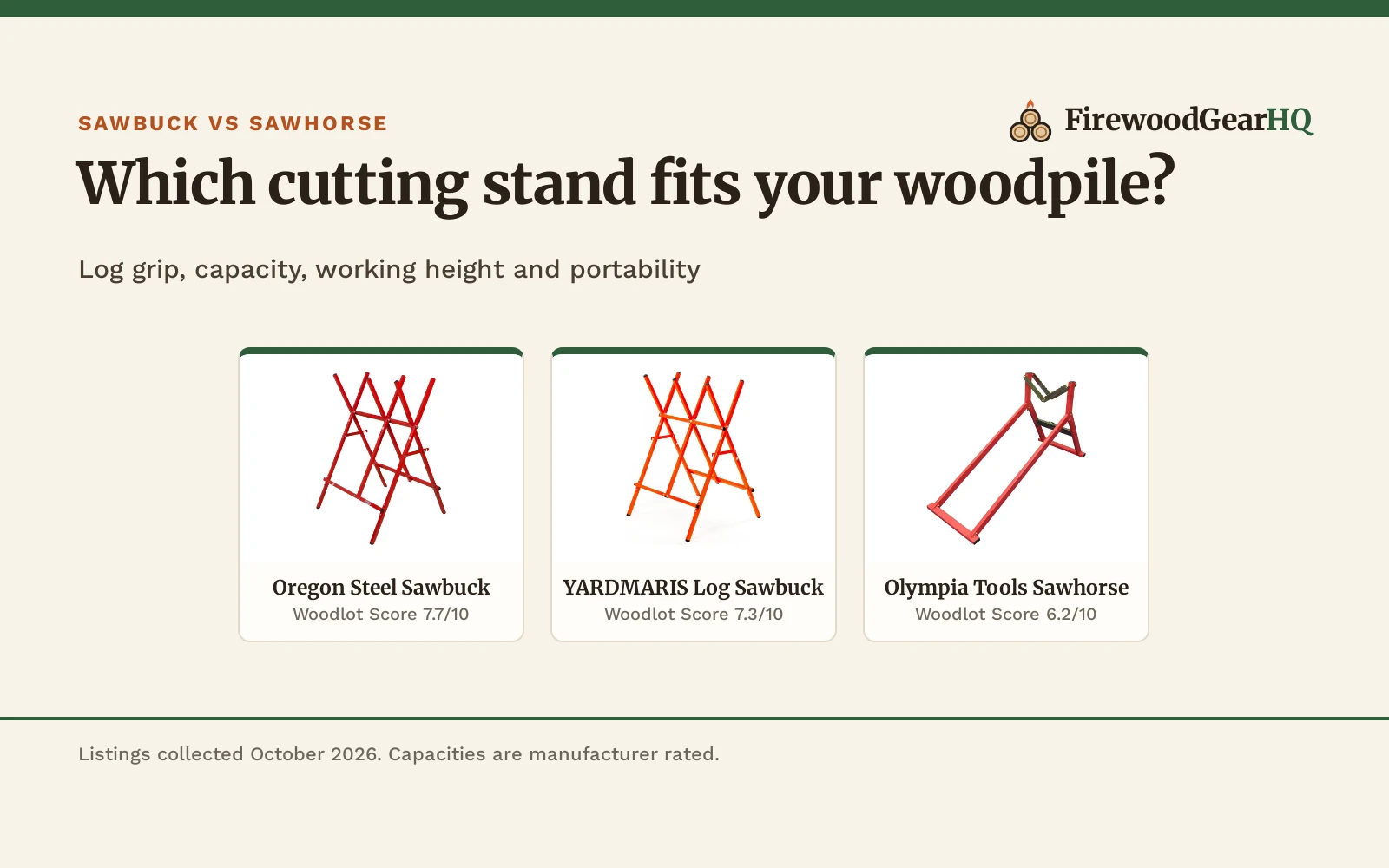
On this page
Top picks at a glance
As an Amazon Associate we earn from qualifying purchases.
- 1
 Oregon Steel Log Saw Horse9.6/10View on Amazon
- 2
 Olympia Tools 80-934 Forest Master Ultimate Sawhorse9.3/10View on Amazon
- 3
 Log Saw Horse9.5/10View on Amazon
Verdict: Choose a sawbuck if you want an adjustable folding stand with a serrated V-cradle that grips round logs and holds up to 176 or 330 pounds on stated models. Choose a sawhorse if you prefer a single-station log holder like the Olympia Tools example, which uses automatic self-adjusting teeth for one-step loading without manual adjustments.
When fall firewood cutting arrives and you need to buck fallen logs and tree limbs into stove lengths, keeping wood stable off the dirt protects your chainsaw chain from dulling on rocks. Deciding between a sawbuck vs sawhorse comes down to how wood is held, load capacity, working height and how easily the stand folds away for storage. This comparison covers how both designs operate, followed by three concrete examples from the listings we evaluated.
FirewoodGearHQ may earn a small commission if you buy through links on this page. The price you pay stays the same. Affiliate disclosure.
| # | Product | Woodlot Score | Buy |
|---|---|---|---|
| 1 | Oregon Steel Log Saw Horse | 9.6/10 | Buy on Amazon |
| 2 | Log Saw Horse, Log Cutting Stand | 9.5/10 | Buy on Amazon |
| 3 | Olympia Tools 80-934 Forest Master Ultimate | 9.3/10 | Buy on Amazon |

Oregon Steel Log Saw Horse
A foldable steel sawbuck with serrated teeth to clamp logs, adjustable width up to a 10.6 inch log capacity, a 176 pound load rating, and a limited lifetime warranty.
Pros
- Limited lifetime warranty included with boxed steel frame
- Serrated teeth clamp onto wood for cutting stability
- Adjustable width with up to 10.6 inch log capacity
- Lightweight at 15 pounds and folds for storage
Cons
- 176 pound load capacity is lower than the YARDMARIS example
- Assembly required with spanner or wrench not included
- Listing contradicts itself on 10, 10.5 and 10.6 inch capacity
- Spec table lists stainless steel but the unit has a painted finish

Log Saw Horse, Log Cutting Stand
A foldable orange steel sawbuck with snap-lock height adjustment, top width adjustable from 8.6 to 10.6 inches, anti-slip sawtooth top, and a 330 pound load capacity.
Pros
- 330 pound load capacity supports heavier logs
- Snap-lock adjustments for height and an 8.6 to 10.6 inch adjustable top width
- Anti-slip sawtooth top edge grips logs during chainsaw cutting
- Lightweight build at 8.91 pounds that folds flat in seconds
Cons
- No warranty term is stated in the listing
- Weight contradiction between 8.91 pounds in bullets and 9.53 pounds in spec table
- Model ym48 listing publishes very few technical specifications
- Top width tops out at 10.6 inches for log diameter
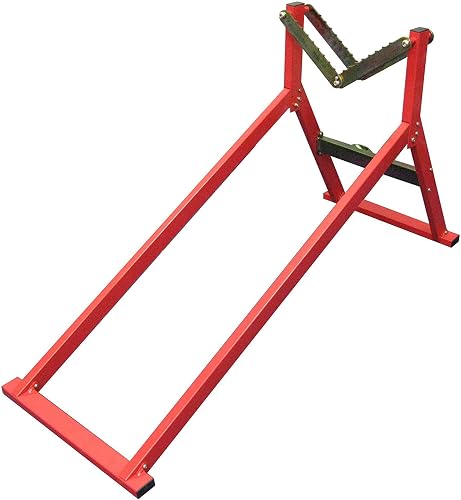
Olympia Tools 80-934 Forest Master Ultimate
A 32.5 pound iron sawhorse featuring one-step log loading with automatically adjusting teeth to grip logs at a natural working height.
Pros
- One-step loading allows logs to be loaded and removed without manual clamps
- Teeth automatically adjust to log diameter for a secure grip
- Natural height positioning allows cutting without bending
- Sturdy 32.5 pound iron frame provides solid cutting ground
Cons
- No warranty term is stated in the listing
- Log diameter capacity and load capacity are not stated
- Substantially heavier to transport at 32.5 pounds
- Title calls it Forest Master while bullets name it Quick Fire Sawhorse
Side by side
| Model | Weight | Log capacity | Load capacity |
|---|---|---|---|
| Oregon Steel Sawbuck | 15 lb | 10.6 in | 176 lb |
| YARDMARIS Log Sawbuck | 8.91 lb | 8.6 to 10.6 in | 330 lb |
| Olympia Tools Sawhorse | 32.5 lb | Not stated | Not stated |
Ranges are typical of the listings we reviewed; example figures are manufacturer rated, collected 13 October 2026.
Sawbuck vs Sawhorse: Cradle Design and Log Grip
The primary difference between these two cutting supports is how they cradle and secure a round log. A sawbuck uses a V-cradle that guides round wood into the center of the frame. In models like the Oregon and YARDMARIS examples, serrated steel teeth along the cradle edges bite directly into log bark to stop the wood from twisting during chainsaw cutting without needing manual clamping knobs.
A sawhorse, by contrast, is built around a horizontal frame or elevated station. The Olympia Tools sawhorse example features a dedicated log cutting position with self-adjusting teeth that automatically grip the log diameter as soon as the timber is placed, allowing one-step loading and removal without adjusting separate clamps.
Capacity: Log Diameter and Weight Limits
Log diameter and weight ratings vary across individual listings. For the sawbuck listings, the YARDMARIS model states a top width adjustable between 8.6 and 10.6 inches and a manufacturer-rated load capacity of 330 pounds. The Oregon sawbuck states an adjustable width with a maximum log capacity of 10.6 inches (with 10 inches in the title and 10.5 inches in the spec table) and a rated load capacity of 176 pounds.
For the sawhorse side, the Olympia Tools listing leaves both figures unclear: it does not state a maximum log diameter capacity or a maximum load capacity, though it notes its teeth automatically adjust to the log diameter. Because the sawhorse listing omits these ratings, buyers cannot directly compare its weight limit against the 176 and 330 pound capacities stated for the sawbuck examples.
Working Height and Body Mechanics
Working height affects posture and cutting control at the woodpile. The Olympia Tools sawhorse listing highlights a natural working height designed to let logs be cut without bending, helping prevent back strain during operation.
The sawbuck examples address working posture through adjustable height settings rather than a fixed frame. The YARDMARIS listing includes snap-lock adjustments to change both frame height and top width according to user preferences, while the Oregon sawbuck is listed as a height-adjustable log holder standing 34.32 inches high. Being able to set working height helps keep the log positioned comfortably for cutting while maintaining a stable base on outdoor ground.
Portability, Weight and Off-Season Storage
Portability and storage depend on frame weight and folding designs. The YARDMARIS sawbuck weighs 8.91 pounds in its bullet points (and 9.53 pounds in its spec table) and folds flat for storage and transport. The Oregon sawbuck is also foldable and weighs 15 pounds.
By comparison, the Olympia Tools sawhorse listing specifies an iron construction with a listed item weight of 32.5 pounds. That heavier weight gives the Olympia Tools example a substantial presence on the ground, but makes it heavier to transport than the 8.91 and 15 pound sawbuck examples.
Three examples
How we scored them
Each example is scored out of 10 on performance, build, value, safety and warranty, using only what the listing publishes. The weights are on our How We Pick page.
| Product | Woodlot Score | Perf. /35 | Build /25 | Value /25 | Safety /10 | Warranty /5 |
|---|---|---|---|---|---|---|
| Oregon Steel Sawbuck | 9.6 | 28 | 20 | 20 | 5 | 4 |
| YARDMARIS Log Sawbuck | 9.5 | 29 | 19 | 20 | 5 | 0 |
| Olympia Tools Sawhorse | 9.3 | 23 | 18 | 18 | 4 | 0 |
Scores run from 9.2 to 9.8: each product’s point total is placed on that range, so more points always means a higher score.
Lift with your legs, not your back, and get help or a mechanical aid for big rounds. Respect each tool's rated capacity, keep feet clear of rolling logs, and wear gloves against splinters. Read our Safety Disclaimer.
Around the Woodpile
- Keep gripping teeth clean: Serrated edges on sawbucks and self-adjusting jaws on logging sawhorses need clear contact with bark to prevent log slippage during chainsaw cutting.
- Respect stated weight limits: Do not exceed stated maximum capacities, such as the 176 pound rating on the Oregon sawbuck or 330 pounds on the YARDMARIS stand, especially when handling heavy green wood.
- Store stands under cover: Painted and powder-coated steel finishes resist corrosion, but folding stands flat and storing them in a dry shed prevents rust around pivot bolts and adjustment pins.
- Check stability before cutting: Ensure legs sit firmly on solid, level ground before loading logs to avoid tipping while operating a saw.
Frequently Asked Questions
What is the main difference between a sawbuck and a sawhorse?
A sawbuck uses a V-cradle designed specifically to hold round firewood logs firmly so they cannot roll during chainsaw cuts. A traditional carpentry sawhorse features a flat horizontal crossbeam, while specialized logging sawhorses like the Olympia Tools example incorporate gripping teeth to hold round timber.
Can you use a standard carpenter sawhorse for cutting firewood?
A standard flat carpenter sawhorse lacks notches or teeth to secure round wood, allowing logs to roll or slide under a chainsaw. Firewood cutting requires either a serrated sawbuck or a logging sawhorse equipped with gripping teeth.
Why do sawbucks have serrated teeth?
Serrated teeth along the cradle edges bite into rough log bark to stop the wood from spinning or shifting as chainsaw chain teeth pull across the cut, increasing stability and control.
Are sawbucks portable enough to take into the woods?
Yes. The folding steel sawbucks evaluated here are lightweight, including the 8.91 pound YARDMARIS example and 15 pound Oregon example, folding flat so they can be carried directly to the woodpile or transported in a vehicle.
Do I need clamps to secure a log in a sawbuck?
The sawbuck listings reviewed rely on the V-shaped cradle and serrated teeth to hold the log under its own weight without manual clamping knobs. The Olympia Tools sawhorse example uses self-adjusting teeth for one-step holding without manual clamps.
Related guides
See our guide on what is a sawbuck, our step-by-step instructions on how to buck firewood safely with a chainsaw, our overview on how to move heavy logs safely, and the firewood handling category. For cutting equipment, see the best chainsaws for firewood and the chainsaw safety gear checklist.