Firewood Moisture Content Chart: When Is Wood Dry Enough?
A firewood moisture content chart for reading a pin meter: green means low moisture, orange means keep drying, and red means high moisture.

On this page
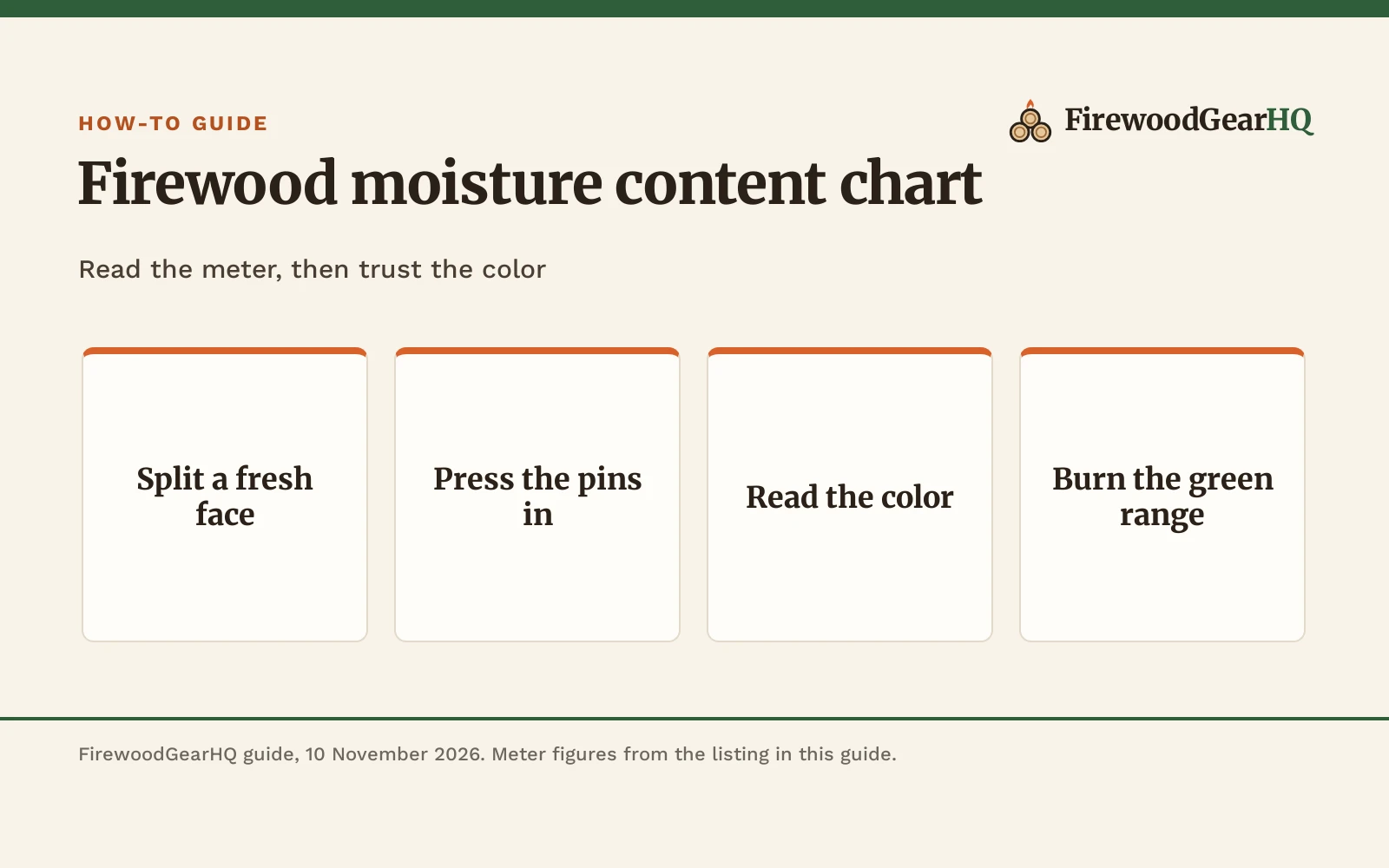
Firewood that looks dry can still be wet inside, and the stove knows the difference before you do: wet wood smokes, sulks and coats the flue, while dry wood catches fast and burns hot. A meter reading settles the question, and the firewood moisture content chart below reads the meter for you: green means low moisture, orange means medium moisture, and red means high moisture. Split a piece, press the pins into the fresh face, and read the color against the chart below.
As an Amazon Associate I earn from qualifying purchases. FirewoodGearHQ earns a small commission if you buy through links on this page. The price you pay stays the same. Read our affiliate disclosure.
Firewood moisture content chart: the quick answer
Split a piece of firewood and press the meter pins into the fresh face: the meter shows green for low moisture, orange for medium and red for high. Green means low moisture; orange means medium moisture that needs more time in the stack; red means high moisture that stays out of the stove until it dries. The chart below spells out each color, and the steps after it show how to get a reading you can trust.
The moisture content chart
The chart follows the 3-color display on a pin meter like the Klein Tools ET150 (on Amazon): red for high, orange for medium and green for low. The listing states no moisture percentage for any color, so the chart reads the meter’s ranges, not a fixed threshold. The meter reads the wood the pins touch, so the reading is only as good as the face you press it into.
| Meter color | What it means | What to do |
|---|---|---|
| Green (low) | The meter reads low moisture | Burn it; keep the rest of the stack covered on top |
| Orange (medium) | The meter reads medium moisture | Leave it in the stack to dry longer, then read it again |
| Red (high) | The meter reads high moisture | Do not burn it; split it smaller and stack it to dry |
Read the color, not the calendar: wood dries at its own pace, and a meter reading beats a guess about how long the wood has sat.
How to read a moisture meter
A pin meter reads the wood its pins touch, so the face matters more than the meter. Work through the steps below, and read each piece the same way so the readings compare.
Split a fresh face
Split the piece open and read the fresh face, not the bark and not the weathered end. Bark and ends dry first and read low while the middle is still wet, so the fresh face is the honest reading. Press the pins into the fresh face and hold them steady until the reading settles.
Mind the pin depth
The pins on the Klein Tools ET150 reach 8 mm deep, so the reading covers the wood just under the fresh face. The pins reach 8 mm deep, so the reading covers the wood just under the fresh face. Read the middle of the face, not the edge, where the wood dries quickest.
Pick the wood mode
Set the meter to the wood mode for the piece in hand: the Klein meter carries calibrated modes for softwood and hardwood, and the reading shifts with the species. A softwood mode on a hardwood piece reads wrong, so check the mode before the pins go in. The meter also carries a calibration check on the cap, so verify the calibration before a round of readings.
Read the color
Read the backlit display: green for low, orange for medium and red for high. The backlit display shows the range in color, so it reads at a glance in a dim woodshed. An audible alert is built in, and a work light helps in the dark corners of the stack.
What makes wood read wet
Fresh-cut wood reads red, and so does wood that was split and stacked where the air cannot reach it. Rounds that were never split hold water in the middle: splitting opens the faces the air dries. A stack wrapped tight in a tarp traps moisture and reads wet for seasons, while a stack covered on top only, with the sides open to the wind, dries down to the green range. Bark slows drying too, so split pieces with the bark facing out dry faster than rounds left whole.
How to tell without a meter
Time is a guide, not proof, but the signs line up with the meter when you know them:
- Cracks: checks run out from the center on the ends.
- Color: the ends turn gray or yellow instead of bright and fresh.
- Sound: seasoned pieces knocked together make a hollow clack, while wet pieces sound dull.
- Bark: it loosens and peels away easily.
- Weight: seasoned wood feels light for its size compared with a fresh split piece.
These signs point the same way the meter does, but the signs alone do not settle it: when the signs and the meter disagree, split another piece and read the fresh face again.
FAQ: wood, fire and gear
What moisture level is dry enough to burn?
The low range on the meter: green means low moisture, and anything in the orange or red range needs more drying. Do not burn wood that reads medium or high: it smokes, gives little heat and coats the flue with creosote.
How do I use a pin moisture meter?
Split a piece, set the wood mode for the species, and press the pins into the fresh face until the reading settles. The Klein Tools ET150 pins reach 8 mm deep and show green, orange or red for low, medium and high moisture. Read several pieces from different parts of the stack before deciding the whole stack is ready.
Should I read the bark or the split face?
The split face. Bark dries first and reads low while the middle is still wet, so a bark reading flatters the wood. Split the piece open and read the fresh face.
Why does my wood read wet after a year in the stack?
Usually because the stack cannot breathe: a tarp wrapped all the way down traps moisture, rounds left whole hold water in the middle, and a shaded corner dries slowly. Split the pieces, cover only the top, leave the sides open to the wind, and read the wood again after it has had time to dry.
Can I burn wood that reads in the orange range?
It will burn, but badly: it smokes, gives little heat and leaves creosote in the flue. Leave orange wood in the stack until it reads green, and burn only the wood that reads in the low range.
More firewood guides
See the firewood handling hub, the best firewood moisture meters and the how long to season firewood guide. Stack it right with the best firewood rack with cover.