Pickaroon vs Peavey: Which One Should You Buy?
A practical comparison of the pickaroon and peavey, explaining how each tool works, their key design differences, and which tool to choose for firewood or logs.

On this page
Top picks at a glance
As an Amazon Associate we earn from qualifying purchases.
- 1
 Peavey Cant Hook9.6/10View on Amazon
- 2
 Stihl aluminium pickaroon Brand: StihlView on Amazon
- 3
 Earth WorthView on Amazon
- 4
 WOODCHUCK Wct03 Timberjack Peavey and Cant HookView on Amazon
- 5
 Ironton Wooden Handle PeaveyView on Amazon
When autumn arrives and you are cutting, bucking and splitting firewood for the winter woodpile, moving heavy wood off the ground quickly strains your back and arms. Choosing the right tool makes woodlot chores faster and safer. If you are weighing a pickaroon vs peavey, the choice depends on timber size and the movement required. A pickaroon hooks, drags and lifts cut firewood rounds without constant bending. A peavey levers, rolls and positions whole logs and tree trunks during bucking and sawmilling.
More options to compare
 Stihl aluminium pickaroon Brand: StihlCheck price on Amazon
 Earth WorthCheck price on Amazon
 WOODCHUCK Wct03 Timberjack Peavey and Cant HookCheck price on Amazon
 Ironton Wooden Handle PeaveyCheck price on Amazon
FirewoodGearHQ may earn a small commission if you buy through links on this page. The price you pay stays the same. Read our affiliate disclosure.
Pickaroon vs peavey: the quick answer
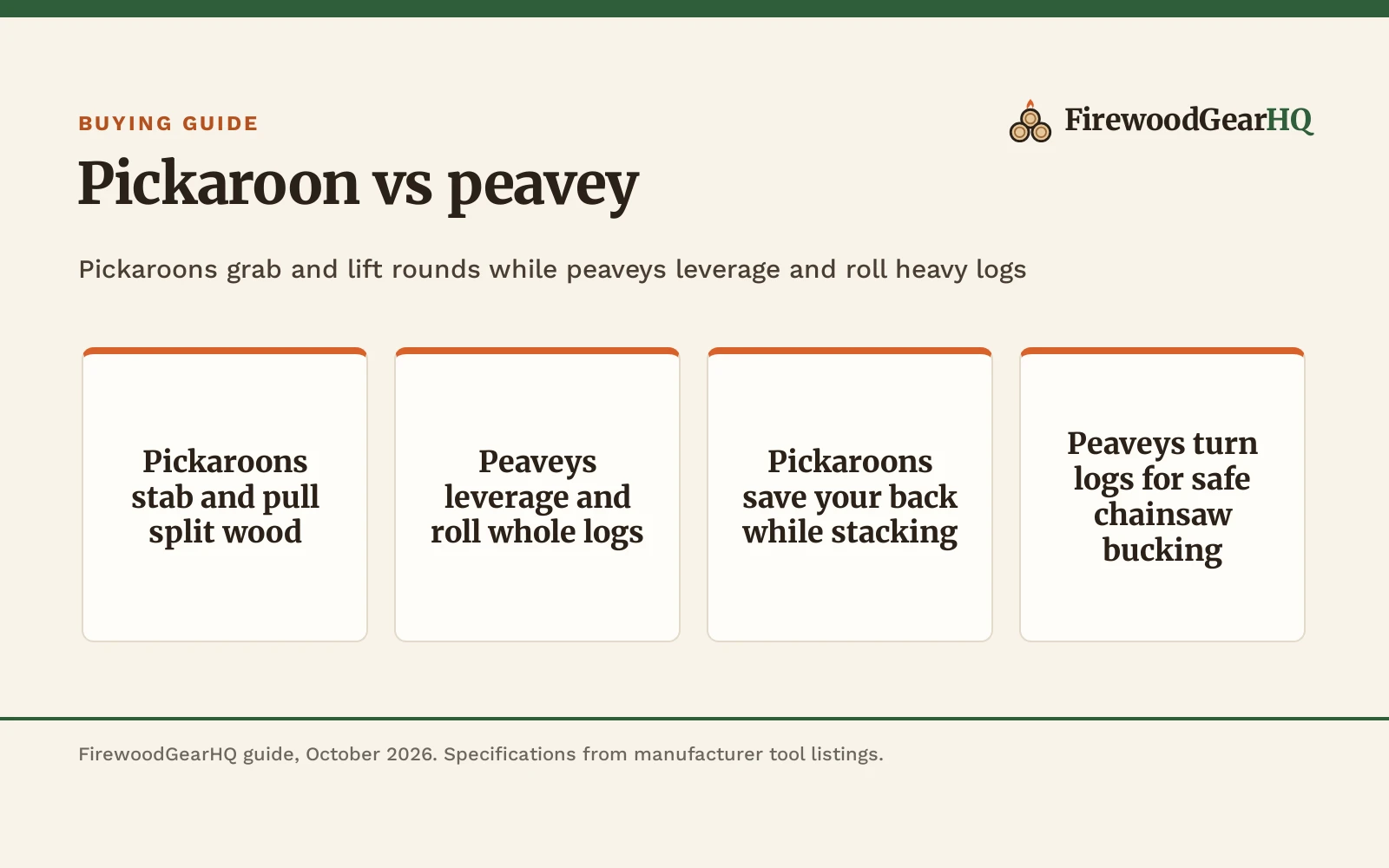
The main difference between a pickaroon and a peavey is their mechanical design and intended task. A pickaroon, or hookaroon, resembles an axe with a pointed, down-turned steel beak instead of a cutting blade. You swing the head into a cut round, and the sharp point embeds into the grain so you can pull, drag or stack firewood without bending over. It handles split pieces, rounds and pulpwood at the splitter or woodpile.
A peavey is a heavy lever tool designed for moving whole tree trunks. Named after Joseph Peavey, it features a long handle, a swinging curved steel hook, and a sharp straight spike at the tip. You hook the arm over a log and seat the base against the bark, creating leverage to roll trunks during chainsaw bucking, or drive the spike between logs to pry them apart. A peavey is too bulky for split firewood, while a pickaroon cannot roll heavy sawlogs. Many woodcutters keep each in their firewood handling kit.
Comparison table: pickaroon vs peavey
Use the table below to compare the core mechanics and primary uses of each tool before deciding which fits your woodlot.
| Feature | Pickaroon | Peavey |
|---|---|---|
| Primary Purpose | Grabbing, dragging, and stacking split rounds and pulpwood | Rolling, pivoting, and prying heavy logs and tree trunks |
| Head Design | Fixed pointed beak or hooked steel spike | Swinging hinged hook with a sharp straight point at the tip |
| Typical Handle Length | Compact to mid-length handles for swinging and dragging | Extended long handles designed for maximum leverage |
| Best Woodlot Phase | Splitting at the woodpile, unloading trucks, and stacking cords | Felling, bucking logs with a chainsaw, and sawmill staging |
| Back Strain Relief | Eliminates bending to pick up split firewood from the ground | Provides mechanical advantage so you avoid lifting log weight |
| Grip Mechanism | Point embeds into end grain or split face with a light swing | Hinged dog wraps around log circumference while spike bites wood |
They address different stages of wood processing: a pickaroon saves your back when handling rounds, while a peavey multiplies your leverage against heavy timber.
How each tool works on the woodlot
What a pickaroon does best
A pickaroon shines once firewood is cut to stove length. Stacking cords requires constant bending, and lifting rounds out of a truck bed strains back muscles. Swinging the pointed head into the end grain or exposed split face seats the hooked point firmly, allowing you to drag rounds across the ground or pull them toward your splitting block.
At the splitter, a pickaroon retrieves dropped chunks or repositions knots on the beam without placing hands near the wedge. Releasing the bite requires only a quick forward flick of the handle. When learning how to use a pickaroon, you find that it acts as an arm extension that spares fatigue during fall processing.
What a peavey does best
A peavey comes into play right after a tree hits the ground. When a trunk rests flat on dirt, bucking it with a chainsaw risks running the chain into rocks or pinching the bar. To roll the trunk and finish cuts from above, you need leverage.
Engage the curved hook over the log and seat the pivot point against the bark. Pushing or pulling the long handle forces the dog deeper into the timber, allowing an individual woodcutter to roll heavy sawlogs safely. It is an essential tool when practicing how to move heavy logs safely in the woods.
Handle materials and leverage
A traditional pickaroon with wooden handle, crafted from American hickory or ash, absorbs vibration when the steel point strikes hard rounds. Woodcutters often prefer a pickaroon wood handle because hickory flexes slightly under strain. Commercial listings show distinct sizing: Council Tool offers a 36-inch hookaroon with a 1.5-pound head on an American hickory handle, while FORESTER lists pickaroon models in 16-inch, 28-inch, and 36-inch handle lengths with a 1.5-pound drop forged steel head. For lighter tasks and smaller logs, Fiskars produces a compact 12-inch hookaroon weighing 9.6 ounces with an engineered composite handle, and WICING manufactures 15-inch and 28-inch models featuring fiberglass composite handles. Peavey handles must endure heavy bending force, using thick hickory poles or steel tubing to prevent breakage while prying timber.
Hook design and point mechanics
A pickaroon head features a sharp, tapered beak that penetrates wood grain with light swing force. Some models add serrated teeth along the lower curve to keep icy rounds from slipping. Specialized forestry tools combine a pickaroon with axe head features by placing a cutting blade opposite the pick, though standard firewood models use a dedicated hook head. A peavey head features a steel collar, a straight spike, and an independently pivoting hook that opens wide to grip large trunks.
How to choose the right tool for your woodpile
To choose between these tools, consider your typical firewood tasks:
- Choose a pickaroon if: you handle cut rounds, split cordwood, or bucked pieces; you spend time running a best log splitter for home use; you unload rounds from a truck bed; or you want to avoid back strain from bending.
- Choose a peavey if: you manage full tree-length logs, fell trees, or clear windfalls; you need to roll logs off the ground during chainsaw bucking; you feed a portable sawmill; or you pry apart tangled logs.
- Get both tools if: you process trees from stump to stove. The peavey rolls logs during bucking, and the pickaroon takes over once wood is cut into rounds.
Safe log handling and common woodlot mistakes
Handling heavy timber requires careful footing and sound mechanics:
- Glancing blows with a pickaroon: Never swing toward your legs or feet. If the point strikes a knot or frozen grain, it can glance off. Strike outside your stance and wear sturdy work boots.
- Prying with a pickaroon: A pickaroon is built for pulling and moving wood. Using the handle as a pry bar on heavy logs can loosen the head or split the handle.
- Standing in the roll path: When rolling logs on a slope with a peavey, stand uphill and push the log away. Never position yourself downhill in the path of rolling timber.
- Inspect tool joints: Check handle wedges on pickaroons and pivot bolts on peavey hooks before work to avoid loose tool heads.
Peaveys, cant hooks and timber tools
A peavey is often compared to a cant hook. As detailed in our guide on the cant hook vs peavey, a cant hook replaces the sharp terminal spike with a blunt, toothed toe designed for flat cants on sawmill decks. The peavey’s pointed spike digs into forest soil and between logs for woods work. If shopping for log rollers, see our guide to the best cant hook options.
Other timber tools complement these implements. For lifting a log off the ground during bucking, a best log lifter combines a hook with a support stand. For skidding logs behind machinery, tongs from our review of the best log tongs grip bark securely. Once rounds are bucked, splitting them with a best splitting maul prepares clean firewood for seasoning.
Frequently Asked Questions
Can a pickaroon roll heavy logs?
No. A pickaroon is designed to spear, drag, and move cut rounds or split pieces. Attempting to roll a heavy sawlog with a pickaroon can bend the hook point or crack the handle.
What is the difference between a pickaroon and a hookaroon?
The terms are used interchangeably today. Traditionally, a pickaroon features a straight or slightly angled spike, while a hookaroon has a downward-curved beak for gripping end grain.
Why does a peavey have a spike on the end instead of a blunt toe?
The straight steel spike lets you jam the tool between logs, pry tangled timber apart, or anchor the tip in the dirt. A cant hook uses a blunt toe designed for flat sawmill decks.
Which tool should I use while running a log splitter?
A pickaroon is ideal at the log splitter. It lets you retrieve split pieces and reposition blocks on the beam without bending over or putting hands near the wedge.
Is a wooden handle better than fiberglass for these tools?
American hickory handles provide natural flex and comfortable grip during long stacking sessions. Fiberglass composite handles resist weather and rot, making them durable for outdoor storage.
Can a peavey replace log tongs for moving firewood?
No. A peavey rolls logs on the ground but cannot clamp around rounds for lifting. Dedicated log tongs are required for carrying or skidding timber.
Related guides
Explore our woodlot guides to work efficiently. Learn handling technique in how to use a pickaroon and how to use a cant hook. Compare tool heads in cant hook vs peavey and review safety in how to move heavy logs safely. Find top gear in our reviews of the best cant hook, best log tongs, and best log lifter, or check handle sizing in best length for pickaroon. For cutting and splitting, see how to bucking firewood safely with a chainsaw, the best chainsaw for firewood, the best log splitter for home use, and the best splitting maul. Finally, review how to stack firewood, choose a best firewood rack with cover, or visit our firewood handling hub.