How to Stack Firewood: Methods for Stability and Airflow
How to stack firewood for airflow and stability, including pillar ends, row spacing, ground clearance and top covering for seasoning.
 By FirewoodGearHQ Editorial
Updated October 9, 2026
By FirewoodGearHQ Editorial
Updated October 9, 2026
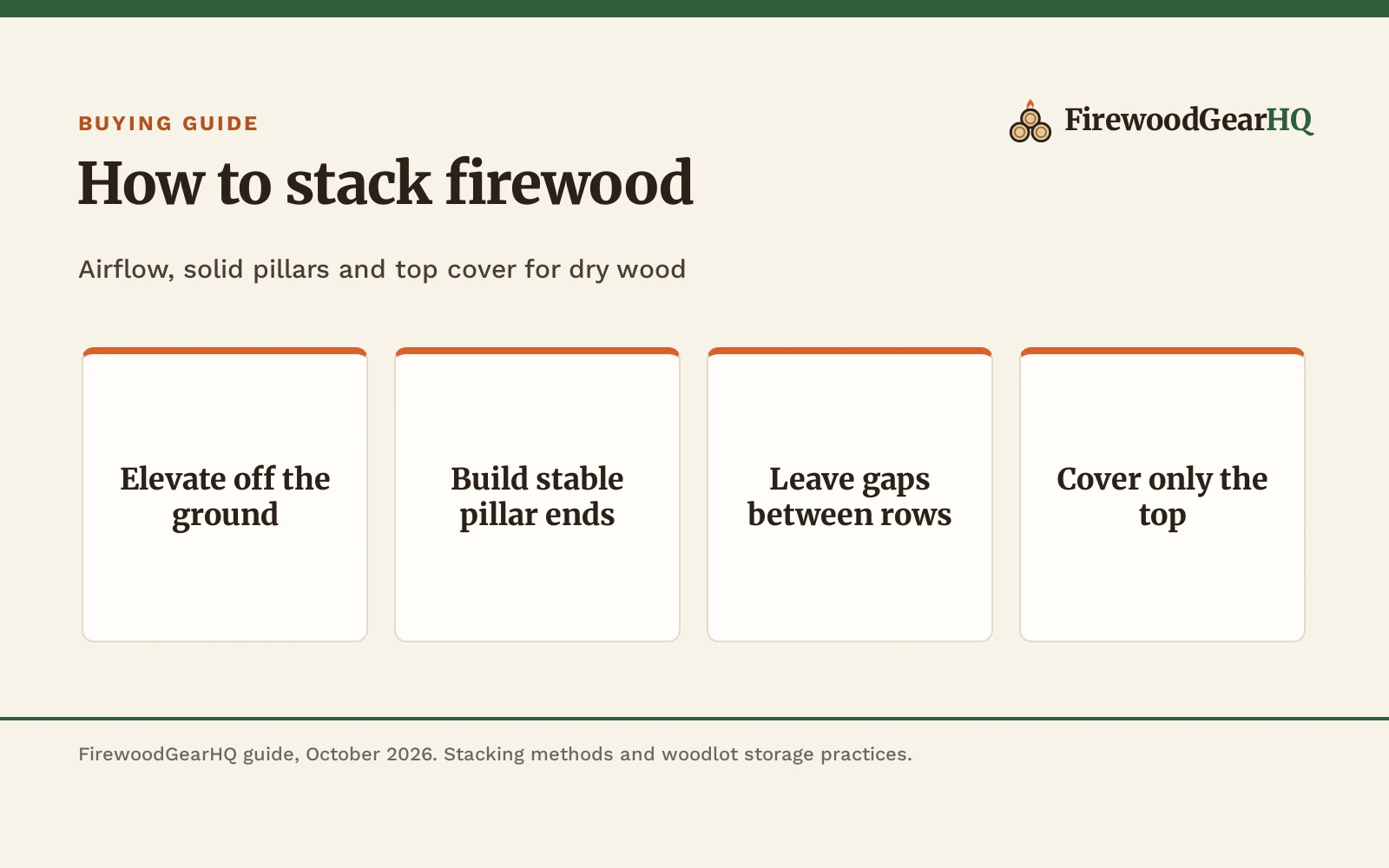
To know how to stack firewood properly, place split logs off the ground on a raised base, build stable crisscross pillar ends, and leave space between parallel rows so wind and sun can circulate. Keep the stack level and well-ventilated, covering the top of the pile while keeping air pathways open. Stacking firewood this way accelerates seasoning, sheds rain and snow, and prevents the pile from shifting or collapsing over time.
FirewoodGearHQ earns a commission when you buy through links on our product pages, at no extra cost to you. Read our affiliate disclosure.
The quick answer
The most reliable way to stack firewood for home heating is a parallel row stack supported by square end pillars. Choose an open, level location that catches prevailing winds and maximum sun exposure. Elevate the bottom course off bare soil using rails, pallets, or a dedicated log rack so rising ground dampness cannot rot the lowest logs. Stack split pieces in straight courses along each row, leaving small air spaces between logs while keeping generous open corridors between parallel rows for cross-ventilation. Cap the pile with a durable top cover that extends slightly past the wood to deflect rainfall while keeping the long sides open so moisture can evaporate.
Firewood stacking methods compared
| Method | Best application | Key advantages |
|---|---|---|
| Traditional row stack | Long property borders and fence lines | Simple to build, easy to measure, provides good airflow across long rows |
| Crisscross pillar stack | Freestanding rows | Self-supporting ends eliminate the need for fixed posts, walls or end supports |
| Holz Hausen (round stack) | Open fields and large yards with variable winds | Circular shape sheds rain naturally, resists high winds and holds large volumes |
| Elevated rack stack | Patios, porches and neat woodlot storage | Lifts wood completely off the ground and holds logs firmly in rigid frames |
Select a stacking method based on your available ground space, woodlot layout and how quickly you need the logs to dry.
How to stack firewood
Choose a level, well-drained site
Where you build a woodpile determines how quickly moisture leaves the wood. Select a firm, level location that receives direct sunlight throughout the day, preferably with a southern or western exposure. Avoid low-lying hollows where cold, damp air pools after rain. Keep the stack clear of dense brush and overhanging trees that drop wet leaves and restrict air movement. Align rows parallel to prevailing breezes so wind sweeps down the corridors between them to carry away evaporating moisture.
Elevate the bottom layer off bare soil
Never lay firewood directly on bare earth. Soil holds persistent moisture that wicks into seasoned or green logs, causing the bottom course to decay, grow mold and attract wood-boring insects. Use treated wooden rails, gravel beds, skids or elevated steel framing to create an air buffer above the ground. Raising the pile allows dry air to flow beneath the lowest logs, keeping the entire stack dry from bottom to top.
Build stable crisscross pillar ends
A woodpile needs rigid ends to prevent horizontal rows from tumbling outward. Unless your stack sits between fixed posts or a rigid storage framework, construct self-supporting pillars at each end using a crisscross technique. Lay parallel split logs side by side on the ground, then lay the next layer across them at right angles. Continue alternating orientations until the pillar reaches your desired stack height. These interlocking wooden columns act as bookends, holding the looser horizontal logs packed between them.
Orient bark for drying and weather protection
How you turn each split log influences both moisture release and weather resistance. On open woodpiles exposed to rain, placing logs with the bark facing up helps shed rainfall down the outer curve rather than letting water soak into the exposed wood grain. However, for stacks positioned under a protective roof or top cover, turning logs with the split wood facing up allows moisture to evaporate freely without being trapped beneath impermeable bark. On the lowest course resting on support rails, orienting the bark downward creates a protective barrier against rising ground humidity.
Leave open corridors between parallel rows
When stacking multiple cords of wood, avoid packing rows flush against each other. Pressing rows together blocks airflow and creates a damp microclimate in the center of the pile where mold thrives. Leave an open corridor between parallel stacks so wind sweeps freely between them. This gap ensures that sun warmed air pulls moisture from the split faces on both sides of every row.
Cover the top and leave the sides open
Protecting firewood from rain and snow is necessary, but sealing an entire stack under a non-breathable plastic tarp down to the soil is a mistake. Sealed tarps trap ground dampness and condensation inside the pile, creating a greenhouse effect that promotes rot. Outdoor stacks season most effectively when top covering protects the upper tier while sides remain exposed to breezes. If using a deeper protective drop cover, select one with built-in downward air vents or roll up the front and side flaps during dry periods so cross-ventilation is never blocked.
How to tell if a firewood stack is stable
A well-constructed woodpile should remain upright throughout months of wind, settling and drying. Check these key signs to verify stack stability:
- Base alignment: The bottom rails or rack legs rest firmly on level, compacted earth without sinking or rocking.
- Vertical plumb: The stack stands upright or leans very slightly inward toward the center, never outward toward walking paths.
- Tight end pillars: The crisscross pillar logs interlock firmly without loose joints or tilting blocks.
- Settling allowance: As logs lose moisture, the pile shrinks and shifts slightly, so loose wedges should be repacked to prevent gaps.
- Air corridors: Corridors between parallel rows remain open and clear of fallen debris so air circulates continuously.
- Moisture reduction: Sun and wind penetrate deep into the rows, allowing split faces to season until meter readings confirm they are ready for the stove.
The U.S. EPA Burn Wise program advises stacking firewood off damp ground with top protection and open sides to ensure fuel dries thoroughly for cleaner, hotter fires with less chimney smoke.
What happens when firewood is stacked improperly
Improper stacking ruins good firewood and creates safety hazards around the yard. Placing logs directly onto damp soil allows ground moisture to wick into the timber, rotting the bottom tiers and welcoming wood-boring insects. Stacking wood flush against an exterior wall traps dampness against home siding and restricts air movement, stalling the drying process. A poorly balanced pile or weak end support can give way under heavy snow or shifting weight, collapsing unexpectedly. When wood fails to dry because of restricted airflow, burning it produces weak heat, smoldering fires and heavy smoke. Unburned moisture carries volatile vapors up the flue, leading to stubborn creosote buildup inside chimney pipes that increases the risk of a dangerous flue fire. To prepare logs to manageable split sizes that stack neatly, use a splitting maul or splitting axe, or a log splitter for home use for larger cord volumes.
Firewood storage racks and bracket kits
While pallets and scrap timber work for rough yard stacks, manufactured steel racks and heavy-duty brackets offer rigid, dependable support. For outdoor storage that shields fuel from precipitation while maintaining bottom airflow, choosing the best firewood rack with cover provides a rigid, elevated foundation. The VIVOHOME 8 ft steel rack measures 8ft x 4ft x 13.8 inches with 1.2mm thickened steel tubes, a double powder-coated finish and a 2204 pounds shelf capacity rating, with the maker stating it can hold up to 1/2 cord off the soil. VIVOHOME also includes a cover measuring 8ft x 3.5ft x 24 inches constructed with 600D Oxford fabric; because the cover drops down the sides, its downward-facing air vents are essential to maintain airflow and prevent internal condensation. For smaller storage footprints, the CADUKE 6 ft metal rack provides a 1.9-inch elevated base to keep logs raised off damp ground, supported by 12 support legs; CADUKE lists it as a 1/4 cord holder rated for 880 lbs in its title, though its spec table lists a 400 pounds shelf capacity. BALIE SPACE lists an 8-feet stand that lifts logs 3.5 inches above the ground on 14 sturdy legs, though its title states 8 support legs. For custom pile dimensions, BALIE SPACE also supplies a set of 2 brackets for 2×4 lumber with 2 MM thick tube walls. For high-capacity storage, the Kendane 8FT rack uses 14 reinforced support legs and a 25mm thickened steel frame that the listing rates for 1500lbs capacity to hold 1/2 cord, with a finish that survives -30°F to 120°F. C-Hopetree lists a 4Ft rack with a 1-year warranty period that holds up to 800 pounds, adjusting from 32 inches across 2 sections to 48 inches across 3 sections.
Turn a stack's length, height and depth into full and face cords, and estimate how much wood a winter takes.
Frequently Asked Questions
How high can you safely stack firewood?
Keep freestanding firewood stacks at about chest height for stability. Taller stacks become top-heavy and risk toppling as the timber dries and settles. Taller piles require dedicated vertical posts or structural framework.
Should firewood be stacked bark up or bark down?
Both orientations serve practical purposes. When wood is protected by a top cover, stacking logs with the split face up and bark down allows moisture to evaporate quickly. On open, uncovered stacks or the top tier, placing bark facing up sheds rainfall. For the bottom tier on support rails, turning bark downward helps block ground moisture.
Should a firewood stack be covered completely?
No. Never wrap a firewood stack completely in plastic down to the soil. Completely wrapping a pile traps moisture and humidity inside, accelerating rot and mold growth. Cover only the top tier and leave the sides open so breezes circulate.
How far should a firewood stack be from a house?
Keep outdoor firewood stacks positioned away from house walls and foundation perimeters. Keeping wood away from the home prevents wood-boring insects from entering living spaces and ensures wind can move around the woodpile. For staging fuel near hearths, read our guide on whether you can bring firewood indoors.
How do you keep a firewood stack from falling over?
Establish a firm, level base off bare earth, build interlocking crisscross pillars at both ends, and pitch horizontal rows slightly inward toward the center rather than outward. Repack any loose pieces as the wood dries and shifts.
Can you stack firewood directly on the ground?
Stacking directly on bare soil should be avoided. Soil dampness transfers into the lower logs, promoting fungal decay and drawing termites and beetles. Always elevate the bottom tier using poles, skids, pallets or metal racks.
Related guides
Explore our complete firewood storage resource hub for additional yard and hearth setups. To speed up drying times, read our guide on how to season firewood fast and review how long does firewood take to season. Verify that your split fuel is ready for the firebox with the best firewood moisture meter, and learn what moisture content firewood should be along with how to use a firewood moisture meter. For covered yard storage, compare options in our firewood shed outdoor with roof guide, firewood rack outdoor with cover review, and cheap firewood rack roundup. Protect existing storage frames with a cover for firewood storage rack, or consider metal wood racks outdoor for firewood and a firewood rack for porch. If you are keeping kindling close to the hearth, browse indoor firewood rack ideas, the best indoor firewood rack, an inside wood rack for firewood, and the best fireplace log holder. When bucking and processing your seasonal timber, choose the best chainsaw for firewood and keep your cutting teeth sharp with the best chainsaw sharpener.
About the author
The FirewoodGearHQ editorial team researches firewood and wood heating equipment from published specifications, ratings and warranty terms, and scores every pick the same way. We do not run our own product trials.