How to Season Firewood Fast: A Step-by-Step Drying Guide
How to season firewood fast by splitting pieces small, elevating stacks off wet ground, maximizing airflow and sun, and protecting the pile from rain.
 By FirewoodGearHQ Editorial
Updated October 9, 2026
By FirewoodGearHQ Editorial
Updated October 9, 2026
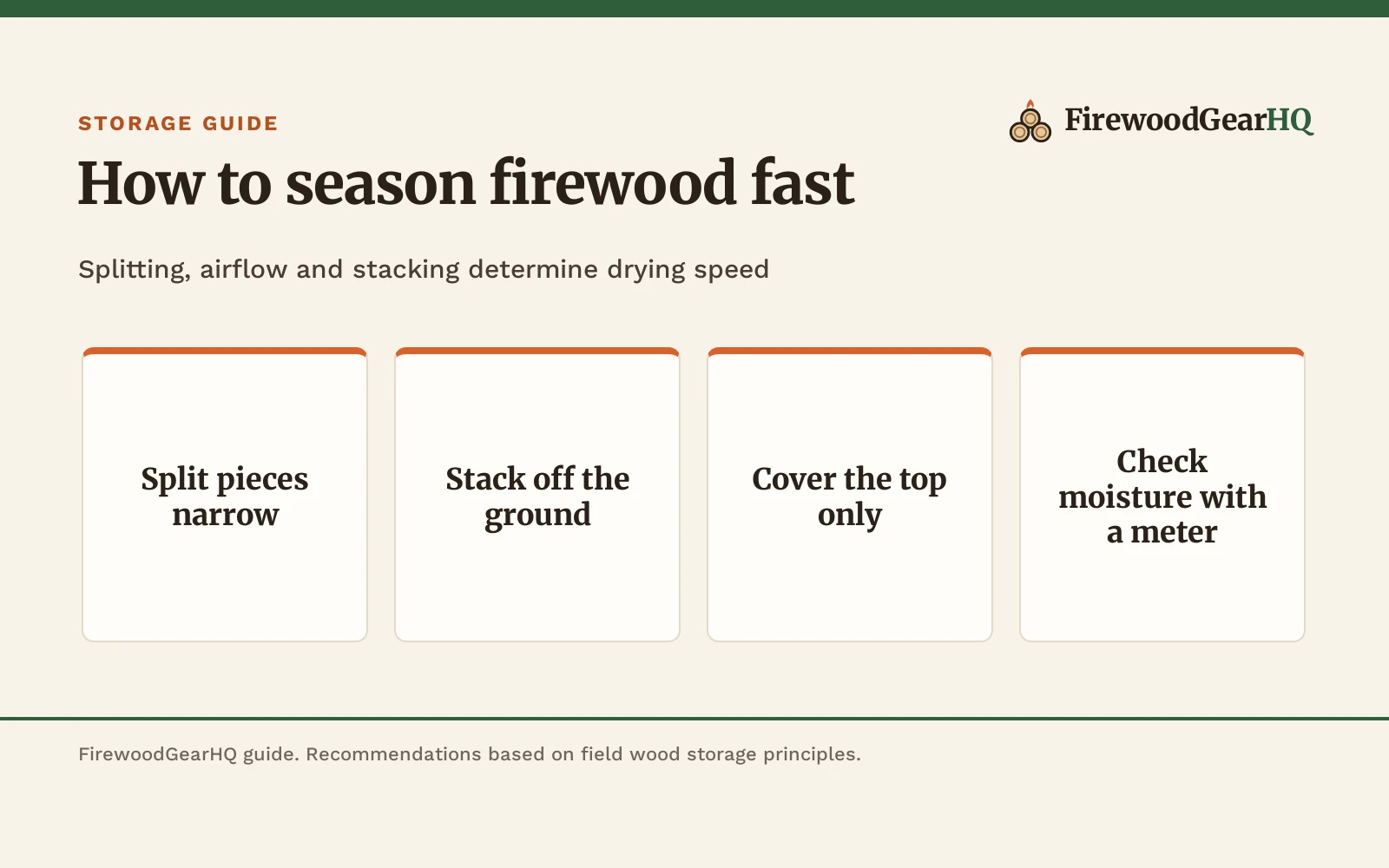
Learning how to season firewood fast comes down to removing moisture from green wood through prompt splitting, elevated stacking, and steady air circulation. Fresh-cut firewood contains high moisture trapped behind protective bark, making green logs difficult to light and prone to heavy, smoldering smoke. To accelerate drying, split logs into narrower pieces, elevate stacks off damp ground on a dedicated rack or pallets, position the pile for exposure to sun and wind, and cover only the top surface while leaving the sides open. These practices allow moisture to evaporate rapidly through the cut ends and split faces.
FirewoodGearHQ earns a commission when you buy through links on our product pages, at no extra cost to you. Read our affiliate disclosure.
How to season firewood fast
Seasoning is an evaporation process. Living trees carry sap and water throughout their cell structure. Left as uncut rounds with bark intact, logs retain moisture because tree bark prevents water loss. The fastest way to lower moisture content is to disrupt that barrier immediately and maximize airflow across exposed wood fibers.
Many wood burners ask whether it is easier to split wood green or seasoned. For many common species like oak and maple, splitting green wood shortly after felling is easier before wood fibers dry and toughen. Splitting early also starts the seasoning process immediately rather than letting uncut rounds sit damp on the ground. Once split, wood stacked in rows oriented in the direction of prevailing breezes dries far faster than wood piled in disorganized heaps.
Fast seasoning comparison by wood category
| Wood Category | Drying Tendencies | Fast Seasoning Strategy |
|---|---|---|
| Softwoods (Pine, Fir, Spruce) | Low density and porous grain allow moisture to leave rapidly. | Split into medium pieces, elevate off the ground, and keep top covered. |
| Light hardwoods (Ash, Birch, Cherry) | Moderate density with lower initial sap volume than heavy species. | Split promptly, stack in open sunlight, and protect from rain. |
| Dense hardwoods (Oak, Hickory, Beech) | High density slows water migration from the center to split faces. | Split into narrow pieces and stack in rows oriented in the direction of prevailing wind. |
| Kiln-dried packaged wood | Mechanically dried under controlled heat for immediate burning. | Store off damp ground under shelter to prevent reabsorbing humidity. |
See our guide on how long to season firewood to compare drying times across species.
Techniques that accelerate firewood seasoning
Split rounds promptly and split them small
Wood loses moisture through its split faces and cut end grain. Large rounds left intact take far longer to dry because water must travel through dense wood to escape. When logs are split into narrower pieces, the surface area exposed to moving air increases substantially.
Commercial firewood producers reflect common split dimensions: Firewood Central supplies 16-inch firewood splits, and Old Potters also packages 16-inch logs, sized to fit standard home fireboxes. While cutting wood shorter exposes more end grain to speed evaporation, 16 inches remains standard for stove compatibility and stack stability. Within that length, splitting pieces into narrower wedges dramatically increases exposed surface area.
Split green logs with a balanced splitting maul or a sharp splitting axe. For difficult rounds, pair a maul with a steel splitting wedge. If processing multiple cords, using the best log splitter for home use saves labor and produces uniform split sizes. Always follow log splitter safety rules: enforce a single-operator zone, keep hands clear of the wedge, and wear eye protection. When swinging a maul, verify a clear swing zone free of bystanders and overhead obstacles.
Elevate firewood off damp ground
Never stack green firewood on bare ground. Soil transfers moisture directly into bottom logs, causing decay and preventing drying. Elevating the pile allows dry air to circulate underneath the stack, drawing moisture up and out.
Stack wood on pallets or a dedicated firewood rack with cover. An elevated outdoor firewood rack keeps bottom logs suspended above damp soil and snowmelt. Tubular steel storage such as a metal wood rack or a budget-friendly cheap firewood rack provides rigid support that resists ground moisture.
Maximize sunlight and crosswind exposure
Sun and wind drive evaporation. Solar heat warms wood fibers and pushes moisture toward the surface, while breezes carry water vapor away before it recondenses. Stacking in a shaded, stagnant area slows drying drastically.
Position woodpiles along an open south or west exposure receiving full sunlight. Orient the rows in the direction of prevailing breezes so air flows freely down the alleys between stacks. If stacking multiple rows, leave generous space between parallel rows so wind circulates past every exposed log end and split face.
Cover the top while keeping sides open
Covering an entire woodpile with a tarp traps evaporating moisture inside the stack. This creates a humid environment where trapped vapor condenses back onto wood, causing mold and sluggish drying.
Cover only the top surface using a fitted cover for firewood storage racks or metal roofing sheets weighted down securely. Extend the cover just far enough to shed rain past the top row while leaving vertical sides completely open to moving air. A dedicated firewood shed outdoor with roof provides overhead protection with slatted sides designed for airflow.
Cut and stack early in the spring
Seasoning depends on warm temperatures and long daylight hours. Splitting and stacking in early spring gives wood the entire summer drying window. Wood cut during late autumn dries very slowly because cold air holds minimal moisture.
When cutting logs with a chainsaw, follow OSHA logging safety practices: wear chaps, a helmet with face shield and hearing protection, gloves, and protective boots. Cut with the best chainsaw for firewood, sharpen cutters regularly with the best chainsaw sharpener, and never cut alone.
How to tell when firewood is properly seasoned
Elapsed time is only an estimate. Check these physical indicators and confirm with an instrument before burning:
- Moisture meter reading: Split a log to expose fresh interior wood and press meter pins firmly into the center parallel to the grain. Check our reviews of the best firewood moisture meters and read how to use a firewood moisture meter to master reading technique. Learn what moisture content firewood should be before heating your home.
- Radial end checks: Capillary shrinkage causes cracks spreading outward from the center across the end grain. Visible checks indicate substantial internal drying.
- Weight: Water adds significant mass. Seasoned pieces feel noticeably light compared to heavy green splits of similar dimensions.
- Sound: Knock seasoned pieces together. Dry wood produces a sharp, resonant clack, whereas wet wood makes a dull thud.
- Bark: Bark loosens and falls away easily as wood shrinks underneath.
The U.S. EPA Burn Wise program advises burning seasoned firewood rather than green wood for cleaner heat, higher efficiency, and reduced smoke.
What happens if you burn unseasoned firewood
Burning unseasoned wood wastes heat energy boiling off internal moisture. As steam mixes with unburned wood gases, flue temperatures drop, causing volatile compounds to condense inside the chimney as flammable creosote.
Heavy creosote accumulation creates serious chimney fire hazards. Review what creosote is and how to prevent it to safeguard your flue. Wet wood also causes blackened stove glass and indoor smoke spillage. A magnetic stove thermometer monitors flue temperature to verify efficient burning.
Always observe manufacturer clearances from combustible walls, maintain smoke and carbon monoxide alarms on every living level, and schedule an annual chimney inspection with a certified sweep. Check our wood stove safety checklist before lighting fires. When choosing a heater, see the best wood stove for heating a house.
Kiln-dried and store-bought wood
When dry firewood is needed immediately without waiting for natural seasoning, store-bought packaged options provide a ready alternative. Commercial firewood producers use heated kilns to reduce moisture under controlled conditions, while specialized makers offer manufactured logs and resin-rich kindling.
For example, Firewood Central lists Pennsylvania hardwood splits dried to 15% moisture or less, packaging 14 to 18 evenly sized 16-inch splits into a 38-pound bundle. Firewood Central offers pure hickory and a mixed blend of oak, maple, hickory, cherry, walnut, and ash. Old Potters lists kiln-dried hickory in 16-inch logs, packaging approximately 1.5 cubic feet weighing 38 to 45 pounds. Solo Stove packages precut juniper firewood in 0.5 cubic foot bundles containing 6 to 8 logs. In manufactured wood logs, Green Mountain Firewood lists bundles of 8 logs with less than 4% moisture and heat output rated at 8852 BTU per pound.
For rapid fire starting without standard kindling prep, makers supply resinous pine fatwood harvested from stumps. Better Wood Products lists 25-pound boxes of fatwood sticks split to approximately 8 inches in length and 0.75 inches in diameter. Billy Buckskin provides 50-pound boxes of sticks around 8 inches long with thickness ranging from 0.3 to 1.25 inches. Greenes Fence supplies 50-pound boxes of natural pine kindling, and EasyGoProducts offers fatwood sticks in 10-pound boxes with a 30-day refund policy. While packaged cordwood and starters cost more than wood you split and season yourself, they provide immediate burning performance.
Turn a stack's length, height and depth into full and face cords, and estimate how much wood a winter takes.
Frequently Asked Questions
What is the fastest way to season firewood?
The fastest way to season firewood naturally is to split logs into smaller pieces immediately after cutting, elevate them off damp soil on pallets or a rack, stack in a sunny and windy spot, and cover only the top of the pile while leaving sides open to breezes.
Can green firewood be seasoned in a single summer?
It depends on wood species, split dimensions, and local weather. Lighter softwoods like pine or fast-drying hardwoods like ash can sometimes reach seasoned condition over a single hot, breezy summer if split into narrow pieces and stacked in full sun. However, dense hardwoods like oak almost always require additional drying seasons. Always confirm dryness with a moisture meter rather than relying on calendar time.
Should firewood stacks be covered with a tarp?
Cover only the top surface to shed rain and snow. Never wrap a tarp around the sides of a stack, because enclosing the pile traps evaporating moisture and causes mold and decay.
Does splitting wood make it dry faster?
Yes. Splitting exposes interior grain and increases surface area, allowing internal moisture to escape rapidly. Unsplit rounds retain water behind waterproof bark far longer.
Does firewood continue to dry during winter?
Drying slows significantly during winter because lower temperatures reduce evaporation rates and solar radiation is limited. While some surface drying can occur in dry, breezy winter conditions, the bulk of internal moisture loss takes place during warm spring and summer weather.
How can you tell if firewood is dry enough without a meter?
Look for radial checks across cut ends, a light hollow feel, weathered gray end grain, loose bark, and a sharp ringing sound when pieces are knocked together. A moisture meter provides the most dependable verification.
Related guides
Explore our complete firewood storage hub, and compare the best firewood racks with covers and outdoor firewood racks with covers. Protect your woodpile with a durable cover for firewood storage racks, build permanent shelter with a firewood shed outdoor with roof, or select tubular framing from our guide to metal wood racks outdoor for firewood and budget-friendly cheap firewood racks. For porch setups, see the firewood rack for porch. Keep kindling and logs organized hearthside with the best indoor firewood racks, an inside wood rack for firewood, or a heavy-duty best fireplace log holder, and browse indoor firewood rack ideas. Before bringing wood indoors, read can you bring firewood indoors.
About the author
The FirewoodGearHQ editorial team researches firewood and wood heating equipment from published specifications, ratings and warranty terms, and scores every pick the same way. We do not run our own product trials.