How to Use a Firewood Moisture Meter: Step-by-Step Guide
Learn how to use a firewood moisture meter step by step, where to probe split logs, how to interpret moisture readings and how to ensure clean burning in your stove.
 By FirewoodGearHQ Editorial
Updated October 9, 2026
By FirewoodGearHQ Editorial
Updated October 9, 2026
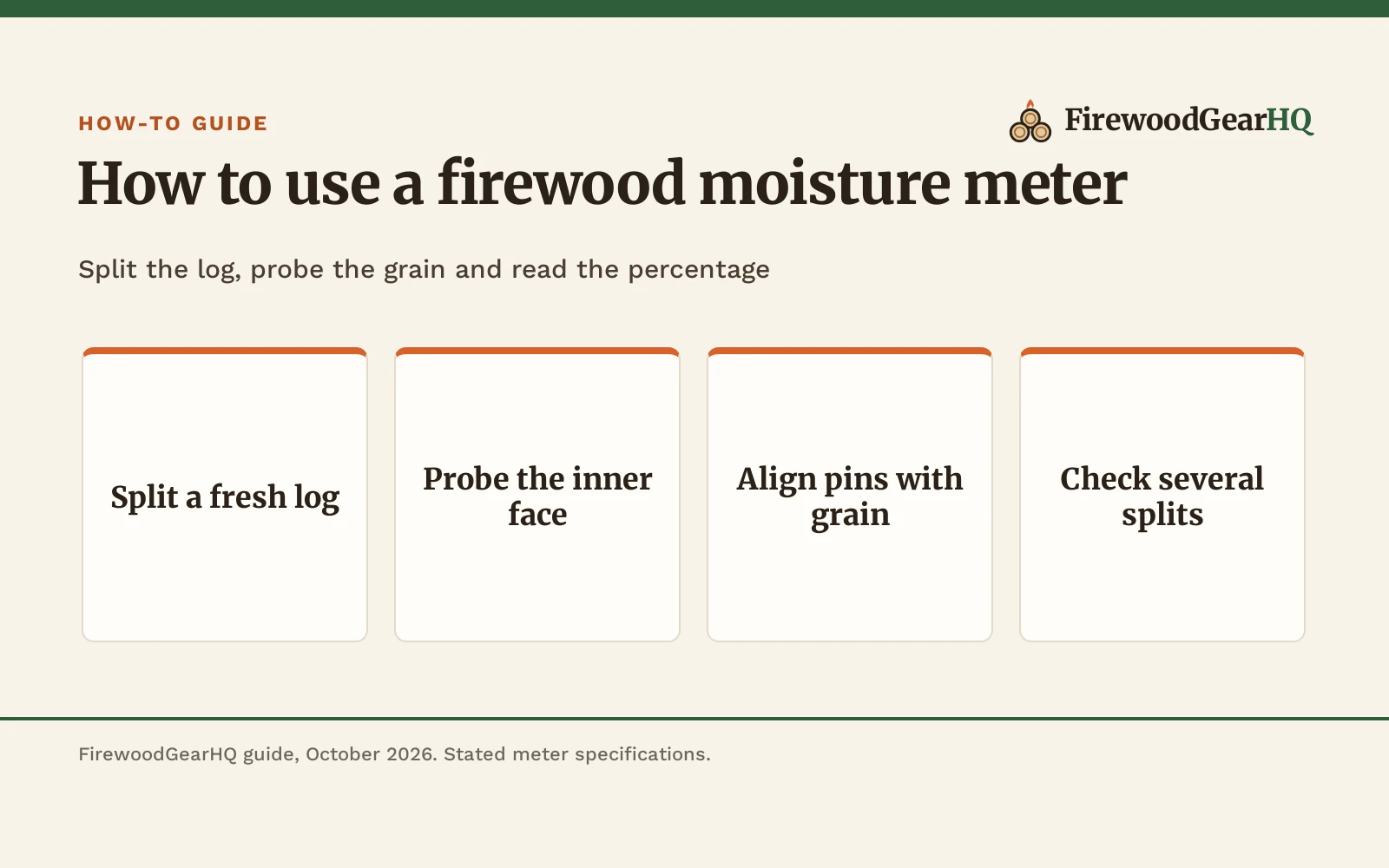
Learning how to use a firewood moisture meter requires splitting a log down the middle to expose fresh interior wood, selecting wood mode, and firmly pushing the contact pins into the split face along the wood grain. Read the moisture percentage on the digital screen: seasoned firewood ready for your stove displays a low moisture percentage, while logs with elevated readings require further drying. Checking several split pieces across your woodpile confirms that your logs are seasoned and ready to burn cleanly.
FirewoodGearHQ earns a commission when you buy through links on our product pages, at no extra cost to you. Read our affiliate disclosure.
The quick answer
Using a wood moisture meter requires checking a freshly split surface rather than the outside bark or weathered end grain. The exterior of a log dries in the sun and wind even when the interior remains saturated, while rain can wet the outside of seasoned wood. Split a log from your pile, power on your pin meter, select the wood group if your model provides species calibration, and firmly press the contact pins into the unexposed grain. Individual meters use different indicators to communicate moisture levels. For example, the coczow PM6821A listing classifies wood moisture readings into three defined brackets: low moisture at 14.8% or less, medium moisture from 14.9% to 20.4%, and high moisture at 20.5% or above. For that model, wood registering in the high range indicates that logs should remain stacked to season further before burning.
The specifications below outline stated measurement scales, modes and accuracy ratings from manufacturer reference listings. Use these checkable figures to understand what digital moisture meters report.
Firewood moisture meter reading reference
| Model | Stated measurement range | Stated accuracy or brackets | Notes |
|---|---|---|---|
| coczow PM6821A | 2.0% – 40.0% | Low: ≤14.8%, Medium: 14.9%~20.4%, High: ≥20.5% | Stated auto shut-off after 5 minutes |
| Prexiso PMX-57A | 0% to 57% | Stated ±1 degree temperature accuracy | 7 calibration scales stated |
| Klein Tools ET140 | Not stated | 9 LED bars for moisture range | Pinless sensor senses up to 3/4-Inch deep |
| Povlen MT510-Y | Not stated | ±4% measurement accuracy | 4 scanning modes stated |
| RDINSCOS MT19B | Not stated | 0% display on dry lumber | Replaceable contact pins |
Refer to these manufacturer figures when assessing your display readings. Confirming your firewood is dry before bringing it inside protects your hearth and your chimney.
How to use a firewood moisture meter
Split a log to expose fresh interior wood
Never take a reading on outside bark, weathered wood surfaces, or cut ends. The exterior of firewood dries out rapidly in ambient wind and sunlight, creating a false impression that the entire log is seasoned. Conversely, a passing rain shower can wet the surface while the core remains dry. Splitting a log exposes the center of the wood where trapped moisture resides. Taking your measurement on this fresh split face reveals the true moisture condition of the piece.
Power on the meter and select wood calibration mode
Remove the protective probe cap and turn on your device. Digital moisture meters frequently offer selectable modes for different building materials and wood groups. For example, the Bosch UniversalHumid listing provides two groups of wood on its selection scale, allowing users to match the tool to specific wood types. The Povlen MT510-Y listing features 4 scanning modes to separate wood from masonry surfaces, while the Prexiso PMX-57A listing includes 7 calibration scales. Set your tool to wood mode so the internal microprocessor applies the correct calibration scale for wood density.
Push the contact pins firmly into the grain
Align the pins with the direction of the wood grain rather than across it. Electric current travels along wood fibers more consistently than across cell walls, producing a steadier reading. Press the pins firmly into the fresh split face. The RDINSCOS MT19B listing notes that users should insert pins deep for best contact, ensuring complete contact with the lumber being measured. Keep the probes seated steadily until the reading registers.
Read the percentage and check the indicator
Hold the pins firmly in place while the digital readout stabilizes. Some digital meters feature color-coded alerts to assist with reading interpretation. For instance, the coczow PM6821A listing includes a three-color backlit display that indicates whether its reading falls in its low, medium, or high range. When checking logs, a lower percentage indicates seasoned wood ready for burning, whereas elevated percentages signal that wood retains too much moisture and requires more seasoning time in the stack.
Sample multiple logs across the woodpile
A single log does not represent the moisture level of an entire woodpile. Wood stacked near the top and outside edges of a rack dries faster than pieces nested deep in the center or along the bottom row. Select several logs from different sections of your wood storage rack, split each one open, and check the fresh face. Consistent readings across multiple samples confirm that your firewood supply is dependable and ready for heating season.
How to get accurate moisture readings
To avoid false readings and ensure your wood burns safely, follow these essential measuring practices:
- Measure at room temperature when possible: Frozen logs show artificially low moisture readings because ice conducts electrical current differently than liquid water. Bring sample splits indoors to thaw before measuring.
- Always measure freshly split faces: Exposed end grain and weathered log surfaces dry out in the wind and sun long before the center of the log loses its moisture.
- Drive pins parallel to the grain: Electrical conductivity flows along the length of wood fibers, giving more consistent readings than inserting across the grain.
- Watch for zero readings on dry stock: As the RDINSCOS MT19B listing highlights, extremely dry wood may show 0% on digital screens when moisture drops below measurable limits.
- Keep pin contacts clean: Pitch, sap and dirt on probe tips create electrical resistance that skews digital readings. Wipe the pins clean after checking resinous softwoods like pine.
- Protect battery life: Meters with automatic power management, like the coczow model that automatically powers off after 5 minutes of inactivity, help prevent drained batteries when working around the woodpile.
A moisture meter takes the guesswork out of woodpile management, ensuring your fires burn with maximum heat output and minimal smoke.
What happens if you burn wet firewood
Feeding unseasoned firewood into a stove or fireplace causes immediate performance problems and creates long-term safety hazards. High-moisture wood requires tremendous thermal energy simply to boil off trapped water before the cellulose can combust. Instead of producing warmth for your home, heat gets lost out the chimney as steam. The fire smolders at low temperatures, producing dense smoke packed with unburned volatile compounds.
As that cool, unburned smoke travels up the chimney flue, it condenses along the cold pipe walls to form creosote. Creosote is a flammable tar that builds up over time and presents a severe chimney fire hazard. Smoldering wet wood also coats ceramic door glass in black soot. Pairing your moisture checks with a stove thermometer helps you monitor operating temperatures and confirm that your flue stays hot enough to minimize creosote formation. Once seasoned wood burns efficiently, distributing that heat with the best wood stove fan circulates warmth throughout your living space without requiring electrical outlets. If you are planning an upgrade to your primary heating setup, our guide to the best wood stove for heating a house compares high-efficiency freestanding options.
Pin moisture meters versus pinless moisture meters
Choosing between pin-type and pinless instruments depends on how and where you measure your wood. Pin moisture meters use two sharp metal probes that penetrate the wood surface to measure electrical resistance between the pins. Pin models are the standard choice for firewood because splitting a log provides rough, unplaned surfaces where sharp pins make firm contact. The coczow PM6821A listing and Prexiso PMX-57A listing both utilize two stainless steel probes to penetrate wood fibers directly.
Pinless moisture meters, by contrast, use electromagnetic sensor pads to measure moisture without leaving holes. The Klein Tools ET140 listing specifies pinless detection up to 3/4-Inch deep across building materials and lumber. While pinless meters excel on finished furniture and smooth boards where cosmetic pinholes must be avoided, they require flat, smooth contact to measure accurately. On rough, irregular firewood splits, pin-type meters remain the practical and dependable choice for woodlot owners.
Turn a stack's length, height and depth into full and face cords, and estimate how much wood a winter takes.
Frequently Asked Questions
Where is the best place to measure a piece of firewood?
Always measure on a freshly split interior face. Splitting a log exposes the core where moisture lingers longest. Probing weathered exterior ends or outside bark gives misleading readings because surface layers dry or absorb ambient humidity faster than the interior.
Can I use a moisture meter on frozen firewood?
Frozen wood does not provide accurate moisture readings on electrical resistance meters. Ice conducts electricity differently than liquid water, causing digital meters to report falsely low numbers. Bring a split sample piece inside and let it reach room temperature before probing.
Should the pins go across the grain or with the grain?
Insert the pins parallel to the wood grain. Wood fibers transport electrical current along their length more readily than across cell walls. Aligning your meter pins with the grain yields more reliable and repeatable measurements.
What should I do if my firewood readings are too high?
If your moisture meter shows elevated moisture readings indicating that wood is not yet seasoned, stack the wood off the ground in a sunny, breezy location with only the top of the pile covered. Leave the sides open to airflow. Read our guide on how long to season firewood to estimate when your species will be ready to burn.
Is a pin or pinless moisture meter better for firewood?
Pin meters are better suited for firewood. Firewood splits have uneven, rough surfaces that prevent pinless electromagnetic pads from making full contact. Sharp metal pins press directly into split wood grain regardless of surface texture.
Can I bring freshly checked firewood directly indoors?
Store only small amounts of seasoned firewood indoors right before burning. Stacking large quantities inside can introduce pests and excess humidity into your living space. Review our guide on whether can you bring firewood indoors for safe indoor staging practices.
Related guides
See our stove accessories hub for more hearth gear guides, including the best wood stove fan and the best stove thermometer. If you are shopping for a dedicated meter, read our comparison of the best firewood moisture meters. For seasoning timelines and woodpile management, consult our guide on how long to season firewood. Also see our can you bring firewood indoors guide. Also see our how to start a fire in a wood stove guide. Also see our how to keep a wood stove burning all night guide. Also see our why does my wood stove glass turn black guide. Also see our why does my wood stove smoke when i open the door guide. Also see our wood stove safety checklist.
About the author
The FirewoodGearHQ editorial team researches firewood and wood heating equipment from published specifications, ratings and warranty terms, and scores every pick the same way. We do not run our own product trials.