How to Choose a Wood Stove: Sizing, Heating Capacity and Buying Guide
How to choose a wood stove for your home or cabin, covering heating area sizing, firebox dimensions, log length, efficiency ratings, and safe clearance requirements.
 By FirewoodGearHQ Editorial
Updated October 9, 2026
By FirewoodGearHQ Editorial
Updated October 9, 2026
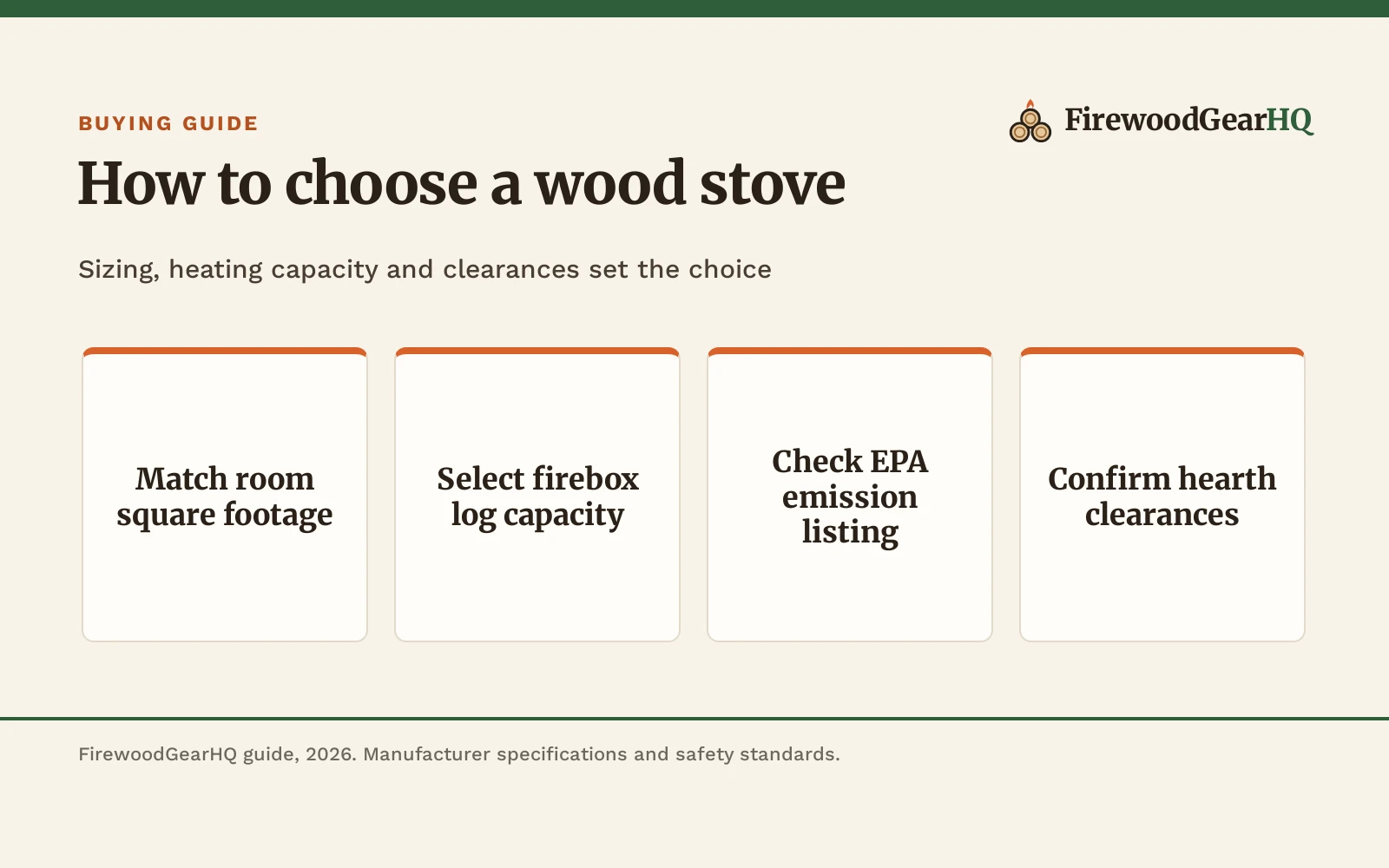
Learning how to choose a wood stove requires matching heating coverage to your living space, selecting a firebox that fits common split log lengths, verifying EPA emissions certification, and planning clearances to combustibles. A stove sized too large causes smoldering when damped down, while an undersized model struggles to warm the room. Sizing your space, selecting plate steel or cast iron, and verifying flue requirements ensure safe heating.
FirewoodGearHQ earns a commission when you buy through links on our product pages, at no extra cost to you. Read our affiliate disclosure.
The quick answer
Measure the square footage of the area you intend to heat. For small rooms or cabins up to 750 sq. ft., a compact stove provides warmth without overheating. Mid-sized zones between 1000 and 1,200 sq ft need balanced output and steady burn cycles. Large spaces up to 2,500 sq. ft. require higher output and longer log capacity. Verify EPA-certified status, confirm required clearances, and schedule annual chimney inspections.
Wood stove capacity and heating chart
| Stove model and brand | Stated heating coverage | Stated heat output | Maximum log length | Firebox build and features |
|---|---|---|---|---|
| Cleveland Iron Works Mini Wood Stove | 750 sq. ft. | 26631 british thermal units | 11-in | Carbon steel, cast iron door with viewing window, brick-lined firebox |
| Comfort Glow Cast Iron Stove (CGWS900) | 900 Sq. Ft. | Not stated | 22″ logs | Cast iron build, cooking surface, 6″ flue collar |
| Stepnext Cast Iron Stove with Oven | 1000 sq ft | Not stated | Not stated | Cast iron top, baking oven, brick-lined firebox, 5.1″ flue with 5.9″ adapter |
| Comfort Glow Solid Fuel Stove (CGWS1500) | 1,200 sq ft | 68,000 BTUs | 18″ | Plate steel with cast iron door, firebrick lined, mobile home approved |
| Canyon Lodge Medium Wood Stove | 2,500 sq. ft. | 58030 british thermal units | 18″ | Brick-lined firebox, cast iron door, 6-inch flue (spec table lists 2,000 sq. ft. and 16 inches) |
Use these manufacturer specifications to compare capacities. Always size a stove to your primary living zone rather than whole-structure square footage.
How to choose a wood stove
Calculate your room heating area
The primary factor is the square footage of the heated space. A compact stove like the Cleveland Iron Works heats up to 750 sq. ft., fitting workshops or small cabins. A mid-size model like the Comfort Glow CGWS1500 covers up to 1,200 sq ft for common living zones. For large spaces, stoves like the Canyon Lodge rate up to 2,500 sq. ft. (with 2,000 sq. ft. noted in its spec table). For standalone residential recommendations, see our guide on the best wood stove for heating a house.
Check firebox dimensions and log length
Firebox volume sets fuel capacity and reload frequency. Firewood is often split to lengths around 16 inches. Stoves accepting 18″ logs, such as the Comfort Glow CGWS1500 or Canyon Lodge (which states 18″ in bullets and 16 inches in its table), take common cordwood without re-cutting. Wide designs like the Comfort Glow CGWS900 fit 22″ logs despite a compact 900 Sq. Ft. rating, while small models like the Cleveland Iron Works take logs up to 11-in. Review our guide on the best wood for a wood stove.
Select plate steel or cast iron construction
Stoves are built from welded plate steel, cast iron, or both. Plate steel heats up rapidly, delivering quick warmth after lighting; models like the Comfort Glow CGWS1500 pair a plate steel body with a cast iron door and firebrick lining. Cast iron stoves, like the Comfort Glow CGWS900 or Stepnext stove with oven, absorb heat slowly and radiate warmth after flames die down. Weight also affects floor support: Cleveland Iron Works weighs 120.2 pounds, Stepnext weighs 92.6 lbs, and Canyon Lodge weighs 372.6 pounds. Compare options in wood burning stove vs insert.
Verify EPA certification and clean combustion
Residential stoves must meet clean air standards set by the Environmental Protection Agency. EPA-certified stoves use secondary combustion to re-burn smoke particles before exhaust leaves the firebox. The Comfort Glow CGWS1500, Comfort Glow CGWS900, and Canyon Lodge are EPA-certified. Clean combustion protects flue passages and viewing glass. Always burn seasoned wood only. See our guide on what is creosote and how to prevent it, and check moisture with the best firewood moisture meter.
Plan clearances to combustibles and safety alarms
Every stove requires certified clearance distances to combustible walls, ceilings, and floors. Follow the dimensions on the appliance label and local building codes (the Canyon Lodge is ETL Listed). Install working smoke alarms and carbon monoxide alarms on every living level. For heat circulation, the Comfort Glow CGWS1500 supports an optional blower (#29-6013). Compare airflow options in stove fan vs blower or see the best wood burning stove with blower.
How to evaluate wood stove build and efficiency
When comparing models, examine these key build elements:
- Emissions listing: EPA-certified status ensures efficient combustion, while models like the Comfort Glow CGWS1500 also add mobile home approval.
- Firebrick lining: Refractory firebrick lines quality fireboxes, including the Cleveland Iron Works, Comfort Glow, and Canyon Lodge, protecting exterior metal and storing heat.
- Airtight door seal and window: Gasketed doors prevent air leaks, while ceramic glass windows (such as 9.5″(W) x 10.5″(H) on the Cleveland Iron Works) let you monitor flames without opening the door.
- Ash removal system: Ash drawers or plugs on the Canyon Lodge and Cleveland Iron Works simplify daily cleanout.
- Flue collar dimensions: Confirm the collar fits your chimney. Comfort Glow and Canyon Lodge use 6-inch (or 6″) collars, while Stepnext uses a 5.1″ flue with a 5.9″ adapter.
- Warranty protection: Check coverage terms: Comfort Glow provides a 1-year warranty on the CGWS900 and a 2 Year warranty on the CGWS1500, while Canyon Lodge and Cleveland Iron Works provide a 5 Year Limited warranty.
The U.S. EPA Burn Wise program advises burning seasoned wood only in certified stoves to maximize efficiency and reduce creosote.
What happens if you size a stove wrong
An oversized stove rated for 2,500 sq. ft. in a compact room forces you to damp the fire down to prevent overheating. In non-catalytic stoves, choked airflow causes smoldering, low flue temperatures, and rapid creosote buildup, increasing chimney fire hazards and blackening glass. See our guide on why does my wood stove glass turn black.
An undersized stove rated for 750 sq. ft. in a large home must be run constantly at peak output, stressing steel seams, warping cast iron, and wasting fuel. Monitor flue heat with the best stove thermometer or best wood stove thermometer, and follow our wood stove safety checklist.
Catalytic vs non-catalytic wood stoves
Buyers choose between non-catalytic and catalytic designs. Non-catalytic stoves use firebox baffles and secondary air tubes to burn wood gases. They are simple to run and require no catalyst maintenance, but need higher temperatures for clean combustion. Catalytic stoves route smoke through a honeycomb catalyst that lowers gas ignition temperatures, enabling clean, low-output burns at reduced air settings without heavy creosote. To extend burn duration, read how to keep a wood stove burning all night.
Note that the federal biomass stove tax credit has expired and is unavailable for new installations. See our review of the wood stove tax credit.
Estimate the heat output and stove size class for your space from square footage, insulation and climate.
Frequently Asked Questions
What size wood stove do I need?
Match heating capacity to your primary living space. Small stoves rated for 750 sq. ft. (like Cleveland Iron Works) suit single rooms. Mid-size stoves rated for 1,200 sq ft (like Comfort Glow CGWS1500) heat standard living areas. Large stoves rated up to 2,500 sq. ft. (or 2,000 sq. ft. in spec tables, like Canyon Lodge) suit spacious homes.
What log length should a wood stove accommodate?
Firewood is commonly cut to 16 inches. Fireboxes accepting 18″ logs (such as Comfort Glow CGWS1500 or Canyon Lodge) or 22″ logs (such as Comfort Glow CGWS900) easily fit standard cordwood. Compact fireboxes accepting logs up to 11-in (like Cleveland Iron Works) require shorter split wood.
Is cast iron better than plate steel for a wood stove?
Neither is universally superior. Plate steel heats rapidly and warms a room quickly after lighting. Cast iron absorbs heat slowly and radiates warmth long after coals die down. Many stoves combine plate steel bodies with cast iron doors and firebrick lining.
Can I install a wood stove myself?
Installations should be completed by a CSIA or NFI certified professional. Safe operation demands exact clearances to combustibles, proper hearth floor protection, and a correctly drafted flue complying with local building codes.
Do I need a blower or a wood stove fan?
A heat-powered stove fan circulates warmth from the stove top without electricity. An electric convection blower, such as the optional #29-6013 blower for Comfort Glow stoves, mounts to the rear channel to move higher air volume across large spaces.
How often should a wood stove chimney be inspected?
Have chimneys inspected and swept annually by a CSIA certified professional, and check flues regularly for creosote. Burning dry wood and maintaining proper flue temperatures minimize buildup. See how often should you clean your chimney with a wood stove.
Related guides
Explore our wood stoves hub. Compare freestanding heaters in best wood stove for heating a house and blowers in best wood burning stove with blower. Compare options in wood burning stove vs insert, wood burning stove vs fireplace, wood stove vs wood furnace, wood burning stove vs gas fireplace, and what is a wood stove insert. For outdoor setups, see best tent wood stove and best wall tent wood stove. For hearth safety, see our wood stove safety checklist, how to start a fire in a wood stove, why does my wood stove smoke when i open the door, and how to dispose of wood stove ashes safely. Check gear in best ash vacuum for wood stoves, best wood stove humidifier steamer, and best wood stove fan. Check firewood drying in how long to season firewood, and compare designs in Woodstock Progress Hybrid vs Ideal Steel Hybrid.
About the author
The FirewoodGearHQ editorial team researches firewood and wood heating equipment from published specifications, ratings and warranty terms, and scores every pick the same way. We do not run our own product trials.