Wood Burning Stove vs Insert: Which One Should You Buy?
Compare freestanding wood burning stoves and fireplace inserts to evaluate heat output, hearth clearances, chimney venting, and installation requirements for your home.
 By FirewoodGearHQ Editorial
Updated October 9, 2026
By FirewoodGearHQ Editorial
Updated October 9, 2026
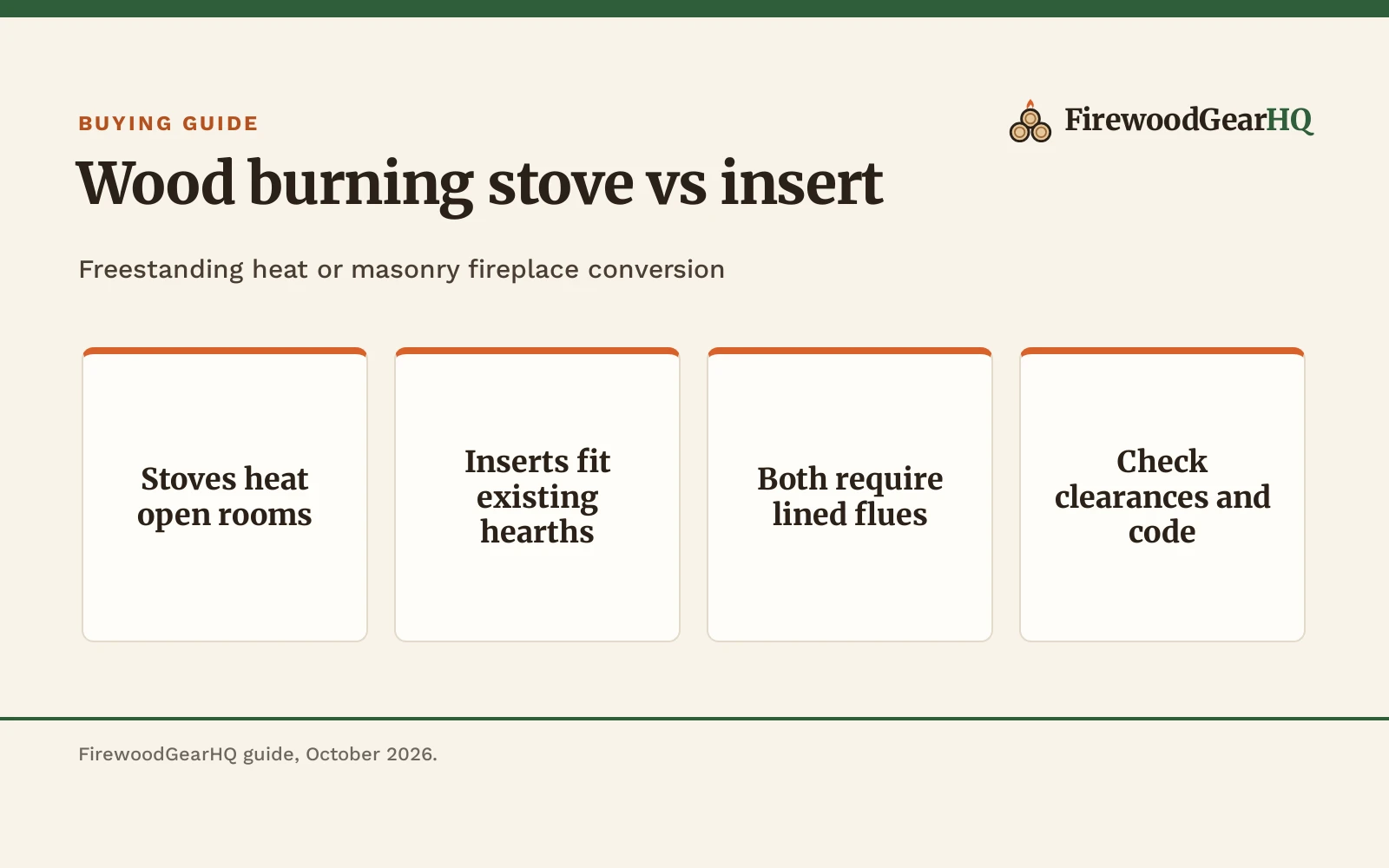
A wood burning stove vs insert decision centers on whether you are converting an existing open fireplace or heating an open living area. An insert slides inside an existing masonry firebox to turn a drafty fireplace into a sealed heater. If your home lacks a fireplace, or you want radiant heat from an exposed firebox with a cooktop, buy a freestanding wood burning stove. Both provide efficient heat, but their installation, venting, and room footprints differ.
FirewoodGearHQ earns a commission when you buy through links on our product pages, at no extra cost to you. Read our affiliate disclosure.
The quick answer
Choose a fireplace insert if you own an open brick fireplace and want to stop losing heat up the chimney. An insert slides into the masonry firebox, connects to a stainless steel flue liner to the chimney crown, and uses an electric blower to push warm air into the room without taking floor space.
Choose a freestanding wood stove if you want a heat source in a room without an existing fireplace. It stands on a hearth pad, radiates heat in all directions, and heats through power outages without electricity. For whole-home setups, see our guide on the best wood stove for heating a house.
Wood burning stove vs insert: key differences
| Feature | Freestanding wood stove | Fireplace insert |
|---|---|---|
| Placement | Freestanding on an approved hearth pad | Slides into an existing masonry firebox |
| Heat delivery | Radiant heat from all sides plus natural convection | Forward radiant face heat plus convection driven by an electric blower fan |
| Room footprint | Uses room floor space; requires wall clearances | Uses existing fireplace cavity without taking extra floor area |
| Chimney venting | Dedicated chimney pipe or connected to a lined masonry flue | Continuous stainless steel liner installed inside the existing chimney |
| Cooking utility | Flat top surface allows boiling water and cooking | No exterior cooktop surface available |
| Power outage heating | Heats fully without electricity | Radiates face heat without power; blower requires electricity for full convection |
| Clearances | Requires clearance from combustible walls | Requires clearance to mantels, trim, and adjacent side walls |
| Appearance | Exposed stove body, legs, and stove pipe | Built-in faceplate flush with fireplace opening |
Use this comparison to evaluate your layout, chimney structure, and heating priorities before buying.
Key differences explained step by step
Installation and room placement
A fireplace insert retrofits an existing masonry fireplace. If you are wondering what is a wood stove insert, it is a steel or cast-iron firebox surrounded by an outer jacket and a faceplate that seals the hearth opening to convert an inefficient fireplace into a closed heater.
A freestanding wood burning stove stands in the room on legs or a pedestal. You can position it anywhere with proper wall clearances, a hearth pad, and an exterior chimney run. While an insert preserves floor area, a freestanding stove serves as a visible focal point.
Heat output and distribution
A freestanding stove radiates heat from its top, sides, glass, and rear panel. Natural air currents warm the room without mechanical help, and adding a heat-powered wood stove fan circulates air across the living space.
A fireplace insert sits inside masonry that conceals its sides. While it radiates heat forward through its glass, heat from its firebox walls would be trapped without active airflow. Inserts use a convection jacket and blower fan to pull cool room air under the firebox and push hot air through upper louvers. For active circulation, see the best wood burning stove with blower options or a fireplace blower fan.
Chimney venting and flue requirements
An insert vents through your existing chimney, where codes require a continuous stainless steel liner from the insert collar to the chimney top to maintain draft and minimize creosote.
A freestanding stove connects to a lined masonry flue or an independent chimney. When building a new run, you connect stove pipe to an insulated stainless steel chimney pipe penetrating ceilings and the roof, requiring proper framing, firestopping, and roof flashing.
Hearth clearances and floor protection
Freestanding stoves radiate heat from all sides, requiring clearance from drywall and combustible flooring unless protected by approved shields. The appliance listing plate and local building codes specify required wall distances and hearth pad ratings.
Fireplace inserts simplify wall clearances because the firebox sits in noncombustible masonry, though they still require clearances to mantels, trim, and nearby side walls. If the existing hearth does not extend far enough forward, install an approved hearth extension pad.
Cooking utility and emergency heating
A freestanding stove heats without electricity during winter blackouts, and its flat steel or cast-iron top boils water or heats food. Specialized units illustrate this; for example, the YRenZ tent stove with oven combines cooking and heating in a 2-in-1 design measuring 19″D x 18″W x 10.6″H and weighing 7 kg, with a dedicated baking compartment.
An insert still provides radiant face heat during an outage, but its blower requires backup electricity to circulate air, and its recessed firebox offers no cooktop surface.
Safety standards, clearances, and building codes
Solid-fuel heating requires following manufacturer manuals and local building codes. The National Fire Protection Association (NFPA) and the Chimney Safety Institute of America (CSIA) recommend professional installation by an NFI-certified technician or CSIA-certified sweep, along with annual chimney inspections.
Install smoke alarms and carbon monoxide detectors on every level following U.S. Consumer Product Safety Commission (CPSC) guidance. The EPA Burn Wise program advises burning seasoned firewood that has dried thoroughly to minimize smoke and creosote; see how long to season firewood for drying details.
Draft performance, smoke spillage, and odor control
Rising hot gases create draft that draws fresh combustion air into the firebox. If a flue is cold or obstructed, smoke can spill into the room.
New stoves produce odors during initial fires as factory paint sets. While portable units like the Vrygle wood stove allow an outdoor burn of approximately 30 min before tent use, residential stoves and inserts must be broken in on the indoor hearth. Open windows during early fires to clear fumes while paint bakes on.
Airtight door gaskets prevent uncontrolled air leakage; reference specifications include the Midwest Hearth 5/8″ x 84″ Wood Stove fiberglass gasket. Inside the firebox, refractory bricks protect the shell and retain heat; for example, Rutland residential fire clay bricks rated to 2000°F (1093°C) and measuring 9″ x 4.5″ x 1.25″ in a 6-Pack provide standard replacement lining. While camp stoves use pipe dampers like the SoloWilder 2.36 inch Stove Pipe with Damper, residential stoves control combustion through internal air intake controls.
Operating costs, maintenance, and 2026 tax status
Both options require regular ash removal; an ash vacuum for wood stoves clears cold ash without airborne dust. When glass becomes cloudy, let the unit cool and wipe the ceramic glass with a damp cloth dipped in fine ash or an approved wood stove glass cleaner. Unlike fireplaces that use grates such as the SteelFreak Heavy Duty 13 x 10 Inch steel grate to elevate logs, closed stoves and inserts burn cordwood directly on an ash bed over firebricks. Adding a grate introduces excess underfire air and causes overfiring. A magnetic stove thermometer monitors flue temperatures to prevent cool burns.
The federal biomass stove tax credit has expired and is not available in 2026. See our guide on the wood stove tax credit for program details.
Turn a stack's length, height and depth into full and face cords, and estimate how much wood a winter takes.
Frequently Asked Questions
Can you cook on a wood stove?
Yes. Freestanding stoves feature flat top surfaces for boiling water and cooking during blackouts. Specialized units like the YRenZ tent stove with oven combine cooking and heating in a 2-in-1 design measuring 19″D x 18″W x 10.6″H and weighing 7 kg. Fireplace inserts lack an accessible cooktop.
How far does a wood burning stove need to be from a wall?
Clearances depend on the manufacturer listing plate and heat shielding. Listed stoves with rear shields and double-wall pipe sit closer than unlisted models. Check the appliance plate and local building codes.
Why does my wood burning stove smell when lit?
New appliances produce odors as factory paint sets. While camp stoves like the Vrygle wood stove allow an initial burn of approximately 30 min outdoors, indoor units are broken in on the hearth with open windows. Established stoves may smell from summer dust, poor draft, or wet firewood.
How much is a wood burning stove compared to an insert?
Costs depend on equipment capacity, venting materials, and labor. Inserts require a full chimney liner inside an existing flue, while freestanding stoves need independent chimney pipe and a hearth pad. Request quotes from certified hearth installers.
Does a fireplace insert need a blower to heat a room?
An insert radiates heat forward through its glass, but an electric blower is essential to heat an entire room by circulating air around the outer jacket. See our guide to the best fireplace blower fans.
How to use wood burning tools compared to heating stoves?
An electric woodburning tool is a pyrography pen for craft art on wood and leather, unrelated to heating stoves. The QWORK woodburning kit features adjustable heat, warms in 4-5 minute intervals, and includes 9 points for craftwork.
Related guides
Browse the wood stoves category hub, compare options in wood burning stove vs fireplace, and evaluate central heating in wood stove vs wood furnace. See our picks for the best wood stove for heating a house and the best wood burning stove with blower. For alternative fuel inserts, see best electric fireplace inserts. Protect your hearth with a fireplace screen for wood burning stove, manage ash with an best ash vacuum for wood stoves, and select fuel with our guide to the best wood for a wood stove.
About the author
The FirewoodGearHQ editorial team researches firewood and wood heating equipment from published specifications, ratings and warranty terms, and scores every pick the same way. We do not run our own product trials.