Wood Stove vs Pellet Stove: Differences Explained
Wood stoves and pellet stoves compared on heating capacity, fuel storage, electricity needs, operation and upkeep, with examples from the listings we reviewed.
 By FirewoodGearHQ Editorial
Updated October 9, 2026
By FirewoodGearHQ Editorial
Updated October 9, 2026
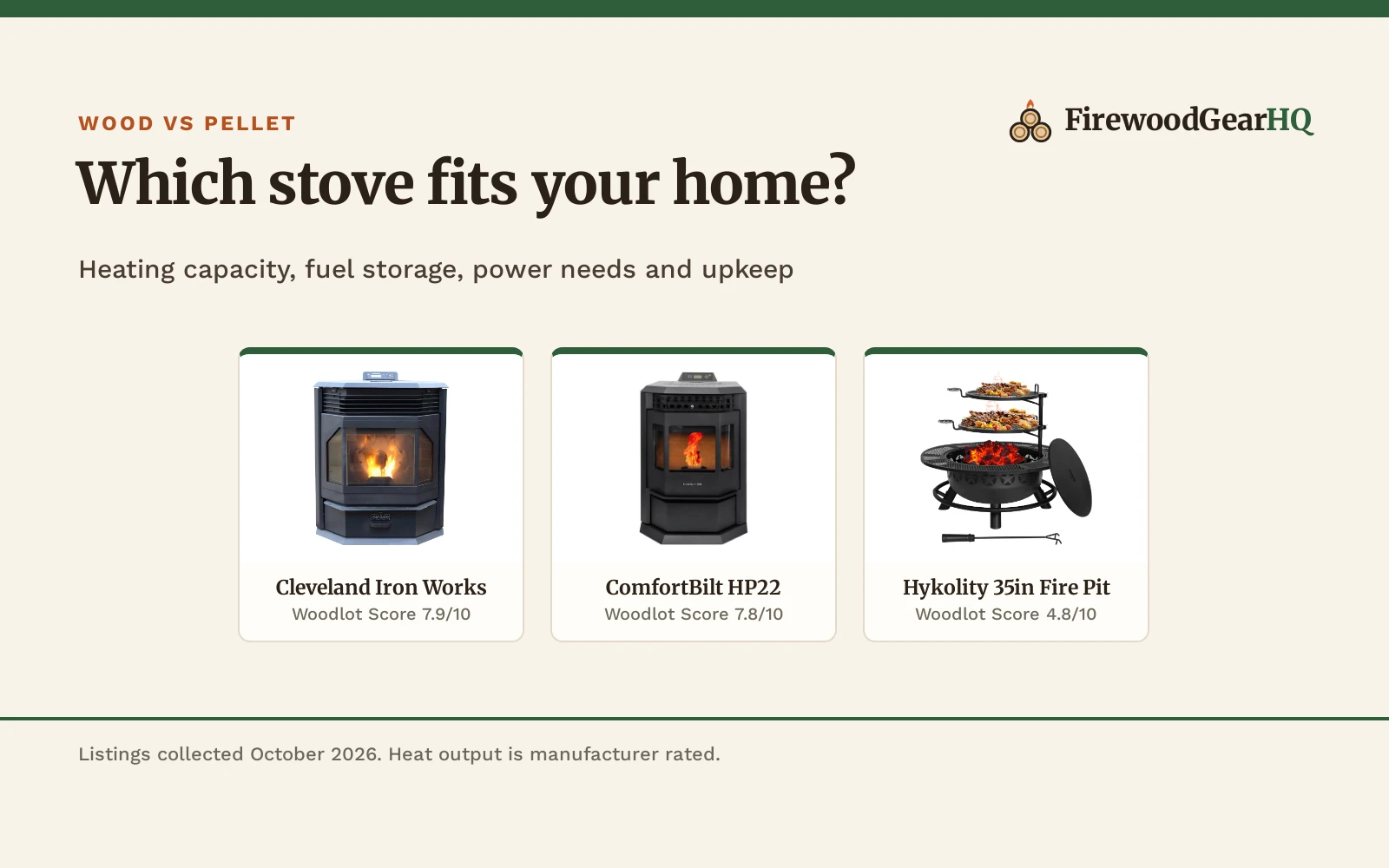
Verdict: Choose a wood stove if you want off-grid heating independence without electricity, have access to cordwood, and prefer radiant heat from seasoned logs. Choose a pellet stove if you want automated thermostatic heat control, longer unattended burn times up to 20 hours, and compact bagged fuel storage, and have reliable household power.
When deciding between a wood stove vs pellet stove, the main difference comes down to fuel supply, electricity requirements, heat distribution and daily operation. Wood stoves burn split cordwood through natural draft without power, while pellet stoves rely on an electric auger and room blower to burn compressed sawdust pellets. This guide compares both heating systems side by side, followed by three concrete examples from current listings.
FirewoodGearHQ earns a commission when you buy through links on this page, at no extra cost to you. Affiliate disclosure.
Side by side
| Factor | Wood stove (Hykolity) | Pellet stove (ComfortBilt) | Pellet stove (Cleveland Iron Works) |
|---|---|---|---|
| Primary fuel | Cordwood logs | Compressed wood pellets | Compressed wood pellets |
| Electrical power needed | None for passive draft burning | Required for auto ignition, auger and blower | Required for auto ignition, auger and WiFi |
| Heat control | Manual air damper adjustment | Programmable thermostat, power settings and remote | Control panel, remote and WiFi app |
| Fuel feed and loading | Manual log loading through firebox door | Automated motorized auger from hopper | Automated motorized auger from hopper |
| Burn time per load | Varies with firebox size and wood species | Up to 20 hours stated on ComfortBilt example | Not stated on listing |
| Heating coverage stated | Not stated on Hykolity listing | Up to 2,800 sq ft under mild conditions | 1,800 to 2,500 sq ft (bullets) / 800-1,200 sq ft (table) |
| Stated heat output | Not stated on Hykolity listing | Up to 41,000 BTU per hour (bullets) / 50,000 BTU (table) | 30,173 BTU |
| Stated safety certifications | Not stated on Hykolity listing | EPA and CSA certified | EPA approved and ETL listed |
| Weight | 30.1 pounds | 273 pounds | 231.5 pounds |
| Stated warranty | 1 year | Not stated on listing | 1 yr electrical, 8 yr steel parts |
Ranges are typical of the listings we reviewed; example figures are manufacturer rated, collected 9 October 2026.
Wood stove vs pellet stove: key differences
Both heating appliances provide supplementary or primary home warmth, but they operate on fundamentally different principles. A wood stove is a manual, radiant heating appliance designed for cordwood logs, whereas a pellet stove is an automated, fan-forced appliance that meters processed biomass into a burn pot. Deciding which system fits your home depends on fuel access, electricity availability, and how much manual fire management you prefer. For sizing principles and heating considerations, see our guide on how to choose a wood stove.
Fuel type and storage
Wood stoves burn cordwood cut to length, split, and seasoned. Cordwood requires outdoor stacking space, protective seasoning covers, and handling with gloves and carts. Pellet stoves burn uniform pellets manufactured from compressed sawdust and wood byproducts. Pellets are packaged in clean bags that store neatly in a dry garage, basement, or closet. Storing pellets avoids insect activity indoors, but you cannot harvest or split pellets yourself if supply chains are disrupted.
Electricity and off-grid reliability
Wood stoves require no electrical power. They rely entirely on natural chimney draft created by hot rising exhaust gases, providing continuous radiant warmth during winter storms, grid failures, and rural blackouts. Pellet stoves require a continuous household electrical supply to power their motorized fuel auger, combustion intake blower, convection room blower, and digital control circuitry. Without an uninterruptible power supply or generator backup, a pellet stove shuts down immediately during a power outage.
Heat output and temperature control
A wood stove produces radiant heat that warms nearby surfaces, requiring manual airflow damper adjustments to raise or lower heat output. Pellet stoves provide convective heat distributed through an integrated room blower fan. Stated output on pellet listings can reach 41,000 BTU per hour, as shown on the ComfortBilt HP22 example, or 30,173 BTU on the Cleveland Iron Works model. Pellet stoves feature programmable digital thermostats and multi-level power settings, maintaining precise room temperatures by automatically modulating pellet feed rates.
Daily operation and upkeep
Operating a wood stove requires manual kindling, draft monitoring, and periodic log reloading through the firebox door. Pellet stoves offer automated electric ignition and continuous hopper feeding, delivering up to 20 hours of burn time on the 55 lb hopper of the ComfortBilt example before reloading. Upkeep on both appliances includes routine ash removal using a dedicated ash bucket or vacuum. Wood stoves require regular chimney inspection and sweeping to address creosote buildup, while pellet stoves require weekly burn pot scraping, heat exchanger cleaning, and venting clearance checks.
Safety standards and installation
Both wood and pellet stoves must be installed in accordance with manufacturer specifications and local building codes, observing strict clearance distances to combustible walls and hearth pads. Professional installation by a certified chimney sweep or hearth specialist is strongly recommended. Homes heating with wood or biomass should always maintain operating smoke alarms and carbon monoxide detectors on every level. Look for clean-burning certifications such as EPA listing and recognized laboratory safety standards; read our guide on what EPA certified wood stove means for regulatory details. Note that the federal biomass stove tax credit has expired and is not available for equipment placed in service in 2026.
Three examples from our review
| Award | Product | Woodlot Score About the HQ ScoreThe Woodlot Score runs from 0 to 10 and weighs performance (35%), build (25%), value (25%), safety (10%, where it applies) and warranty (5%), using only what the manufacturer and the listing publish. How we pick › | |
|---|---|---|---|
 Cleveland Iron Works Bayfront Pellet Stove
|
7.9/10 | Buy | |
 ComfortBilt HP22 Pellet Stove, 2,800 sq. ft.
|
7.8/10 | Buy | |
 Hykolity 35 Inch Fire Pit with 2 Cooking Grate
|
4.8/10 | Buy |
Cleveland Iron Works Bayfront Pellet Stove
A freestanding pellet stove with a stated 30,173 BTU output, 87% efficiency, built-in WiFi, remote control, cast iron build and an 8 year steel parts warranty.
Pros
- 8 year warranty on steel parts, 1 year on electrical
- EPA approved and ETL listed for safety
- Stated 87% efficiency with 30,173 BTU heat output
- Built-in WiFi connectivity and included remote control
Cons
- Spec table lists 24 lb hopper versus 66 lb in title
- Spec table lists 800 to 1,200 sq ft versus 1,800 to 2,500 sq ft in bullets
- Requires electricity to power auger, control board and blower
- 231.5 lb weight requires floor mounting and clear hearth space
ComfortBilt HP22 Pellet Stove, 2,800 sq. ft.
A freestanding pellet stove delivering up to 41,000 BTU per hour with a 55 lb hopper, up to 20 hours of burn time, five power settings, remote control, and EPA and CSA certifications.
Pros
- Up to 41,000 BTU per hour heating up to 2,800 sq ft
- 55 lb hopper provides up to 20 hours of burn time
- EPA and CSA certified with bay-view window and room blower
- Five power settings, programmable thermostat and remote control
Cons
- No warranty term is stated
- Spec table lists 50,000 BTU while bullets state up to 41,000 BTU
- Heavy unit weighing 273 pounds
- Requires electricity for auto ignition, blower and controls
Hykolity 35 Inch Fire Pit with 2 Cooking Grate
A 35-inch outdoor wood-burning steel fire pit and table featuring a 24-inch fire bowl, two swiveling cooking grates, charcoal pan, log rack, poker, and a 1 year warranty.
Pros
- 1 year warranty with free exchange for quality problems
- Includes two 360-degree swiveling cooking grates and charcoal pan
- Cover lid converts fire bowl into an outdoor table
- Heavy-duty gauge steel construction with log rack and poker
Cons
- Outdoor fire pit only, not an indoor home heating stove
- Bullets state 26 in height while spec table lists 22 in
- No EPA certification or UL safety listing stated
- No chimney, damper, room heating capacity or BTU rating stated
How we scored them
Each example is scored out of 100 on performance, build, value, safety and warranty, using only what the listing publishes. The weights are on our How We Pick page.
| Product | Woodlot Score | Perf. /35 | Build /25 | Value /25 | Safety /10 | Warranty /5 |
|---|---|---|---|---|---|---|
| Cleveland Iron Works | 7.9 | 28 | 20 | 19 | 9 | 4 |
| ComfortBilt HP22 | 7.8 | 29 | 20 | 20 | 9 | 0 |
| Hykolity 35in Fire Pit | 4.8 | 14 | 15 | 16 | 0 | 3 |
Estimate the heat output and stove size class for your space from square footage, insulation and climate.
Install stoves and inserts to the manufacturer's instructions and your local code, usually by a certified installer with a permit and inspection. Keep the listed clearances to combustibles, run working smoke and carbon monoxide detectors, have the chimney inspected and cleaned every year to prevent creosote fires, burn only seasoned wood, and check local burn rules. See EPA Burn Wise, NFPA heating safety, CPSC carbon monoxide guidance and the Chimney Safety Institute of America (CSIA). Read our Safety Disclaimer.
Frequently Asked Questions
Is a wood stove or pellet stove better for whole-house heating?
Both can heat large living areas when sized correctly. The ComfortBilt pellet stove listing states coverage up to 2,800 square feet, while the Cleveland Iron Works pellet model states 1,800 to 2,500 square feet in bullets. Wood stoves deliver strong radiant heat without electricity, while pellet stoves distribute warmth more evenly using motorized room blowers.
Do pellet stoves work during a power outage?
No, standard pellet stoves stop working during an electrical outage because their motorized fuel auger, internal draft fan, and room circulation blower require household power. Operating a pellet stove off-grid requires a battery backup system or backup generator.
Is it cheaper to burn pellet or wood?
If you own wooded land or have access to inexpensive local cordwood that you fell, buck, and split yourself, wood heating offers very low fuel expense. Purchased bags of wood pellets provide consistent heat without splitting labor, but you must buy fuel every season from commercial retailers.
Can a wood stove and a pellet stove share the same chimney?
No. National fire safety codes prohibit venting multiple solid-fuel appliances into the same flue. Wood stoves require an appropriately sized chimney with natural draft, whereas pellet stoves utilize smaller, sealed direct-vent exhaust pipes under positive mechanical fan pressure.
Is the federal biomass stove tax credit still available in 2026?
No. The federal tax credit for biomass heating stoves has expired and cannot be claimed for stoves installed during 2026.
Related guides
See our wood stove hub, our guide on how to choose a wood stove, our roundup of the best wood stove for heating a house, the best small wood stove for small spaces, the best wood stove for a cabin, the best ash vacuum for pellet stove, and our comparison on catalytic vs non-catalytic wood stoves.
About the author
The FirewoodGearHQ editorial team researches firewood and wood heating equipment from published specifications, ratings and warranty terms, and scores every pick the same way. We do not run our own product trials.