What Is a Wood Stove Insert?
A wood stove insert is a closed steel or cast iron firebox installed inside an existing masonry fireplace to turn an inefficient hearth into a powerful room heater.
 By FirewoodGearHQ Editorial
Updated October 9, 2026
By FirewoodGearHQ Editorial
Updated October 9, 2026
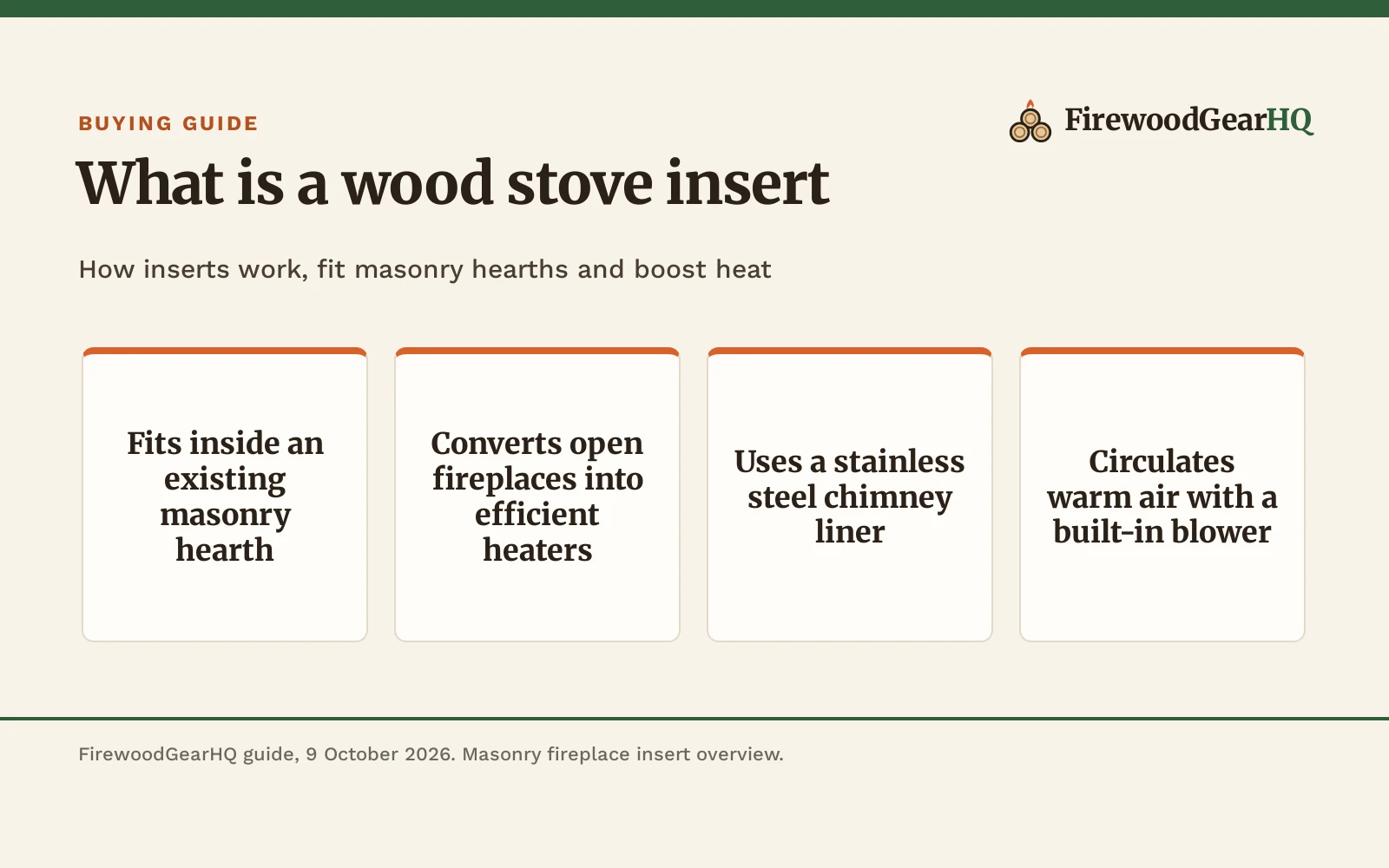
To understand what is a wood stove insert, think of it as a heavy-duty steel or cast iron firebox engineered to slide directly inside an existing open masonry fireplace hearth. The appliance seals the open fireplace opening to prevent heated indoor air from escaping up the chimney flue and exhausts through a dedicated stainless steel flue liner. By controlling combustion airflow and circulating heat into the living space with a convection blower, an insert transforms an inefficient open fireplace into a dependable home heating appliance.
FirewoodGearHQ earns a commission when you buy through links on our product pages, at no extra cost to you. Read our affiliate disclosure.
The quick answer
An open masonry fireplace draws massive volumes of heated room air up the chimney stack, creating a draft that pulls cold outdoor air into the house through window frames and doors. A wood stove insert solves this problem by turning an open cavity into a closed heating system. The insert fits inside the existing brick or stone firebox, connects directly to a continuous stainless steel flue liner running to the top of the chimney, and uses an electric blower fan to push warm air throughout the living space. Homeowners gain substantial supplemental heat from their firewood supply while keeping the classic ambiance of a wood fire behind a clean ceramic glass door.
What is a wood stove insert
A wood stove insert is essentially a modern, high-efficiency wood stove designed without legs or a pedestal base so it can sit securely inside a masonry fireplace opening. A decorative faceplate or surround panel trims out the perimeter, covering any gap between the firebox body and the surrounding brickwork to form an attractive, draft-free seal. Because open fireplaces operate at very low heating efficiency, installing an insert captures heat that would otherwise escape outdoors.
| Feature | Open masonry fireplace | Wood stove insert | Freestanding wood stove |
|---|---|---|---|
| Combustion control | Open hearth with uncontrolled air intake | Gasketed sealed door with adjustable intake damper | Gasketed sealed door with adjustable intake damper |
| Heat delivery | Radiant heat with major draft loss up flue | Circulating convection blower plus radiant front | Radiant heat and natural room convection |
| Flue venting | Open chimney flue with manual throat damper | Continuous stainless steel liner to chimney top | Dedicated chimney pipe through ceiling or wall |
| Room footprint | Recessed into existing wall masonry | Fits flush inside existing masonry hearth | Sits on open room floor with dedicated hearth pad |
| Primary function | Decorative ambiance and open flames | High-efficiency room and zone heating | Whole-home or primary zone heating |
Compared to a freestanding stove, an insert preserves existing floor space by occupying a hearth that already exists. Compared to an open hearth, an insert burns significantly less cordwood while producing far more usable indoor warmth.
What makes a wood stove insert heat effectively
Heavy steel or cast iron firebox construction
Inserts are constructed from heavy plate steel or cast iron panels capable of enduring sustained firebox temperatures. Inside the chamber, firebrick linings protect the outer metal shell and reflect heat back into the coal bed. Modern clean-burning designs incorporate stainless steel secondary air tubes or catalytic combustors just below the baffle board. These components reignite unburned gases and smoke particles before they enter the flue collar, increasing heat extraction while satisfying strict Environmental Protection Agency clean air standards.
Dedicated stainless steel chimney flue liner
A wood stove insert cannot simply vent into an expansive masonry chimney flue. Professional installers connect a flexible or rigid stainless steel chimney liner directly to the appliance exhaust collar and extend it all the way to the top of the masonry chimney crown. This continuous conduit maintains proper flue gas velocity, sustains strong draft, and prevents smoke from expanding, cooling, and condensing along old flue tiles.
Convection blower and air jacket
While an open fireplace delivers only radiant heat from the front of the fire, an insert relies on convection. An outer steel convection jacket surrounds the firebox on the sides, back, and top. Cool room air enters through lower intake louvers, travels around the blazing firebox walls where it absorbs heat, and discharges through upper louvers into the living area. An electric blower fan accelerates this airflow, circulating warm air across the room and into adjacent spaces.
Sealed ceramic glass door and air wash
The front door features high-temperature ceramic glass sealed with fiberglass rope gaskets to ensure an airtight closure. Homeowners regulate combustion speed and burn duration using an intake air damper handle. An internal air-wash channel directs a curtain of preheated air down across the inner glass surface, sweeping away soot particles and keeping the view of the fire clean.
How to tell if your fireplace can take an insert
Before selecting a unit, evaluate the structural condition and physical dimensions of the existing hearth. Professional chimney sweeps verify compatibility using standard checklist items:
- Masonry firebox condition: The existing brickwork, mortar joints, and lintel must be sound, intact, and free from settlement cracks or water leakage.
- Hearth opening dimensions: The height, width, and depth of the masonry firebox must exceed the insert body dimensions, allowing adequate clearance for surround panels to overlap the brick face.
- Hearth extension protection: The noncombustible floor pad in front of the opening must extend far enough forward and to the sides to shield combustible flooring from stray sparks and embers.
- Chimney flue pathway: The chimney passage must accommodate a continuous stainless steel flue liner without severe bends or restrictive pinch points.
- Electrical access: A grounded electrical wall outlet must be accessible nearby to supply power to the convection blower motor.
Always consult National Fire Protection Association guidelines, Chimney Safety Institute of America certified sweeps, and local building officials. Certified specialists verify that the masonry structure meets mandatory clearance standards before installation begins.
What happens if you burn without a proper liner
Attempting to vent an insert into an unlined masonry chimney or relying on a partial flue connection creates severe operating and safety hazards. Hot flue gases exit the appliance collar and immediately expand into the wide masonry cavity. As the gases expand, their temperature drops rapidly, destroying the upward draft needed to pull combustion air through the firebox. Sluggish draft causes the fire to smolder, fills the glass with black soot, and spills smoke into the living room whenever the door opens.
More critically, cooling smoke condenses into combustible creosote along the flue tiles. Heavy creosote accumulation presents an immediate chimney fire risk. A direct stainless steel liner sized to the appliance collar keeps exhaust temperatures hot, draft strong, and creosote formation low. To safeguard the household, install working smoke alarms and carbon monoxide detectors on every level of the home, follow Consumer Product Safety Commission safety recommendations, burn seasoned cordwood with low moisture content per Environmental Protection Agency Burn Wise advice, and schedule an annual chimney inspection by a certified professional before every heating season. Regarding tax credits, federal biomass stove tax credits expired at the end of the previous calendar year and are unavailable for current installations.
Cast iron and steel wood stove inserts
Manufacturers build inserts using either welded plate steel or bolted cast iron sections. Each material performs admirably, yet heat distribution differs:
Plate steel inserts feature thick steel plates welded into a robust seamless box. Steel conducts heat quickly, radiating warmth into the room shortly after kindling catches. This responsiveness makes steel units ideal for homeowners who desire rapid supplemental warmth upon returning home from work. Welded steel models require minimal seam maintenance over years of daily service.
Cast iron inserts utilize molded iron castings assembled with high-temperature furnace cement and gaskets. Cast iron takes longer to absorb heat, but once brought up to operating temperature, it retains thermal energy and radiates soft, steady warmth long after the flame bed settles into glowing embers. Cast iron also allows ornate decorative detailing, arched doors, and porcelain enamel finishes that complement traditional hearth architecture.
Turn a stack's length, height and depth into full and face cords, and estimate how much wood a winter takes.
Frequently Asked Questions
What is the difference between a wood stove and an insert?
A freestanding wood stove stands on its own legs or pedestal on an open floor, venting through dedicated chimney pipe installed through a ceiling or exterior wall. A wood stove insert is specially engineered without legs or exterior trim to fit directly inside an existing masonry fireplace cavity, utilizing the existing chimney structure with a stainless steel liner.
Can an insert heat a whole house?
An insert excels at zone heating, keeping the primary living space comfortably warm while reducing reliance on a central furnace. Depending on home layout, insulation levels, floor plan openness, and weather severity, a properly sized insert can heat an entire floor or small to medium home when the blower circulates air effectively.
Does a wood stove insert require a chimney liner?
Yes. Installing a continuous stainless steel liner from the insert exhaust collar to the chimney cap is essential for safety, draft performance, and building code compliance. An unlined installation causes poor draft, sluggish combustion, heavy creosote accumulation, and heightened chimney fire risks.
Can an insert operate during a power outage?
Yes, an insert burns safely and produces radiant heat through its ceramic glass front during an electrical blackout. However, the electric convection blower will not run without power, which reduces circulating airflow. Some homeowners connect the blower cord to a backup power station or generator during winter storms.
What is the best wood stove insert?
The best wood stove insert is a model sized accurately for your square footage, built by a reputable manufacturer, and certified to current Environmental Protection Agency emission standards. It must fit the physical dimensions of your existing masonry firebox while providing the heat output, burn duration, and door style that match your household heating goals.
Does a wood stove insert produce smoke inside the house?
During normal operation with the door latched, an insert releases no smoke into the room. When opening the door to reload firewood, opening the air damper beforehand establishes strong upward draft and prevents smoke spillage. Burning seasoned cordwood rather than damp wood also ensures clean, smoke-free operation.
Related guides
Explore our complete wood stoves guide, compare freestanding models in our guide to the best wood stove for heating a house, and keep hearth cleanups manageable with the best ash vacuum for wood stoves. For monitoring flue heat and distributing warmth, browse our picks for the best stove thermometer and the best wood stove fan. To prepare clean fuel, read how long to season firewood, verify split pieces with the best firewood moisture meter, and browse essential gear in stove accessories.
About the author
The FirewoodGearHQ editorial team researches firewood and wood heating equipment from published specifications, ratings and warranty terms, and scores every pick the same way. We do not run our own product trials.