Wood Stove Tax Credit 2026: Is It Still Available?
The federal 25C credit for wood and pellet stoves ended with 2025 installs. What still counts, who can claim a 2025 stove, and where to look for 2026 help.
 By FirewoodGearHQ Editorial
Updated October 6, 2026
By FirewoodGearHQ Editorial
Updated October 6, 2026
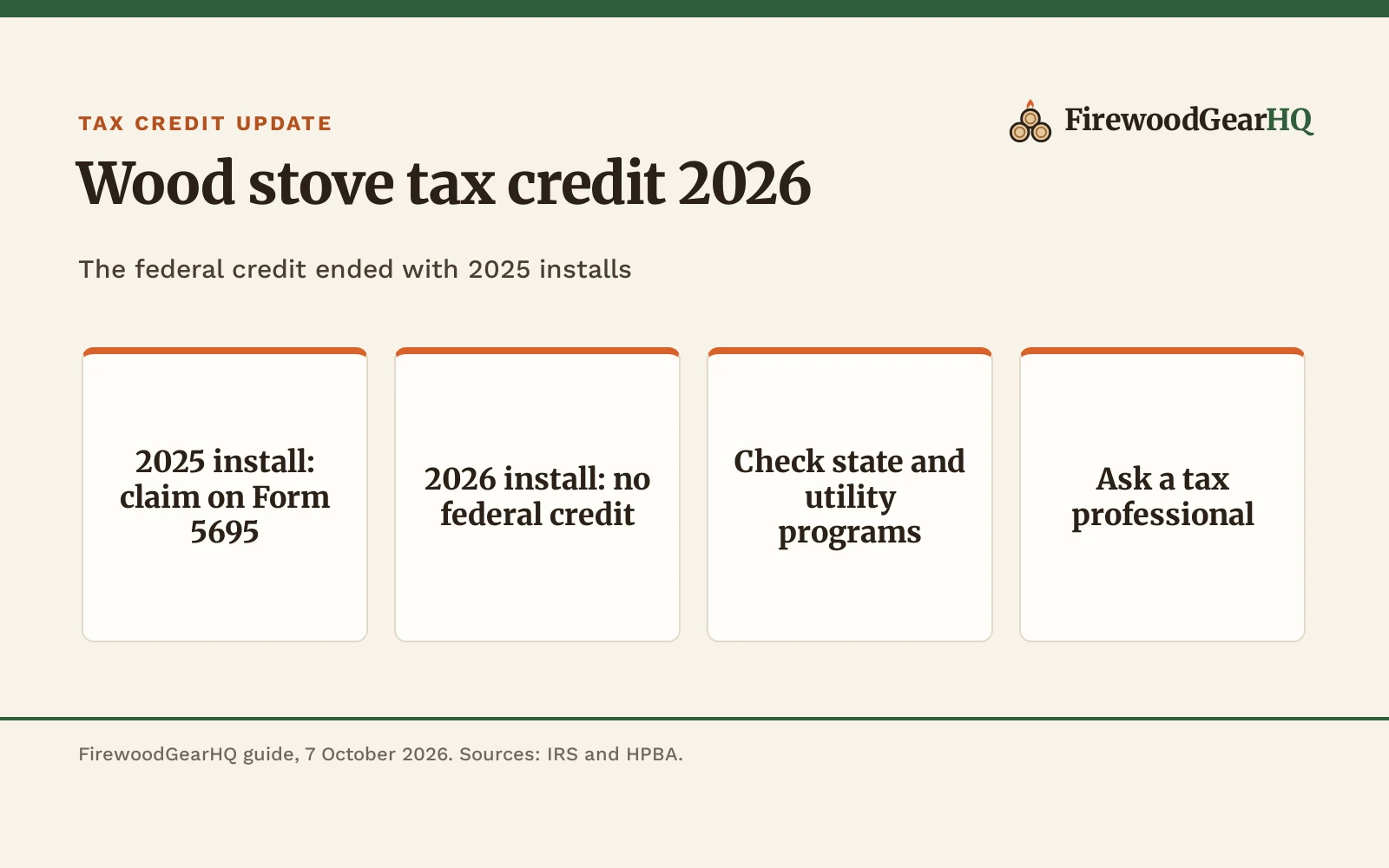
There is no federal wood stove tax credit 2026 buyers can use. The 30 percent Energy Efficient Home Improvement Credit (Section 25C), which covered qualifying wood and pellet stoves, ends for property placed in service after December 31, 2025. If your stove was installed and running in 2025, you can still claim it on the 2025 return you file in 2026. If it goes in during 2026, the federal credit is gone, and state, utility or local programs are the places left to look.
FirewoodGearHQ earns a commission when you buy through links on our product pages, at no extra cost to you. Read our affiliate disclosure.
This page is general information as of October 7, 2026, not tax advice. Tax rules change and your situation matters, so confirm anything you plan to claim with the IRS or a tax professional.
Wood stove tax credit 2026: the short answer
| When the stove was placed in service | Federal 25C credit | What to do |
|---|---|---|
| 2023, 2024 or 2025 | Up to 30% of cost, capped at $2,000 per year for biomass stoves and boilers | Claim it on that year’s return with IRS Form 5695 |
| 2026 or later | Not available | Look for state, utility and local programs |
The key date is when the stove is placed in service, which in plain terms means installed and ready to use in your home. A stove bought in December 2025 but installed in January 2026 falls on the wrong side of the line, so check the date on your installer’s paperwork before you assume anything.
What changed, and why the credit ended
On July 4, 2025, the law known as the One Big Beautiful Bill Act (H.R. 1) was signed. According to the Hearth, Patio and Barbecue Association, it moved the expiration of the Energy Efficient Home Improvement Credit up to December 31, 2025. Before that change, the credit had been expected to run for several more years. The IRS page for the credit now describes it as allowed for qualifying property placed in service from January 1, 2023 through the end of 2025.
For wood burners, that means the biomass part of the credit, the part that covered wood and pellet stoves, ended with the rest of 25C. You may still see older articles, store signs or ads that mention a 30 percent wood stove credit. Most of them were written before the law changed. For a stove installed in 2026, treat any federal credit claim as out of date unless the IRS says otherwise.
If you installed a wood stove in 2025
You may still be able to claim the credit on your 2025 federal return, filed in 2026. These are the main rules on the IRS page for the credit:
- Amount: 30 percent of qualified costs, up to $2,000 per year for biomass stoves and boilers. That $2,000 limit is separate from the $1,200 limit that covers items like insulation, windows and doors.
- Efficiency: the stove or boiler needs a thermal efficiency rating of at least 75 percent. The stove maker or your dealer can tell you whether a model met it.
- Costs: for this type of property, the IRS says costs may include labor for installation.
- Your home: it must be your main home, in the United States, and an existing home you improve. A brand new home does not qualify, and landlords who do not live in the property cannot claim it.
- New equipment only: used stoves do not qualify.
- Qualified manufacturer ID: for property placed in service in 2025, the IRS says no credit is allowed unless the item came from a qualified manufacturer and you report its Qualified Manufacturer Identification Number (QMID) on your return. Ask the dealer or maker for it, and keep it with your receipt.
- Nonrefundable: the credit can lower your tax to zero, but you do not get the excess back, and the IRS says you cannot carry an excess forward to later years.
- Rebates: subsidies, rebates and other incentives may need to be subtracted from your costs first.
The form is IRS Form 5695, Residential Energy Credits. Keep the itemized invoice, the installer’s paperwork showing the install date, the maker’s efficiency statement and the QMID together. If any of that is missing, ask for it now rather than at tax time.
If you are buying a wood stove in 2026
Without the federal credit, the full cost of the stove and install is on you, so a few other sources of help are worth checking before you buy:
State programs
Some states have run their own rebates, grants or tax credits for cleaner wood and pellet heat. They change often, and many have income limits or require a specific stove type. Search DSIRE, the database of state incentives, for your state and look for biomass or wood heat programs.
Utility and local programs
Electric and gas utilities, counties and air quality districts sometimes fund wood stove changeout programs, which pay part of the cost of replacing an old, uncertified stove with a cleaner model. EPA Burn Wise is a good starting point for what these programs look for. Call your utility and local air district and ask directly.
Dealer timing
Hearth dealers often run their own promotions in the spring and summer, when demand is lowest. That is a dealer price question, not a tax benefit, but it is a real way to lower your cost if you can wait.
Choosing a stove now that the credit is gone
The credit was a nudge toward efficient stoves, and the reasons behind it still hold. An EPA-certified stove that is sized for your space burns less wood for the same heat, makes less smoke and is less likely to choke on creosote. Work out how much heat you need with the wood stove size calculator, then compare picks in our guide to the best wood stove for heating a house. Our wood stoves hub collects every stove guide on the site.
Efficiency on paper only shows up in your home if you burn dry wood and run the stove in its proper range. A firewood moisture meter tells you whether a load is under 20 percent, and a stove thermometer shows whether you are burning too cool or too hot. Our guide on how long to season firewood covers the drying side.
Install stoves and inserts to the manufacturer's instructions and your local code, usually by a certified installer with a permit and inspection. Keep the listed clearances to combustibles, run working smoke and carbon monoxide detectors, have the chimney inspected and cleaned every year to prevent creosote fires, burn only seasoned wood, and check local burn rules. See EPA Burn Wise, NFPA heating safety, CPSC carbon monoxide guidance and the Chimney Safety Institute of America (CSIA). Read our Safety Disclaimer.
Whatever you buy, have it installed by a qualified professional, such as an NFI-certified installer, and to the stove manual and local building code. Many areas need a permit and inspection, and your home insurer may ask for proof. This site does not give installation or chimney instructions.
Estimate the heat output and stove size class for your space from square footage, insulation and climate.
Common mistakes with the wood stove credit
- Going by the purchase date. The credit followed the date the stove was placed in service, not the day you paid.
- Trusting old sales material. Signs and pages written before July 2025 may still promise a 30 percent credit on 2026 installs.
- Missing the QMID. For 2025 property, no QMID on the return means no credit, according to the IRS.
- Expecting a refund larger than your tax. The credit is nonrefundable.
- Claiming it on a rental or new build. The rules cover your main home, and an existing home only.
Frequently Asked Questions
Is there a tax credit for wood stoves in 2026?
Not at the federal level for stoves placed in service in 2026. The 25C credit, including its biomass stove part, ended for property placed in service after December 31, 2025. Some states, utilities and local air districts still run their own programs, so check DSIRE and call your utility.
Can I still claim a wood stove I installed in 2025?
Generally yes, on your 2025 federal return using Form 5695, if the stove met the rules: new, at least 75 percent thermal efficiency, installed in your main home, and reported with the maker’s QMID. A tax professional can confirm your case.
Did the 25C biomass credit end early?
Yes. HPBA reports that the law signed on July 4, 2025 moved the end of the Energy Efficient Home Improvement Credit to December 31, 2025, earlier than previously scheduled.
How much was the wood stove tax credit?
For 2023 through 2025, it was 30 percent of qualified costs, up to $2,000 per year for biomass stoves and boilers. Installation labor could count toward the cost.
Do pellet stoves still get a tax credit?
Pellet stoves were covered by the same biomass part of 25C, so the federal credit ended for them on the same date. State and utility programs may treat pellet and wood stoves differently, so read each program’s list.
Related guides
Start with the best wood stove for heating a house and size it with the wood stove size calculator. Once it is running, the best wood stove fans help move heat into the next room, and the stove accessories hub covers the rest of the hearth. Also see our best tent wood stove. Also see our best wall tent wood stove. Also see our what is a wood stove insert. Also see our best fireplace insert electric. Also see our best fireplace blower fan. Also see our best wood burning stove with blower. Also see our best wood stove for backpacking. Also see our best wood for a wood stove. Also see our wood burning stove vs fireplace. Also see our wood stove vs wood furnace. Also see our wood burning stove vs insert. Also see our wood burning stove vs gas fireplace. Also see our woodstock progress hybrid vs ideal steel hybrid. Also see our how to choose a wood stove. Also see our what size wood stove do i need. Also see our what does epa certified wood stove mean. Also see our how much does it cost to install a wood stove. Also see our can you install a wood stove yourself. Also see our how much firewood does a wood stove use per winter. Also see our best small wood stove for small spaces. Also see our does a wood stove need a permit. Also see our is heating with wood cheaper than propane. Also see our best wood stove for a cabin. Also see our blaze king vs woodstock wood stove. Also see our best outdoor wood boiler. Also see our catalytic vs non catalytic wood stove. Also see our wood stove vs fireplace insert. Also see our wood stove vs pellet stove. Also see our cast iron vs steel wood stove. Also see our can you burn pine in a wood stove.
About the author
The FirewoodGearHQ editorial team researches firewood and wood heating equipment from published specifications, ratings and warranty terms, and scores every pick the same way. We do not run our own product trials.