How Much Firewood Does a Wood Stove Use Per Winter?
How much firewood a wood stove uses per winter, what factors change your cordwood consumption, how to calculate your heating needs and tips for burning efficiently.
 By FirewoodGearHQ Editorial
Updated October 9, 2026
By FirewoodGearHQ Editorial
Updated October 9, 2026
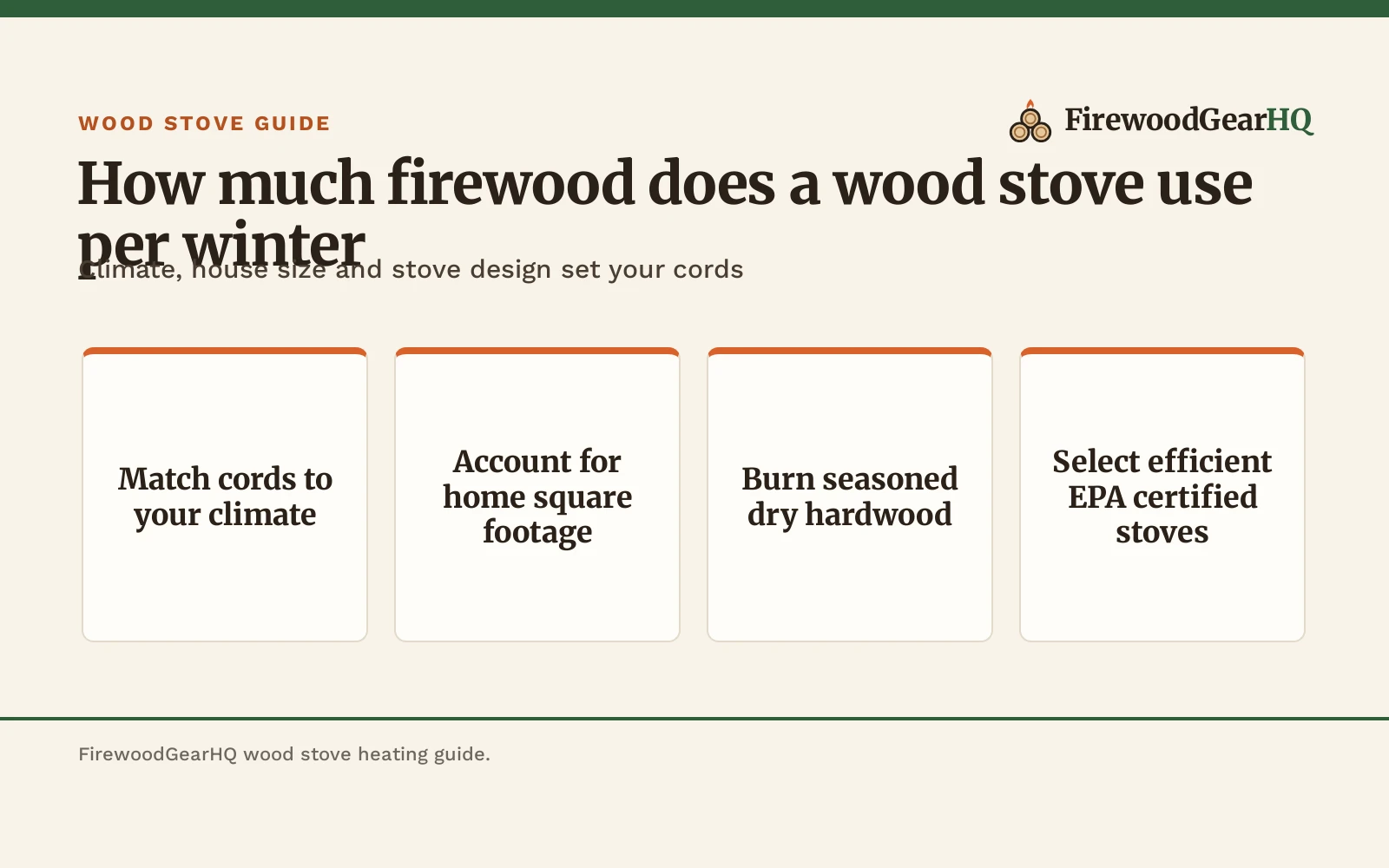
How much firewood does a wood stove use per winter depends on whether the stove provides primary or supplemental heat, regional climate, and home insulation. Heating a home full-time through a harsh winter burns multiple full cords of seasoned hardwood, while supplemental evening fires use a fraction of that volume. Matching firebox capacity and heating habits sets your seasonal supply.
FirewoodGearHQ earns a commission when you buy through links on our product pages, at no extra cost to you. Read our affiliate disclosure.
How much firewood does a wood stove use per winter
A cord of firewood is a stacked pile of split wood, bark, and air space. Whole-home winter heating in deep freezes demands dense, seasoned hardwood stacked before winter arrives. Homes using a stove for supplemental evening heat need far less wood. Plan your woodpile by heating demand using the benchmarks below.
Winter firewood consumption planning chart
| Heating role | Winter firewood demand | Stove use and planning notes |
|---|---|---|
| Primary whole-home heat | Multiple full cords | Continuous daily burning in cold climates; requires large seasoned hardwood stacks |
| Supplemental evening heat | Moderate cordwood volume | Fires lit on cold evenings to offset furnace cycles |
| Occasional or emergency heat | Low cordwood volume | Intermittent burns during storms and power outages |
| Compact camp or cabin heat | Small split bundles | Short burn cycles in compact stoves for temporary shelters |
Compare stove sizing in our guides on how to choose a wood stove and what size wood stove do I need.
What determines your winter firewood consumption
Primary heating versus supplemental heating
Relying on a stove as your primary heat source requires round-the-clock burning and steady reloads. Supplemental heating burns wood only during evening chill, cutting consumption substantially. For full-home heating, choosing the best wood stove for heating a house ensures proper firebox volume and heat distribution.
Firebox capacity and log length
Firebox size governs reload frequency and log capacity. Residential stoves use standard split lengths; the Old Potters listing specifies 16 inch logs in 1.5 cu ft boxes weighing 38 to 45 lbs. In comparison, the Camp Chef Alpine CS14 cylinder wood stove listing details dimensions of 24 in length by 20 in width by 22.5 in height with a 5 inch flue, 10-12 gauge steel, and a weight of 74 pounds, designed for compact shelters rather than full-home winter heating.
Climate severity and season length
Sub-zero northern winters require steady high-output burning and far more wood than mild southern seasons. Monitoring stove temperatures with the best stove thermometer keeps combustion in the active zone without wasting fuel.
Home square footage, layout, and insulation
Larger spaces require more thermal energy, while tight insulation and quality windows hold warmth indoors, reducing reload frequency and fuel consumption.
Firewood species and density
Dense hardwoods like oak, hickory, and beech produce lasting coals that sustain long burns. Lighter softwoods like pine ignite fast for kindling but burn quickly. See our guide on the best wood for a wood stove and check drying timelines in how long to season firewood.
How wood moisture content changes winter fuel use
Burning wet wood wastes fuel boiling off water, causing sluggish fires, lower temperatures, and creosote buildup. The best firewood moisture meters confirm when wood is dry enough to burn cleanly.
Small kindling sticks demonstrate how low moisture aids fast ignition. Pre-cut pine sticks from WIFER, HuoYmut, and WFLUOLUO list a moisture content of less than 6 percent. WIFER packages 4 inch pine sticks in a 2 lb box burning 20 to 30 minutes. HuoYmut supplies 3.5 inch lengths in a 4 lb box (300 cubic inches) alongside 5 inch options. WFLUOLUO lists 4 inch pieces in a 4 lb box (64 ounce) with 300 cubic inches, available in 3.5, 4, and 5 inch lengths. Superior Trading Co. provides 4 to 5 inch oak in a 10 to 11 lb box with starter pods burning 15 to 20 minutes. While kindling ignites fast at very low moisture, full cordwood needs balanced outdoor seasoning for steady heating.
Clean burning, fire starting, and creosote prevention
Hot, well-drafted fires burn volatile wood gases cleanly, maximizing heat from every split. Dedicated fire starters speed up ignition without dense smoke. Pure Garden supplies fatwood sticks in a 10 lb box with a 30 day warranty, using 2 to 3 sticks per fire. Billy Buckskin provides resin pine sticks in a 50 lb box measuring 8 inches long and 0.3 to 1.25 inches thick, requiring 2 to 3 sticks to light. KoleSummit includes 2 fire starters with its 2 lb box of 4 inch mini firewood.
Keeping chimney flues clear preserves draft and safety. Flue restriction chokes fires and causes smoke spillage. While fireplace products like the Pine Mountain Creosote Buster firelog (a 3.5 lb log, spec table 3.8 pounds, used once per season or every 40 fires, claiming up to 80 percent less carbon monoxide and 75 percent less particulate matter than cordwood) are made for open fireplaces, wood stoves require regular physical sweeping and dry wood. See what creosote is and how to prevent it and how often should you clean your chimney with a wood stove.
Wood stove safety and operational standards
Stoves must be installed to manufacturer clearances and local codes by certified technicians (NFI or CSIA). Maintain working smoke and carbon monoxide detectors on every level (CPSC, NFPA), and schedule an annual chimney sweep. Store bulk wood outdoors off bare soil and covered on top, bringing daily wood inside per our guide on can you bring firewood indoors.
Buying cordwood versus packaged firewood
Whole-house winter heating relies on bulk seasoned cordwood stacked outdoors off the ground and top-covered. Packaged boxes suit small fire bowls or kindling. Protect stacks with the best firewood rack with cover or stage logs indoors with the best indoor firewood rack.
Turn a stack's length, height and depth into full and face cords, and estimate how much wood a winter takes.
Frequently Asked Questions
How much firewood does a wood stove use per winter for primary heat?
A stove providing primary winter heat in cold climates consumes multiple full cords of seasoned hardwood, depending on house size, insulation, and regional temperatures.
Does a modern EPA certified wood stove use less firewood?
Yes. Secondary combustion and catalytic systems burn wood smoke and gases, extracting more usable heat from each log and reducing cordwood demand.
What firewood species lasts the longest in a wood stove?
Dense hardwoods like oak, hickory, and beech burn longest and maintain durable coal beds overnight, requiring fewer reloads than softwoods.
Can you keep a wood stove burning all night?
Stoves with adequate firebox capacity hold coals until morning when loaded tightly with dense hardwood and set to steady cruising draft. See how to keep a wood stove burning all night.
Why is my wood stove burning through firewood too fast?
Excessive air intake, leaky door gaskets, strong chimney draft, or burning lightweight softwoods causes fast burn rates. Check seals and moderate draft controls.
How do you know if firewood is dry enough for your wood stove?
Seasoned wood has radial checks on cut ends, loose bark, and sounds hollow when struck. Confirming moisture with a wood meter ensures clean burning.
Related guides
Browse our wood stoves category, find the best wood stove for heating a house, learn how to choose a wood stove, and check what size wood stove do I need. For firewood prep, see the best log splitter for home use, the best splitting maul, the best splitting axe, the best chainsaw for firewood, and the best chainsaw sharpener. Organize your hearth with the best firewood rack with cover, the best indoor firewood rack, the best fireplace log holder, and the firewood storage hub.
About the author
The FirewoodGearHQ editorial team researches firewood and wood heating equipment from published specifications, ratings and warranty terms, and scores every pick the same way. We do not run our own product trials.