Can You Install a Wood Stove Yourself?
Whether you can install a wood stove yourself, what building permits and clearances require, how insurance rules apply, and why certified installation protects your home.
 By FirewoodGearHQ Editorial
Updated October 9, 2026
By FirewoodGearHQ Editorial
Updated October 9, 2026
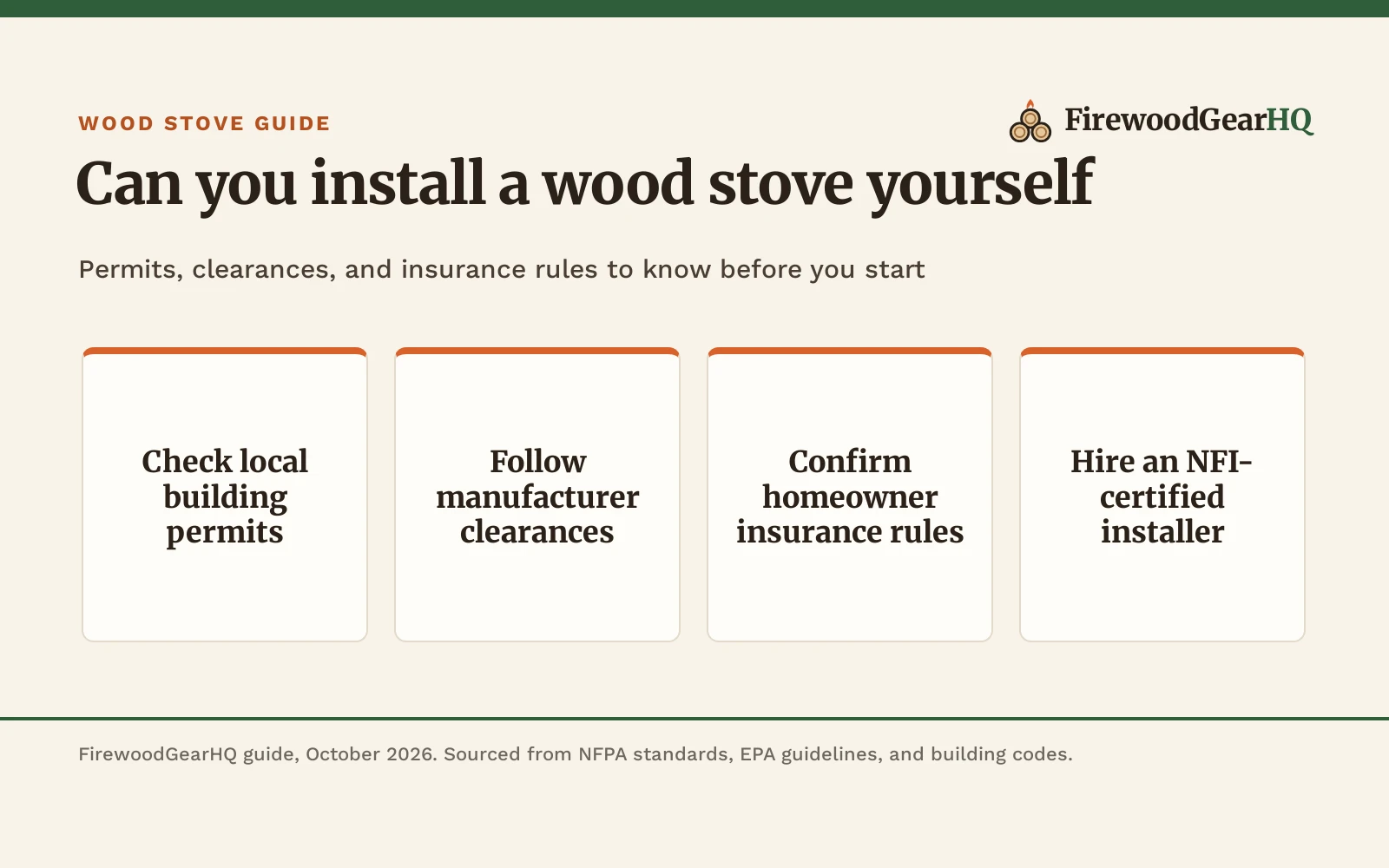
Can you install a wood stove yourself? While homeowners in some regions can legally put an appliance in place, tackling a complete do-it-yourself wood stove setup is rarely advisable. Navigating local building permits, mandatory municipal inspections, strict manufacturer clearances, and homeowner insurance requirements creates substantial hurdles. Hiring an installer certified by the National Fireplace Institute ensures the appliance meets current building codes and preserves your insurance protection.
FirewoodGearHQ earns a commission when you buy through links on our product pages, at no extra cost to you. Read our affiliate disclosure.
The quick answer
Connecting a solid-fuel appliance involves far more than placing a heavy metal box on a hearth. Every installation combines high thermal energy, combustible wall materials, and complex flue venting through walls, ceilings, or roofs. Local authorities require strict adherence to manufacturer instructions and local safety codes. Even if your municipality allows a homeowner to pull a building permit, insurance carriers often demand signed sign-offs from certified technicians or local fire marshals before extending coverage. When evaluating the best wood stove for heating a house, budgeting for professional installation is essential to ensure long-term safety and legal compliance. To understand the financial commitment involved, review our breakdown on how much it costs to install a wood stove.
Can you install a wood stove yourself?
The legal ability to install a solid-fuel appliance depends entirely on local municipal ordinances and county building codes. Some rural regions allow property owners to install their own heating equipment, provided they obtain the appropriate building permits. In urban and suburban jurisdictions, local regulations frequently mandate that only licensed contractors or certified hearth technicians handle solid-fuel flue connections. Checking with your municipal building department is the essential opening move before purchasing equipment.
Obtaining a building permit involves submitting detailed documentation prior to starting any physical work. Building officials examine the proposed stove location, proximity to combustible framing, hearth floor protection materials, and the venting pathway. Once the equipment is positioned and the chimney connected, a building inspector or fire marshal inspects the completed setup in person. Attempting to install an appliance without an active permit violates municipal building codes and can result in stop-work orders, steep fines, or an order to remove the stove completely.
Homeowner insurance rules and liability risks
Homeowner insurance policies carry strict provisions regarding solid-fuel heating appliances. Installing a wood stove introduces thermal risks that insurers scrutinize closely. Most insurance carriers require advance notification before an appliance is installed and operated. Failing to disclose a new wood stove can void your entire property insurance policy.
Insurance companies routinely request proof that the installation meets recognized safety standards. Underwriters often require a copy of the finalized municipal building permit, a signed inspection report from a local fire official, or documentation verifying that an accredited professional performed the work. If an unpermitted or self-installed stove causes a chimney fire or house fire, insurance adjusters investigate the origin thoroughly. If the investigation reveals an uninspected installation or a failure to comply with manufacturer clearances, the insurance carrier can deny the property damage claim outright, leaving the homeowner responsible for all financial losses.
Clearance codes, hearth protection, and chimney draft
Wood stoves generate substantial radiant heat that can ignite nearby combustible materials over extended burning periods through pyrolysis. Pyrolysis lowers the ignition temperature of surrounding wood framing over time, creating a fire hazard even without direct flame contact. To prevent this hazard, certified stoves carry metal data plates detailing mandatory clearance distances to side walls, rear walls, corners, and ceilings. These clearance specifications derive from rigorous safety standards established by accredited laboratories for solid-fuel appliances. Modifying clearances requires approved heat shields constructed with dedicated air spaces per National Fire Protection Association guidelines.
Hearth protection is equally demanding. A non-combustible floor protector must extend beneath the stove and forward past the fuel loading door to guard against falling sparks and rolling embers. Beyond physical coverage, many modern appliances mandate hearth pads with certified thermal resistance values to stop heat transfer into combustible subfloors. Sizing the chimney flue correctly is crucial for safe operation. A chimney that is too narrow restricts exhaust, while an oversized flue cools flue gases rapidly, causing excessive creosote formation. Proper draft physics require the correct flue diameter, adequate vertical height, and minimal directional elbows. To understand clean combustion standards, see our guide on what EPA-certified wood stoves require.
Why an NFI-certified installer protects your home
Hiring a certified technician eliminates the uncertainty, physical risks, and liability associated with do-it-yourself installations. The National Fireplace Institute educates and credentials professionals in wood-burning appliance design, clearance calculations, and venting physics. Similarly, technicians credentialed by the Chimney Safety Institute of America specialize in flue construction, liner installation, and creosote prevention.
A certified professional handles every critical detail: verifying that floor joists support stove and hearth weight, calculating draft requirements, installing insulated chimney thimbles through combustible walls, and weatherproofing roof penetrations. Crucially, certified installers supply the exact documentation municipal building inspectors and insurance underwriters require. Working with an accredited specialist also protects your appliance warranty, as major stove manufacturers stipulate that improper installation voids warranty coverage.
Essential wood stove safety rules and equipment
Operating a wood-burning appliance safely demands proper equipment, certified accessories, and regular maintenance routines. Review our comprehensive wood stove safety checklist for seasonal upkeep habits. Core safety practices include:
- Install smoke and carbon monoxide detectors: Solid-fuel appliances can produce carbon monoxide if draft weakens or exhaust leaks develop. Mount working smoke alarms and dedicated carbon monoxide detectors on every level of the home, placing units near bedrooms and in the living area where the stove operates. Compare reliable alarms in our review of the best carbon monoxide detector for wood stove homes.
- Schedule annual chimney inspections: Have a certified chimney sweep inspect the flue and chimney structure annually before lighting the initial fire of the cold season. Annual inspections identify creosote accumulation, damaged flue liners, and structural deterioration. Learn more in our guide on chimney cleaning frequency and our safety guide on creosote prevention.
- Burn seasoned firewood exclusively: Burning wet or green cordwood produces cool flue temperatures, heavy smoke, and dangerous creosote glaze along flue walls. Always burn firewood that has seasoned thoroughly until dry and clean-burning.
- Monitor combustion temperatures: Using a magnetic or probe thermometer on your stovepipe helps you maintain optimal operating temperatures, avoiding both cool, creosote-forming smolders and hazardous over-firing. Find top-rated meters in our guide to the best stove thermometer.
- Verify current tax regulations: Homeowners evaluating new installations should note that federal biomass stove tax credits have expired and are no longer available. Review details in our wood stove tax credit guide.
Install stoves and inserts to the manufacturer's instructions and your local code, usually by a certified installer with a permit and inspection. Keep the listed clearances to combustibles, run working smoke and carbon monoxide detectors, have the chimney inspected and cleaned every year to prevent creosote fires, burn only seasoned wood, and check local burn rules. See EPA Burn Wise, NFPA heating safety, CPSC carbon monoxide guidance and the Chimney Safety Institute of America (CSIA). Read our Safety Disclaimer.
Frequently Asked Questions
Can you legally install your own wood stove?
Legality varies by jurisdiction. Some local building departments permit homeowners to install solid-fuel appliances on their own property, provided they obtain a building permit and pass formal inspections. Other municipalities require licensed contractors to complete all flue connections. Regardless of local legal allowances, homeowner insurance companies frequently require certified installation to maintain property coverage.
Do you need a building permit to install a wood stove?
In most jurisdictions, yes. Nearly all municipal and county building departments mandate a formal building or mechanical permit prior to installing a wood-burning stove or chimney system. The permitting process ensures the installation adheres to manufacturer clearance specifications, hearth pad requirements, and local fire codes before the stove is operated.
Will homeowner insurance cover a self-installed wood stove?
Insurance coverage depends on your carrier. Many insurers require proof of professional installation by an accredited technician or a signed inspection certificate from a municipal building official. If an unpermitted, self-installed stove causes a chimney fire or property damage, the insurance company can investigate and potentially deny the claim.
What is an NFI-certified wood stove installer?
An NFI-certified specialist is an installer credentialed by the National Fireplace Institute in solid-fuel hearth systems. These technicians are trained in manufacturer clearance standards, combustion airflow, flue sizing, and building code compliance. Their documentation is widely recognized and trusted by municipal building inspectors and insurance providers.
Can an unpermitted wood stove void insurance claims?
In many cases, yes. Operating an unpermitted wood stove without notifying your insurer violates standard policy conditions. In the event of a fire, an insurance investigator will inspect the installation. If the stove lacked permits, failed local building codes, or was never disclosed to the insurer, the company can deny claim payouts.
What safety alarms belong in a wood stove home?
Homes heated with wood require operational smoke alarms and carbon monoxide detectors on every level, particularly near sleeping quarters and within the room housing the stove. Interconnected alarms provide the earliest alert if draft conditions reverse or flue gases escape.
Related guides
Explore our complete wood stoves hub for advice on sizing, safety, and equipment. When planning a heating upgrade, consult our buying guides on the best wood stove for heating a house and how to choose a wood stove. Size your living space accurately with our guide on what size wood stove you need, and compare home heating alternatives in our comparisons of wood burning stove vs fireplace and wood burning stove vs insert. Maintain daily safety with our wood stove safety checklist, monitor flue conditions with the best stove thermometer, and discover essential hearth gear in our stove accessories section.
About the author
The FirewoodGearHQ editorial team researches firewood and wood heating equipment from published specifications, ratings and warranty terms, and scores every pick the same way. We do not run our own product trials.