Best Carbon Monoxide Detector for Wood Stove Homes: 5 Alarms Compared (2026)
Five carbon monoxide detectors for wood stove homes compared by sensor technology, power source, UL safety standards, and backup battery life during power outages.
 By FirewoodGearHQ Editorial
Updated October 9, 2026
By FirewoodGearHQ Editorial
Updated October 9, 2026
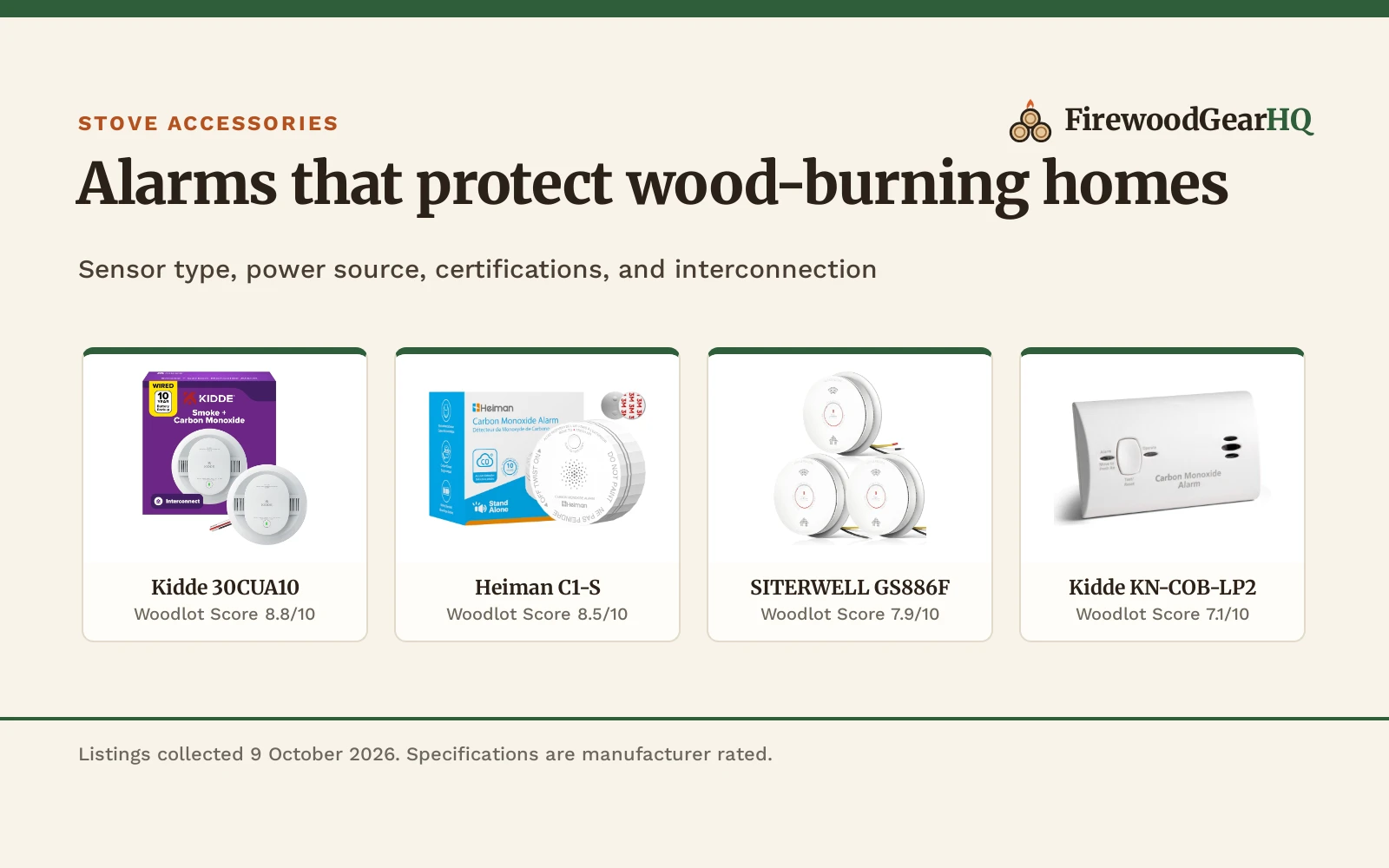
Heating with a wood stove brings comforting warmth and independence, but any wood-burning appliance presents a carbon monoxide hazard if draft stalls, door seals leak, or flue dampers close prematurely. Choosing the best carbon monoxide detector for wood stove homes means finding reliable sensing that alerts your family before toxic fumes spread. This guide compares five carbon monoxide detectors across electrochemical sensing accuracy, dual smoke detection, power sources, safety certifications, and battery backup during winter power outages.
FirewoodGearHQ earns a commission when you buy through links on this page, at no extra cost to you. Affiliate disclosure.
Quick picks
- Best Overall Kidde 30CUA10: Hardwired 120V combo alarm with a 10-year sealed battery backup, UL 2034 and UL 217 certifications, and a 10-year limited warranty. Check price
- Best Battery-Powered Heiman C1-S: Compact standalone unit with a Figaro electrochemical sensor, UL 2034 certification, and a 10-year battery life. Check price
- Best Voice Interconnected SITERWELL GS886F: Hardwired combo unit with battery backup, voice alerts, and interconnection for up to 12 alarms across the home. Check price
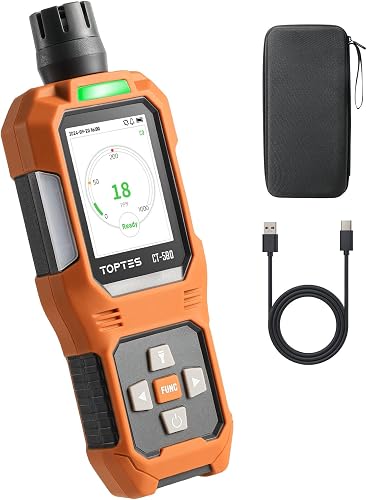
- Best for Spot Checks TOPTES CT-580: Handheld rechargeable monitor with a 0.3-second response time, 0 to 1000 PPM color screen, and three alert modes. Check price
Compare the picks
| Model | Woodlot Score | Power Source | Sensor Type | Certifications (stated) | Alarms & Indicators | Warranty (stated) |
|---|---|---|---|---|---|---|
| Kidde 30CUA10 | 8.8/10 | 120V AC with 10-year battery backup | Photoelectric and electrochemical | UL 2034 5th Ed, UL 217 10th Ed, FCC | 85 dB audible, red LED | 10 years |
| Heiman C1-S | 8.5/10 | 10-year lithium battery | Figaro electrochemical | UL 2034 5th Ed, CSFM, UL94 V-0 | 85 dB audible, visual LED | 10 years (7 years in table) |
| SITERWELL GS886F | 7.9/10 | 120V AC with 2 AA battery backup | Dual sensors (photoelectric and CO) | UL 2034, UL 217 | Exceeds 85 dB audible, voice alert | Not stated |
| Kidde KN-COB-LP2 | 7.1/10 | 2 AA batteries | Electrochemical | Not stated | 85 dB audible, green and red LEDs | Not stated |
| TOPTES CT-580 | 6.9/10 | USB-C rechargeable battery | Electrochemical | Accredited lab certified | Audible, visual, and vibration | Not stated |
Specifications are manufacturer rated, collected 9 October 2026. Dimensions and weights are as listed. Only two of these listings state an explicit warranty term.
The picks
| Award | Product | Woodlot Score About the HQ ScoreThe Woodlot Score runs from 0 to 10 and weighs performance (35%), build (25%), value (25%), safety (10%, where it applies) and warranty (5%), using only what the manufacturer and the listing publish. How we pick › | |
|---|---|---|---|
 Kidde Smoke & CO Detector
|
8.8/10 | Buy | |
 Heiman Carbon Monoxide Detectors
|
8.5/10 | Buy | |
 SITERWELL Smoke & CO Detector Interconnected
|
7.9/10 | Buy | |
 Kidde Carbon Monoxide Detector
|
7.1/10 | Buy | |
 TOPTES CT-580 Portable Carbon Monoxide Detector
|
6.9/10 | Buy |
Kidde Smoke & CO Detector
A hardwired 120V combination smoke and carbon monoxide alarm with a sealed 10-year battery backup, wired interconnect capability, and UL 2034 and UL 217 certifications.
Pros
- Dual detection combines photoelectric smoke and electrochemical carbon monoxide sensors
- Hardwired 120V connection with a built-in 10-year sealed battery backup
- Certified to meet UL 2034 5th Edition and UL 217 10th Edition standards
- 10-year limited warranty stated by the manufacturer
Cons
- Requires existing 120V household wiring and electrical installation
- Heaviest residential unit in this group at 10.4 ounces
- Interconnect requires compatible Kidde wired alarm wiring
- Lacks a digital parts-per-million numerical readout display
Heiman Carbon Monoxide Detectors
A compact standalone carbon monoxide detector powered by a 10-year lithium battery, featuring a Japanese Figaro electrochemical sensor and UL 2034 5th Edition certification.
Pros
- Equipped with a Japanese Figaro electrochemical sensor for accurate detection
- 10-year sealed lithium battery eliminates battery replacement routines
- Certified to UL 2034 5th Edition standards and CSFM approved
- Flame-retardant UL94 V-0 ABS and polycarbonate housing
Cons
- Listing contradicts warranty duration, stating 10 years in bullets but 7 years in the spec table
- Standalone design without whole-home wireless or wired interconnection
- No numerical parts-per-million digital display screen
- Dedicated carbon monoxide detector only, without smoke sensing
SITERWELL Smoke & CO Detector Interconnected
A 2-in-1 combination smoke and carbon monoxide alarm with wired and wireless interconnectivity for up to 12 units, audible voice alerts, and dual battery backup.
Pros
- Supports wired or wireless interconnection across up to 12 compatible alarms
- Clear voice warning clearly identifies whether smoke or carbon monoxide is present
- Complies with UL 2034 and UL 217 safety standards
- Operates on 120V AC household current with two AA battery backup
Cons
- No warranty term is stated anywhere in the listing data
- Listing contradicts package count, stating 3 packs in title but 1 item in spec table
- Spec table lists only photoelectric sensor despite bullets describing dual sensors
- Largest physical profile in this review at 6.1 inches square and 14.08 ounces
Kidde Carbon Monoxide Detector
A portable, battery-operated carbon monoxide detector running on two AA batteries, with an 85 dB audible alarm, LED indicators, and event memory.
Pros
- Powered by two included AA batteries with no electrical wiring required
- Versatile design mounts on a wall or stands independently on a tabletop
- Event memory records the last detection or manual check event
- Lightweight and portable at 3.68 ounces
Cons
- No warranty term is stated on this listing
- Listing does not state compliance with UL 2034 standards
- No digital display to view real-time numerical carbon monoxide levels
- Requires ongoing battery replacements rather than a 10-year sealed cell
TOPTES CT-580 Portable Carbon Monoxide Detector
A handheld, USB-C rechargeable carbon monoxide inspection monitor featuring a 0.3-second response time, 0 to 1000 PPM color screen, and three alert modes.
Pros
- Rapid 0.3-second response time with high-sensitivity electrochemical sensor
- Full-color TFT graphical display showing 0 to 1000 PPM measurements
- Three simultaneous alarm modes: indicator light, audible sound, and vibration
- USB-C rechargeable battery, auto screen-off, and built-in flashlight
Cons
- No warranty term is stated on the listing
- Designed as a handheld inspection tool rather than a permanent residential wall alarm
- Does not carry UL 2034 residential certification
- Specification table lists alarm only as audible despite bullets describing three alert modes
How we scored them
Each detector is scored out of 100 on performance, build, value, safety and warranty, using only what the listing publishes. The weights are on our How We Pick page.
| Product | Woodlot Score | Perf. /35 | Build /25 | Value /25 | Safety /10 | Warranty /5 |
|---|---|---|---|---|---|---|
| Kidde 30CUA10 | 8.8 | 32 | 22 | 20 | 9 | 4 |
| Heiman C1-S | 8.5 | 30 | 21 | 21 | 9 | 4 |
| SITERWELL GS886F | 7.9 | 29 | 20 | 21 | 9 | 0 |
| Kidde KN-COB-LP2 | 7.1 | 26 | 19 | 21 | 5 | 0 |
| TOPTES CT-580 | 6.9 | 27 | 19 | 19 | 5 | 0 |
Buying guide: choosing the best carbon monoxide detector for wood stove homes
A wood stove is an enclosed combustion appliance that relies on chimney draft to pull combustion air in and push exhaust gases outside. When wood burns completely, it yields carbon dioxide and water vapor. However, when draft falters, kindling smolders, or coals starve for oxygen, combustion becomes incomplete and produces carbon monoxide. Because carbon monoxide is completely invisible and odorless, specialized detection equipment is mandatory for every wood-burning household.
Why wood-burning homes require specialized alarms
Unlike homes heated solely by central furnaces, wood stove households experience distinct draft patterns. Opening a stove door to reload logs can momentarily reverse airflow, allowing exhaust to enter the room. Barometric pressure changes, cold flue chimneys, and tight home construction with negative air pressure can also induce downdrafts. Having a dedicated carbon monoxide alarm near wood stove rooms ensures that sudden backdrafts or decaying coals do not quietly elevate gas concentrations while occupants sleep.
Electrochemical sensor technology
Modern carbon monoxide detectors rely on electrochemical sensors. Inside an electrochemical cell, platinum electrodes and chemical solutions react with carbon monoxide molecules, generating an electrical current directly proportional to gas concentration. This technology provides accurate tracking, consumes minimal battery power, and avoids false triggers from household dust or humidity.
Hardwired versus sealed battery power during winter outages
Winter storms that drop tree limbs on power lines frequently cause grid blackouts. During these cold snaps, wood stoves often run as the primary heat source. An alarm powered purely by household AC electricity without battery backup goes dead during the exact moment wood stoves work hardest. Wood stove owners should select hardwired units with integrated battery backup or dedicated 10-year sealed lithium battery detectors that operate independently of household power.
Interconnection and whole-home warning coverage
In many rural and suburban layouts, wood stoves operate in living rooms, basements, or hearth rooms distant from upstairs bedrooms. A single localized buzzer may fail to wake sleeping residents down the hallway. Interconnected alarm networks solve this danger: when one sensor triggers in the stove room, all linked sirens sound across the entire residence simultaneously.
Where to place a CO alarm near wood stove rooms
Proper placement of a co alarm near wood stove living areas requires balancing proximity with environmental protection. Do not install a detector directly above the stove door or on the ceiling directly over the flue collar. Concentrated heat, ash dust, and normal reloading draft puffs can soil sensors or cause nuisance chirps. The National Fire Protection Association (NFPA) and the Consumer Product Safety Commission (CPSC) recommend placing alarms on every level of the home and outside each sleeping area. Inside the stove room, mount the alarm according to manufacturer instructions, positioned on a wall or ceiling several paces away from the hearth where air circulates freely.
Safety certifications and official standards
When selecting life-safety hardware, verify formal third-party certifications. Residential carbon monoxide alarms should be certified to UL 2034, which defines response times and calibration criteria for single and multiple station carbon monoxide alarms. Combination smoke and carbon monoxide units should also comply with UL 217 for smoke detection. Approvals from the California State Fire Marshal (CSFM) and fire-retardant enclosure ratings such as UL94 V-0 offer additional assurance of build quality.
Hearth safety practices and maintenance
Detectors serve as an essential warning barrier, but prevention remains your first defense. Always operate wood stoves according to manufacturer clearances and local building codes. Burn only seasoned firewood dried below 20 percent moisture, which burns cleaner and minimizes creosote formation, as recommended by the EPA Burn Wise program. Schedule an annual inspection and sweep of your flue with a certified professional from the Chimney Safety Institute of America (CSIA), and maintain routine hearth checks using our wood stove safety checklist.
Wear eye protection and gloves for cutting, splitting and handling, follow every tool's manual, install stoves to code, and have the chimney inspected and cleaned every year. See EPA Burn Wise and NFPA heating safety. Read our Safety Disclaimer.
Frequently Asked Questions
What is the best carbon monoxide detector for wood stove homes?
For homes with existing wiring, a hardwired combo unit certified to UL 2034 and UL 217 with a 10-year sealed backup battery and whole-home interconnection offers the most comprehensive defense. For homes without hardwired connections, a standalone 10-year sealed lithium battery unit with an electrochemical sensor provides dependable cordless monitoring.
Where should I place a CO alarm near wood stove equipment?
Follow NFPA guidelines by installing alarms on every level of the house and outside all sleeping areas. Within the wood stove room, mount the device along an interior wall or ceiling away from direct heating drafts, avoiding the space directly above the firebox door where heat and ash concentrate.
Can a wood stove trigger a carbon monoxide detector?
Yes. If chimney draft weakens, flue dampers are restricted too early, door gaskets wear thin, or negative air pressure draws exhaust downward into the room, carbon monoxide can escape into living spaces and trigger the alarm. A sounding alarm demands opening windows, turning off air handlers, evacuating the home, and inspecting your stove setup once safe.
Do I need an interconnected alarm system with a wood stove?
Interconnected systems are strongly recommended for multi-story or sprawling homes. If a wood stove in a basement or ground-floor den leaks carbon monoxide during the night, an interconnected network ensures that alarms inside distant bedrooms sound immediately.
How often should my chimney be inspected?
The NFPA and the Chimney Safety Institute of America recommend an annual chimney inspection and cleaning prior to every heating season. Regular chimney maintenance prevents creosote blockages that cause chimney fires or force exhaust gases back into your home.
Related guides
Keep your hearth running safely and efficiently by pairing your alarms with our wood stove safety checklist. For temperature control and heat circulation, see our reviews of the best wood stove thermometers and the best wood stove fans. When managing draft and smoke issues, learn why your wood stove smokes when you open the door and find out how often you should clean your chimney. To reduce creosote buildup from unseasoned fuel, read our guide on creosote prevention, or master overnight burns with our steps on how to keep a wood stove burning all night. For cleanup, compare the best ash vacuums for wood stoves. Explore our full hubs on wood stoves and stove accessories.
About the author
The FirewoodGearHQ editorial team researches firewood and wood heating equipment from published specifications, ratings and warranty terms, and scores every pick the same way. We do not run our own product trials.