Oak vs Hickory Firewood: Heat, Burn Time and Splitting Compared
A detailed comparison of oak vs hickory firewood covering heat output, burn time, splitting effort, seasoning requirements and the best uses for home heating.
 By FirewoodGearHQ Editorial
Updated October 10, 2026
By FirewoodGearHQ Editorial
Updated October 10, 2026
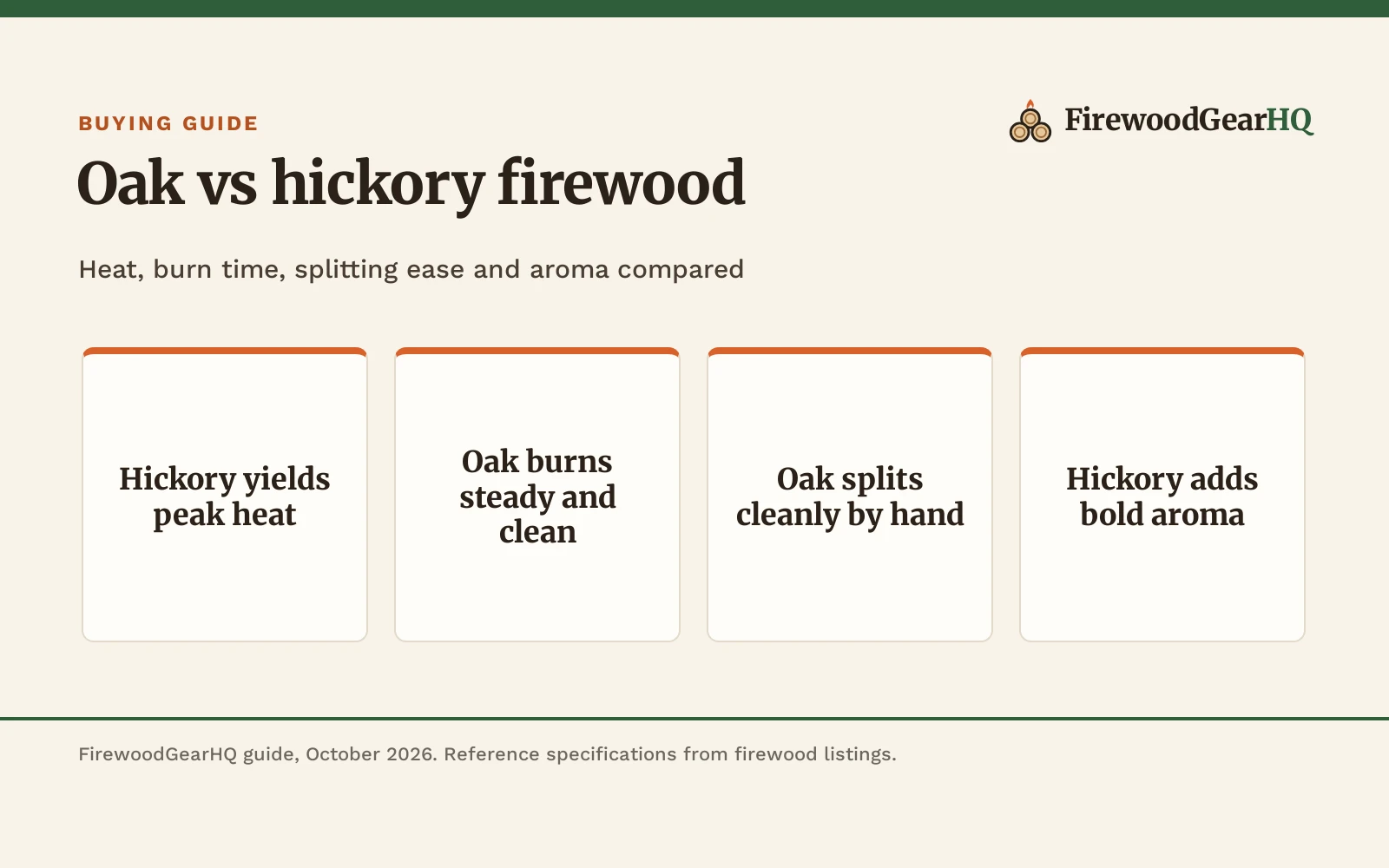
When comparing oak vs hickory firewood, hickory delivers higher heat output and an intense smoke aroma, while oak provides a steadier, calmer burn and splits far more easily by hand. Both are dense hardwoods that produce long-lasting coal beds for overnight heating in a wood stove or fireplace. For peak heat output and barbecue smoking, hickory holds the advantage, while oak is generally the more manageable everyday heating wood for manual processing and smooth stove regulation.
FirewoodGearHQ earns a commission when you buy through links on our product pages, at no extra cost to you. Read our affiliate disclosure.
The quick answer
Hickory produces more heat per cord than nearly any other domestic firewood, making it ideal for bitter cold spells when a stove needs maximum output. Oak sits just behind hickory in total heat, burning at a calmer pace that is easier to regulate in a wood stove. Both woods form durable coal beds that keep a firebox warm until morning. Oak is often easier to harvest and split by hand, while hickory demands more effort with a maul or wedge. For broader heat rankings, see our guide to the best firewood to burn.
Oak vs hickory firewood: quick comparison
Both species rank in the top tier of dense firewood. The table below compares how oak and hickory perform across key burning characteristics.
| Characteristic | Oak Firewood | Hickory Firewood | Practical Comparison |
|---|---|---|---|
| Heat Output | Very high; steady, sustained warmth | Peak heat; highest among domestic hardwoods | Hickory for maximum heat |
| Burn Duration | Exceptionally long; steady, even burn cycle | Exceptionally long; intense warmth through extended burn | Tie; both sustain long burns |
| Ease of Splitting | Straight grain splits cleanly when green | Stringy, interlocked grain resists splitting wedges | Oak by a wide margin |
| Coaling Properties | Heavy, durable coal bed that holds heat for hours | Excellent coal bed; maintains high radiant heat | Tie; both produce superb coals |
| Seasoning Demand | Requires extended drying; tight cellular structure | Requires thorough drying to prevent smoldering | Tie; both demand patient drying |
| Smoke and Aroma | Mild, subtle aroma suitable for indoor burning | Strong, sweet, rich smoke aroma favored for barbecue | Hickory for flavor; oak for subtle scent |
| Sparks and Popping | Minimal sparking; burns quietly and safely in fireplaces | Occasional sparking; open hearths require a screen | Oak for quiet, low-spark fires |
Compare both species against other common timbers in our firewood BTU chart and our guide on hardwood vs softwood firewood.
Key differences between oak and hickory
Heat output and fire efficiency
Wood density determines heat energy per log, and hickory is among the densest hardwoods in North America. Seasoned hickory generates intense radiant warmth that easily heats a home during sub-zero cold waves. Oak is also remarkably dense, producing dependable, high-yield warmth that outperforms birch, maple, and cherry. While hickory releases more heat at peak burn, oak delivers a smooth, steady warmth that helps avoid overheating smaller living spaces.
Burn duration and coal bed quality
Both oak and hickory produce heavy, enduring beds of glowing red coals that sustain heat overnight. Once initial flames subside, an oak coal bed radiates steady warmth that allows easy morning reloading without rekindling. Hickory creates an equally durable, hot coal bed, but because hickory burns with higher flame intensity when draft air is open, regulating intake air carefully is essential to achieve extended overnight burns.
Splitting difficulty and processing effort
Processing reveals a sharp contrast between these two species. Straight-grained oak logs, especially red oak, split cleanly along growth rings when green. A sharp splitting axe or splitting maul can divide fresh oak rounds with clean strikes. Hickory presents a tougher challenge: its fibers are interlocked, tough, and stringy. Striking green hickory with a hand maul can cause the tool to bounce without splitting the wood. If you process substantial quantities of hickory, a dedicated log splitter saves significant physical effort.
Seasoning time and moisture loss
Both species hold significant moisture when green and require patient, thorough drying before burning. Oak dries slowly because cellular pores trap moisture deep within the heartwood. Hickory’s dense fibers similarly slow internal evaporation. Burning either species green leads to cool fires, heavy smoke, and dangerous creosote buildup in your chimney flue. Split logs promptly after cutting and stack off the soil for airflow. For drying schedules, see our guides on how long to season firewood and how to season firewood fast.
Smoke flavor and aroma
When burned in open fireplaces, campfires, or smokers, the aroma of oak and hickory becomes immediately noticeable. Hickory produces a pungent, sweet, bacon-like smoke aroma favored for smoking pork shoulders, brisket, and ribs. Oak offers a milder, more rounded smoke character that imparts gentle warmth without overpowering food. Inside an airtight wood stove, combustion gases vent safely outside through the chimney flue, though opening the stove door to reload can briefly release wood aroma. In open hearths where embers can escape, oak burns quietly with minimal sparking, whereas popping hickory requires a protective fireplace screen.
When to choose oak or hickory
Choosing between oak and hickory depends on heating needs, processing habits, and availability:
- Choose oak if: you split firewood by hand, want steady burns without constant damper adjustments, prefer a subtle aroma, and buy from local suppliers.
- Choose hickory if: you face bitter winter cold demanding peak heat, plan to smoke meats outdoors, or own hydraulic splitting equipment capable of handling stringy wood grain.
- Consider a mix: loading oak for an enduring overnight base and adding hickory splits for daytime heat provides balanced warmth and efficiency.
Inspect bark before bringing logs inside. For pest prevention, see how to keep bugs out of firewood and our guide on whether you can bring firewood indoors.
Stacking and seasoning best practices
Dense hardwoods reward careful storage to ensure clean combustion:
- Split promptly: splitting exposes heartwood to sun and wind, accelerating drying.
- Elevate off bare ground: damp soil causes rot. Use a firewood rack with cover or pallets to keep bottom rows dry.
- Cover top only: shield the top from rain, leaving sides open to breezes. See our guide on whether you should cover firewood.
- Confirm dryness with a meter: split a piece and check fresh grain with a firewood moisture meter. See how to tell if firewood is seasoned.
- Stack for stability: build straight rows with cross-hatched end pillars. See how to stack firewood.
Kiln-dried and store-bought wood
Commercially packaged kiln-dried wood provides ready-to-burn fuel that lights cleanly with low smoke. Kiln chambers reduce moisture while eliminating pests.
Several producers package oak and hickory in standard sizes for home heating and cooking:
- Firewood Central states its kiln-dried PA hickory in 16-inch splits is dried to 15 percent moisture or less, in a 38-pound bundle containing 14 to 18 splits.
- Smoak Firewood, founded in 2011, lists USDA-certified kiln-dried white oak in 12-inch lengths (3 to 4 inches wide) weighing 45 to 50 pounds, plus 16-inch logs in a 24 by 18 by 18 inch box at 120 to 140 pounds.
- Old Potters lists USDA-certified kiln-dried oak and hickory in 16-inch logs in a 1.5 cubic foot bundle at 38 to 45 pounds, and 8-inch cooking logs (2 to 3 inches thick) in an 1100 cubic inch bundle at 18 pounds with 16 to 18 logs.
- Gimgsoen lists mini kiln-dried bark-free oak in 6-inch logs in a 15-pound box for tabletop stoves and pizza ovens.
- Kona lists wood pellets in variety packs featuring 100 percent oak and 100 percent hickory for grilling and smoking.
When purchasing by the cord, check our guides on how much is a cord of wood and face cord vs full cord.
Turn a stack's length, height and depth into full and face cords, and estimate how much wood a winter takes.
Frequently Asked Questions
Which firewood burns hotter, oak or hickory?
Hickory burns hotter than oak. Both rank among the highest-yielding hardwoods, but hickory has higher density and produces slightly more heat per cord. Oak provides a calmer burn that is easier to regulate.
Is hickory harder to split than oak?
Yes. Hickory has stringy, interlocked fibers that resist splitting wedges, making manual splitting demanding. Oak has straighter grain that splits predictably along growth rings.
Can you mix oak and hickory in the same fire?
Yes. A base of oak creates an enduring bed of coals, while adding hickory splits boosts heat output during cold spells.
Why does oak take so long to season?
Oak has tight cellular pores that hold bound moisture deep within its heartwood, requiring patient stacking in a breezy, sunny spot to reach low moisture levels.
Which wood is better for cooking and smoking meat?
Hickory is famous for its bold bacon-like aroma, ideal for ribs and brisket. Oak gives a milder smoke flavor that complements poultry, fish, and pizza without overpowering them.
Related guides
Explore our library for species comparisons, tools, and heating advice. Start with our overview of the best firewood to burn, check the firewood BTU chart, and read hardwood vs softwood firewood. For processing, see the best chainsaw for firewood, the best chainsaw sharpener, the best splitting maul, the best splitting axe, and the best log splitter for home use. For storage, visit the firewood storage hub, compare the best firewood rack with cover, and learn how to stack firewood. For stove safety, read on what is creosote and how to prevent it, check the best stove thermometer, select the best wood stove for heating a house, and see whether you can burn pine in a wood stove as well as woods you should never burn.
About the author
The FirewoodGearHQ editorial team researches firewood and wood heating equipment from published specifications, ratings and warranty terms, and scores every pick the same way. We do not run our own product trials.