How to Use a Pickaroon: A Step-by-Step Firewood Handling Guide
Learn how to use a pickaroon to move, lift, and stack firewood rounds without back strain, covering proper stance, swing mechanics, and release technique.

On this page
Top picks at a glance
As an Amazon Associate we earn from qualifying purchases.
- 1
 Hookaroon 28 Inch9.6/10View on Amazon
- 2
 FORESTER Pickaroon Logging Tool9.6/10View on Amazon
- 3
 FORESTER Pickaroon Logging Tool9.5/10View on Amazon
Hauling freshly bucked rounds to the splitter or stacking firewood for winter burning wears down your back from constant bending. A pickaroon, often called a hookaroon, is a wood-handling tool with a sturdy handle and pointed steel hook designed to move firewood rounds without stooping. Knowing how to use a pickaroon comes down to simple mechanics: set a balanced stance with feet wide, swing the pointed beak firmly into the wood, and use handle leverage to pull or lift the round before twisting your wrist to pop the hook free. This keeps fingers clear of pinch points and speeds up wood processing.
FirewoodGearHQ may earn a small commission if you buy through links on this page. The price you pay stays the same. Read our affiliate disclosure.
The quick answer
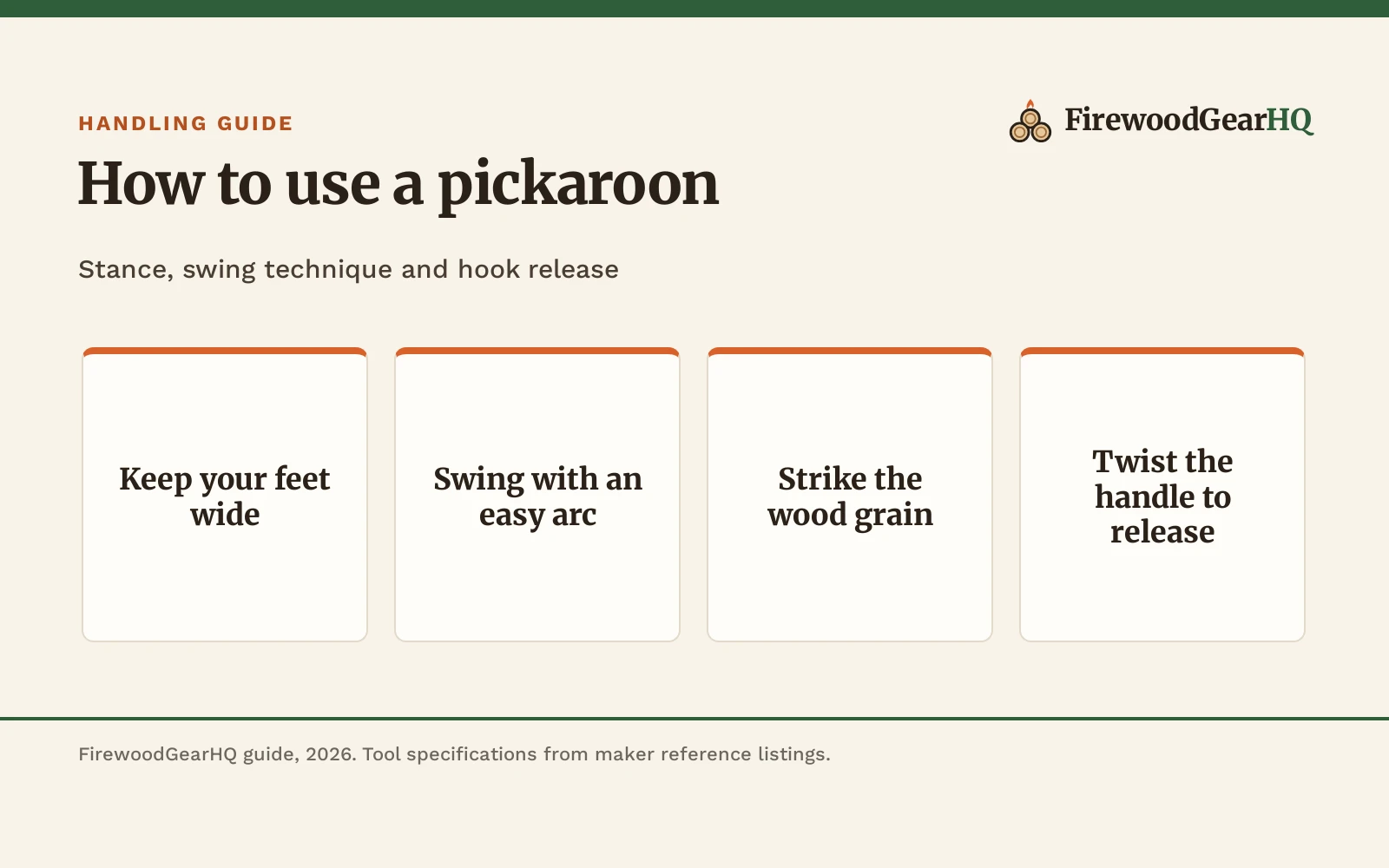
To use a pickaroon, grip the handle near the end and stand with feet wide and clear of the log. Swing the pointed beak in a controlled downward arc along the outside of your leg so the steel tip bites into the wood. Once the hook embeds, lift with your legs or slide the round across the ground. At the splitter, truck bed, or stack, twist the handle sharply sideways to release the point.
Pickaroon handle lengths and specifications
Pickaroons come in varied handle lengths and weights for different tasks. Shorter tools suit sorting on a splitter table or truck bed, while longer handles let you drag rounds off the ground without bending. The specifications below come from maker reference listings.
| Tool model | Handle length | Head weight | Total weight | Handle material |
|---|---|---|---|---|
| Fiskars 12″ Hookaroon | 12″ | Not stated | 9.6 ounces | Plastic (FiberComp) |
| WICING 15″ Hookaroon | 15″ | 708.7 g | 1.8 pounds | Fiberglass |
| XROPURR 17″ Pickaroon | 17″ | Not stated | 2.92 pounds | Steel |
| WICING 28″ Hookaroon | 28″ | 2 pounds | 2.8 pounds | Fiberglass Composite |
| Dolibest 28″ Pickaroon | 28″ | Not stated | 2.99 pounds | Steel |
| XROPURR 28″ Pickaroon | 28″ | Not stated | 4.19 pounds | Steel |
| Council Tool 36″ Hookaroon | 36″ | 1.5 pounds | 3 pounds | Hickory Wood |
| FORESTER 36″ Pickaroon | 36″ | 680 g | 1.5 pounds | Hickory Wood |
| FORESTER Pickaroon (Orange) | Not stated | 1.5 pounds | 1.5 pounds | Hickory Wood |
| FORESTER Pickaroon Platinum | Not stated | Not stated | 1.29 kg | Hickory Wood |
Match tool length to your height and tasks. See our guide to the best length for pickaroon.
How to use a pickaroon
Set your stance before swinging
Safe tool use starts with solid footing. Position your feet wider than shoulder width on level ground before reaching for a log. Never stand directly in the swing path. If the beak glances off hard bark or frozen wood, the head should swing harmlessly past your body rather than into your shin. Keep knees bent to absorb shock, and clear your work area of tripping hazards and stray kindling.
Swing alongside your leg into the grain
Hold the handle near the base with a firm grip. Guide the tool in an easy downward swing along the outside of your thigh. You do not need heavy force; head momentum and the sharp point bury the beak into the wood. Aim for sound wood on the side or end of the round. Striking side bark across the grain gives strong hold for dragging logs. On upright rounds, striking the end grain or rim provides a secure lifting hold. Avoid loose bark, knots, or splits where the beak cannot bite firmly.
Lift and drag with leg power
Once the steel beak embeds in the wood, use the handle as an arm extension. To move a round across the ground, keep your arm straight and pull backward with your legs. To lift rounds into a cart or onto a splitting platform, bend your knees and push upward through your heels. This transfers the load from your lower spine to your leg muscles. For logs too heavy for hand dragging, use dedicated skidding gear like log tongs or a cant hook instead of overloading the tool.
Twist the handle to release the point
Releasing the tool requires a quick wrist motion. Never yank straight backward, which can loosen the head or strain your shoulder. Instead, apply a sharp sideways twist to the handle. Rotating the handle forces the beak to pry against the wood grain, popping the point free instantly. Fiskars lists a 12-inch forestry tool with a 9.6-ounce weight featuring a pointed beak with toothed edges to assist with grabbing and clean release on firewood.
Work efficiently at the splitter and truck bed
A pickaroon excels when loading a log splitter or unloading a truck. Stand on the ground and hook rounds near the truck cab, sliding them toward the tailgate without climbing in. At the splitter, snag fallen split halves from the ground and swing them back onto the beam without stooping. This keeps fingers away from the wedge and slide, supporting sound log splitter safety rules.
Pickaroon safety and personal protection
Always wear leather gloves to guard against splinters and steel-toe boots in case a round slips. Keep your swing line outside your legs, and review how to move heavy logs safely to prevent injury.
- Clear your swing arc: Keep bystanders and secondary tools well outside your reach.
- Swing to the outside: Swing the hook alongside your thigh, never between your legs or toward your feet.
- Check the connection: Inspect the handle eye and wedges before use. Council Tool secures its 1.5-pound head with both a poplar and steel wedge on a 36-inch hickory handle to prevent loosening.
- Never pry sideways: Pull and lift along the handle line; prying sideways against heavy logs can crack wood handles or bend steel shanks.
- Cover the tip: Use a sheath or guard when storing or carrying the tool to prevent punctures.
Pickaroon versus cant hook, peavey, and log tongs
A pickaroon pulls, drags, and lifts firewood rounds, but is not built for rolling logs or skidding sawlogs. Choose the right tool for each task:
- Pickaroon: Reaches, lifts, and drags firewood rounds without stooping.
- Cant hook: Uses a clasping arm to roll logs on the ground or sawmill bed. See how to use a cant hook and cant hook vs peavey.
- Log tongs: Features gripping jaws for lifting rounds or skidding timber. See how to use log tongs.
- Timberjack: Elevates logs off dirt for clean chainsaw bucking. See the best log lifters.
Pickaroon maintenance and point sharpening
A blunt point requires heavier swings and slips off bark. Sharpen the tip periodically with a flat mill file, filing toward the tip along the original beak angle. Keep wooden hickory handles smooth with boiled linseed oil. For steel and fiberglass handles, wipe off mud and sawdust with a damp cloth to protect the powder-coat finish.
Lift with your legs, not your back, and get help or a mechanical aid for big rounds. Respect each tool's rated capacity, keep feet clear of rolling logs, and wear gloves against splinters. Read our Safety Disclaimer.
Frequently Asked Questions
What is the difference between a pickaroon and a hookaroon?
Makers and wood handlers use the terms interchangeably for tools that grab and move firewood rounds. Historically, some loggers noted a pickaroon had a straight pick while a hookaroon had a curved beak, but modern tools use both names for hooked points. Both perform the same job: moving wood without bending.
How deep should the pickaroon point penetrate the wood?
The point only needs to penetrate into the wood fibers through outer bark or end grain. A moderate swing provides sufficient hold for lifting or dragging. Sinking the pick too deep makes it harder to dislodge and slows down your pace.
Can you use a pickaroon on frozen firewood?
Yes, but frozen timber is harder than green wood. Strike into the end grain or clean sapwood, as the hook can glance off frozen outer bark. Keeping the point sharp ensures a clean bite into cold logs.
What handle length is best for a pickaroon?
Choose handle length based on height and task. Reference listings show 28 and 36 inches allow dragging rounds with minimal bending. Shorter models of 12 to 17 inches offer agile sorting on splitter tables or truck beds. See our guide to the best length for pickaroon.
How do you release a pickaroon stuck in a log?
Never pull straight backward against a stuck hook. Grasp the handle and twist it sharply sideways. This forces the beak against the wood grain, levering the point free with minimal effort.
Can you lift heavy logs overhead with a pickaroon?
No. A pickaroon is designed to drag rounds across the ground, slide pieces across a truck bed, or lift firewood to waist height. Never lift rounds overhead or swing logs toward your body.
Related guides
Explore more tools in our firewood handling hub. For rolling logs, read how to use a cant hook, compare cant hook vs peavey, and see the best cant hooks. For timber tongs, see how to use log tongs and the best log tongs. Keep logs off dirt while bucking with the best log lifters. Pair your gear with the best log splitter for home use, follow log splitter safety rules, and review how to move heavy logs safely. Once wood is split, see how to stack firewood, protect rows with the best firewood rack with cover, and check moisture with the best firewood moisture meter. For cutting, find the best chainsaw for firewood, sharpen chains with the best chainsaw sharpener, and review the chainsaw safety gear checklist. Split stubborn pieces with the best splitting maul, best splitting axe, or a best splitting wedge, and carry splits with a best log carrier.