Do Wood Stove Fans Really Work? Airflow and Heat Distribution Explained
How heat-powered wood stove fans work, what airflow they move, where to place them on the stovetop, and what limits to expect.
 By FirewoodGearHQ Editorial
Updated October 9, 2026
By FirewoodGearHQ Editorial
Updated October 9, 2026
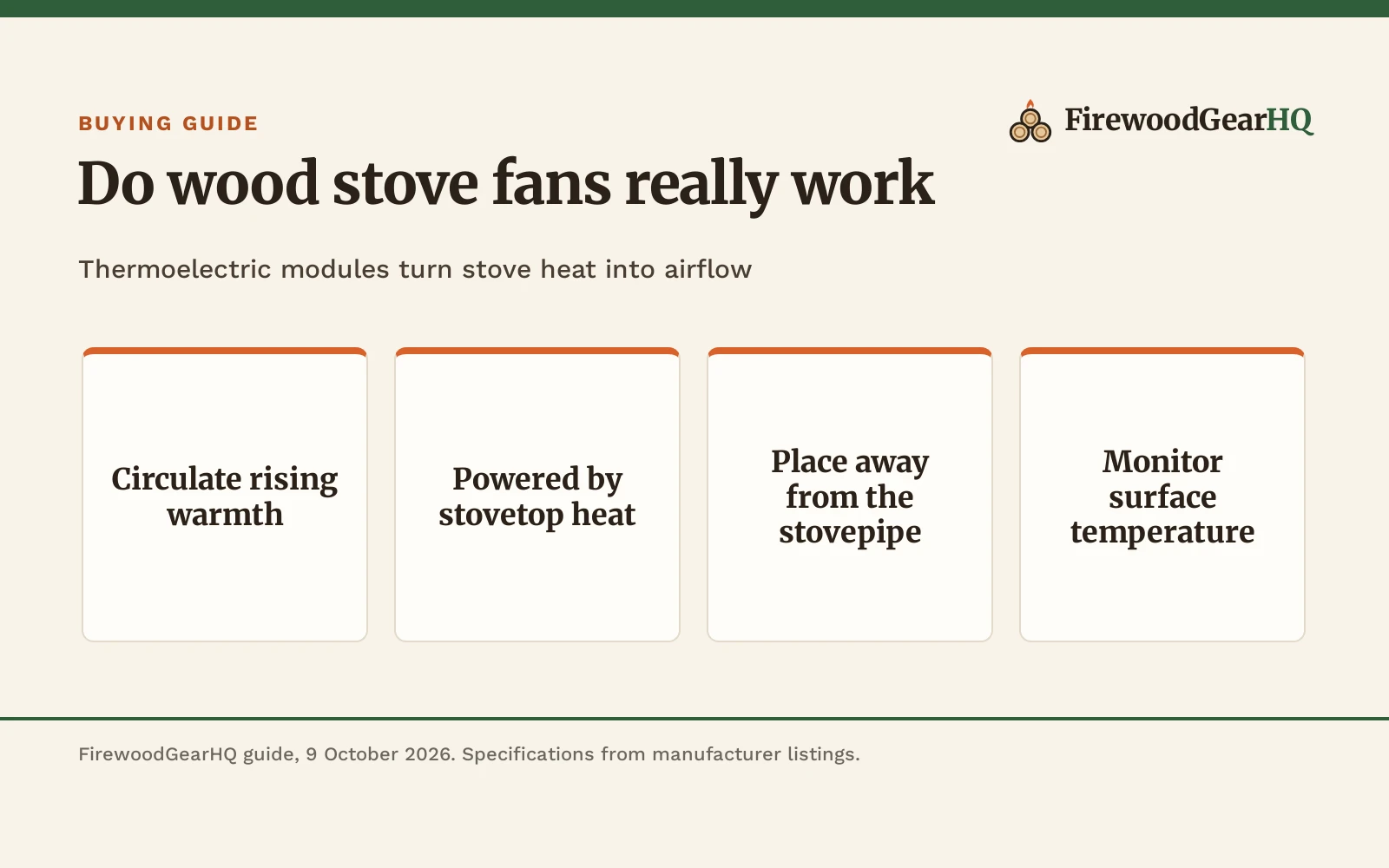
Do wood stove fans really work? Yes, heat-powered wood stove fans work for gentle air circulation, but they do not blow forceful air like electric blowers. A stove fan sits on a hot stovetop and uses a thermoelectric module to generate its own electricity. The spinning blades redirect rising warmth horizontally into the room, reducing hot spots around the stove and distributing heat more evenly across the living area.
FirewoodGearHQ earns a commission when you buy through links on our product pages, at no extra cost to you. Read our affiliate disclosure.
The quick answer: do wood stove fans really work?
Wood stove fans convert stove heat into electricity without cords, batteries, or outlets. A freestanding wood stove radiates intense heat around its firebox while warm air rises toward the ceiling. A wood stove fan interrupts that rising column of warmth and pushes it horizontally across the living area.
The airflow is soft and silent rather than forceful like a furnace vent. The main benefit is evening out room temperatures and pushing heat away from the hearth into cooler areas. For anyone looking to improve comfort from a freestanding stove, adding a model from our best wood stove fan guide offers a practical upgrade among essential stove accessories.
Wood stove fan specifications and airflow comparison
| Brand and model | Blade count | Stated airflow | Operating temperature | Weight |
|---|---|---|---|---|
| Ecofan UltrAir (810CAXBX) | 2 blades | 125 CFM | Not stated | 1.7 pounds |
| Tomersun 6-Blade Extra Large | 6 blades | 180 CFM | 185°F to 660°F (optimal 482°F to 572°F) | 2 pounds |
| Tomersun 8-Blade Compact | 8 blades | Not stated (claims 30% more air than 6-blade) | 176°F start, 392°F to 482°F optimal | 1.3 pounds |
| VODA 6-Blade (VDSF654BUT) | 6 blades | Not stated (claims 28% less wood consumption) | Maximum 653°F (345°C) | 1.9 pounds |
| Tovisel Dual-Head (FWFF001) | 12 blades (dual motor) | Not stated | 130°F start, 350°F to 530°F optimal, 570°F max | 2.2 pounds |
| Tovisel 7-Blade (FWFF003) | 7 blades | Not stated | Not stated | Not stated |
| Tovisel 6-Blade (FWFF002) | 6 blades | Not stated | 130°F start, 356°F to 536°F optimal, 572°F safety lift | Not stated |
| AmzWorld 6-Blade | 6 blades | Not stated | Not stated | Not stated |
Published specifications highlight key differences among models. While some makers publish airflow ratings, others focus on starting temperatures, blade counts, or noise ratings. Always match the fan to the operating temperature of your stove.
How heat-powered wood stove fans work
The Seebeck effect and thermoelectric generation
A heat-powered wood stove fan relies on the Seebeck effect to generate electricity without cords or batteries. Sandwiched between the aluminum base and the upper cooling fins sits a thermoelectric module. When the stovetop heats the base while room air cools the upper fins, the temperature difference generates direct electrical current to spin a small DC motor.
Within the maker’s operating range, a greater temperature difference produces more voltage, spinning the blades faster. If the stove overheats or the cooling fins heat-soak, the temperature differential collapses and fan output drops.
Blade counts and fan airflow
Blade counts vary widely across models. Caframo equips the Ecofan UltrAir with a 2-blade system designed to reduce motor drag and resistance, listing a 125 CFM airflow rating. Other makers use multi-blade designs to move air at low speeds: Tomersun lists a 180 CFM rating on its six-blade model and claims its eight-blade unit moves 30% more air than standard six-blade fans. VODA similarly claims its six-blade design delivers larger air volume than four-blade units, while Tovisel offers seven-blade and 12-blade dual-motor configurations.
Operating temperature ranges and heat transfer
Thermoelectric modules require a minimum temperature to overcome motor resistance. Starting thresholds vary: Tovisel lists models starting at 130°F, while Tomersun lists starting thresholds of 158°F and 176°F (80°C). Optimal ranges also differ: Tomersun lists 392°F to 482°F (200°C to 250°C) on its eight-blade and six-blade units, and 482°F to 572°F on its extra-large model. Tovisel lists optimal ranges of 350°F to 530°F on its dual-motor fan and 356°F to 536°F on its six-blade model. A surface-mounted stove thermometer confirms your stove operates within the fan maker’s range.
Bimetallic safety strips for overheat protection
Excessive heat can damage thermoelectric modules and miniature motors. To reduce this risk, makers including Tomersun, VODA, and Tovisel include a bimetallic strip under the aluminum base. At high temperatures, the strip curves downward to tilt the base off the stovetop, reducing heat conduction. Tovisel lists overheat protection activating above 570°F or 572°F, while Tomersun and VODA instruct users to remove the fan if stove temperatures exceed 653°F (345°C).
Whisper-quiet operation
Heat-powered fans run in near-complete silence. Listings from Tomersun, VODA, and Tovisel specify operating noise under 25 dB, which is quieter than a whisper. AmzWorld lists motor sound below 25 dB in its description, with 30 dB noted on its specification table.
Where to place a wood stove fan for best results
Placement directly influences performance. Because the thermoelectric generator relies on a temperature contrast, the fan must draw cool air across its cooling fins.
- Place near the rear corner: Set the fan on a flat section near the rear corner of the stovetop. This lets the blades push warm air forward while the rear fins draw cooler room air from behind or beside the stove.
- Keep away from the flue pipe: Avoid placing the fan directly in front of or adjacent to the hot stovepipe. Radiant flue heat warms the cooling fins, shrinking the temperature differential and slowing the blades.
- Check surface temperatures: Soapstone and insulated tops radiate heat slowly. Use a surface thermometer to ensure the surface reaches the starting threshold.
- Monitor high fires: Keep a magnetic meter near the fan base. See our guide to the best wood stove thermometer options for surface monitoring.
What happens when a stove gets too hot or stays too cool
A stove fan responds directly to firebox heat. During kindling startup or late in an overnight burn, surface temperatures may fall below the fan’s starting threshold. If stovetop heat sits below the listed 130°F or 176°F (80°C) minimums, the thermoelectric module cannot generate enough current and the fan remains stationary.
Over-firing presents the opposite danger. If temperatures exceed maximum manufacturer limits, such as 570°F on Tovisel or 653°F (345°C) on Tomersun and VODA, internal components can suffer heat damage. Even with a bimetallic lift strip, prolonged exposure to extreme heat can degrade the motor or module. Move the fan to the hearth if temperatures approach the maximum rating.
Wood stove fans versus electric stove blowers
While both devices circulate warm air, they suit different heating needs. A heat-powered wood stove fan operates passively without electricity, cords, or outlets, remaining fully functional during winter power outages. However, stated airflow ratings like 125 CFM on the Ecofan UltrAir or 180 CFM on Tomersun provide gentle circulation intended for single rooms.
Electric blowers use powered AC motors to force high air volumes through a convection jacket, pushing heat into adjoining rooms. However, blowers consume electricity, generate audible motor noise, and shut down during grid outages. To evaluate primary heating stoves, see our reviews of the best wood burning stove with blower models and the best wood stove for heating a house.
Wear eye protection and gloves for cutting, splitting and handling, follow every tool's manual, install stoves to code, and have the chimney inspected and cleaned every year. See EPA Burn Wise and NFPA heating safety. Read our Safety Disclaimer.
Frequently Asked Questions
Do wood stove fans really work without electricity?
Yes. Wood stove fans generate their own electricity from stovetop heat using the Seebeck effect. A thermoelectric module between the hot base and cool fins converts the temperature difference into direct current to spin the motor without cords or batteries.
Are stove fans worth it for home heating?
Yes. For freestanding stove owners, stove fans quietly distribute rising heat horizontally across living areas, reducing hot spots near the hearth. While makers like Tomersun and VODA claim fuel savings up to 28 percent through improved circulation, actual wood consumption depends primarily on home insulation and stove operation.
Where is the best place to put a wood stove fan?
The best placement is near the rear corner or outer edge of a flat stovetop, away from the chimney pipe. This allows the rear fins to draw cooler room air while blades push heat forward. Avoid placing the fan directly in front of the flue pipe, where radiant heat warms the upper fins.
Can a wood stove fan overheat and get damaged?
Yes. Temperatures beyond maker limits can damage thermoelectric modules and motors. Tovisel lists a 570°F limit, while Tomersun and VODA warn against temperatures exceeding 653°F (345°C). While several models include bimetallic lift strips, using a magnetic thermometer prevents over-firing damage.
How much airflow does a wood stove fan produce?
Stove fans produce gentle air circulation. Among listings with published airflow, Ecofan lists 125 CFM for its two-blade UltrAir and Tomersun lists 180 CFM for its six-blade unit. Most brands do not publish CFM ratings, relying on six, seven, eight, or 12 blades to disperse warmth quietly.
Do wood stove fans work on pellet stoves or fireplace inserts?
Wood stove fans generally do not work on fireplace inserts, which sit inside masonry cavities without overhead blade clearance or cool air circulation. They will work on freestanding pellet or gas stoves only if the unit has an exposed, flat metal top reaching starting temperatures like 130°F, 158°F, or 176°F (80°C).
Related guides
Compare heat-powered models in our guide to the best wood stove fan heat powered picks, explore essential hearth gear in our stove accessories hub, and monitor operating temperatures with the best stove thermometers and best wood stove thermometers. For whole-home heating setups, compare the best wood stove for heating a house and the best wood burning stove with blower options. When prepping winter fuel, check our guide on how long to season firewood, keep moisture levels in check with the best firewood moisture meter, and keep splits dry on a best firewood rack with cover. Also see our guides on wood burning stove vs fireplace, wood burning stove vs insert, freestanding fireplace screen with doors, fireplace tools set with wood rack, and the best ash vacuum for wood stoves.
About the author
The FirewoodGearHQ editorial team researches firewood and wood heating equipment from published specifications, ratings and warranty terms, and scores every pick the same way. We do not run our own product trials.