How Long Does Firewood Take to Season? A Complete Drying Guide
How long firewood takes to season depends on species, split thickness, sun and airflow, with clear signs to check before burning.
 By FirewoodGearHQ Editorial
Updated October 9, 2026
By FirewoodGearHQ Editorial
Updated October 9, 2026
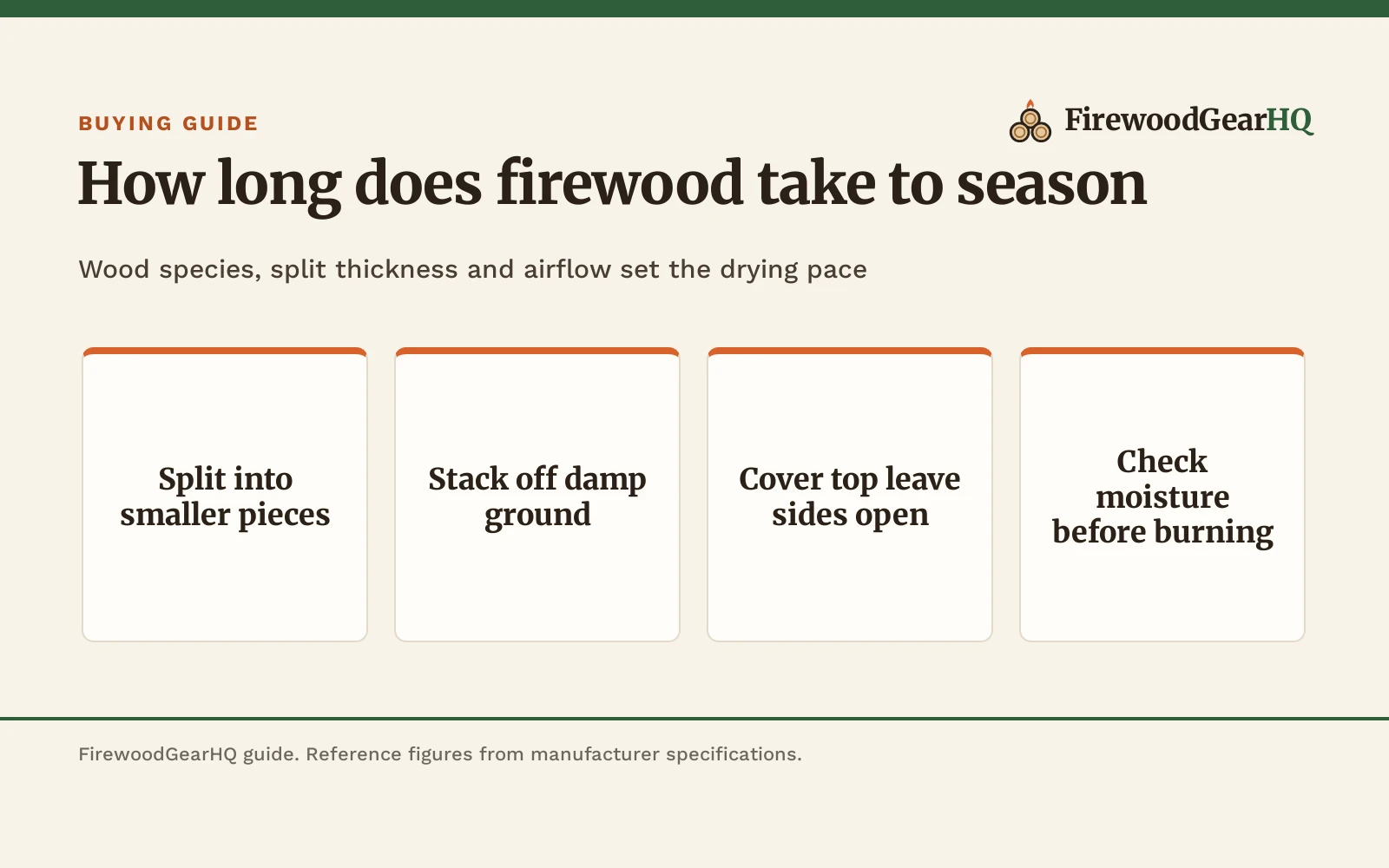
Burning unseasoned firewood is the primary reason stoves smoke, flues clog with soot, and fires struggle to generate heat. Knowing how long does firewood take to season helps you plan your woodpile so you always have clean, dry fuel ready. Most firewood requires several months up to multiple warm seasons of drying before it reaches clean-burning moisture levels. Softwoods dry comparatively quickly across a warm summer, while dense hardwoods demand multiple drying seasons to season thoroughly. Wood seasoning is simply natural evaporation driven by sun, wind, and smart stacking.
FirewoodGearHQ earns a commission when you buy through links on our product pages, at no extra cost to you. Read our affiliate disclosure.
How long does firewood take to season: the quick answer
For standard firewood piles, the drying timeline depends heavily on wood density, split thickness, and local weather. Light softwoods split into modest pieces can dry over a warm summer stretch if stacked in open sunlight with steady airflow. By contrast, heavy hardwoods possess dense grain that retains moisture tightly, routinely requiring multiple drying seasons before the wood burns clean. Proper stacking, lifting logs off damp soil, and shielding the top of the pile from rain shorten seasoning time significantly. However, weather fluctuations, humid climates, and oversized splits can delay drying by months, making physical moisture checks essential rather than relying strictly on the calendar.
Drying time chart by species
Seasoning time by wood varies across botanical categories because wood density and cellular structure dictate how fast moisture escapes. The comparison table below outlines relative seasoning pace and drying characteristics across common firewood species:
| Wood species | Relative seasoning pace | Drying characteristics |
|---|---|---|
| Spruce, cedar | Fastest pace | Lightweight softwoods that shed moisture rapidly in warm air |
| Pine, fir | Moderate pace | Resinous softwoods that season steadily; keep covered once dry |
| Ash, birch, cherry | Moderate pace | Medium hardwoods; ash holds low initial moisture and dries quickly |
| Maple | Extended pace | Moderate density hardwood; split small to accelerate drying |
| Beech, black locust | Extended pace | Dense fiber structure that requires prolonged warm airflow |
| Hickory, elm | Prolonged pace | Stringy fibers and high water retention demand patient seasoning |
| Oak | Longest pace | Extremely dense grain requiring multiple hot seasons to dry completely |
Treat this species chart as an operational planning guide rather than an absolute guarantee. Regional climate, humidity, split dimensions, and stacking technique alter drying rates. Only a direct moisture reading confirms that logs are ready for the hearth.
What makes firewood dry faster
Split it, and split it small
Bark acts as a moisture barrier that seals water inside the log. Splitting logs exposes fresh grain and cut end pores to moving air. Smaller splits dry much faster than large rounds or heavy halves. Use a splitting maul or splitting axe for manual splitting, or turn to the best log splitter for home use for processing larger firewood piles.
Stack it off the ground
Wood stacked on bare soil absorbs moisture and rots from the bottom up. Elevating the stack lets air circulate underneath the pile. Use pallets, timbers, or a dedicated rack like the best firewood rack with cover to keep wood dry and stable. Leave space between rows and walls for airflow.
Pick a sunny, windy spot
Sunlight warms log surfaces and draws out sap, while wind sweeps moisture away. Choose an open area that receives direct sun rather than a shaded tree line. Stack rows in the direction of prevailing winds so breezes blow freely along and between the stacks.
Cover the top, leave the sides open
Rain and snow soak into exposed wood and stall seasoning. Place a roof, metal sheet, or cover over the top layer to shed precipitation. Never wrap a tarp down the sides of the stack, as sealing the pile traps moisture and causes mold. Keep sides open to the wind.
Start early
Firewood needs warm, dry weather to season properly. Cutting and splitting in late winter or early spring gives the wood the full summer to dry. Wood cut in autumn will not be ready for that coming winter. For dense hardwoods like oak, cutting multiple seasons ahead ensures dry wood when cold weather arrives.
How to tell when firewood is seasoned
Time alone is not proof of dryness. Check these physical indicators, and confirm moisture before burning:
- Moisture reading: Split a log and press a meter against the fresh interior grain. See the best firewood moisture meter, and review what moisture content should firewood be for target levels.
- Weight: Seasoned wood feels noticeably light compared to a green split of identical size.
- Radial cracks: Check log ends for visible checks radiating outward from the center.
- Faded color: Seasoned wood fades to a weathered gray or dull tan rather than bright, fresh grain.
- Acoustic resonance: Knocking seasoned logs together makes a hollow, ringing crack rather than a dull thud.
- Loose bark: As wood shrinks, bark loosens and falls away easily.
EPA Burn Wise guidance emphasizes burning dry wood to maximize heat and minimize chimney deposits.
What happens if you burn it too soon
Burning unseasoned firewood causes frustration and chimney hazards. Wet wood wastes heat boiling off water instead of warming your room, leaving firebox temperatures low and causing sluggish fires to smolder.
As cool smoke rises, unburned gases condense along flue walls into flammable creosote. Reviewing what is creosote and how to prevent it is vital for safety, as creosote buildup is the primary cause of chimney fires. Smoldering fires also blacken stove glass and create nuisance smoke. A surface stove thermometer lets you monitor flue temperature to confirm your fire is burning hot. For whole-home heating, installing the best wood stove for heating a house ensures clean, efficient performance when supplied with properly seasoned cordwood.
Kiln-dried and store-bought wood
Commercially dried firewood provides an immediate option with verified moisture specifications from individual makers. Kiln drying uses heated chambers to remove moisture rapidly, eliminating pests and delivering logs ready for immediate hearth use, though packaged wood costs substantially more per cord than cordwood you season yourself.
Individual listings publish varied figures reflecting their specific formats rather than a single industry standard. Firewood Central lists its kiln-dried Pennsylvania oak splits at 8 inches with moisture dried to 15% moisture or less, packaging bundles at approximately 39.5 pounds with 30 to 35 splits per bundle. Old Potters lists kiln-dried hickory logs at 16 inches in bundles of approximately 1.5 cubic feet, and Woodover lists apple and cherry logs at 15 inches with 1200 cubic inches per bundle. Compact tabletop and cooking options carry smaller dimensions: WIFER lists kiln-dried pine sticks at 4 inches with a moisture content of less than 6% in a 2-pound box, while KoleSummit lists 4-inch pine logs in a 2-pound box with 2 fire starters. For outdoor campfire bundles, Billy Buckskin lists seasoned oak logs in an 18-pound pack. For fire starting and maintenance accessories, Pure Garden lists fatwood pine sticks in a 10-pound box measuring 17.5 inches by 10.5 inches by 8.75 inches, Duraflame lists manufactured logs in a 12-pack with a 3-hour burn time, and Pine Mountain lists its creosote buster firelog at 3.5 pounds with the maker listing a single firelog for use once per season or every 40 fires. Wood sold as seasoned is not always dry, so read a split piece with a meter before buying in volume.
Turn a stack's length, height and depth into full and face cords, and estimate how much wood a winter takes.
Frequently Asked Questions
Can green firewood season during a warm summer?
Light softwoods like spruce or pine split small can season over warm summer weather with steady airflow. Dense hardwoods like oak hold sap tightly and almost always need multiple drying seasons. Always check split pieces with a moisture meter before burning.
How does wood density affect seasoning time?
Dense hardwoods feature tightly packed fibers that hold moisture deep inside, requiring extended heat and airflow to dry. Softwoods have open cell structures that release water rapidly, seasoning in far less time.
Does firewood season faster when split into smaller pieces?
Yes. Tree bark seals in moisture, so water escapes almost entirely through cut ends and split faces. Splitting logs into smaller pieces dramatically increases exposed surface area and speeds evaporation.
Should I cover my outdoor firewood stack with a tarp?
Cover only the top to shield wood from rain and snow. Never wrap a tarp down the sides of the pile. Enclosing firewood traps evaporating water, fostering mold and rot while preventing airflow.
Does standing dead wood require seasoning?
Standing dead trees often have lower moisture than green wood, but rain, bark decay, and ground dampness can leave them wet. Split the wood and check the fresh face with a meter before burning.
How do you know firewood is seasoned without a meter?
Look for radial cracks on log ends, weathered gray color, and loose bark. Seasoned logs also feel lighter and make a sharp ringing sound when knocked together. A moisture meter provides definitive proof.
Related guides
Explore our firewood storage hub for complete woodpile organization, and learn how to season firewood fast with specialized airflow methods. Check our detailed chart on how long to season firewood by wood species, and discover the best wood for a wood stove for maximum heat output. If you process logs yourself, equip your woodlot with the best chainsaw for firewood and maintain a razor-sharp cutting edge with the best chainsaw sharpener. Also see our firewood shed outdoor with roof. Also see our firewood rack outdoor with cover. Also see our cover for firewood storage rack. Also see our best indoor firewood rack. Also see our best fireplace log holder.
About the author
The FirewoodGearHQ editorial team researches firewood and wood heating equipment from published specifications, ratings and warranty terms, and scores every pick the same way. We do not run our own product trials.