Best Felling Axe (2026): 5 Top Chopping Axes Compared
Five felling axes compared by head weight, handle length, steel grade, handle materials and what each listing publishes on warranty and balance.
 By FirewoodGearHQ Editorial
Updated October 10, 2026
By FirewoodGearHQ Editorial
Updated October 10, 2026
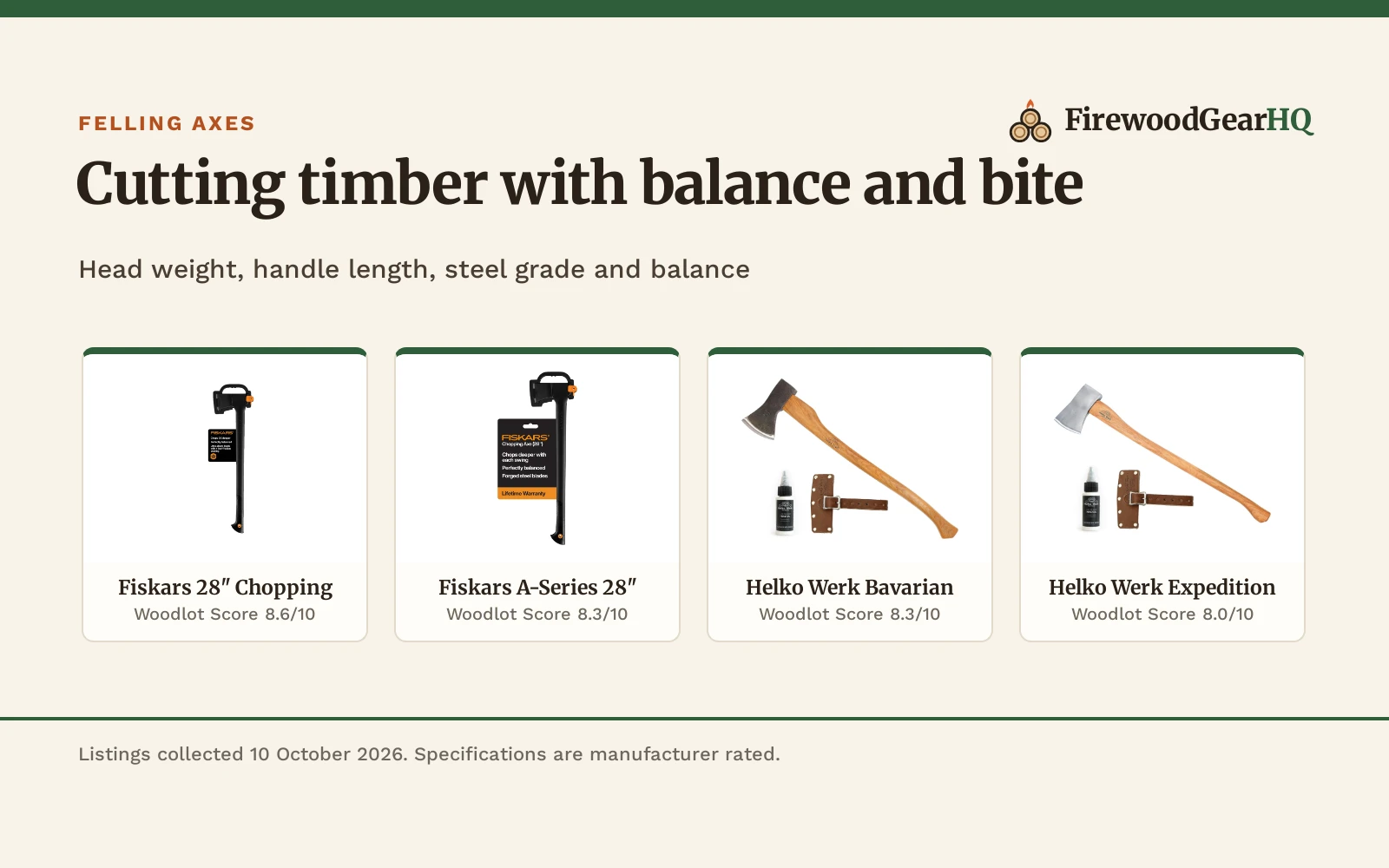
Finding the best felling axe depends on matching head weight and handle length to your physical strength and the timber you cut. A traditional felling axe uses a thin, sharp bit to sever wood fibers across the grain, unlike a blunt splitting tool that forces logs apart along the grain. This guide compares five felling axes by head weight, handle length, steel quality, handle material, and manufacturer warranty.
FirewoodGearHQ earns a commission when you buy through links on this page, at no extra cost to you. Affiliate disclosure.
Quick picks
- Best Overall Fiskars 28″ Chopping: Balanced 28 in felling axe with forged steel, low-friction blade coating and a full lifetime warranty. Check price
- Best Lightweight Fiskars A-Series 28″: At 3.5 lb total weight, its FiberComp handle and non-stick blade deliver quick swing speed and a lifetime warranty. Check price
- Best Traditional Forestry Axe Helko Werk Bavarian: Hand-forged German C50 steel head in Rheinland pattern on a 31 in Grade A hickory handle with sheath and oil. Check price
- Best Heavy-Duty Helko Werk Expedition: A 4.5 lb hand-forged C50 steel head on a 35 in hickory handle delivers heavy cutting force for large timber. Check price
- Best Long Handle on a Budget INTERTOOL 36″ Chopping: A 36 in fiberglass handle gives leverage with a 2.8 lb carbon steel head and included blade cover. Check price
Compare the picks
| Model | Woodlot Score | Head weight | Overall length | Blade material | Handle material | Total weight |
|---|---|---|---|---|---|---|
| Fiskars 28″ Chopping | 8.6/10 | Not stated | 28 in | Forged steel | Fiberglass | 3.8 lb |
| Fiskars A-Series 28″ | 8.3/10 | Not stated | 28 in | Forged steel | FiberComp | 3.5 lb |
| Helko Werk Bavarian | 8.3/10 | 3.5 lb | 31 in | C50 carbon steel | Hickory wood | 5.5 lb |
| Helko Werk Expedition | 8.0/10 | 4.5 lb | 35 in | C50 carbon steel | Hickory wood | 6 to 6.5 lb |
| INTERTOOL 36″ Chopping | 6.5/10 | 2.8 lb | 36 in | Carbon steel | Fiberglass | 4.8 lb |
Specifications are manufacturer rated, collected 10 October 2026. None of these listings names a third-party safety standard, so all five score zero for safety. Only Fiskars states a concrete warranty term, while the remaining listings state no warranty length.
The picks
| Award | Product | Woodlot Score About the HQ ScoreThe Woodlot Score runs from 0 to 10 and weighs performance (35%), build (25%), value (25%), safety (10%, where it applies) and warranty (5%), using only what the manufacturer and the listing publish. How we pick › | |
|---|---|---|---|
 Fiskars 28" Chopping Axe
|
8.6/10 | Buy | |
 Fiskars A-Series Chopping Axe 28"
|
8.3/10 | Buy | |
 1844 Helko Werk Germany Traditional Bavarian
|
8.3/10 | Buy | |
 1844 Helko Werk Germany Classic Expedition Felling
|
8.0/10 | Buy | |
 INTERTOOL 36 Inch Chopping Axe
|
6.5/10 | Buy |
Fiskars 28" Chopping Axe
A 28 in felling and chopping axe with a forged steel blade, proprietary grind, low-friction coating and a fiberglass handle.
Pros
- Forged steel head with a proprietary grind
- Low-friction blade coating helps prevent sticking in wood
- Fiberglass handle with balance designed to increase swing speed
- Full lifetime warranty stated by the maker
Cons
- Spec table gives length as 13.96 while title and dimensions state 28 in
- Head weight is not stated in the listing
- No sheath or blade cover listed among included components
- No safety standard or certification stated
Fiskars A-Series Chopping Axe 28"
A 28 in felling axe weighing 3.5 lb, featuring a forged steel blade with low-friction coating and a shock-absorbing FiberComp handle.
Pros
- Light overall weight at 3.5 lb for controlled swing speed
- Shock-absorbing FiberComp handle reduces vibration
- Forged steel blade with hardened non-stick coating
- Lifetime warranty stated in the listing
Cons
- Spec table contradicts title by listing handle as steel and wood
- Spec table lists blade as alloy steel while title states forged steel
- Head weight is not stated separately
- No sheath or blade guard included in listing
1844 Helko Werk Germany Traditional Bavarian
A German hand-forged felling axe with a 3.5 lb Rheinland pattern C50 carbon steel head, 31 in hickory handle, leather sheath and oil.
Pros
- Hand-forged German C50 high-carbon steel head with 53-56 HRC hardness
- Wide-bit Rheinland pattern head delivers deep cutting bite
- Grade A American hickory handle finished with boiled linseed oil
- Includes a vegetable-tanned full-grain leather sheath and 1 oz protective oil
Cons
- No warranty term is stated
- Spec table lists style as Drop Forged Tomahawk instead of felling axe
- Spec table names manufacturer as Supportiback rather than Helko Werk
- Heavier total weight at 5.5 lb requires good physical conditioning
1844 Helko Werk Germany Classic Expedition Felling
A heavy-duty German felling axe with a 4.5 lb C50 carbon steel head on a 35 in hickory handle, built for heavy timber cutting.
Pros
- Substantial 4.5 lb head delivers heavy striking momentum
- Hand-forged German C50 carbon steel with 53-56 HRC hardness
- Long 35 in Grade A American hickory handle gives maximum leverage
- Includes a full-grain leather sheath and 1 oz protective oil
Cons
- Heavy total weight of 6 to 6.5 lb demands high stamina to swing
- No warranty term is stated
- Bullets list 35 in handle while spec dimensions state 36 in
- Bullets state 6.5 lb total weight while spec table states 6 lb
INTERTOOL 36 Inch Chopping Axe
A 36 in chopping axe with a 2.8 lb carbon steel head, shock-absorbing fiberglass handle and an included blade cover.
Pros
- Long 36 in fiberglass handle delivers leverage for log cutting
- Forged carbon steel 2.8 lb head with rust-resistant coating
- Textured rubber grip reduces vibration and improves hand hold
- Includes a protective blade cover for transport and storage
Cons
- Severe listing contradictions between title and spec table
- Spec table lists hatchet dimensions including 12.6 in handle and 1.8 lb head
- Listing gives contradictory weights of 1.5 lb, 2.65 lb, and 4.8 lb
- No warranty term is stated
How we scored them
Each axe is scored out of 100 on performance, build, value, safety and warranty, using only what the listing publishes. The weights are on our How We Pick page.
| Product | Woodlot Score | Perf. /35 | Build /25 | Value /25 | Safety /10 | Warranty /5 |
|---|---|---|---|---|---|---|
| Fiskars 28″ Chopping | 8.6 | 30 | 21 | 21 | n/a | 5 |
| Fiskars A-Series 28″ | 8.3 | 29 | 20 | 21 | n/a | 5 |
| Helko Werk Bavarian | 8.3 | 33 | 24 | 20 | n/a | 0 |
| Helko Werk Expedition | 8.0 | 30 | 22 | 19 | n/a | 0 |
| INTERTOOL 36″ Chopping | 6.5 | 24 | 16 | 18 | n/a | 0 |
Scores run from 0 to 10. Safety counts only for powered gear or where the listing states safety features; where it does not apply, the score is taken over the remaining 90 points.
Buying guide: choosing the best felling axe
Felling axe vs splitting axe
A felling axe is designed for chopping across the wood grain to fell standing trees or cut through fallen logs, using a thin, razor-sharp blade that bites deep into green fibers. In contrast, a splitting axe or maul uses a heavier, wedge-shaped head to push wood grain apart along its length. For splitting rounds on the woodpile, see our guide on the splitting axe vs maul to choose the right firewood tool.
Head weight and swing effort
Head weight directly affects striking momentum and fatigue. A lighter head around 2.8 to 3.5 pounds allows faster swing speed and better control for extended limbing or smaller trees. Heavier heads, such as 4.5 pounds, deliver maximum chopping force per strike but demand substantial upper-body strength and physical stamina. Swing fatigue increases the risk of mishits, so choose a head weight you can swing with complete control.
Handle length and leverage
Handle length provides the leverage that drives the axe head into timber. Handles ranging from 28 to 31 inches offer agility, easy transport, and tight control in dense brush or around low branches. Longer handles of 35 or 36 inches generate greater rotational leverage and head speed, but require open swing zones and careful spatial awareness. Match handle length to your height and workspace clearance.
Steel grade and head geometry
Felling axes rely on hardened steel that holds a fine cutting bevel without chipping. Hand-forged carbon steel, such as German C50 steel hardened to 53-56 HRC, provides edge retention and tough impact resistance. Broad Rheinland pattern bits offer a wide cutting contact area, while coated forged steel blades reduce friction and help prevent the axe bit from binding in green wood.
Hickory vs composite handles
Traditional American hickory remains favored for felling axes because natural wood grain absorbs shock and can be replaced if damaged. Hickory handles require occasional treatment with boiled linseed oil to maintain flexibility and resist weather drying. Fiberglass and composite handles, such as FiberComp, do not dry out, resist weather exposure, and absorb strike vibration without needing oil maintenance.
Clear the swing area (overhead too), split on a solid chopping block at a comfortable height, keep your feet apart with the block in front of you, and wear eye protection and sturdy boots. Replace a cracked or loose handle before you swing again. Read our Safety Disclaimer.
Frequently Asked Questions
What is the main difference between a felling axe and a splitting axe?
A felling axe features a slim profile and a sharp cutting edge designed to sever wood grain across the trunk when cutting into timber. A splitting axe has a wider wedge-shaped head engineered to push wood fibers apart along the grain.
What handle material is more durable for chopping?
Composite and fiberglass handles offer high impact resistance and require no seasonal oiling. Grade A American hickory provides natural shock absorption, comfortable grip feel, and classic balance, though wood requires boiled linseed oil to prevent drying.
Why is head-to-handle balance important?
Proper balance between the axe head and handle allows the user to swing with consistent accuracy and less wrist strain. An unbalanced axe wanders during the swing, reducing cutting depth and increasing fatigue.
How should an axe blade be protected during storage?
Keep the cutting edge covered with a fitted leather sheath or blade guard when not in use. Applying a light coat of protective metal oil on carbon steel heads helps prevent surface rust and corrosion.
Can a felling axe be used to split firewood rounds?
A felling axe can split smaller kindling or light stove wood, but its thin bit can become wedged in large, knotty firewood rounds. A dedicated splitting maul or heavy splitting tool is far more effective for large rounds.
Related guides
Explore our axes and mauls category hub for more hand tool reviews. See our comparisons for the best splitting axes, the best splitting mauls, and the best hatchets for splitting wood. For technique and tool comparisons, read how to split wood with an axe, hatchet vs axe, and maul vs axe. If you work with difficult timber, see our picks for the best splitting wedges, our guide on how heavy should a splitting maul be, and our tips on how to move heavy logs safely. For chainsaw cutting and processing, review the best chainsaws for firewood, the chainsaw safety gear checklist, and the best firewood moisture meters.
About the author
The FirewoodGearHQ editorial team researches firewood and wood heating equipment from published specifications, ratings and warranty terms, and scores every pick the same way. We do not run our own product trials.