Hatchet vs Axe: Which One Should You Buy?
Hatchets and axes compared on handle length, weight, swing control, wood splitting and portability, with concrete examples from the listings we reviewed.
 By FirewoodGearHQ Editorial
Updated October 9, 2026
By FirewoodGearHQ Editorial
Updated October 9, 2026
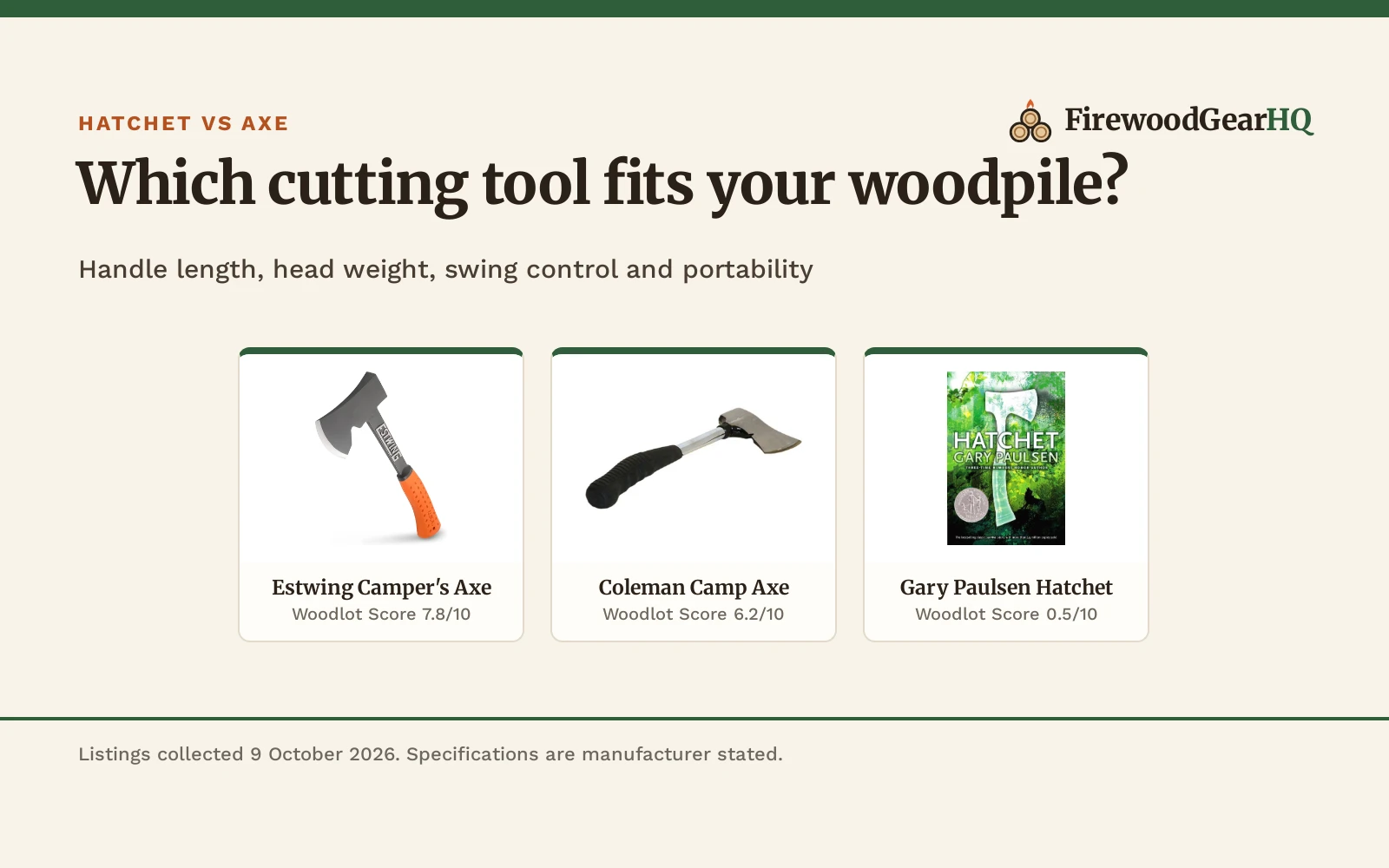
Verdict: Choose a hatchet if you need a dedicated compact tool for single-hand kindling prep, carving, and campsite fire tenders. Choose an axe if you need a tool designed for broader outdoor chopping, limbing, and camp tasks, keeping in mind that compact camp axe models blur the line with hatchets while full-size axes offer longer reach.
In the debate over hatchet vs axe, both tools share a wedge-shaped head mounted to a handle, but they serve different tasks around the woodpile. They differ in handle reach, head weight, swing control, and portability. This comparison covers both tool types, followed by concrete examples from the listings we reviewed.
FirewoodGearHQ earns a commission when you buy through links on this page, at no extra cost to you. Affiliate disclosure.
Side by side
| Factor | Hatchet | Axe | Verdict |
|---|---|---|---|
| Intended use | Kindling prep, campsite chores and light trimming | Camp clearing, chopping branches and general woodcutting | Hatchets focus on close kindling work; axes cover broader chopping |
| Grip design | Single-hand grip for close control | Single-hand on compact models, dual-hand on full-size patterns | Camp axes handle like hatchets; full patterns use both hands |
| Portability | Pack or belt carry when sheathed | Camp axe models fit packs; full axes require vehicle or shed storage | Compact camp axes carry easily; long axes need dedicated storage |
| Reviewed tool specifications | Edged tool specs not stated (reviewed listing is a novel) | The reviewed axe listings state 13 to 14.25 in length, 2 to 2.3 lb weight | The listings leave tool-to-tool comparisons unclear |
| Example: Estwing Camper’s Axe (axe) | Not applicable | 14 in (spec: 14.25 x 4.5 in), 2.3 lb, 3.25 in blade (bullet: 4-in.) | Solid American steel one-piece construction |
| Example: Coleman Axe (axe) | Not applicable | 13 x 5 in, 2 lb, 3 in blade | Drop-forged steel with stake puller |
| Example: Gary Paulsen Hatchet (hatchet) | 2.31 lb (book reissue, tool specs not stated) | Not applicable | Listing describes a novel rather than an edged tool |
Ranges are typical of the listings we reviewed; example figures are manufacturer stated, collected 9 October 2026.
Hatchet vs axe: handle length and leverage
The primary distinction between a traditional hatchet and a full-size axe is handle length and swing leverage. Hatchets feature compact handles designed for nimble, single-hand control during kindling preparation and light trimming. In the listings reviewed for this comparison, the two axe examples are compact camp axes: the Coleman axe listing states a 13 in length, and the Estwing camper’s axe listing states a 14 in length (with 14.25 in recorded in its specification table). In fact, both axe listings classify their head type as hatchet in their specification tables, demonstrating how closely compact axes and hatchets overlap in marketplace descriptions. Meanwhile, the listing on the hatchet side describes a printed novel, leaving edged tool dimensions unstated. Because of this, the listings leave a direct spec-to-spec handle comparison between physical tools unclear.
Head weight and cutting force
Head weight influences how deeply an edge bites into timber and how easily the tool splits wood grain. A hatchet is designed around a lightweight head that allows quick, single-hand control without fatiguing the wrist. Among the axe listings reviewed, the Coleman axe listing records an item weight of 2 pounds, while the Estwing camper’s axe listing records 2.3 pounds. The Gary Paulsen hatchet listing records an item weight of 2.31 pounds, though that number represents a printed book rather than a forged head. The listings do not publish separate head weights for the tools. While full-size felling and splitting axes typically carry heavier heads to drive through large rounds, compact camp axes like the Coleman and Estwing examples prioritize manageable weight for quick campsite chores and light splitting.
Wood splitting and kindling
For kindling prep next to a wood stove or campfire, a compact hatchet excels. It allows you to split small dry pieces cleanly without the fatigue of swinging a heavy tool. When dealing with full rounds, knotty hardwood, or seasonal firewood cords, a standard splitting axe or dedicated maul is necessary. The 2 pound Coleman axe listing and 2.3 pound Estwing camper’s axe listing represent compact camp tools that lack the wide wedge profile to burst large logs, though their listings highlight campsite utility, small wood splitting, and driving or pulling tent stakes with notched heads.
Portability and pack carry
Portability depends heavily on tool pattern. Dedicated hatchets are prized for their compact profile in a backpack or on a belt. However, compact camp axes share that same advantage. In the reviewed axe listings, the 14 in Estwing camper’s axe includes a ballistic nylon sheath with a belt loop specifically designed for close carry during outdoor projects. The Coleman axe listing highlights a 13 in length intended for backpacking and campsite use, though its listing does not include a protective sheath among its components. While full-size felling axes require dedicated storage in a vehicle bed, shed, or woodlot rack, compact camp axes and traditional hatchets remain similarly portable for field work.
Maintenance and safety
Both tools require regular care and strict safety awareness. Steel heads must remain clean, oiled, and sharp to avoid glancing blows. When swinging either tool, you must establish a clear swing zone free of bystanders, pets, and overhead branches. Wear safety glasses and sturdy leather footwear. The Estwing model incorporates a patented shock reduction grip stated to reduce impact vibration by 70 percent, reducing strain during extended cutting tasks.
Three examples
| Award | Product | Woodlot Score About the HQ ScoreThe Woodlot Score runs from 0 to 10 and weighs performance (35%), build (25%), value (25%), safety (10%, where it applies) and warranty (5%), using only what the manufacturer and the listing publish. How we pick › | |
|---|---|---|---|
 ESTWING Camper's Axe, 14" Orange Axe with Stake
|
7.8/10 | Buy | |
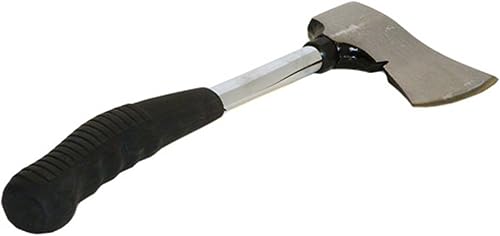 Coleman Axe with Durable Steel Head & Non-Slip
|
6.2/10 | Buy | |
 Hatchet by Gary Paulsen (Author)
|
0.5/10 | Buy |
ESTWING Camper's Axe, 14" Orange Axe with Stake
A 14 in camping axe forged in one piece from American steel, featuring a shock reduction grip, tent stake puller, ballistic nylon sheath and a listed weight of 2.3 pounds.
Pros
- Forged in one piece from solid American steel with no welds
- Patented shock reduction grip claims 70 percent impact vibration reduction
- Includes rugged ballistic nylon sheath with belt loop
- Integrated tent stake puller notch in the axe head
Cons
- Contradiction on blade length between 4 in bullet and 3.25 in spec table
- Length listed as 14 in in title but 14.25 in in spec table
- No warranty term is stated in the listing
- 2.3 pounds is heavier than basic camp hatchets
Coleman Axe with Durable Steel Head & Non-Slip
A 13 in steel camp axe with a drop-forged head, integrated tent stake puller notch, non-slip rubber grip handle and a listed weight of 2 pounds.
Pros
- Drop-forged alloy steel axe head and robust steel handle
- Non-slip rubber grip handle for secure grip
- Integrated tent stake puller notch in the axe head
- Compact 13 in length and 2 pounds listed weight
Cons
- No protective blade sheath included in the listing
- No concrete warranty term is stated (listing says see manufacturer)
- Title calls it an axe while spec table lists head type as hatchet
- 3 inch blade length limits cutting capacity on larger rounds
Hatchet by Gary Paulsen (Author)
A reissue publication of Gary Paulsen's survival novel Hatchet from Simon and Schuster Books for Young Readers, listed with a weight of 2.31 pounds.
Pros
- Classic survival fiction book published by Simon and Schuster
- Listed reading age of 9+ years from customers
- English language reissue edition
- Lightweight listed package weight of 2.31 pounds
Cons
- Listing describes a printed book rather than an edged woodcutting tool
- Cutting performance is zero for wood splitting and chopping
- No blade, steel, handle material or sheath specifications
- No warranty term is stated in the listing
How we scored them
Each example is scored out of 100 on performance, build, value, safety and warranty, using only what the listing publishes. Our scoring weights award up to 30 points for performance, 20 for build quality, 20 for value, 15 for stated safety features, and 15 for documented warranty terms.
| Product | Woodlot Score | Perf. /35 | Build /25 | Value /25 | Safety /10 | Warranty /5 |
|---|---|---|---|---|---|---|
| Estwing Camper’s Axe | 7.8 | 29 | 22 | 21 | 5 | 0 |
| Coleman Camp Axe | 6.2 | 26 | 19 | 18 | 0 | 0 |
| Gary Paulsen Hatchet | 0.5 | 0 | 2 | 2 | 0 | 0 |
Clear the swing area (overhead too), split on a solid chopping block at a comfortable height, keep your feet apart with the block in front of you, and wear eye protection and sturdy boots. Replace a cracked or loose handle before you swing again. Read our Safety Disclaimer.
Frequently Asked Questions
What is the difference between a hatchet and an axe?
A hatchet is a compact tool designed primarily for single-hand kindling prep, close carving, and light campsite duties. Traditional axes encompass a broader category, ranging from compact camp axes that share short handles with hatchets to long-handled felling and splitting patterns designed for powerful two-handed swings.
How to choose a hatchet?
To choose a hatchet for firewood prep or camping, examine head construction, handle material, and overall weight. A forged steel head offers dependable durability compared to cast alternatives. Handle choice depends on preference: traditional wooden handles absorb shock naturally, while steel handles maximize structural strength. Look for a secure grip and an included protective sheath for safe storage and carry.
How big is a hatchet?
Hatchets typically feature compact handles suited for single-hand use. In the marketplace, compact camp axes often share similar dimensions. For example, the Coleman axe listing states a 13 in length and the Estwing camper’s axe listing states a 14 in length (with 14.25 in listed in its specifications table), with both models listing their head type as hatchet. Full-size felling axes feature significantly longer handles for two-handed swings.
How to use a hatchet?
When using a hatchet to split kindling or limb branches, establish a clear swing zone around your chopping area. Place the wood on a firm chopping block rather than loose ground. Hold the handle firmly near the base, keep your supporting hand away from the cutting path, and strike with controlled momentum rather than excessive force.
How to clean a hatchet?
After chopping or splitting wood, wipe moisture, sap, and wood debris from the steel head using a dry rag. Clean resin buildup with a mild solvent. Apply a light coat of protective oil to alloy steel surfaces to guard against rust, and store the tool in its protective sheath in a dry place.
How much is a hatchet?
Hatchet costs vary based on steel grade, manufacturing origin, and included accessories. Basic camp models with steel handles occupy entry-level brackets, while tools forged in one piece from American steel with patented shock reduction grips occupy the premium tier. Because marketplace prices change regularly, check current listings directly.
Related guides
See the axes and mauls hub, the best hatchet for splitting wood, the best splitting axe, the maul vs axe comparison and the best kindling splitter. Splitting by hand? See the best splitting maul.
About the author
The FirewoodGearHQ editorial team researches firewood and wood heating equipment from published specifications, ratings and warranty terms, and scores every pick the same way. We do not run our own product trials.