Best Axe Sharpener (2026): 5 Sharpening Tools Compared
Five axe sharpeners compared by abrasive type, motorized belts or manual filing, preset guide slots, dimensions, weight and stated warranty terms.
 By FirewoodGearHQ Editorial
Updated October 10, 2026
By FirewoodGearHQ Editorial
Updated October 10, 2026
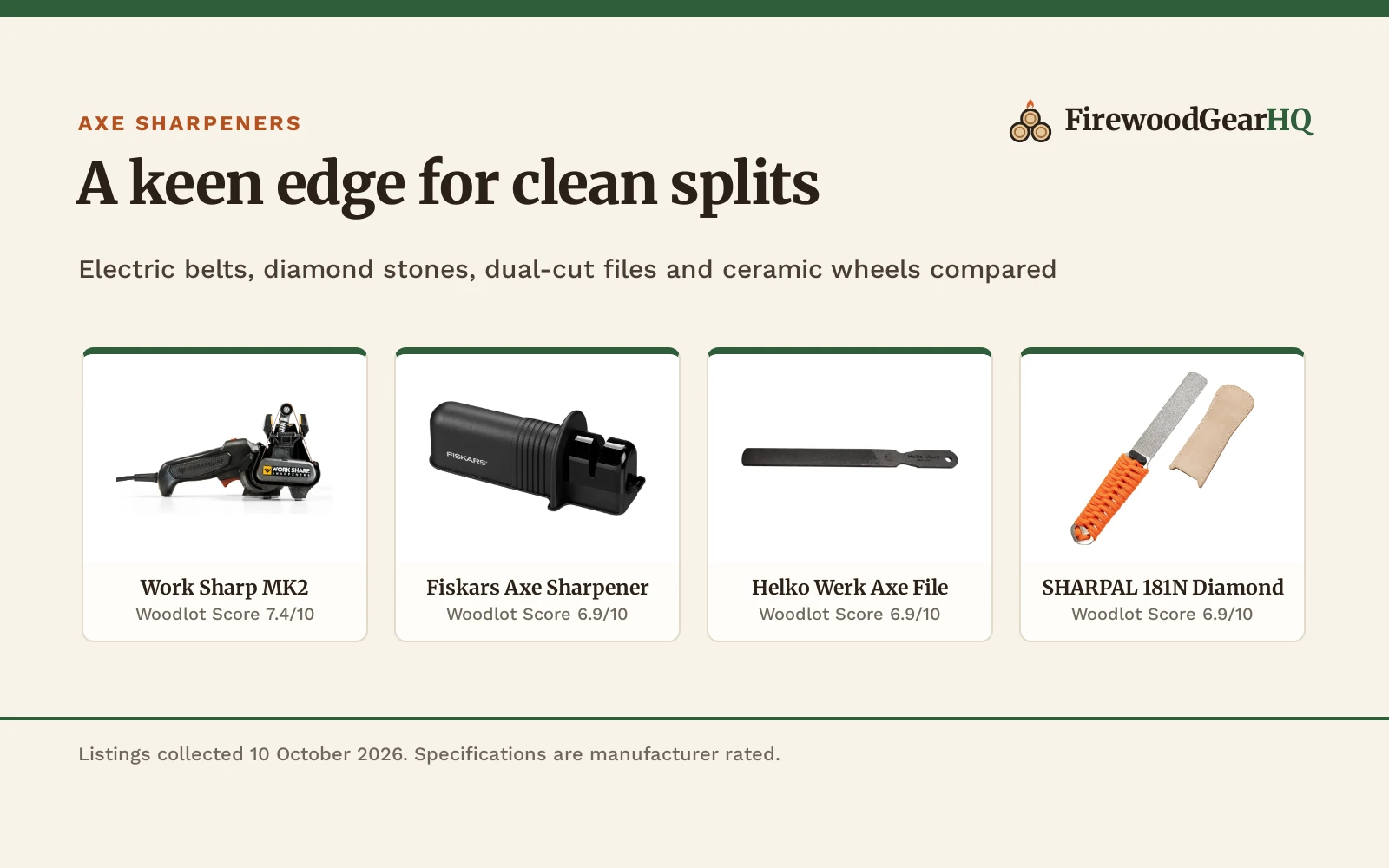
Finding the best axe sharpener keeps your splitting axes and hatchets cutting cleanly through firewood rounds without wasting physical effort. The right sharpener depends on whether you prefer benchtop motorized abrasive belts for rapid convex bevel shaping or manual files and diamond stones for portable edge touch-ups at the woodpile. This guide compares five sharpeners by abrasive system, sharpening speed, build materials and manufacturer warranty terms.
FirewoodGearHQ earns a commission when you buy through links on this page, at no extra cost to you. Affiliate disclosure.
Quick picks
- Best Electric Work Sharp MK2: Two-speed motor with flexible abrasive belts that match curved axe bevels, backed by a 3-year warranty. Check price
- Best Value Fiskars Axe Sharpener: Ceramic wheels sharpen both blade sides in preset slots and come backed by a lifetime warranty. Check price
- Best Heavy File Helko Werk Axe File: German C125W2 tool steel with double-cut teeth for reprofiling and single-cut teeth for deburring. Check price
- Best Diamond File SHARPAL 181N Diamond: Monocrystalline diamond steel file with 325 and 1200 grit surfaces plus a leather strop sheath. Check price
- Best Multi-Tool SHARPAL 103N Sharpener: Five sharpening parts with preset angle slots, carbide and ceramic bars, and a large hand guard. Check price
Compare the picks
| Model | Woodlot Score | Type | Abrasive | Dimensions / Length | Weight | Warranty |
|---|---|---|---|---|---|---|
| Work Sharp MK2 | 7.4/10 | Electric belt sharpener | Flexible abrasive belts | 7.02″L x 2.26″W x 1.27″H | 1.12 ounces (table) | 3-year warranty |
| Fiskars Axe Sharpener | 6.9/10 | Pull-through ceramic | Ceramic wheels | 9″L x 3.25″W x 2.25″H | 4.54 g (table) | Lifetime warranty |
| Helko Werk Axe File | 6.9/10 | Dual-sided steel file | German C125W2 carbon steel | 11.5 in length | 8 oz | Not stated |
| SHARPAL 181N Diamond | 6.9/10 | Diamond stone file | Monocrystalline diamond | 8.66″L x 1.65″W x 0.59″H | 160 g | Not stated |
| SHARPAL 103N Sharpener | 6.8/10 | Multi-slot sharpener | Carbide and ceramic | 8.46″L x 2.95″W x 1.34″H | 176 g | Not stated |
Specifications are manufacturer rated, collected 10 October 2026. Scoring follows stated terms and checkable specifications: Work Sharp and Fiskars state warranties with concrete terms, while the remaining listings state no formal warranty length. None of the listings cites a formal third-party safety standard, so safety scores zero across all five picks.
The picks
| Award | Product | Woodlot Score About the HQ ScoreThe Woodlot Score runs from 0 to 10 and weighs performance (35%), build (25%), value (25%), safety (10%, where it applies) and warranty (5%), using only what the manufacturer and the listing publish. How we pick › | |
|---|---|---|---|
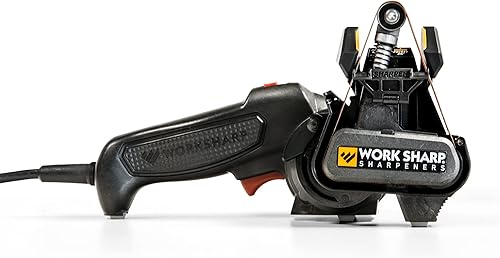 Work Sharp MK2 Electric Knife Sharpener
|
7.4/10 | Buy | |
 Fiskars Axe & Knife Blade Sharpener
|
6.9/10 | Buy | |
 1844 Helko Werk Germany Dual Sided 11.5 Inch Axe
|
6.9/10 | Buy | |
 SHARPAL 181N Dual-Grit Diamond Sharpening Stone
|
6.9/10 | Buy | |
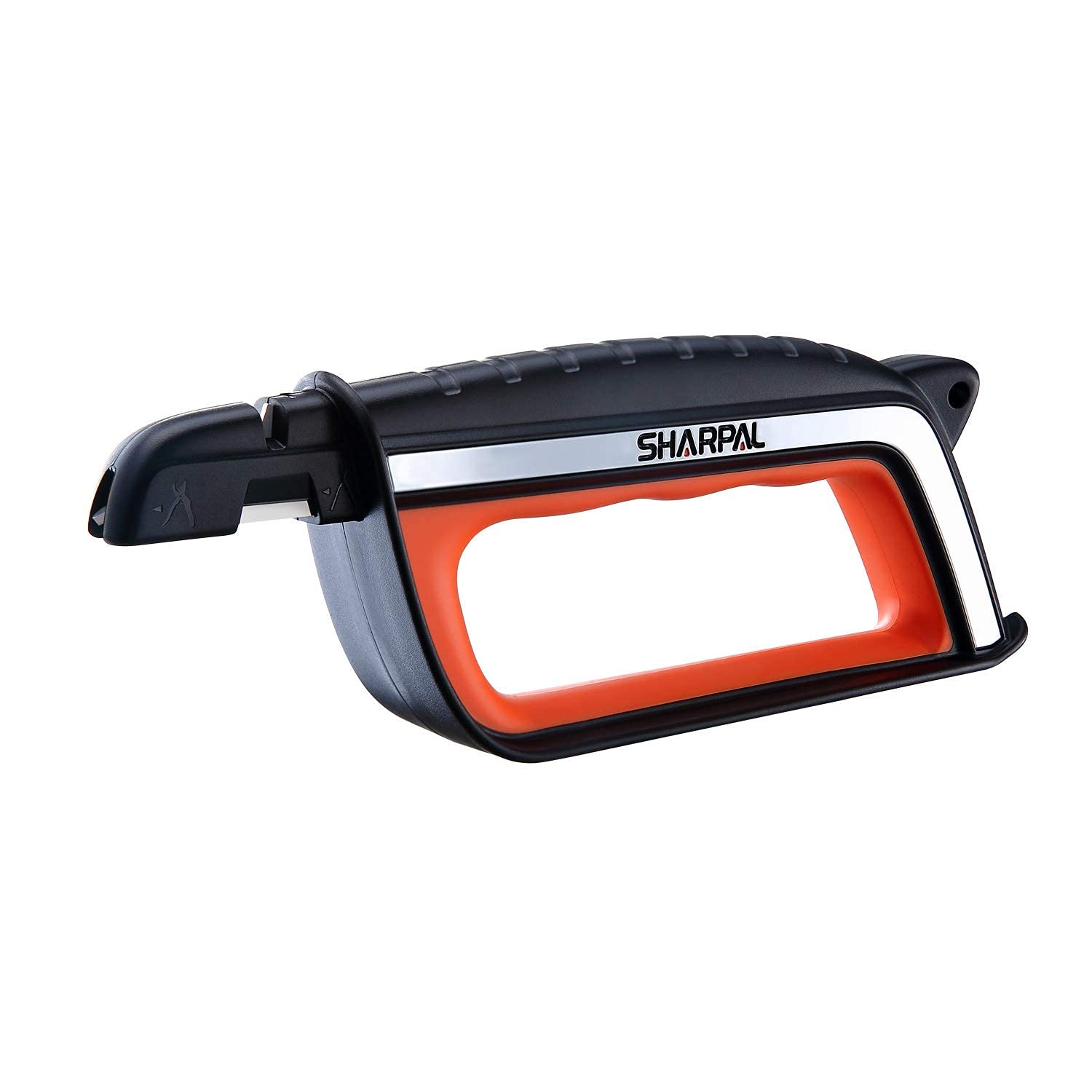 SHARPAL 103N All-in-1 Knife Garden Tool Lawn Mower
|
6.8/10 | Buy |
Work Sharp MK2 Electric Knife Sharpener
An electric sharpening station with a two-speed motor and flexible abrasive belts that conform to axe blade bevels for fast edge restoration.
Pros
- Two-speed motor provides higher power for heavy axe profiling and lower speed for control
- Flexible abrasive belts conform to curved axe edge bevels
- Backed by a stated 3-year warranty from the manufacturer
- Edge guide supports blade along the cutting edge during passes
Cons
- Spec table lists weight at 1.12 ounces for a motorized unit
- Requires electrical power and cannot be used away from an outlet
- Plastic body construction rather than cast metal
- Higher complexity with moving belts and motor components
Fiskars Axe & Knife Blade Sharpener
A handheld pull-through sharpener with grooved ceramic wheels and preset slots that sharpen both bevel sides of an axe blade simultaneously.
Pros
- Ceramic wheels sharpen both sides of the blade simultaneously
- Manufacturer backs the sharpener with a lifetime warranty
- Integrated safety guard protects hands and fingers during passes
- Non-slip pads on the base provide tabletop stability
Cons
- Ceramic wheels are fine grit and cannot reprofile heavy nicks
- Preset slot angle cannot be adjusted for custom axe profiles
- Spec table lists item weight at 4.54 g for a 9 in unit
- Plastic housing can wear over extended heavy use
1844 Helko Werk Germany Dual Sided 11.5 Inch Axe
An 11.5 in heavy axe file forged in Germany from C125W2 high carbon tool steel with double-cut teeth on one side and single-cut on the other.
Pros
- Forged in Germany from C125W2 high carbon tool steel
- Double-cut teeth remove steel rapidly to repair dings and nicks
- Single-cut side provides fine finishing and deburring
- Blank teeth-free edges prevent accidental damage to axe cheeks
Cons
- No warranty term is stated in the listing
- Requires proper manual filing technique to maintain correct bevels
- Spec table lists dimensions as 11.5 in by 11.5 in
- Does not include a protective sheath or edge cover
SHARPAL 181N Dual-Grit Diamond Sharpening Stone
A dual-grit monocrystalline diamond sharpening stone on a stainless steel base, equipped with 325 coarse and 1200 extra fine surfaces and a strop sheath.
Pros
- Industrial monocrystalline diamond sharpens dry without water or oil
- Dual grits offer coarse 325 for reshaping and extra fine 1200 for honing
- Genuine cowhide leather sheath doubles as a strop for final deburring
- Stainless steel base with removable paracord-wrapped handle
Cons
- No warranty term is stated in the listing
- Diamond plating can wear out if subjected to excessive grinding pressure
- Thinner profile than traditional bench stones
- Relies on manual angle control without guide slots
SHARPAL 103N All-in-1 Knife Garden Tool Lawn Mower
A handheld multi-sharpener featuring five sharpening parts including three preset angle slots, a tungsten carbide bar and a ceramic rod with a large hand guard.
Pros
- Five sharpening parts handle both single and double beveled edges
- Large hand guard and oversized handle protect fingers during passes
- Rubber over-molded grip and base prevent slipping on surfaces
- Tungsten carbide bar and ceramic rod offer coarse and fine options
Cons
- No formal warranty term stated (bullet notes 3 years of service commitment)
- Preset slots may not match specialized convex axe bevels
- Spec table lists grit simply as Medium despite multiple abrasive types
- Plastic handle frame with rubber over-mold rather than all-metal build
How we scored them
Each sharpener is scored out of 100 on performance, build, value, safety and warranty, using only what the listing publishes. The weights are on our How We Pick page.
| Product | Woodlot Score | Perf. /35 | Build /25 | Value /25 | Safety /10 | Warranty /5 |
|---|---|---|---|---|---|---|
| Work Sharp MK2 | 7.4 | 30 | 20 | 20 | 0 | 4 |
| Fiskars Axe Sharpener | 6.9 | 26 | 19 | 20 | 0 | 5 |
| Helko Werk Axe File | 6.9 | 32 | 24 | 21 | 0 | 0 |
| SHARPAL 181N Diamond | 6.9 | 30 | 22 | 21 | 0 | 0 |
| SHARPAL 103N Sharpener | 6.8 | 28 | 20 | 20 | 0 | 0 |
Buying guide: choosing the best axe sharpener
Abrasive types: files, stones, belts and wheels
Different sharpeners remove steel at very different rates. A hardened carbon steel file, such as the German C125W2 tool steel on the Helko Werk file, shears metal away quickly to re-establish bevels and erase chips. Monocrystalline diamond files like the SHARPAL 181N cut fast and work dry on tough alloys. Motorized abrasive belts like those on the Work Sharp MK2 speed up reshaping on heavy tools, while fine ceramic wheels like those on the Fiskars sharpener serve strictly for daily edge alignment.
Preset slots versus freehand filing
Preset guide slots remove guesswork by forcing the blade to meet the abrasive at fixed angles. Handheld tools like the SHARPAL 103N and Fiskars sharpener provide guided channels that make sharpening straightforward for beginners. In contrast, flat files and diamond plates require freehand control: you hold the tool at a consistent bevel pitch while pushing along the cutting edge. Freehand filing takes practice, but it allows woodcutters to follow custom convex profiles.
Bevel geometry and edge maintenance
Firewood axes do not use thin razor bevels like carving knives; they rely on robust convex cheeks that force wood fibers apart without binding or chipping on knots. Whether maintaining a dedicated firewood splitter or a heavier maul, understanding your tool geometry matters; read our splitting axe vs maul guide to see how head profiles differ. Preserving a thick, supported cutting edge prevents rolled steel when striking frozen rounds.
Benchtop power versus pocket portability
Decide where maintenance takes place before selecting a sharpener. An electric station with a two-speed motor provides rapid stock removal at the workshop bench, but it cannot run at the woodpile or in remote timber stands. Portable files and pocket sharpeners fit inside a pack or tool roll for immediate field touch-ups. Some firewood cutters keep an axe puck sharpener in a pocket for quick circular honing, but a dual-cut steel file or diamond plate provides greater surface contact across broad axe bits.
Safe sharpening technique and swing zones
Axe maintenance requires careful handling because hands work close to exposed cutting edges. When filing, push the file away from the bit or draw-file with blank safe edges facing toward your body, and always wear sturdy leather work gloves. In addition, when working around axes at the woodpile, maintain a clear swing zone free of bystanders, pets and tripping hazards before taking practice swings or checking balance.
Clear the swing area (overhead too), split on a solid chopping block at a comfortable height, keep your feet apart with the block in front of you, and wear eye protection and sturdy boots. Replace a cracked or loose handle before you swing again. Read our Safety Disclaimer.
Frequently Asked Questions
What is the best axe sharpener for firewood axes?
For shop maintenance across multiple outdoor tools, a two-speed powered belt sharpener like the Work Sharp MK2 reshapes curved bevels quickly. For portable field work and reprofiling nicked edges, a dual-sided carbon steel file like the Helko Werk heavy file delivers reliable control without electricity.
Can you use an axe puck sharpener instead of a file?
An axe puck sharpener works well for light circular honing and touch-ups on a clean edge. However, a round stone cannot remove heavy steel quickly when an axe strikes dirt or rocks; reshaping damaged bits requires an aggressive double-cut steel file or coarse diamond plate.
How often should an axe be sharpened?
Touch up the cutting edge whenever the axe begins to bounce or glance off seasoned firewood instead of biting clean wood fibers. A quick touch-up with a fine ceramic wheel or fine single-cut file after a splitting session keeps the edge keen without requiring major regrinding.
Should an axe edge be razor sharp?
A splitting axe needs a keen, clean apex, but it should retain a stout wedge geometry rather than a delicate razor edge. A bevel that is too thin will nick, fold or chip when driving through knotty hardwoods or frozen logs.
Can you use a knife sharpener on an axe?
Standard kitchen knife sharpeners set bevel angles that are far too narrow for the heavy impact of splitting wood. Only use sharpeners specifically designed with wide tool slots, flexible belts or flat files that match durable axe profiles.
Related guides
See the axes and mauls hub, our guide to the best splitting axe, the best splitting maul, the best felling axe, and the best hatchet for splitting wood. Learn field methods in our guide on how to split wood with an axe.
About the author
The FirewoodGearHQ editorial team researches firewood and wood heating equipment from published specifications, ratings and warranty terms, and scores every pick the same way. We do not run our own product trials.