Best Steel for Fireplace Grate (2026)
Why heavy solid structural carbon steel and thick square bars make the best steel for a fireplace grate, how steel compares with cast iron and how to pick the right size.

On this page
Top picks at a glance
As an Amazon Associate we earn from qualifying purchases.
- 1
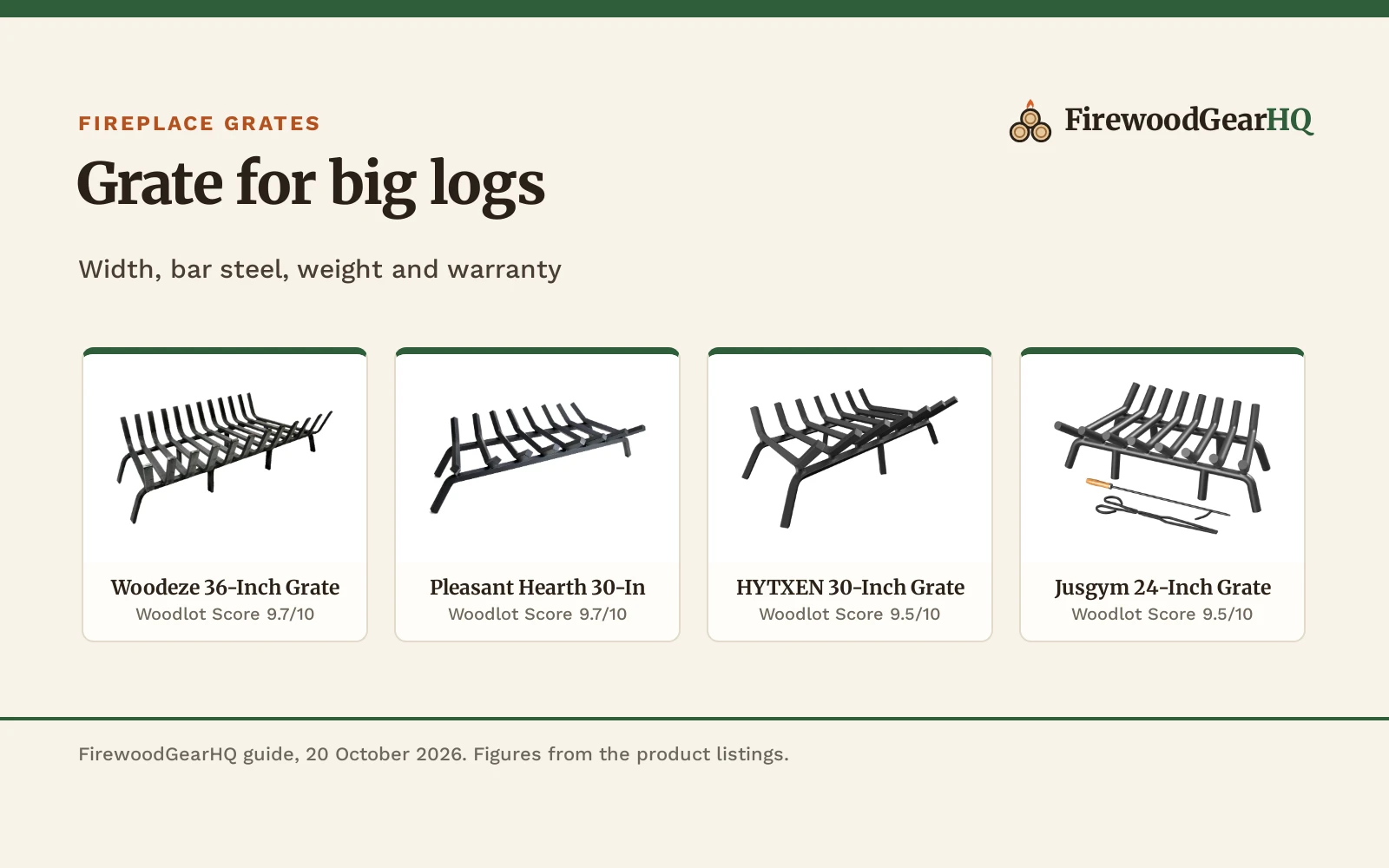
 Jusgym Fireplace Grate 24 Inch with 8 Support Legs and Fire9.7/10View on Amazon
- 2
 Grate Wall of Fire Model M-5 Smoke-Free Fireplace Grate9.7/10View on Amazon
- 3
 Fireplace Grate 14 Inch9.6/10View on Amazon
- 4
 SteelFreak Super Heavy Duty Steel Fireplace GrateView on Amazon
- 5
 Pleasant HearthView on Amazon
When winter cold settles in and the fireplace burns every evening, a weak hearth grate quickly shows its flaws. Intense heat from glowing hardwood coals softens lightweight metal, causing cheap bars to sag and warp. The best steel for fireplace grate construction is heavy, solid structural carbon steel shaped into thick square or flat bars rather than uncooled hollow tubing or thin wire. Solid carbon steel, such as the hot-rolled Q235 structural steel specified by INNO STAGE, withstands intense coal temperatures without buckling under heavy firewood rounds. Choosing solid steel bars with sturdy support legs keeps firewood elevated to feed air underneath the fire.
More options to compare
 SteelFreak Super Heavy Duty Steel Fireplace GrateCheck price on Amazon
 Pleasant HearthCheck price on Amazon
FirewoodGearHQ may earn a small commission if you buy through links on this page. The price you pay stays the same. Read our affiliate disclosure.
Best steel for fireplace grate: the quick answer
Solid structural carbon steel bar stock is the best steel for a fireplace grate. It provides the necessary thermal mass to absorb radiant coal heat without deforming. Commercial listings specify materials from Q235 structural steel (listed by INNO STAGE) to heavy wrought iron solid steel bars. Solid square bars measuring 3/4 inch thick, or heavy flat steel measuring 5/16 inch thick, offer far superior durability over lightweight wire or uncooled hollow tubes that burn out under hot embers.
Published specifications highlight these differences: INNO STAGE uses solid Q235 steel with 4-inch floor clearance, InnFinest uses solid 3/4-inch square and hexagonal bars across a 30-inch frame, and WILLOW WEAVE uses flat bars 1 inch wide and 5/16 inch thick weighing 10.5 pounds. For lighter hearths, SNOGSWOG lists 1/2-inch solid steel bars across a 17-inch frame weighing 5 pounds. For regular winter heating, grates with solid 3/4-inch square bars or heavy flat stock supported by 6 or 8 legs resist heat sag best.
Fireplace grate steel comparison chart
| Steel and metal type | Bar dimensions and build | Heat behavior and durability |
|---|---|---|
| Solid Q235 structural steel | Solid bar stock; INNO STAGE lists 4-inch hearth clearance with 4 legs | Handles high heat cycles well; ductile enough to resist thermal cracking under heavy logs |
| Heavy square bar steel | InnFinest lists 3/4-inch square and hexagonal bars across a 30-inch frame | Dense steel mass absorbs coal bed heat without sagging; superior rigidity over long spans |
| Flat bar solid steel | WILLOW WEAVE lists bars 1 inch wide and 5/16 inch thick weighing 10.5 pounds | Broad surface area supports firewood securely; resists bowing when supported by 8 legs |
| Mid-weight solid steel | SNOGSWOG lists 1/2-inch solid steel bars with 6 legs across a 17-inch width | Sufficient for modest fireplaces; lighter 5-pound build heats faster than 3/4-inch stock |
| Cast iron | UBACKS lists a 24.0-pound grate with a 4-inch cast-on leg clearance | Excellent resistance to coal burn-through, but brittle and susceptible to cracking if dropped |
Heavy solid steel bars consistently outlast thin or hollow metal across repeated burning seasons.
What makes the best steel for fireplace grate durability
Solid steel bar stock vs hollow tubing
A common reason hearth grates fail prematurely is the use of uncooled tubular metal or thin wire. Budget grates made of thin hollow tubing oxidize and collapse under hot coals. See our guide to cheap fireplace grates to identify structural shortcuts to avoid. In contrast, solid steel bar stock contains dense metal that conducts heat away from hot spots, slowing oxidation and preventing burnout.
Bar thickness and cross-section profiles
Metal volume directly dictates how many burning seasons a grate will survive. A solid 3/4-inch square steel bar, as InnFinest specifies on its 30-inch model, contains substantially more metal than a 1/2-inch bar, like the quadrilateral bars listed by SNOGSWOG. Heavy square bars placed with diamond edges pointing upward cradle round logs naturally. Flat bars also perform well: WILLOW WEAVE uses flat steel bars measuring 1 inch wide and 5/16 inch thick, which support splits securely while resisting downward deflection.
Structural carbon steel grades in hearth grates
Among published hearth listings, INNO STAGE designates Q235 steel for its 21-inch grate. Q235 is a standard hot-rolled structural mild carbon steel offering dependable weldability and thermal ductility. In a wood-burning fireplace, a grate undergoes severe thermal expansion. Mild carbon steel retains ductile toughness, flexing under thermal stress rather than snapping like brittle metals.
Support leg distribution and anti-sag design
Grates fail almost exclusively at the center where the coal bed concentrates heat and firewood weight presses down. To counter sagging, manufacturers add intermediate support legs beneath the center span. AMAGABELI builds its 24-inch grate with 8 legs to prevent sagging across 10 solid steel bars. Jusgym equips its 24-inch model weighing 14.87 pounds and its 30-inch model weighing 16.22 pounds with 8 support legs, while its 17-inch model weighing 8.1 pounds uses 6 support legs. WILLOW WEAVE incorporates 8 support legs across its 17-inch, 7-bar frame. Spreading weight across 6 or 8 legs shortens the unsupported span and stops center sag.
Airflow clearance and coal bed management
Wood requires oxygen from underneath to burn cleanly. Lifting firewood off the firebox floor allows primary air to circulate beneath logs, promoting clean combustion and reducing chimney smoke. Listings show common elevation heights: INNO STAGE provides 4-inch clearance, Jusgym lists 4.5 inches of elevation on its 24-inch grate and 4 inches on its 17-inch grate, SNOGSWOG lists a 3.5-inch gap, and Zettfuly lists a 3.35-inch height. For top picks, read our guide to the best fireplace grate for wood burning.
How to choose fireplace grate size and clearance
Measure your firebox before purchasing: front width, rear width, depth and interior height. Most masonry fireplaces taper narrower toward the back wall. Hearth grates mirror this taper: UBACKS lists a 24-inch front width with a 21-inch rear width and 15-inch depth, while InnFinest lists a 27-inch front width with a 23-inch rear width. Leave ample clearance on all sides for thermal expansion and tool access. Check our detailed fireplace grate size chart for firebox sizing steps.
- 14-inch to 17-inch grates: For compact hearths. Zettfuly lists a 14-inch model with an 11-inch width, WILLOW WEAVE lists a 17-inch width with a 10-inch depth, and Jusgym lists a 17-inch model with 5 bars.
- 18-inch to 24-inch grates: Standard residential hearths. Grates measuring 18 inch or 24 inch represent standard sizes, including 24-inch models from AMAGABELI and Jusgym.
- 27-inch to 30-inch grates: Large hearths. InnFinest lists a 30-inch frame with 7 bars, and Jusgym lists a 30-inch model with 8 bars and 8 legs.
Cast iron vs solid steel fireplace grates
Wood burners choose between solid steel and cast iron for hearth grates:
- Solid steel grates: Welded from rolled carbon steel bars. Steel withstands heavy impacts without cracking when logs are loaded, though bars require multi-leg support to prevent long-term heat sag.
- Cast iron grates: Poured as a single piece, such as the UBACKS 24-inch model weighing 24.0 pounds. Cast iron resists oxidation under hot ember beds and holds its shape without sagging, but it is brittle and can fracture if struck by heavy firewood splits.
For standard cordwood burning in a masonry hearth, solid structural steel remains the most practical choice. Read our roundup of the best cast iron fireplace grate options to compare cast models.
Best way to clean and care for a steel fireplace grate
Managing ash accumulation is essential for protecting steel grates. When wood ash builds up until it touches the underside of the steel bars, airflow beneath the grate stops. Without air circulation, the bars overheat, glow red and sag into the ash bed.
- Let ashes cool completely: Always allow coals to cool overnight before cleaning.
- Clear ash buildup regularly: Shovel cooled ashes into an ash bucket for fireplace cleanup, keeping the space beneath the grate open with a shovel from a fireplace tool set.
- Brush the bars: Use a stiff wire brush to remove soot. Avoid using water, which promotes rust.
- Maintain hearth safety: Follow manufacturer guidelines and local fire codes. Maintain working smoke and carbon monoxide alarms, schedule an annual chimney sweep per NFPA recommendations, and burn dry seasoned wood per EPA Burn Wise guidance. Place a fireplace screen across the hearth opening to catch sparks.
Frequently Asked Questions
What is a fireplace grate?
A fireplace grate is a heavy metal rack set on the firebox floor. It lifts firewood above the hearth floor to feed combustion air underneath the logs, improving draft and concentrating coals for steady heat.
How to choose a fireplace grate size for my hearth?
Measure the front width, rear width and depth of your fireplace floor. Select a grate that leaves clearance on both sides and along the rear wall. A 17-inch or 18 inch grate fits smaller hearths, while larger hearths fit a 24 inch or 30-inch model.
What is the difference between cast iron and steel fireplace grates?
Solid steel grates are welded from rolled bar stock, providing high impact resistance against falling logs. Cast iron grates are cast in molds, resisting coal bed burnout well, but they are brittle and can fracture under impact.
What is the best way to clean a fireplace grate?
Wait until coals are completely cold. Brush the bars with a stiff wire brush to remove soot, and shovel ash from beneath the grate into a metal bucket so airflow remains open. Do not wash steel with water.
Can I use a fireplace grate with a blower?
Yes. A fireplace grate with blower uses heavy tubular steel pipes connected to an electric fan that circulates cool room air through the heated pipes, extracting heat into the room and preventing the metal from overheating.
Why do steel fireplace grates sag in the middle?
Center sagging happens when hot embers soften the steel while log weight presses down across an unsupported span. Grates with 6 or 8 support legs, such as models from Jusgym or AMAGABELI, reinforce the center span to prevent sagging.
Related guides
See our stove accessories hub, our guide to the best fireplace grate for wood burning and our roundup of the best cast iron fireplace grate models. Review firebox clearances in our fireplace grate size chart, or explore cheap fireplace grate options. Complete your hearth setup with the best fireplace tool set, an best ash bucket for fireplace and a best fireplace screen. Also see our best wood burner fan. Also see our best stove glass cleaner. Also see our best fireplace blower fan. Also see our best ash vacuum for wood stoves. Also see our what is creosote and how to prevent it.