Fireplace Grate Size Chart: Dimensions, Clearances and Sizing Guide
Fireplace grate size chart and measurement guide explaining how to measure firebox width, depth and clearance to choose the proper grate for wood fires.

On this page
Top picks at a glance
As an Amazon Associate we earn from qualifying purchases.
- 1
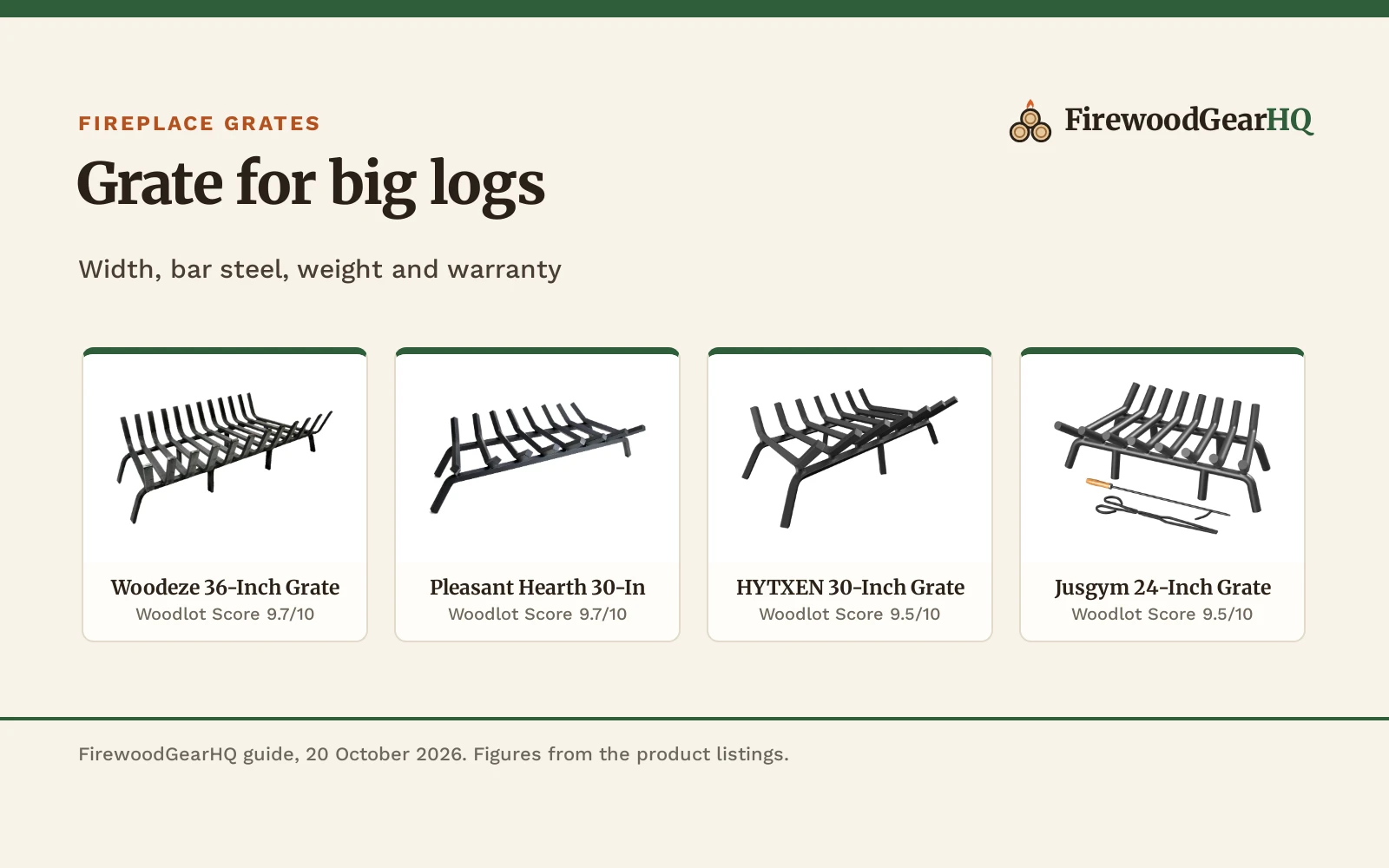
 Jusgym Fireplace Grate 24 Inch with 8 Support Legs and Fire9.7/10View on Amazon
- 2
 Grate Wall of Fire Model M-5 Smoke-Free Fireplace Grate9.7/10View on Amazon
- 3
 Rocky Mountain Goods 18-inch Fireplace Grate with Ember9.6/10View on Amazon
- 4
 INNO STAGE 21 Inch Fireplace Grate with Ember Retainer SolidView on Amazon
- 5
 24 inch Fireplace Grate Heavy DutyView on Amazon
- 6
 Fireplace Grate 14 inchView on Amazon
- 7
 Ace Fireplace Grate Cast Iron 27 " W X 15 " D Black Brand:View on Amazon
- 8
 INNO STAGE 24 Inch Fireplace Grate with Ember Retainer SolidView on Amazon
- 9
 INNO STAGE 30 Inch Fireplace Grate with Ember RetainerView on Amazon
A fireplace grate size chart compares the front width, rear width, depth and floor clearance of a grate to the interior dimensions of your firebox. To choose the correct grate size, measure your firebox front width, rear width and floor depth, then select a grate that leaves clearance on all sides for airflow and tool access. Grates in our reference comparison span front widths from 14 in to 30 in, with tapered models narrowing at the back to match splayed masonry firebox walls.
More options to compare
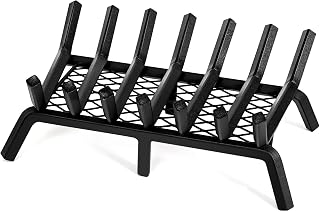 INNO STAGE 21 Inch Fireplace Grate with Ember Retainer SolidCheck price on Amazon
 24 inch Fireplace Grate Heavy DutyCheck price on Amazon
 Fireplace Grate 14 inchCheck price on Amazon
 Ace Fireplace Grate Cast Iron 27 " W X 15 " D Black Brand:Check price on Amazon
 INNO STAGE 24 Inch Fireplace Grate with Ember Retainer SolidCheck price on Amazon
 INNO STAGE 30 Inch Fireplace Grate with Ember RetainerCheck price on Amazon
FirewoodGearHQ may earn a small commission if you buy through links on this page. The price you pay stays the same. Read our affiliate disclosure.
The quick answer
To choose a grate, measure the hearth floor across the front opening, rear wall and depth. The grate must be smaller than the floor in every dimension to sit flat with open space around it. Reference models span widths of 14 in, 17 in, 21 in, 24 in, 27 in and 30 in. For tapered fireplaces, choose a tapered model such as a 24 in front with a 21 in back, or a 27 in front with a 23 in back. For durable wood-burning picks, see our guide to the best fireplace grate for wood burning and our review of the best cast iron fireplace grate options.
Fireplace grate size chart
| Nominal width | Front width | Back width | Depth | Floor clearance | Published model examples |
|---|---|---|---|---|---|
| 14 in | 14 in | Not stated (rectangular) | 11 in | 3.35 in | Zettfuly lists 14 in by 11 in by 5.5 in with 4 feet and 3.35 in clearance |
| 17 in | 17 in | Not stated (rectangular) | 10 in to 11.5 in | 2.5 in to 4 in | WILLOW WEAVE lists 17 in by 10 in by 4 in with 7 bars, 8 legs and 2.5 in clearance; Jusgym lists 17 in with 5 bars, 6 legs and 4 in clearance; SNOGSWOG lists 17 in by 11.5 in by 6.5 in with 5 bars, 6 legs and 3.5 in clearance |
| 21 in | 21 in | Not stated (rectangular) | 14.5 in | 4 in | INNO STAGE lists 21 in by 14.5 in by 6.5 in with 4 legs, 4 in clearance and an ember retainer |
| 24 in | 24 in | 21 in (tapered model) | 15 in (UBACKS) | 4 in to 4.5 in | UBACKS lists a tapered 24 in front by 21 in back by 15 in depth by 7 in height with 4 in clearance; AMAGABELI GARDEN & HOME lists 24 in with 10 bars and 8 legs; Jusgym lists 24 in with 8 bars, 8 legs and 4.5 in clearance |
| 27 in | 27 in | 23 in (tapered model) | 15 in (InnFinest) | Not stated | InnFinest spec table lists 27 in front length by 23 in back length by 15 in width with 6 bars of 3/4 in square steel and 8.5 in height |
| 30 in | 30 in | Not stated | 14.25 in (InnFinest) | 4.5 in (Jusgym) | InnFinest title lists 30 in by 14.25 in by 8.5 in with 7 bars of 3/4 in steel; Jusgym lists 30 in with 8 bars, 8 legs and 4.5 in clearance |
Compare these reference dimensions to your hearth floor measurements. Always measure your firebox floor before buying rather than estimating from opening size.
How to measure your fireplace for a grate
Measuring for a replacement grate takes only minutes, but measuring the wrong spot causes fit issues. Always measure the interior firebox floor where the grate legs sit, not the outer surround or opening top.
Measure the front opening width
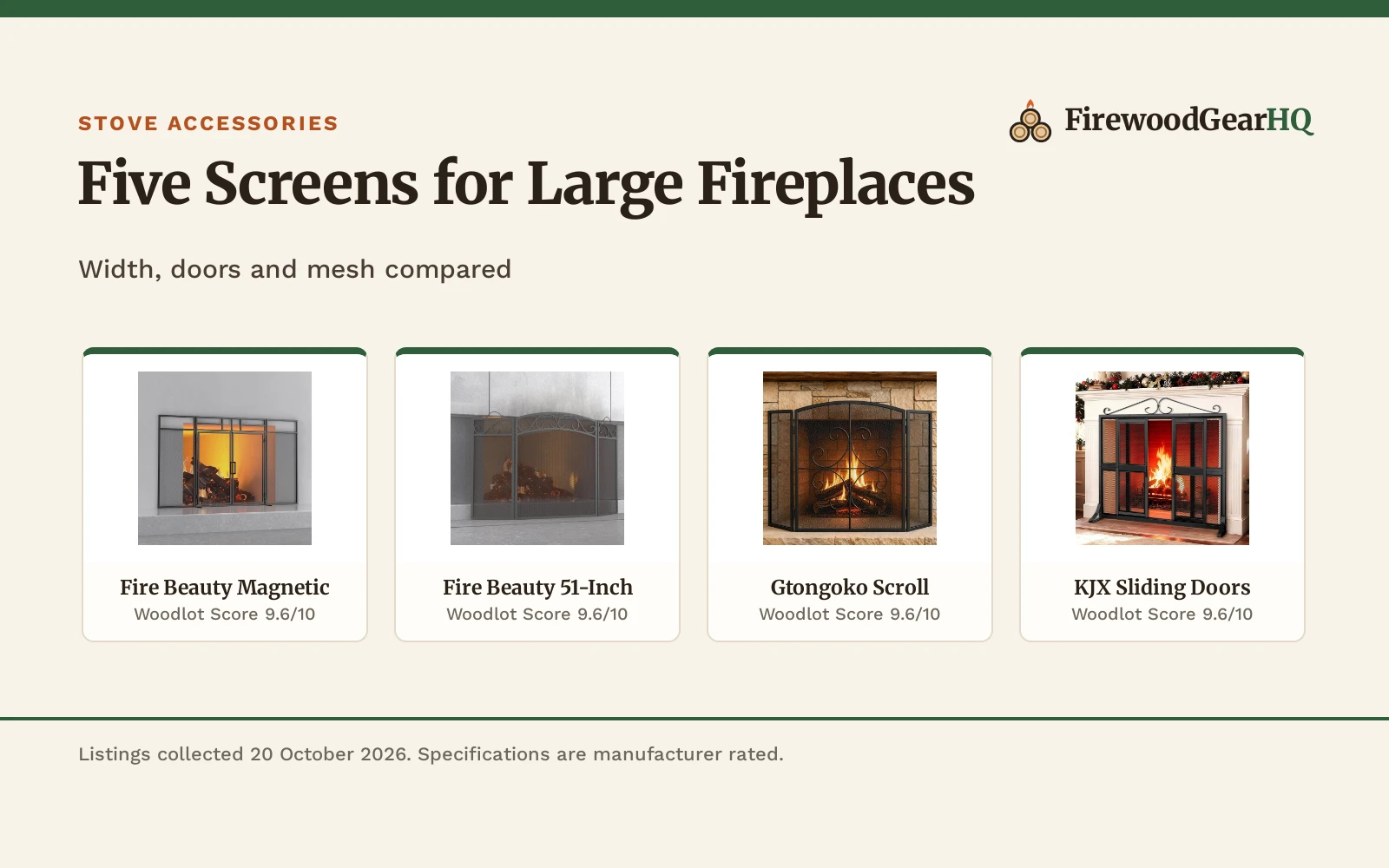
Place your tape measure flat on the firebox floor across the front opening between the side bricks. The front of your grate must be narrower than this width. Side space allows air to circulate around the wood, prevents heat stress on side mortar joints and leaves room for tools. If using a screen, verify the front legs sit behind it. See our review of the best fireplace screen options.
Measure the rear firebox width
Many masonry fireplaces feature angled side walls that narrow toward the back. Measure along the rear firebrick wall at floor level. In a tapered firebox, a rectangular grate chosen solely by front width collides with the walls when pushed back. Tapered grates solve this with a narrower rear width. For example, UBACKS lists a 24 in front and 21 in back, while InnFinest lists a 27 in front and 23 in back. If your walls angle inward, match your rear floor width to the grate rear width.
Measure the firebox depth
Measure from the rear firebrick wall forward to the front opening or door track. Grate depth must be shallower than this distance. Grates sit toward the back of the floor so smoke drafts upward along the sloping rear wall into the chimney throat rather than rolling into the room. Overly deep grates push logs forward against doors or screens. Reference depths range from 10 in on the WILLOW WEAVE model and 11.5 in on the SNOGSWOG model to 14.25 in on the InnFinest model, 14.5 in on the INNO STAGE model and 15 in on the UBACKS model.
Check floor clearance and ember height
Floor clearance is the vertical gap between the hearth floor and the bottom of the grate. Elevating logs lets combustion air enter underneath the fuel bed. Published clearances include 2.5 in on the WILLOW WEAVE grate, 3.35 in on the Zettfuly grate, 3.5 in on the SNOGSWOG grate, 4 in on the INNO STAGE and UBACKS grates, and 4.5 in on the Jusgym grates. Higher clearance accommodates deeper ash between cleanouts, while lower clearance fits fireboxes with low lintels.
Fireplace grate styles and construction
Shape, bar thickness, leg design and material determine how a grate performs under hearth heat.
Cast iron vs steel bar grates
Grates are made from cast iron, solid steel square bars, round bars or flat steel stock. Heavy cast iron grates, like the 24 in UBACKS model weighing 24 pounds, hold heat well and resist sagging under coal beds. Welded steel bar grates provide open airflow channels. InnFinest builds its grate from 3/4 in square steel bars, SNOGSWOG uses 1/2 in solid steel bars, and WILLOW WEAVE uses flat steel bars 1 in wide and 5/16 in thick. Compare budget options in our guide to the cheap fireplace grate category.
Tapered vs rectangular grates
Rectangular grates feature equal front and rear widths for square fireboxes and fire pits. Zettfuly, for example, lists a rectangular 14 in by 11 in grate for compact hearths and stoves. Tapered grates are shaped for masonry fireplaces with angled walls, letting you place firewood back into the radiant zone without binding against side bricks.
Leg counts and anti-sag design
Heat and heavy firewood can cause center bars to warp or sag. To prevent sagging, makers add center support legs. AMAGABELI GARDEN & HOME equips its 24 in grate with 8 legs across the base. Jusgym includes 8 support legs on its 24 in and 30 in grates, and 6 legs on its 17 in model. WILLOW WEAVE uses an 8-leg structure with two long legs measuring 6 1/8 in wide. Models from INNO STAGE and Zettfuly feature 4 stability legs.
Ember retainers and bar spacing
Bar spacing affects how coals interact with the floor. Tightly spaced bars, such as the 10 bars on the AMAGABELI GARDEN & HOME grate, the 8 bars on Jusgym grates, or the 7 bars on the WILLOW WEAVE grate, keep coals against unburned logs. Models like INNO STAGE include a mesh ember retainer to hold coals and kindling above the floor. Wider bar gaps let coals drop to the hearth floor, where makers note they form an ember bed that radiates heat without accelerating log consumption.
Common fireplace grate sizing mistakes
Avoiding sizing errors ensures your fireplace draws properly and burns efficiently.
One mistake is buying based solely on opening width. In a tapered firebox, a grate that fills the front opening will not slide between narrowing side walls. Always verify front and rear hearth floor measurements before ordering.
Another mistake is picking a grate that is too deep. When a grate fills the entire hearth depth, logs sit too close to the front opening where they can tumble against a screen or hit doors. Leaving front space keeps burning logs securely back on the hearth.
Finally, do not overlook ash clearance. A grate with lower clearance, such as 2.5 in, requires frequent cleanouts so trapped ash does not touch bottom bars and accelerate burnout. Removing cooled ashes with a shovel maintains airflow. See our guide to the best ash bucket for fireplace use and our review of the best fireplace tool set.
Frequently Asked Questions
How much clearance should be left around a fireplace grate?
A grate should sit inside the firebox with open space on all sides. Perimeter clearance allows combustion air to flow around the firewood, protects side firebrick walls from direct log contact and leaves room for pokers and shovels.
Why are fireplace grates narrower in the back than in the front?
Many masonry fireplaces have angled side walls designed to radiate heat into the room. Tapered grates are narrower in the rear to fit the back of the firebox without scraping brickwork.
What is the difference between cast iron and steel fireplace grates?
Cast iron grates are thick solid pieces that hold heat and resist sagging under coal beds, though they can crack under sharp impact. Welded steel bar grates use individual steel bars for open airflow channels. Both perform reliably when sized correctly.
How high should a fireplace grate sit off the firebox floor?
Reference grates lift firewood between 2.5 in and 4.5 in above the hearth floor. Published figures include 2.5 in on WILLOW WEAVE, 3.35 in on Zettfuly, 3.5 in on SNOGSWOG, 4 in on INNO STAGE and UBACKS, and 4.5 in on Jusgym. This height supplies airflow while allowing ash accumulation.
What size fireplace grate do I need for a wood-burning fireplace?
Select a grate whose front width, rear width and depth are smaller than your hearth floor. Measure front width, rear width and depth, then choose a size from our comparison, such as 14 in, 17 in, 21 in, 24 in, 27 in or 30 in, that fits inside your firebox.
Related guides
See the stove accessories hub, the best fireplace grate for wood burning and the best cast iron fireplace grate. Also see our cheap fireplace grate. Also see our best fireplace tool set. Also see our best fireplace screen. Also see our best ash bucket for fireplace. Also see our best fire starter for indoor fireplace. Also see our best fireplace log holder. Also see our inside wood rack for firewood. Also see our best indoor firewood rack. Also see our freestanding fireplace screen with doors. Also see our fireplace tools set with wood rack.