How Heavy Should a Splitting Maul Be: Maul Weight Guide
How heavy a splitting maul should be, from 5 lbs to 8 lb heads and total weights up to 10.7 pounds, with advice on matching head weight to wood grain and swing speed.
 By FirewoodGearHQ Editorial
Updated October 9, 2026
By FirewoodGearHQ Editorial
Updated October 9, 2026
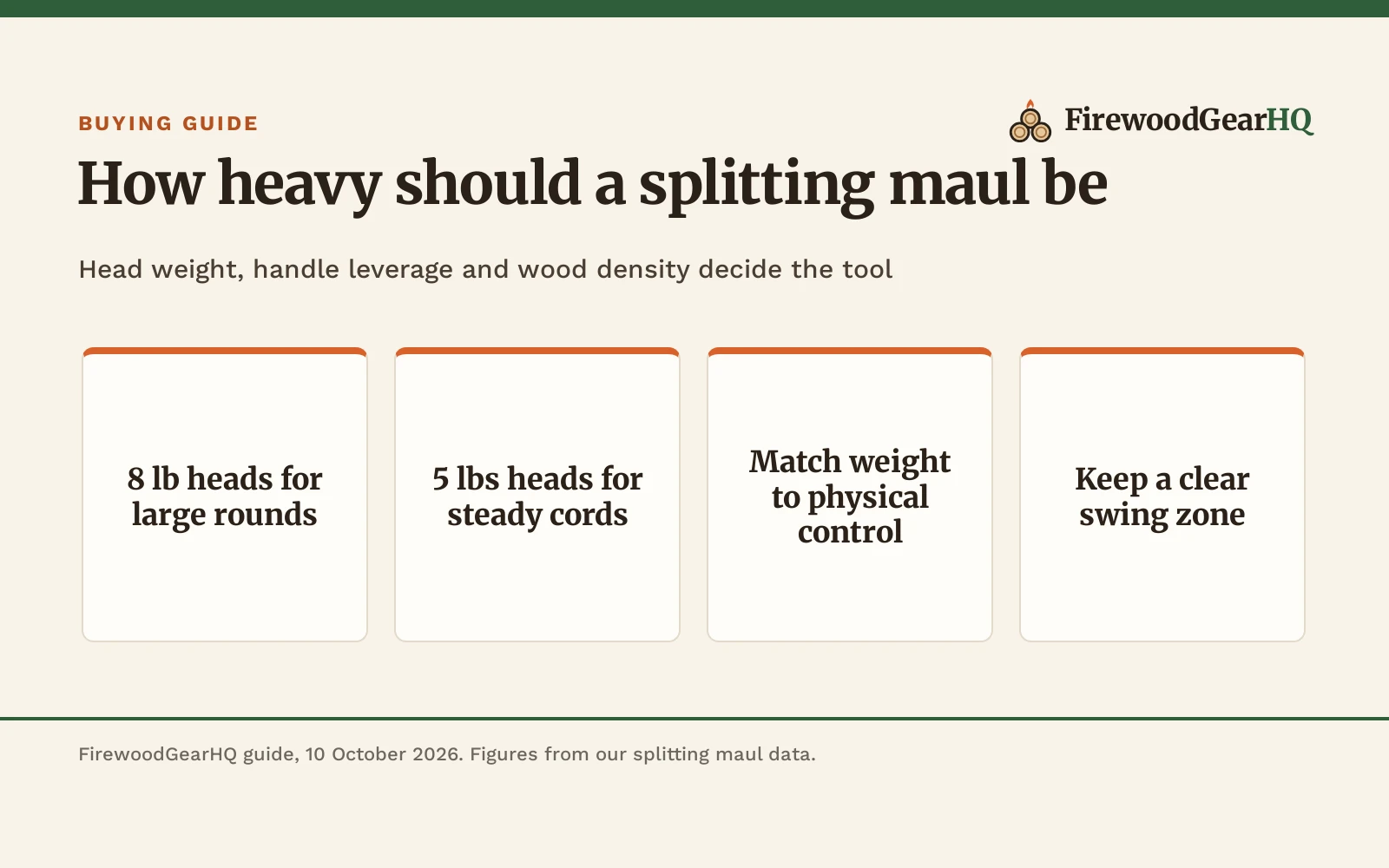
When deciding how heavy should a splitting maul be, most splitters do best with a 5 lbs to 8 lb head, yielding total weights from 6.8 pounds to 10.7 pounds. An 8 lb head delivers momentum for large hardwood rounds, while a 5 lbs head allows faster swing speed and less fatigue. Compact one-handed mauls like the 4.3 pounds Estwing handle kindling chores.
FirewoodGearHQ earns a commission when you buy through links on our product pages, at no extra cost to you. Read our affiliate disclosure.
How heavy should a splitting maul be: the quick answer
The right maul weight balances head mass and swing speed. Unlike an axe that enters fibers with a narrow bit, a maul uses a blunt wedge to force grain apart:
- 8 lb heads (total tool weights 9.5 pounds to 10.7 pounds): Best for stubborn hardwoods and wide trunk rounds, but demanding on stamina.
- Mid-weight mauls (4.5 pounds to 5 lbs heads, total weights 5 pounds to 8 ½ lbs): A versatile balance of power and control with less shoulder strain.
- Compact one-handed mauls (4.3 pounds): Built with short 14.25 in handles for hearthside kindling prep.
For general firewood, a mid-weight maul maintains accuracy and stamina. For knotty hardwood rounds, an 8 lb head in our splitting maul guide provides the needed driving mass.
Splitting maul weight comparison chart
Published listings show how head weight, total weight, and handle length align across reference models:
| Model | Stated head weight | Stated total weight | Handle length | Design focus |
|---|---|---|---|---|
| Estwing Fireside Friend EFF4SE | Not stated | 4.3 pounds | 14.25 in | One-handed compact splitting |
| KSEIBI 274178 | 4.5 pounds | 5 pounds | 36 in | Lightweight full-size utility |
| Husqvarna 576926601 | 4.8 pounds | 6.8 pounds | 32 in | Mid-weight Swedish pattern maul |
| 1844 Helko Werk Germany 10058 | 5 lbs | 8 ½ lbs | 36 in | Heavy wedge interchangeable head |
| Gränsfors Bruks 450 | Not stated | 7 lbs | 31.50 in | Traditional hand-forged splitting |
| Hooyman 1112248 | Not stated | 8 lbs | 36 in | Composite handle with high-carbon head |
| Estwing 62444 | 8 lb | 9.5 pounds | 36 in | Hickory handle heavy-duty splitter |
| Wilton B.A.S.H 50836 | 8 lb | 10 pounds | 36 in | Steel core indestructible handle |
| Channellock 361049 | 8 lb | 10.7 pounds | 36 in | German style heavy wedge |
Reinforced composite or steel handles add mass along the shaft, raising total tool weight above the head weight alone.
What determines how heavy your maul should be
Choosing maul weight requires balancing mechanics, handle leverage, and wood grain.
Head mass versus swing velocity
Striking force depends on mass and velocity. While an 8 lb head provides high mass, a 5 lbs head accelerates faster. If an 8 lb head slows your swing, the delivered energy may be lower than a briskly swung 5 lbs head, which also lands more accurately as fatigue sets in.
Handle length and leverage
A 36 in handle, found on the Wilton, Hooyman, and Channellock listings, provides a wide swing arc for high head speed. Shorter handles, such as the 32 in shaft on the Husqvarna maul or the 31.50 in handle on the Gränsfors Bruks 450, offer tighter control near a chopping block.
Wood species and grain toughness
Straight-grained hardwoods like ash or oak split cleanly, where a mid-weight maul delivers ample force. Tough, interlocking grain like elm and knotty rounds resist splitting regardless of tool weight. Here, an 8 lb head drives deeper, but when rounds stall, using your tool alongside a steel splitting wedge avoids stuck heads.
Fatigue and physical stamina
Splitting several cords involves hundreds of swings. Lifting an 8 lb head repeatedly strains shoulders and wrists. A 5 lbs head, such as on the Helko Werk Vario, allows steady work with less fatigue, preserving swing accuracy and reducing glancing blows.
One-handed versus full-length splitting
Small tasks do not need a full swing. Compact mauls, like the Estwing Fireside Friend at 4.3 pounds with a 14.25 in handle, excel at splitting stove kindling, whereas a 36 in maul is clumsy for hearth work.
How to know if your maul is too heavy or too light
Watching how the tool behaves indicates whether your maul weight is appropriate.
Signs your maul is too heavy:
- Loss of striking accuracy: The head drifts from your targeted crack.
- Slowing swing speed: You rely solely on gravity rather than downward acceleration.
- Premature exhaustion: Back and shoulder strain sets in after a few rounds.
- Frequent overstrikes: The heavy head pulls the handle neck into the wood face.
Signs your maul is too light:
- Bouncing off the end grain: The head rebounds without penetrating wood fibers.
- Getting wedged repeatedly: The blade enters the round without spreading the wood apart.
- Excessive strikes: Straight-grained rounds require repeated hits to open.
What happens if you swing a maul that is too heavy
Swinging a maul beyond your strength creates safety hazards. An 8 lb head on a tool weighing 10 pounds or 10.7 pounds carries high inertia that is hard to redirect when tired. Glancing blows can deflect toward feet or shins, and overstrikes can jar arms or crack wooden handles. Reinforced tools like the Wilton B.A.S.H, featuring a 46 HRC head and steel handle core, withstand overstrikes, but impact shock still reaches the user.
Safe splitting requires establishing a clear swing zone around your work area, keeping bystanders and pets well away. Clear tripping hazards around your block, stand with feet shoulder-width apart, and grip firmly with both hands. Wear eye protection, heavy gloves, and steel-toe boots. If a round resists solid hits, switch to a steel wedge instead of over-swinging.
Splitting mauls compared to axes and wedges
A splitting maul is one tool among several manual options. A dedicated splitting axe is lighter; for example, the Husqvarna splitting axe listing weighs 3.5 pounds with a 30 in handle. Axes have thinner bit profiles for straight-grained firewood and kindling. Compare handling in our maul vs axe guide, learn technique in how to split wood with an axe, or review tool anatomy in what is a splitting maul.
For oversized rounds or knotty crotches where an 8 lb maul binds, driving a forged steel splitting wedge into existing checks is safest. For multiple cords per season, stepping up to the best log splitter for home use saves manual effort. If wood is damp, see whether it is easier to split wood green or seasoned.
Clear the swing area (overhead too), split on a solid chopping block at a comfortable height, keep your feet apart with the block in front of you, and wear eye protection and sturdy boots. Replace a cracked or loose handle before you swing again. Read our Safety Disclaimer.
Frequently Asked Questions
Is an 8 lb splitting maul too heavy for beginners?
For many beginners, an 8 lb head is unwieldy. With total weights reaching 9.5 pounds on the Estwing 62444 or 10.7 pounds on the Channellock, controlling the swing is difficult. Beginners generally achieve better accuracy and safety with a 4.5 pounds or 5 lbs head.
What is the difference between head weight and total weight?
Head weight refers strictly to the forged steel wedge, such as the 5 lbs head on the Helko Werk 10058 or the 8 lb head on the Wilton 50836. Total weight includes handle and grip materials, bringing the Wilton to 10 pounds total.
Can a splitting maul be too light for tough rounds?
Yes. A maul that is too light lacks the inertia needed to part tough hardwood fibers, causing the blade to bounce or bind shallowly. In knotty wood, stepping up to an 8 lb head or a splitting wedge provides the needed force.
How does a 36 in handle affect swinging power?
A 36 in handle on models from Hooyman, Wilton, and Estwing provides leverage that increases head speed before impact. Shorter handles around 31.50 in or 32 in offer closer control near a chopping block.
When should you use a splitting wedge instead of a heavy maul?
When massive rounds or gnarly crotches refuse to crack under an 8 lb maul, switch to a steel splitting wedge. Driving a wedge concentrates force directly into a crack without risking a stuck maul.
What are compact one-handed splitting mauls used for?
Compact mauls like the Estwing Fireside Friend EFF4SE, weighing 4.3 pounds with a 14.25 in handle, are built for one-handed kindling splitting at the hearth rather than splitting large logs.
Related guides
See our axes and mauls hub to explore hand splitting tools, or browse top picks in the best splitting maul roundup. If you prefer a lighter swing, compare models in the best splitting axe guide or learn technique in how to split wood with an axe. For difficult knotty wood, review the best splitting wedge options. Prepping kindling? Check the best kindling splitter and the best hatchet for splitting wood. For cutting firewood logs to length, read the best chainsaw for firewood guide. Keep split wood dry with the best firewood rack with cover, and check drying progress with the best firewood moisture meter. Also see our comparison of maul vs axe. Also see our explainer on what is a splitting maul. Also see our guide on is it easier to split wood green or seasoned. Also see our recommendations for the best log splitter for home use.
About the author
The FirewoodGearHQ editorial team researches firewood and wood heating equipment from published specifications, ratings and warranty terms, and scores every pick the same way. We do not run our own product trials.