How Often Should You Clean Your Chimney with a Wood Stove?
How often to clean your wood stove chimney, including NFPA 211 annual inspection guidelines, seasonal sweeping schedules, creosote signs and maintenance tips.
 By FirewoodGearHQ Editorial
Updated October 9, 2026
By FirewoodGearHQ Editorial
Updated October 9, 2026
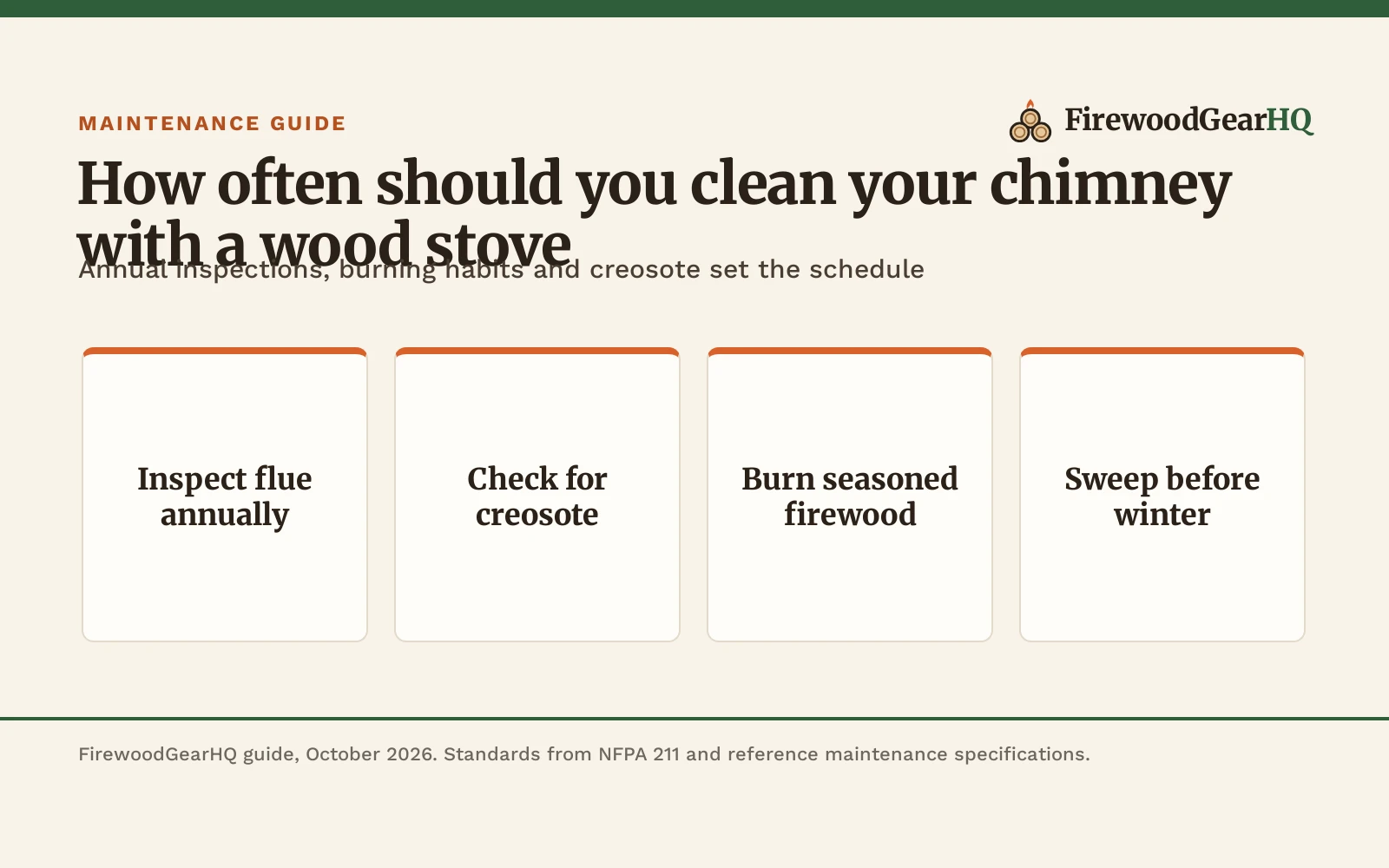
How often should you clean your chimney with a wood stove depends on your heating routine, but every solid-fuel heating system requires an annual inspection under National Fire Protection Association standard NFPA 211. Primary winter wood burners typically require sweeping once per season with additional mid-season sweeping as creosote accumulates. Occasional or supplemental burners generally manage with an annual sweep before heating begins.
FirewoodGearHQ earns a commission when you buy through links on our product pages, at no extra cost to you. Read our affiliate disclosure.
How often should you clean your chimney with a wood stove?
The baseline maintenance schedule begins with an annual inspection by a certified chimney sweep. The Chimney Safety Institute of America (CSIA) and National Fire Protection Association standard NFPA 211 recommend having your flue, connector pipes, and appliance evaluated once each year prior to the cold season. An annual evaluation confirms that joints remain tight, liners show no damage, chimney caps stay clear, and creosote has not reached hazardous levels.
Physical sweeping beyond that benchmark depends on burning frequency, operation habits, and fuel quality. Primary wood burners heating through freezing winters frequently require mid-season sweeping. In contrast, supplemental evening burners often find that sweeping once per season suffices. Chemical maintenance products in reference listings publish clear usage guidelines: Pine Mountain specifies applying a creosote firelog once per season or every 40 fires, the Creosote Sweeping Log directs homeowners to treat deposits every 60 fires, and Co-Mate lists its 2.2 lb cleaner bottle as providing capacity for up to 140 fires. Rutland notes that its creosote remover granule formulation is heat activated at 265°F and provides up to 16 applications per container. While chemical additives help condition deposits, they do not replace manual sweeping.
Chimney cleaning frequency by wood stove usage
| Heating routine | Recommended chimney sweeping frequency | Inspection schedule |
|---|---|---|
| Primary winter heating (continuous daily burning) | Sweeping once per season with mid-season sweeping when deposits build | Inspect flue monthly during burning months; NFPA 211 annual check |
| Supplemental home heating (evening fires) | Sweeping once per season before the heating period begins | Mid-season visual check; NFPA 211 annual professional evaluation |
| Occasional or weekend burning | Sweeping once per season prior to winter use | NFPA 211 annual professional check |
| Low-temperature or smoldering burns | Frequent sweeping whenever dark deposits glaze pipe walls | Inspect flue every few weeks; adjust combustion airflow |
Treat this table as an operational baseline. Wood moisture, draft strength, and flue geometry cause soot to accumulate at varying rates.
What makes chimney creosote build up faster
Burning unseasoned or wet firewood
Fuel moisture strongly governs soot and creosote accumulation. When unseasoned wood enters a firebox, heat is consumed boiling off moisture rather than warming the flue. This smoky exhaust cools rapidly in the stovepipe, where heavy compounds condense into sticky creosote. Learn what moisture content firewood should be, and verify split wood before loading with the best firewood moisture meter on freshly exposed grain.
Cool flue gas and restricted airflow
Restricting an air damper to stretch overnight burns starves the fire of oxygen, causing wood to smolder. Smoldering fires produce unburned gases that condense into dense soot. Monitoring pipe temperature with the best stove thermometer keeps combustion in an efficient heating zone. Distribute convection warmth throughout your room using the best wood stove fan without choking combustion air to cold, smoldering levels.
Oversized or uninsulated chimney flues
A wood stove connected to an unlined exterior chimney or an oversized flue often experiences sluggish draft. When exhaust gases leave the stove collar and expand into a larger passage, velocity drops and temperatures fall. Water vapor and vaporized tar condense before exiting the cap, leaving heavy creosote near the top.
Restricted draft and negative household air pressure
Tight home envelopes, competing exhaust fans, or improper pipe runs choke combustion air. Starved fires produce lazy flames and heavy smoke that clings to flue walls. Maintain pipe clearances and ventilation according to manufacturer instructions, local codes, and our wood stove safety checklist.
Signs it is time to clean your chimney
Calendar schedules provide a guideline, but physical flue conditions dictate when to sweep. Watch for these warning signs:
- Visible creosote accumulation: A crusty layer, flaky buildup, or shiny tar glaze inside the stovepipe or liner indicates sweeping is due.
- Sluggish stove draft: A stove struggling to draw air or spilling smoke into the room on door opening indicates a restricted flue.
- Black smoke or soot fallout: Excessive dark smoke exiting the cap or soot falling past the baffle plate reveals heavy carbon buildup.
- Roaring noise or strong vibration: A loud roaring sound or heavy vibration inside the pipe indicates an active chimney fire, requiring immediate air shutdown, evacuation, and emergency calls.
- Strong soot odors: Acrid odors from the firebox during damp weather indicate creosote lining the flue.
Routine ash cleanup also keeps air intakes clear. Empty cool ash safely, and remove fine residue from hearth grates with the best ash vacuum for wood stoves.
What happens if you delay chimney cleaning
Neglecting chimney cleaning creates severe hazards. Creosote is a combustible byproduct of incomplete combustion. As it thickens along flue walls, it turns into a dense glaze that ignites when flue temperatures spike. Chimney fires burn with intense heat, capable of cracking masonry liners, warping steel pipes, and igniting home framing.
A fouled flue also restricts exhaust draft, forcing toxic carbon monoxide and smoke into living spaces. Follow safety guidance from the Consumer Product Safety Commission (CPSC) and EPA Burn Wise: maintain working smoke and carbon monoxide alarms, burn seasoned cordwood, respect clearances, and schedule an annual inspection by a certified professional.
Mechanical sweeping tools and chemical cleaners
Chimney maintenance combines mechanical sweeping tools with chemical conditioning products. Chemical logs and powders do not replace physical sweeping; they alter sticky creosote, converting it into brittle ash that dislodges easily during brushing.
Mechanical cleaning can be performed with rotary kits driven by drills. Gardus rates its SootEater rotary chimney cleaning system to clean open chimneys up to 18 feet using 6 flexible 3-foot rods and spinning nylon whips, recommending an 18V cordless drill. Morinoli provides a 26-foot chimney sweep kit with 8 flexible rods measuring 39.3 inches each, while Bluesea lists a 30-foot sweep kit with 9 flexible rods measuring 39.3 inches. Sealegend manufactures a 33-foot chimney sweep kit with 10 flexible rods, also measuring 39.3 inches each. These systems enable sweeping straight flues from the bottom up.
Chemical maintenance formulations offer interim support. The Creosote Sweeping Log burns for approximately 90 minutes and continues treating deposits over 1 to 2 weeks for use every 60 fires. Rutland creosote remover granule powder activates at 265°F and provides up to 16 applications to turn sticky creosote into loose ash. Co-Mate produces a 2.2 lb non-toxic powder bottle that lasts up to 140 fires, reducing emissions and inhibiting creosote formation. For hearth masonry, Quick N Brite offers a 16 oz fireplace gel cleaner with a scrub brush to clean stone and brick surfaces. Severe glazed creosote or structural damage requires professional chimney sweep intervention. Always point to certified chimney sweeps and professional installers for stove installation and flue repairs, avoiding risky DIY installation.
Frequently Asked Questions
Can chimney cleaning logs replace manual chimney sweeping?
No. Chemical products like the Creosote Sweeping Log or Pine Mountain Creosote Buster dry out and loosen creosote, but they do not sweep away ash or clear blockages. A mechanical brush or rotary whip system remains necessary to sweep loosened debris out of the flue.
How do I know if my chimney needs cleaning without climbing on the roof?
Once the stove is cold, remove the stovepipe cleanout cap or open the damper, and shine a bright flashlight up into the flue. A crusty layer of soot or dark creosote accumulation indicates mechanical sweeping is needed. Sluggish draft and smoky startups also signal airflow restriction.
Does burning dry hardwood eliminate chimney creosote?
Burning dry hardwood reduces creosote formation compared to wet wood, but does not eliminate it entirely. All wood combustion releases hydrocarbons that collect on cooler flue surfaces over time. An annual inspection under NFPA 211 guidelines remains essential.
What time of year is best to clean a wood stove chimney?
Late spring and early autumn are ideal. Sweeping in spring removes acidic soot before summer humidity causes corrosion. An early autumn inspection ensures nests, leaves, and debris are cleared before cold-weather lighting.
How many fires can you burn before cleaning the chimney?
There is no fixed fire count for sweeping, as wood moisture and temperatures govern creosote formation. Chemical product makers publish treatment intervals: Pine Mountain advises using a firelog once per season or every 40 fires, the Creosote Sweeping Log indicates treatment every 60 fires, and Co-Mate lists its 2.2 lb bottle as lasting up to 140 fires. For physical sweeping, professional standards prioritize flue condition over fire counts, recommending annual inspection and sweeping whenever creosote deposits accumulate.
Can I clean a wood stove chimney from the bottom up?
Yes. Rotary sweep kits like the Gardus SootEater clean chimneys from the bottom up through the cleanout or fireplace opening. Using flexible rods driven by a cordless drill, these tools clean flues without roof work.
Related guides
Explore our complete hearth collection in the stove accessories hub. To optimize wood stove warmth and room air circulation, compare top-rated models in our guide to the best wood stove fan. Monitor firebox temperatures accurately using the best stove thermometer, and maintain clean indoor air with the best ash vacuum for wood stoves. Ensure firewood is properly dried using the best firewood moisture meter, review our comprehensive wood stove safety checklist, and learn what moisture content firewood should be for clean, efficient heating.
About the author
The FirewoodGearHQ editorial team researches firewood and wood heating equipment from published specifications, ratings and warranty terms, and scores every pick the same way. We do not run our own product trials.