Best Fire Starters for Wood Stoves: 5 Natural Picks Compared
Five fire starters for wood stoves compared by material, burn time, packaging weight, piece count and safety features, from pine wood wool tumbleweeds to dense fatwood sticks.
 By FirewoodGearHQ Editorial
Updated October 9, 2026
By FirewoodGearHQ Editorial
Updated October 9, 2026
Lighting a cold wood stove requires steady heat to establish an upward draft in the chimney and ignite dry firewood without filling the room with smoke. The best fire starters for wood stoves provide fast ignition, consistent burning times, and clean combustion without hazardous chemical additives. Natural wood wool tumbleweeds and resin-rich pine fatwood sticks stand out because they ignite quickly, resist moisture, and produce dependable flames to catch your kindling. This guide compares five fire starters for wood stoves across the features that matter around the hearth: materials, piece counts, listed package weights, burn times, and stated safety features, from bulk boxes of pine wood wool to dense fatwood sticks and individually wrapped wax options.
FirewoodGearHQ earns a commission when you buy through links on this page, at no extra cost to you. Affiliate disclosure.
Quick picks
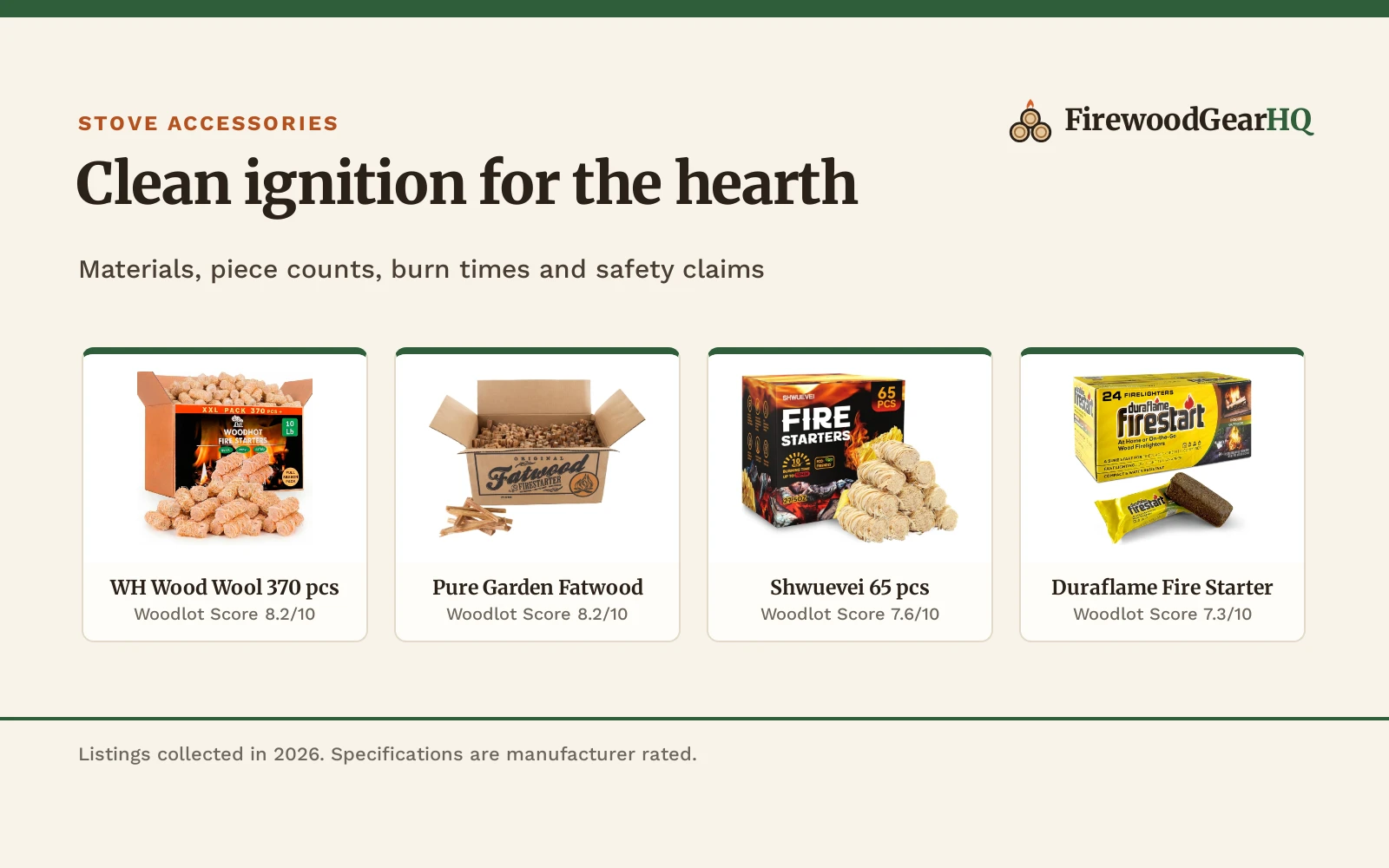
- Best Overall WH Wood Wool 370 pcs: 370 count box of natural pine wood wool tumbleweeds free of wax or paraffin. Check price
- Best Bulk Fatwood Pure Garden Fatwood: 25 lb carton of 100% all-natural pine resin sticks that light when damp. Check price
- Best Long Burn Shwuevei 65 pcs: Hand-woven natural wood curls burning up to 10 minutes with no smoke. Check price
- Best Wrapped Starters Duraflame Fire Starter: 24 individually wrapped wax and biomass sticks for tidy, mess-free hearth lighting. Check price
Compare the picks
| Model | Woodlot Score | Material | Quantity | Listed weight | Burn time | Warranty (stated) |
|---|---|---|---|---|---|---|
| WH Wood Wool 370 pcs | 8.2/10 | Pine wood wool, fatty acid | 370 count | 10 lb (table lists 13.61 g) | Long-burning (stated) | Not stated |
| Pure Garden Fatwood | 8.2/10 | 100% pine wood | 1 count (sticks unstated) | 25 lb (11.14 kg listed) | Not stated (2 to 3 sticks) | Not stated |
| Shwuevei 65 pcs | 7.6/10 | Hand-woven natural wood | 65 count | 1.72 lb | Up to 10 minutes | Not stated |
| Duraflame Fire Starter | 7.3/10 | Wax and renewable biomass | 24 pack (table states 48) | 3.11 kg | Not stated | Not stated |
| HGD Mini Natural | 6.9/10 | Pine wood shavings and wax | 32 count | Not stated | Approximately 6 minutes | Not stated |
Specifications are manufacturer rated, collected 9 October 2026. Package weights and piece counts are as listed in product descriptions. None of these listings states a manufacturer warranty term.
The picks
| Award | Product | Woodlot Score About the HQ ScoreThe Woodlot Score runs from 0 to 10 and weighs performance (35%), build (25%), value (25%), safety (10%, where it applies) and warranty (5%), using only what the manufacturer and the listing publish. How we pick › | |
|---|---|---|---|
 WH 370 pcs Natural Fire Starters for Indoor
|
8.2/10 | Buy | |
 Fatwood Fire Starter Sticks 25lb Box
|
8.2/10 | Buy | |
 Shwuevei 65 pcs Fire Starter
|
7.6/10 | Buy | |
 Duraflame Fire Starter for Indoor and Outdoor Use
|
7.3/10 | Buy | |
 HGD Fire Starter, Mini Natural Fire Starters
|
6.9/10 | Buy |
WH 370 pcs Natural Fire Starters for Indoor
A bulk box of 370 count tumbleweed fire starters made from pine wood wool with natural fatty and lauric acid, free of wax, paraffin, or chemical additives.
Pros
- Large 10 lb box contains 370 count tumbleweeds for a full season supply
- Pine wood wool mixed with natural fatty and lauric acid with no paraffin or wax
- Stated chemical-free, smoke-free, and odorless for indoor stove use
- Quick ignition catches fire with one touch and resists water
Cons
- Spec table contradicts box weight, listing 13.61 g instead of 10 lb
- No warranty term is stated on this listing
- Tumbleweed curls take up significant storage space near the hearth
- Single pieces are small and require careful placement under wood
Fatwood Fire Starter Sticks 25lb Box
A 25 lb bulk box of 100% all-natural pine fatwood sticks designed for quick kindling in wood stoves, fireplaces, and outdoor hearths.
Pros
- Heavy 25 lb bulk box provides a large volume of kindling sticks
- 100% all-natural resin pine wood with no artificial chemicals or additives stated
- Listing states the resin-rich sticks ignite even when damp or wet
- Sticks light with a match and only 2 to 3 are recommended per fire
Cons
- Specific stick count is not stated in the listing or spec table
- No warranty term is stated on this listing
- At 25 lb (11.14 kg listed), the full carton is heavy to move
- Sticks are rigid and cannot be torn or shaped like wood wool
Shwuevei 65 pcs Fire Starter
A pack of 65 hand-woven natural wood fire starters offering a stated burn time of up to 10 minutes without chemical additives or smoke.
Pros
- Stated burn time of up to 10 minutes helps ignite larger firewood
- Hand-woven natural wood construction with no chemical additives
- Stated to produce no flare-ups or smoke in indoor wood stoves
- Listing notes a single piece is sufficient to establish a fire
Cons
- Listing text switches between calling the pieces sticks and cubes
- No warranty term is stated on this listing
- Pack size is limited to 65 count compared to bulk alternatives
- Listed weight is only 1.72 lb for the entire package
Duraflame Fire Starter for Indoor and Outdoor Use
A 24 pack of individually wrapped fire starters made from a sustainable blend of wax and renewable biomass for clean, water-resistant ignition.
Pros
- Individually wrapped pieces allow mess-free handling by the stove
- Formulated with wax and renewable biomass designed to help reduce emissions
- Water-resistant sticks ignite quickly with a single match
- Compact packaging stores neatly in indoor hearth woodboxes
Cons
- Spec table contradicts title by listing 48 firelighters against a 24 pack
- No warranty term is stated on this listing
- Contains wax rather than pure all-natural untreated timber
- Smaller 24 pack requires frequent restocking for daily stove heating
HGD Fire Starter, Mini Natural Fire Starters
A 32 count box of mini fire starters made from pine wood shavings and wax, stated to emit up to 80% less carbon monoxide than traditional starters.
Pros
- Listing claims up to 80% less carbon monoxide than traditional fire starters
- Water-resistant composition burns for approximately 6 minutes even when damp
- Made from natural pine wood shavings and wax
- Compact squares ignite rapidly in wood stoves and hearths
Cons
- Spec table errantly lists Charcoal Starters as the manufacturer and model
- No warranty term is stated on this listing
- Starter pack contains only 32 count, the lowest count in this group
- Listing title calls them sticks while the description refers to squares
How we scored them
Each fire starter is scored on performance, build, value, safety and warranty, using only what the listing publishes. The weights are on our How We Pick page.
| Product | Woodlot Score | Perf. /35 | Build /25 | Value /25 | Safety /10 | Warranty /5 |
|---|---|---|---|---|---|---|
| WH Wood Wool 370 pcs | 8.2 | 32 | 21 | 24 | 6 | 0 |
| Pure Garden Fatwood | 8.2 | 32 | 22 | 22 | 5 | 0 |
| Shwuevei 65 pcs | 7.6 | 29 | 20 | 21 | 5 | 0 |
| Duraflame Fire Starter | 7.3 | 28 | 20 | 20 | 5 | 0 |
| HGD Mini Natural | 6.9 | 27 | 18 | 19 | 6 | 0 |
Buying guide: choosing the best fire starters for wood stoves
Starter types: wood wool, fatwood, and wax blends
Wood stove fire starters generally fall into three distinct material categories: wood wool curls, resinous pine sticks, and wax-bound shavings. Wood wool starters consist of fine shavings of untreated pine woven into compact tumbleweed bundles, often soaked in natural fatty and lauric acid to sustain a steady flame without synthetic wax or petroleum. Fatwood sticks are split from the resin-saturated heartwood of pine stumps, providing dense, all-natural kindling that burns intensely due to organic resin. Wax-based starters blend wood fibers or shavings with wax binders, providing water resistance and uniform combustion across every piece.
Burn time and establishing a draft
In an airtight wood stove, a fire starter must burn long enough to preheat the cold air column in the chimney flue and establish a strong upward draft. If a starter burns out in under a couple of minutes, the draft can collapse and push smoke back into the living area before the kindling catches. Products in this comparison list burning times ranging from approximately 6 minutes up to 10 minutes according to manufacturer specifications. That window delivers sufficient heat to warm the stove collar, ignite seasoned kindling splits, and sustain airflow through the firebox.
Moisture resistance and shelf stability
Fire starters are frequently stored in basements, unheated porches, or humid hearth areas where atmospheric moisture can soften paper or cardboard kindling. High-quality starters resist ambient humidity. Pure Garden states its resinous pine sticks ignite even when damp or wet, while wax-treated options and dense wood wool rolls maintain their starting capability through changing seasons without deteriorating or rotting over time.
Indoor air quality and clean burning
Because wood stoves operate inside living spaces, minimizing noxious fumes, heavy smoke, and artificial additives during startup is critical. Traditional chemical fire starters can release foul odors or leave sticky residues on stove glass and flue linings. Starters formulated from 100% natural pine wood or pine wool with natural fatty acid burn cleanly and odorless. Avoiding paraffin and petroleum additives also ensures the hearth area remains pleasant and safe when loading fuel with the stove door open.
Quantity and winter stockpiles
Homeowners who rely on wood stoves for primary or supplemental winter heat light fires daily or multiple times each week. Pack sizes vary significantly across available listings, ranging from compact 32 count beginner boxes and 24 pack cartons up to 370 count bulk cartons and 25 lb boxes of fatwood. Selecting a bulk pack provides an entire season of reliable starting without the hassle of frequent reordering.
How to arrange starters in a wood stove
Proper airflow is the key to lighting a wood stove without smoke. For a traditional bottom-up fire, place a single wood wool piece or 2 to 3 fatwood sticks on the firebox floor, arrange small splits of dry kindling loosely over the starter in a crisscross pattern, and open the primary air intake fully before lighting with a match. For top-down fires, arrange larger logs on the bottom, place kindling on top, and set your fire starter near the peak so flames burn downward through the wood pile. For more detailed instructions on building and managing hearth fires, read our complete guide on how to start a fire in a wood stove and choose the best wood for a wood stove.
Wear eye protection and gloves for cutting, splitting and handling, follow every tool's manual, install stoves to code, and have the chimney inspected and cleaned every year. See EPA Burn Wise and NFPA heating safety. Read our Safety Disclaimer.
Frequently Asked Questions
What are the best fire starters for wood stoves?
Natural pine wood wool tumbleweeds and resinous pine fatwood sticks are widely considered the top choices for wood stoves. They ignite rapidly with a single match, deliver sustained heat without toxic chemicals or strong odors, and burn cleanly to protect flue draft and stove glass.
How many fire starters do I need to light a wood stove?
For most stove fires, a single wood wool starter or 2 to 3 fatwood sticks is sufficient to catch dry kindling. Using extra starters is unnecessary and can create excessive initial smoke before the flue draft is established.
Can you use fatwood in an airtight wood stove?
Yes. Natural fatwood is 100% pine wood saturated with natural pine resin. It contains no artificial additives, chemicals, or petroleum binders, making it completely safe for modern airtight catalytic and non-catalytic wood stoves when used in moderation.
Do wood stove fire starters produce creosote?
Solid natural fire starters produce negligible creosote because they burn down quickly in several minutes. Creosote accumulation in chimneys is caused by burning wet or unseasoned firewood at low flue temperatures, not by the starter used during startup.
Can I use liquid accelerants in a wood stove?
Never use lighter fluid, gasoline, or liquid fire starters in an enclosed wood stove. Liquid fuels evaporate rapidly into explosive vapors inside a closed firebox, posing an extreme risk of explosion, sudden flare-ups, and shattered ceramic door glass.
Related guides
Explore more hearth equipment on our stove accessories hub and wood stoves guide. For step-by-step starting techniques, read our guide on how to start a fire in a wood stove and learn how to keep a wood stove burning all night. If you also maintain an open hearth, compare picks in our best fire starter for indoor fireplace roundup and review best fireplace tool sets. Selecting fuel? Check the best wood for a wood stove and verify drying times with our guide on how long to season firewood. Monitor burn temperatures using the best wood stove thermometer, distribute warmth with the best wood stove fan, and prepare kindling using the best kindling splitter. For cleanout maintenance, see our guide to the best ash vacuum for wood stoves and learn how to dispose of wood stove ashes safely. Troubleshooting draft issues? Read why does my wood stove smoke when I open the door and why does my wood stove glass turn black.
About the author
The FirewoodGearHQ editorial team researches firewood and wood heating equipment from published specifications, ratings and warranty terms, and scores every pick the same way. We do not run our own product trials.