Best Wood Stove Fan Heat Powered: 5 Fans Compared
Five heat-powered wood stove fans compared by blade count, operating temperature, airflow, overheat protection and warranty terms, from 4-blade to 6-blade models.
 By FirewoodGearHQ Editorial
Updated October 9, 2026
By FirewoodGearHQ Editorial
Updated October 9, 2026
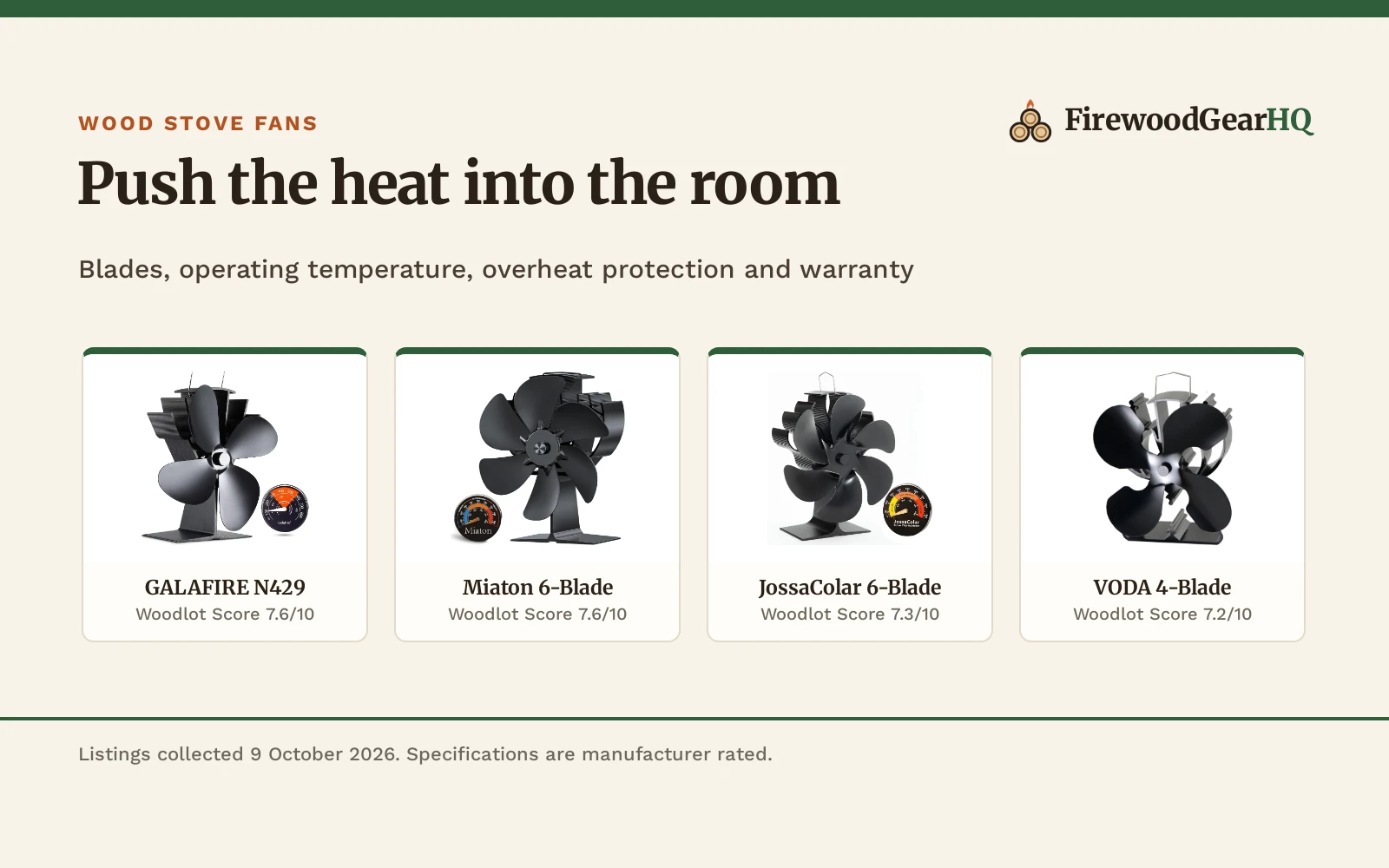
A wood stove warms the air directly around it first, which often leaves heat pooled near the ceiling or trapped around the hearth. Choosing the best wood stove fan heat powered by stove surface heat allows you to circulate warm air through the living area without electrical cords or batteries. This guide compares five heat-powered fans by blade configuration, operating temperature, airflow, overheat protection and stated warranty terms.
FirewoodGearHQ earns a commission when you buy through links on this page, at no extra cost to you. Affiliate disclosure.
Quick picks
- Best Overall GALAFIRE N429: GALAFIRE N429: 4 blades, 122°F low start, magnetic thermometer and a 2-year warranty. Check price
- Best Overheat Protection Miaton 6-Blade: Miaton 6-blade: pop-up overheat shrapnel above 350°C, thermometer and a 1-year warranty. Check price
- Best Stated Airflow JossaColar 6-Blade: JossaColar 6-blade: 150 CFM stated airflow, curved blades, thermometer and a 1-year replacement warranty. Check price
- Best Large Blade VODA 4-Blade: VODA 4-blade: 8.3 in blade diameter, bimetal overheat lift at 482°F and silent operation. Check price
Compare the picks
| Model | Woodlot Score | Blades | Operating temperature | Airflow (stated) | Height | Overheat protection | Warranty (stated) |
|---|---|---|---|---|---|---|---|
| GALAFIRE N429 | 7.6/10 | 4 | Starts 122°F; ideal 482°F | Not stated | 7.48 in | Not stated | 2 years |
| Miaton 6-Blade | 7.6/10 | 6 | Starts above 50°C | Not stated | Not stated | Base shrapnel pop-up (350°C) | 1 year |
| JossaColar 6-Blade | 7.3/10 | 6 | Not stated | 150 CFM | 7.7 in (bullets); 8 in (table) | Not stated | 1-year replacement |
| VODA 4-Blade | 7.2/10 | 4 | Starts around 176°F (80°C) | Not stated | Not stated | Base lift (around 482°F) | Not stated |
| Tomersun 6-Blade | 7.2/10 | 6 | Starts 158°F; 185 to 660°F | Not stated | Not stated | Not stated | Not stated |
Specifications are manufacturer rated, collected 9 October 2026. Airflow figures are the brands’ own and are not comparable between brands.
The picks
| Award | Product | Woodlot Score About the HQ ScoreThe Woodlot Score runs from 0 to 10 and weighs performance (35%), build (25%), value (25%), safety (10%, where it applies) and warranty (5%), using only what the manufacturer and the listing publish. How we pick › | |
|---|---|---|---|
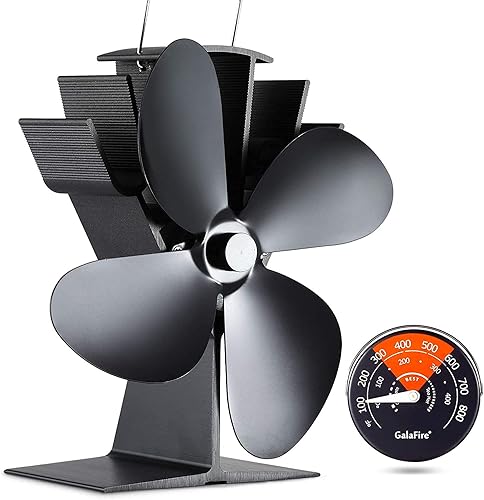 4-Blades Heat Powered Wood Stove Fan + Magnetic
|
7.6/10 | Buy | |
 Wood Stove Fan Heat Powered
|
7.6/10 | Buy | |
 JossaColar Wood Stove Fan Heat Powered Fireplace
|
7.3/10 | Buy | |
 VODA Wood Stove Fan Heat Powered Fireplace Fan No
|
7.2/10 | Buy | |
 Tomersun Wood Stove Fan Heat Powered Stove Fan
|
7.2/10 | Buy |
4-Blades Heat Powered Wood Stove Fan + Magnetic
A compact heat-powered stove fan with 4 anodized aluminum blades, a low 122°F starting temperature, an included magnetic thermometer and a 2-year warranty.
Pros
- 2-year warranty stated in the listing
- Self-starts at temperatures as low as 122°F (50°C)
- Magnetic stove thermometer included in the box
- Compact 7.48 in (19 cm) height fits tighter clearances
Cons
- Airflow volume in CFM is not stated
- No built-in bimetal overheat lift mechanism stated
- Not recommended if stove top maximum is below 212°F
- Decibel sound rating is not stated
Wood Stove Fan Heat Powered
A heat-powered 6-blade stove fan made of anodized aluminum with built-in high-temperature overload protection that pops up above 350°C, an included thermometer and a 1-year warranty.
Pros
- Built-in overload protection pops up above 350°C
- Stated 1-year warranty
- Magnetic thermometer included
- Integrated metal handle for carrying
Cons
- Airflow CFM rating is not stated
- Requires surface temperature above 50°C (122°F) to operate
- Dimensions and weight are not stated
- Will not function on stoves with cooler insulated top layers
JossaColar Wood Stove Fan Heat Powered Fireplace
A 6-blade heat-powered stove fan with curved aluminum blades, a stated 150 CFM airflow capacity, an included magnetic thermometer and a 1-year replacement warranty.
Pros
- 150 CFM airflow capacity stated in specification table
- 1-year replacement warranty and 30-day refund window stated
- Free magnetic thermometer included
- Silent operation rated under 25 dB
Cons
- Conflicting dimensions between bullets and specification table
- Specification table lists erroneous details like wood material and touch control
- No overheat lift mechanism described
- Operating temperature range is not stated
VODA Wood Stove Fan Heat Powered Fireplace Fan No
A heat-powered stove fan equipped with 4 large 8.3-inch anodized aluminum blades, an automatic overheat protection lift around 482°F and silent operation under 25 dB.
Pros
- Overheat protection device lifts fan base around 482°F
- Large 4-blade design with 8.3 in blade diameter
- Heavy-duty anodized aluminum construction
- Operates quietly at less than 25 dB
Cons
- No warranty term is stated
- Airflow CFM rating is not stated
- No thermometer included in the package
- Overall height and weight are not stated
Tomersun Wood Stove Fan Heat Powered Stove Fan
A 6-blade heat-powered stove fan with anodized aluminum blades, a stated 185°F to 660°F operating temperature range, an included thermometer and carrying handle.
Pros
- Broad working temperature range from 185°F to 660°F
- Self-starts around 158°F
- Thermometer included to monitor heat
- Integrated metal carry handle
Cons
- No warranty term is stated
- No automatic overheat lift mechanism stated
- Must be manually removed when temperature exceeds 660°F (350°C)
- Airflow CFM rating is not stated
How we scored them
Each fan is scored out of 100 on performance, build, value, safety and warranty, using only what the listing publishes. Built-in overheat protection devices earn safety credit. Concrete warranty terms earn warranty credit. The weights are on our How We Pick page.
| Product | Woodlot Score | Perf. /35 | Build /25 | Value /25 | Safety /10 | Warranty /5 |
|---|---|---|---|---|---|---|
| GALAFIRE N429 | 7.6 | 29 | 20 | 24 | 0 | 3 |
| Miaton 6-Blade | 7.6 | 29 | 20 | 22 | 4 | 2 |
| JossaColar 6-Blade | 7.3 | 28 | 20 | 24 | 0 | 2 |
| VODA 4-Blade | 7.2 | 29 | 20 | 20 | 3 | 0 |
| Tomersun 6-Blade | 7.2 | 29 | 20 | 22 | 0 | 0 |
Buying guide: choosing the best wood stove fan heat powered
How heat-powered fans work
A thermoelectric module situated in the base of the fan converts heat into electric current using the Seebeck effect. When the heavy base plate heats up from direct thermal contact with the stove top while the upper aluminum cooling fins remain exposed to cooler ambient room air, the resulting temperature differential generates voltage to spin a small direct-current electric motor. The fan operates entirely without cords, batteries or external power. As the stove warms, the speed of the fan increases proportionally, circulating heated air outward into the living area.
Operating temperature and overheat protection
Every thermoelectric stove fan requires a minimum threshold temperature before the module produces enough current to overcome motor resistance and begin spinning. Some models start at lower thresholds, allowing earlier air circulation as the firebox warms, while others require hotter stove surfaces before the blades engage. Operating the fan above the manufacturer’s maximum temperature rating risks damaging the semiconductor bismuth telluride junctions inside the thermoelectric module or degrading the motor wiring. Built-in overheat protection, such as a bimetal spring or metal shrapnel plate positioned beneath the base, provides a mechanical safeguard: as temperatures approach the upper limit, the metal bends and lifts the front edge of the fan away from the stove top, reducing thermal contact and slowing heat absorption until the stove cools down. Using a magnetic stove thermometer alongside the fan allows you to verify surface heat and adjust draft dampers accordingly.
Blades and airflow
Stove fan listings frequently emphasize blade count, offering four-blade or six-blade configurations. While additional blades can provide steady air movement at lower rotational speeds, airflow volume depends on a combination of blade span, curvature, blade pitch, motor efficiency and the temperature gradient across the thermoelectric module. A four-blade fan with larger blade diameter can move as much or more air as a compact six-blade unit. Because manufacturers calculate cubic feet per minute under differing factory conditions, and several brands omit CFM figures entirely, published airflow claims should be viewed alongside warranty terms, blade diameter, metal construction and safety mechanisms when evaluating overall fan value.
Placement
Proper positioning on the stove top is critical for optimal fan performance and longevity. Place the fan near the rear corner or back edge of the stove top, to one side of the flue pipe, with the blades aimed toward the open living area. This arrangement ensures that the rear heat sink fins draw in cooler convection air rising behind the stove hearth, maximizing the temperature difference between the bottom base plate and the upper cooling structure. Never position the fan directly in front of the chimney pipe or single-wall flue connector, where radiant pipe heat can warm the upper heat sink and stall motor rotation. Stoves with soapstone tops, decorative enamel cladding, or insulated double-wall top shields transfer heat more slowly, requiring hotter internal firebox burns to reach the base temperatures needed to spin the blades.
Size and stove clearance
Measure the flat surface area on your stove top and verify clearance around the stove pipe and hearth surrounds before choosing a fan. A fan that is too tall or has an overly wide base may not sit level or could contact surrounding surfaces. Stoves with insulated top layers or embedded fireplace inserts may not produce enough surface heat to activate thermoelectric fans.
Care, cleaning and troubleshooting
Because heat-powered stove fans operate in dusty hearth environments, ash particles and household dust can accumulate on the cooling fins and motor spindle over a heating season. Periodic cleaning ensures smooth operation. Allow the stove and fan to cool completely before handling. Use a soft brush, clean cloth, or compressed air canister to clear ash deposits from between the aluminum fins and around the motor hub. If a fan fails to turn when the stove is hot, check that the spindle spins freely by hand; dust buildup or misaligned blade clearance can create friction that exceeds the small starting torque of the thermoelectric motor. Avoid washing the fan with water or harsh chemical cleaners, which can harm internal electrical connections.
A fan distributes heat best when your stove operates efficiently with well-seasoned firewood. Check your split wood with a firewood moisture meter, and explore our guide to the best wood stove for heating a house.
Estimate the heat output and stove size class for your space from square footage, insulation and climate.
Install stoves and inserts to the manufacturer's instructions and your local code, usually by a certified installer with a permit and inspection. Keep the listed clearances to combustibles, run working smoke and carbon monoxide detectors, have the chimney inspected and cleaned every year to prevent creosote fires, burn only seasoned wood, and check local burn rules. See EPA Burn Wise, NFPA heating safety, CPSC carbon monoxide guidance and the Chimney Safety Institute of America (CSIA). Read our Safety Disclaimer.
Frequently Asked Questions
Do heat-powered wood stove fans really work?
Yes. They do not generate additional heat, but they actively circulate the hot air that naturally collects above the stove. By pushing warmth horizontally into the living space, they help eliminate cold corners and create more consistent room temperatures.
Where should you place a wood stove fan?
Place the fan near the back edge of the stove top, beside the stove pipe, with the blades aimed toward the living area. This arrangement ensures the rear cooling fins receive cooler air from behind the hearth, creating the temperature differential needed to spin the motor.
Why does a heat-powered stove fan spin slowly?
A thermoelectric fan slows down if the stove top surface is not hot enough to generate sufficient current, or if the room air around the upper cooling fins becomes too warm, reducing the temperature differential. Moving the fan slightly farther back toward cooler airflow often improves speed.
Can a wood stove fan overheat?
Yes. Subjecting the fan to temperatures beyond its maximum operating threshold can burn out the internal thermoelectric module or electric motor. Keep a magnetic thermometer on the stove top to monitor surface temperatures, and consider a model with a built-in bimetal lift mechanism if your stove burns hot.
Do I need a heat-powered fan on a stove with a built-in blower?
Stoves equipped with powered electric blowers already push substantial volumes of warm air into the room. A heat-powered fan is primarily beneficial for freestanding stoves without integrated electric blowers or during electrical power outages.
Related guides
Explore our stove accessories hub and browse our overview of wood stoves. Keep your firewood dry on a covered firewood rack and verify that your fuel is properly dried using a firewood moisture meter. Monitor your burn temperatures accurately with a stove thermometer or a dedicated wood stove thermometer. If you are shopping for a new heating appliance, review our guide to the best wood stove for heating a house, clean up hearth ash with the best ash vacuum for wood stoves, or see our top recommendations for best gifts for people with wood stoves. You can also compare this roundup with our broader review of the best wood stove fan.
About the author
The FirewoodGearHQ editorial team researches firewood and wood heating equipment from published specifications, ratings and warranty terms, and scores every pick the same way. We do not run our own product trials.