Chainsaw Problems and Solutions: Common Causes and Fixes
Common chainsaw problems and solutions for starting failures, engine stalling, poor chain lubrication, crooked cuts, and thrown chains on the woodlot.

On this page
Top picks at a glance
As an Amazon Associate we earn from qualifying purchases.
- 1
 Husqvarna 460 Rancher Gas Powered Chainsaw9.7/10View on Amazon
- 2
 Greenworks 40V 16" Brushless Cordless Chainsaw9.7/10View on Amazon
- 3
 WORX Cordless Chainsaw9.7/10View on Amazon
When cutting firewood rounds on the woodlot in crisp autumn weather or clearing storm blowdown, a balky chainsaw stops progress immediately. Chainsaw problems and solutions center on basic operating systems: fuel delivery, ignition spark, air intake, and chain maintenance. Resolving common issues begins with verifying the stop switch position, clearing a flooded combustion chamber, cleaning the air filter, and confirming fresh fuel. Regular bar dressing, proper chain tension, and clearing blocked oil passages restore clean cutting and stop guide bar overheating.
FirewoodGearHQ may earn a small commission if you buy through links on this page. The price you pay stays the same. Read our affiliate disclosure.
The quick answer
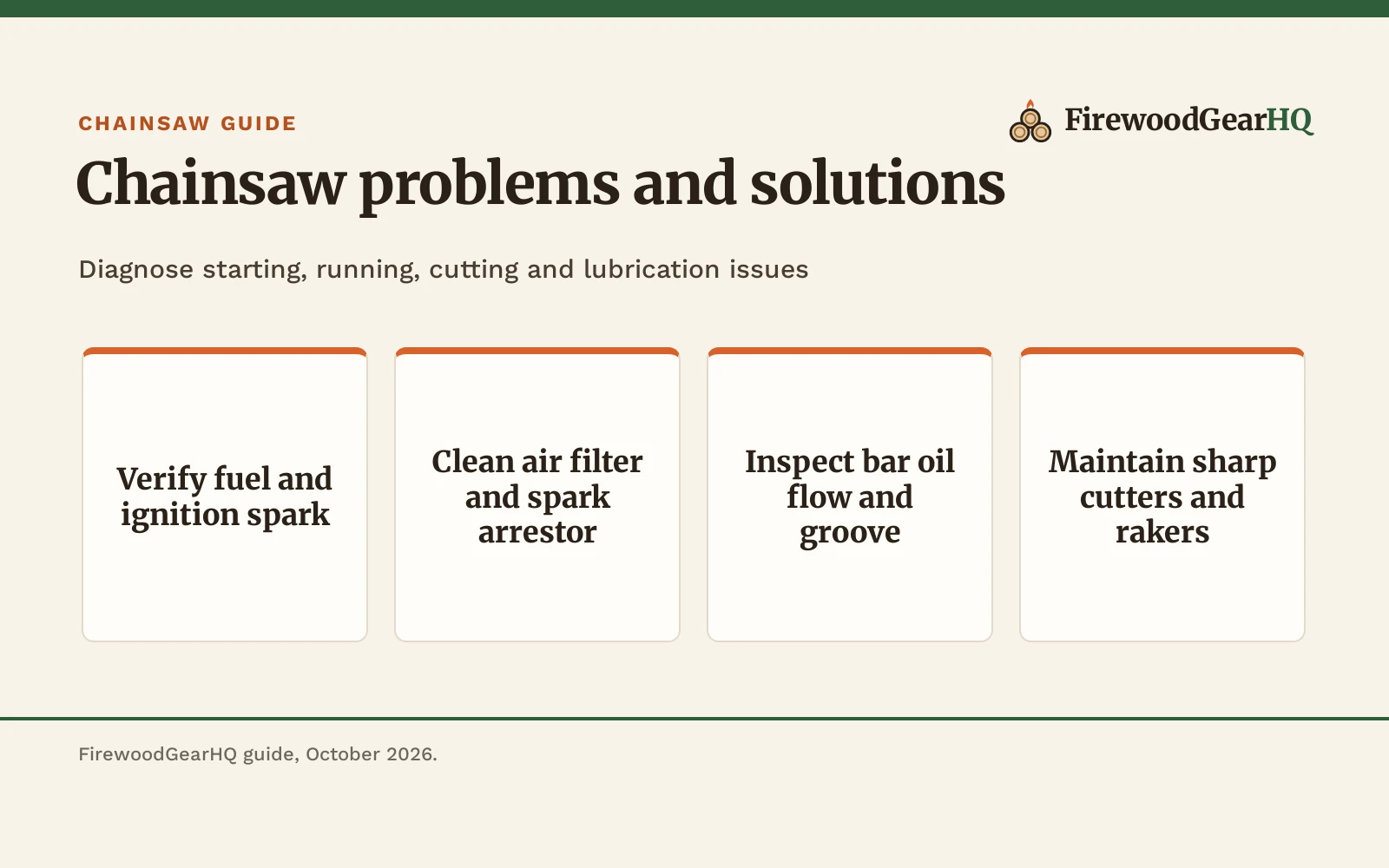
When a chainsaw refuses to run or cut properly, isolate symptoms by system before turning adjustment screws. Fuel degradation causes most hard-starting complaints: old gasoline deposits varnish in carburetor jets, while improper choking floods the cylinder. If the engine fires but bogs under load, inspect the air filter, spark arrestor screen, and fuel filter. If the chain does not turn, check for an engaged chain brake or binding tension. When the engine runs well but cutting stalls in timber, check for dull cutters, improper raker depth, pinched bar rails, or dry guide bar rails starved of oil.
Chainsaw problems and solutions
| Symptom | Probable cause | Solution |
|---|---|---|
| Engine will not start | Flooded cylinder, stale fuel, fouled spark plug, stop switch off | Dry spark plug, drain stale fuel, verify ignition switch, clear flooded chamber |
| Engine stalls under load | Clogged air filter, restricted fuel filter, plugged spark arrestor | Clean air filter, inspect fuel filter, brush spark arrestor screen clean |
| Chain does not rotate | Engaged chain brake, excessive tension, pinched bar rails | Release front hand guard brake, adjust tension, dress bar rails |
| Chain cuts crooked or pulls | Uneven cutter filing, worn bar rails, unequal depth gauges | File cutters to matching length, dress bar rails square, level raker heights |
| Bar and chain smoke | Clogged oil passage, empty oil reservoir, dull cutters | Clear sawdust from oiler hole, fill oil reservoir, sharpen cutters |
| Chain jumps off guide bar | Loose tension, worn drive sprocket, damaged drive links | Adjust tension properly, inspect drive sprocket, replace damaged chain |
| Engine idles roughly or races | Air leak in intake boot, gummed carburetor passages, misadjusted idle screw | Inspect intake boot, clean carburetor jets, adjust idle speed screw |
Use the chart to identify symptoms quickly before disassembling engine components.
How to fix common chainsaw problems step by step
Engine starting failures and flooded cylinders
Starting difficulties usually trace to incorrect choke settings, stale fuel, or flooded combustion chambers. Confirm that the ignition switch is set to run. Pulling repeatedly on full choke draws excess fuel into the cylinder, wetting the spark plug electrode and preventing ignition spark. Remove the spark plug with a scrench and inspect the electrode. Turn the stop switch off, pull the starter cord briskly through several cycles to clear fuel mist, dry the electrode, reinstall the plug, set the switch to run on fast idle, and pull the starter cord. For starting steps, see how to start a gas chainsaw. For fuel guidelines, see what fuel mix for a chainsaw.
Bogging down and loss of power under load
An engine that idles smoothly but bogs down in timber suffers from restricted airflow, fuel starvation, or clogged exhaust. Remove the air box cover and inspect the air filter. Sawdust and oil mist form a film across filter mesh; wash nylon mesh in warm soapy water, rinse, and dry before reinstalling. Next, inspect the spark arrestor screen inside the muffler outlet. Carbon flakes bake onto the screen, creating backpressure that robs engine power. Brush the screen with a brass wire brush until light passes through the mesh. If power loss persists, inspect the fuel filter in the fuel tank, replacing it if fuel varnish restricts delivery.
Chain dulling, crooked cuts, and depth gauge adjustment
Dull cutters force the operator to lean on the handles, generating friction that ruins guide bars. Striking dirty bark or hidden stones fractures cutter chrome edges. When filing teeth, maintain equal cutter lengths and angles; unequal filing causes the saw to pull sideways in the kerf. Dress worn guide bar rails square with a flat file. Depth gauges regulate how deep each cutter bites into timber. Raker clearance specifications vary by chain pitch and timber density; for its depth gauge tool, brand Rosojodg lists a setting of 0.65 mm (0.026 in) for filing rakers to regulate cutter bite. For cutting performance, see why does my chainsaw cut crooked, consult how often should you sharpen a chainsaw chain, compare tools in the best chainsaw sharpener guide, and select loops with the best chainsaw chain.
Bar oiling failure and overheating guide bars
A saw chain requires continuous lubrication to prevent guide bar overheating and metal wear. If the guide bar smokes or discolors, the chain is running dry. Confirm the bar oil reservoir is filled. Remove the clutch cover and guide bar, then scrape packed sawdust from the bar groove using a cleaner tool. Clear the small oil inlet hole on the bar mount pad. Run the engine briefly off idle to verify oil pumps from the crankcase port. Reassemble the bar and chain, run the saw at throttle pointing toward a split stump, and verify oil droplets fling off the tip in a clean line. For dependable lubrication, use the best bar and chain oil.
Loose tension and thrown chains
Cutting heat expands chain metal, creating sag along the bottom of the guide bar. A slack chain derails from the bar groove, damaging drive tangs and presenting severe hazards. Check tension by lifting the chain at the center of the bar; drive tangs must stay seated in the groove and snap back snugly against the rails. The chain must slide smoothly around the bar when pulled with a gloved hand. If the chain keeps slipping off, inspect the drive sprocket behind the clutch drum for deep wear grooves. For detailed troubleshooting, see why does my chainsaw chain keep coming off.
How to inspect a chainsaw before cutting
Preventing breakdowns begins with a systematic inspection before heading into the woodlot:
- Chain brake operation: push the front hand guard forward to verify the brake band locks the drum, then pull back to release.
- Chain tension and sharpness: lift the chain at the top center of the bar to ensure drive links stay seated without sagging below the bottom rail, and verify the chain slides freely by hand.
- Guide bar lubrication: confirm the oil reservoir is full and check oil discharge off the bar tip against a log.
- Air filter and cooling fins: brush away packed wood chips from the air box cover and cylinder cooling fins.
- Throttle lockout and stop switch: verify the throttle trigger locks until the palm latch is pressed, and verify the stop switch halts ignition.
- Guide bar fasteners: ensure guide bar nuts and muffler bolts remain tight against engine vibration.
The OSHA logging safety standard advises checking chain brake function, throttle interlocks, chain tension, and fasteners before starting cutting work.
What happens if you run a damaged chainsaw
Operating a chainsaw with unaddressed mechanical problems damages equipment and creates severe hazards. Forcing dull cutters through timber generates heat that ruins guide bar rails and strains the engine clutch. Running with a lean fuel mixture from gummed carburetor jets causes cylinder overheating and piston scoring. An inoperative chain brake removes essential protection against sudden kickback when the bar tip contacts wood unexpectedly. Safety gear is mandatory for woodlot cutting: wear protective chainsaw chaps, a forestry helmet with a face screen and hearing protection, cut-resistant gloves, and steel-toe logger boots. Never cut alone on the woodlot. Review our chainsaw safety gear checklist, see the best chainsaw chaps, understand do chainsaw chaps work, and learn how to check if your chainsaw or log splitter is recalled.
When to repair at home versus professional service
Routine chainsaw maintenance is manageable on the workbench: replacing spark plugs, cleaning air filters, dressing bar rails, and sharpening cutters require only hand tools. However, severe issues like crankcase air leaks, failed bearings, or scored cylinder walls warrant evaluation by a qualified small-engine repair shop. When choosing equipment for your woodpile, check our guide to the best chainsaw for firewood and compare saw platforms in our gas vs battery chainsaw comparison.
Turn a stack's length, height and depth into full and face cords, and estimate how much wood a winter takes.
Frequently Asked Questions
Why does my chainsaw start and then die immediately?
An engine that fires on fast idle and dies when opened usually suffers from fuel starvation or clogged exhaust. Stale fuel gums carburetor passages, or carbon blocks the spark arrestor screen in the muffler.
Why is my chainsaw chain dulling so fast?
Cutters dull rapidly when touching sandy bark, frozen soil, or hidden stones in logs. Running without adequate bar oil also overheats and softens cutter teeth. For dirty timber, see our guide to the best chainsaw chain for dirty wood.
How often should I clean the chainsaw air filter?
Brush off loose chips after every cutting session on the woodlot. When cutting powdery seasoned logs that produce fine wood flour, clean the filter element more frequently to maintain airflow.
Why does my chainsaw smoke while cutting?
Smoke during cutting indicates friction from an empty oil tank, blocked oil ports, or dull cutters rubbing against timber. Clear the oiler holes and sharpen the cutting teeth.
What causes a chainsaw to pull to one side?
A saw veers sideways in the kerf when cutters along that edge are filed sharper or longer than cutters on the opposite side. Uneven guide bar rails or unleveled depth gauges also cause crooked tracking.
Can old fuel cause chainsaw starting problems?
Yes. Untreated pump gasoline degrades over storage, losing volatility and leaving gummy residues inside carburetor orifices. Always drain the fuel tank before extended storage.
Related guides
See our chainsaw hub, our guide to the best chainsaw for firewood, and the best chainsaw sharpener. Protect your bar with the best bar and chain oil, and wear the best chainsaw chaps and best chainsaw gloves. Learn starting technique in how to start a gas chainsaw, fix crooked cuts in why does my chainsaw cut crooked, and prevent thrown chains with why does my chainsaw chain keep coming off. Check fuel mixing in what fuel mix for a chainsaw, select chain types in what chainsaw chain do I need, and see how often should you sharpen a chainsaw chain. Also see our electric chainsaw vs gas, gas vs battery chainsaw, chainsaw safety gear checklist, do chainsaw chaps work, how to check if your chainsaw or log splitter is recalled, how to bucking firewood safely with a chainsaw, best chainsaw chain for hardwood, best chainsaw chain for dirty wood, best battery chainsaw for homeowners, and best chainsaw chain.