Gas vs Battery Chainsaw: Differences Explained
Gas and battery chainsaws compared on cutting power, bar length, weight, run time and maintenance, with three examples from the listings we reviewed.
 By FirewoodGearHQ Editorial
Updated October 9, 2026
By FirewoodGearHQ Editorial
Updated October 9, 2026
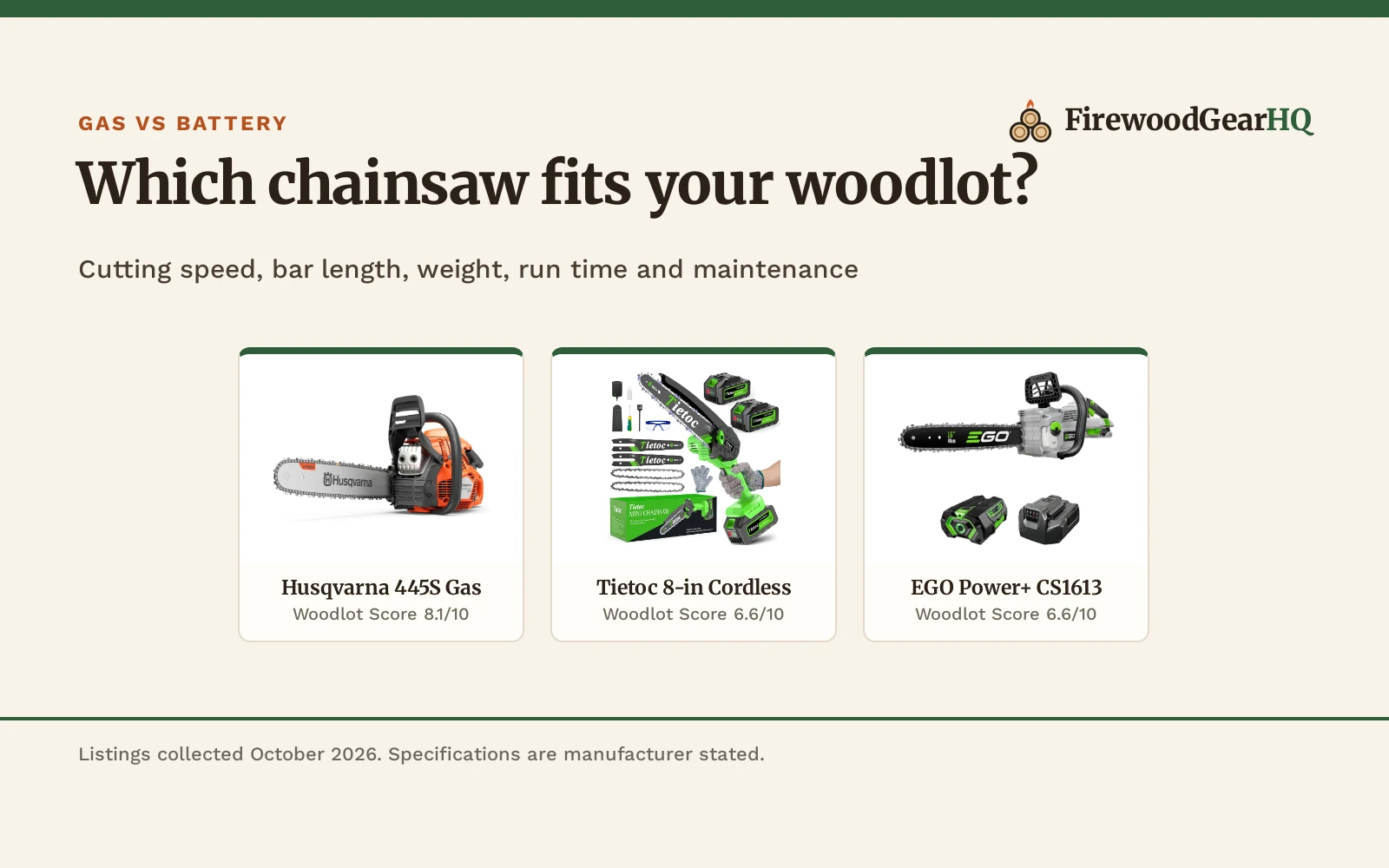
Verdict: When deciding between a gas vs battery chainsaw, pick a battery chainsaw if you cut firewood near home, want push-button starting, and prefer zero exhaust fumes without mixing fuel. Pick a gas chainsaw if you buck larger hardwood logs, cut firewood in the woodlot for hours, need sustained cutting power, and want fast refueling.
Both gas and cordless saws use a spinning chain on a guide bar to sever wood fibers. They differ in power delivery, cutting speed, guide bar length, noise output, run time between replenishments, and regular maintenance requirements. This comparison breaks down how cordless or gas chainsaw designs compare across key woodcutting tasks, featuring three examples from the listings we reviewed.
FirewoodGearHQ earns a commission when you buy through links on this page, at no extra cost to you. Affiliate disclosure.
Gas vs battery chainsaw: side-by-side comparison
| Factor | Husqvarna 445S Gas | EGO Power+ CS1613 | Tietoc 8-in Cordless |
|---|---|---|---|
| Power source | 50-cc gas engine, 3 HP | 56V cordless, 40cc equivalent | 21V cordless, 880W motor |
| Guide bar length | 18 inches (13 to 20 in supported) | 16 inches | 8 inches |
| Cutting speed stated | 20% faster cutting claimed | 20 m/s chain speed | 28.6 ft/s chain speed |
| Run time stated | Not stated (refuel from fuel can) | Up to 130 cuts on 4×4 (4.0Ah battery) | Up to 40 minutes (4000mAh battery) |
| Starting system | Smart Start recoil pull cord | Push-button trigger | Push-button trigger |
| Chain tensioning | Tool required | Tool-free dial | Screwdriver required |
| Weight (listed) | 14.3 pounds (9.7 lbs in spec table) | 20.9 pounds | 3 lbs (3.01 kg in spec table) |
| Safety features | Inertia-activated chain brake | Not stated | Safety lock, splash guard, FCC |
| Stated warranty | 2 Year Limited Manufacturer Warranty | Not stated | 365-day warranty |
Specifications are based on the listings we reviewed; example figures are manufacturer stated, collected 9 October 2026.
Cutting power and speed
Selecting adequate cutting power depends on log diameter and wood species. A gas engine produces power by burning a two-stroke fuel mix, generating strong torque across a broad RPM range. For instance, the Husqvarna listing specifies a 50-cc, 3-HP engine designed to maximize power even at low RPMs for wood cutting and tree trimming, recommended for bars between 13 inches and 20 inches. In contrast, cordless chainsaws rely on electric motors and battery packs. The EGO listing reports performance equivalent to a 40cc gas saw with a chain speed of 20 meters per second, specifically listing capability for cutting hardwood, softwood, and branches. Compact handheld saws, like the Tietoc example, use an 880W motor with a stated chain speed of 28.6 feet per second, claiming an 8-second cut through a 6-inch log. For detailed guidance on matching bar length and power to your woodpile, see our guide on what size chainsaw do I need for firewood.
Run time and refueling
Run time between refills or charges is a major operational difference. The Husqvarna gas listing does not publish a fuel tank capacity or run time per tank, leaving its continuous cutting duration unstated in the listing specifications, though gas engines can be refueled on site from a fuel can. In contrast, cordless models publish specific battery metrics: the EGO listing states its included 56V 4.0Ah battery delivers up to 130 cuts on 4×4 lumber (or up to 220 cuts per charge), while the Tietoc listing claims up to 40 minutes of operation on its 21V 4000mAh pack. Once battery packs are exhausted, cutting must pause until batteries are recharged or swapped with charged spares.
Guide bar length and cutting capacity
Guide bar length determines the log diameter a saw can sever in a single pass. The Husqvarna gas listing features an 18-inch bar and recommends bars between 13 inches and 20 inches for wood cutting and tree trimming. The cordless examples differ widely in bar sizing: the EGO listing provides a 16-inch bar and chain designed for cutting hardwood, softwood, and branches, while the compact Tietoc example provides an 8-inch bar suited for small branches and pruning up to a 6-inch log.
Where you can cut: noise and emissions
Operating location depends on emissions, noise, and workspace safety. Gas chainsaw engines produce exhaust containing carbon monoxide, so CPSC and OSHA guidelines require outdoor operation only. Gas engines also produce elevated engine noise requiring hearing protection. Battery chainsaws produce zero exhaust emissions and eliminate engine idle roar, reducing disturbance when cutting near homes. However, all chainsaw cutting requires an outdoor, clear work area with secure footing and an unobstructed retreat path; chainsaws should never be used in cramped indoor spaces where kickback hazards and wood chip debris are magnified. Regardless of power type, operators must wear full protective gear: chainsaw chaps, a safety helmet with a face screen and hearing protection, heavy-duty gloves, and protective boots. OSHA logging safety standards stress that operators should never cut alone and must guard against kickback. For tree felling, never attempt felling without certified professional training; rely on certified arborists and official logging safety manuals.
Maintenance and starting
Gas chainsaws require periodic engine maintenance, including mixing fresh fuel with two-cycle oil, inspecting spark plugs, servicing air filters, and draining or stabilizing fuel for storage. Starting relies on a recoil pull cord, though the Husqvarna listing includes Smart Start to lessen pull effort. For fuel preparation guidelines, see our guide on what fuel mix for a chainsaw. Cordless chainsaws eliminate engine tuning, fuel mixing, and carburetor adjustments, starting with a trigger press. Both types still require regular guide bar oiling, chain sharpening, and proper chain tension adjustment: the EGO listing provides a tool-free tensioning dial, while the Tietoc example requires an included screwdriver.
Three examples
| Award | Product | Woodlot Score About the HQ ScoreThe Woodlot Score runs from 0 to 10 and weighs performance (35%), build (25%), value (25%), safety (10%, where it applies) and warranty (5%), using only what the manufacturer and the listing publish. How we pick › | |
|---|---|---|---|
 Husqvarna 445S Gas Chainsaw, 18 Inch Chainsaw
|
8.1/10 | Buy | |
 Tietoc Mini Chainsaw 8 inch Cordless with 2x
|
6.6/10 | Buy | |
 EGO POWER+ Chain Saw, 16” Battery Powered
|
6.6/10 | Buy |
Husqvarna 445S Gas Chainsaw, 18 Inch Chainsaw
A 50-cc gas chainsaw with an 18-inch bar, 3-HP X-Torq engine, inertia-activated chain brake, Smart Start recoil system, automatic oiler and a 2-year limited warranty.
Pros
- 50-cc, 3-HP engine with an 18-inch bar for larger firewood rounds
- Inertia-activated chain brake reduces kickback injury risk
- LowVib chassis dampeners reduce in-hand vibration
- 2-year limited manufacturer warranty stated
Cons
- Spec table contradicts title on displacement (40.9 cc vs 50-cc) and bar length (16 vs 18 inches)
- Two conflicting weights listed (9.7 lbs and 14.3 pounds)
- Requires mixed fuel, engine oil upkeep and outdoor operation only
- Pull-cord starting requires more physical effort than push-button electric start
Tietoc Mini Chainsaw 8 inch Cordless with 2x
An 8-inch mini cordless chainsaw powered by a 21V 4000mAh battery with an 880W copper motor, push-button oiler, safety lock, splash guard and 365-day warranty support.
Pros
- Lightweight handheld design with listed 3 lb saw body
- One-touch push-button oiling system simplifies lubrication
- Safety lock, splash guard and FCC certification stated
- 365-day warranty with customer service support
Cons
- Title claims 2x batteries while kit list specifies 1 battery
- Spec table lists horsepower as 880 KW instead of 880W
- Requires screwdriver for chain tension adjustment
- No chain brake; limited to light trimming and branches up to 6 inches
EGO POWER+ Chain Saw, 16” Battery Powered
A 56V cordless chainsaw with a 16-inch bar, brushless motor rated equivalent to a 40cc gas saw, tool-free chain tensioning, IPX4 weather resistance, and an included 4.0Ah battery and charger.
Pros
- High-efficiency brushless motor rated equivalent to a 40cc gas saw
- Chain speed up to 20 m/s for clean cutting
- Tool-free chain tensioning dial eliminates disassembly
- Includes 56V 4.0Ah battery, charger and IPX4 weather-resistant build
Cons
- No warranty term is stated in the listing
- No chain brake is stated in the listing
- Listed weight is 20.9 pounds with battery and packaging
- Run time limited to battery capacity (stated up to 130 cuts on a 4x4)
How we scored them
Each example is scored across performance, build quality, value, safety features, and warranty support using published listing data. The scoring criteria follow our Woodlot Score evaluation system.
| Product | Woodlot Score | Perf. /35 | Build /25 | Value /25 | Safety /10 | Warranty /5 |
|---|---|---|---|---|---|---|
| Husqvarna 445S Gas | 8.1 | 29 | 20 | 20 | 8 | 4 |
| Tietoc 8-in Cordless | 6.6 | 23 | 16 | 19 | 5 | 3 |
| EGO Power+ CS1613 | 6.6 | 30 | 21 | 20 | 0 | 0 |
Wear cut-resistant chaps, a helmet with face screen and hearing protection, gloves and sturdy boots. Know where the kickback zone is (the upper tip of the bar), keep the chain brake working and the chain sharp, and never cut alone in the woods. Felling trees is hazardous work: hire a professional for large, leaning or storm-damaged trees, especially near buildings or power lines. See OSHA logging safety for chain saw operators. Read our Safety Disclaimer.
Frequently Asked Questions
Is a gas or battery chainsaw better for cutting firewood?
Neither is universally superior; the right choice depends on your log sizes and cutting location. The 50-cc Husqvarna gas example offers continuous power and fast refueling for bucking larger logs in remote woodlots where electricity is unavailable. The EGO and Tietoc battery examples offer push-button starting, lower noise, and zero exhaust emissions, making them practical for cutting firewood rounds and yard cleanup near home.
Can a battery chainsaw cut thick hardwood?
The 16-inch EGO battery listing explicitly states design capability for cutting hardwood, softwood, and branches, delivering chain speeds up to 20 meters per second. However, cutting dense hardwood demands more power, which depletes battery charge faster. For sustained cutting in large, dense hardwood logs, the 50-cc Husqvarna gas example provides continuous engine power without battery run-time constraints.
How long does a cordless chainsaw battery last while cutting?
Run time depends on battery capacity, motor efficiency, and wood diameter. The EGO listing states its 56V 4.0Ah battery delivers up to 130 cuts on 4×4 lumber (and up to 220 cuts per charge overall). The compact Tietoc listing claims up to 40 minutes of operation on its 21V 4000mAh battery for light trimming. For comparison, the Husqvarna gas listing does not state a run time per tank.
Can I run a chainsaw inside a garage or shed?
No. Gas chainsaws emit toxic carbon monoxide and must be operated outdoors only. While battery chainsaws produce zero exhaust emissions, chainsaws should not be operated inside a garage or enclosed shed due to flying debris, sawdust fire hazards, and severe kickback risks in confined quarters without an escape path. Always cut firewood outdoors in a clear work area.
What safety gear is essential when operating a chainsaw?
Every chainsaw operator should wear chainsaw chaps, protective boots, heavy-duty gloves, and a forestry helmet equipped with a mesh face screen and hearing protection. Because kickback can occur on both gas and battery saws, maintaining a firm two-handed grip and ensuring the chain brake operates properly where equipped are critical precautions.
Related guides
Explore our chainsaw hub, read our guide on what size chainsaw do I need for firewood, and check our review roundups for the best chainsaws for firewood, best battery chainsaws for homeowners, best 18-inch chainsaws, and best 16-inch chainsaws. For field safety preparation, consult our chainsaw safety gear checklist.
About the author
The FirewoodGearHQ editorial team researches firewood and wood heating equipment from published specifications, ratings and warranty terms, and scores every pick the same way. We do not run our own product trials.