What Size Chainsaw Do I Need for Firewood: Bar Length and Power Guide
What size chainsaw you need for firewood, with guide bar recommendations from 10 to 24 inches, engine power sizing by log diameter, and essential safety gear.
 By FirewoodGearHQ Editorial
Updated October 9, 2026
By FirewoodGearHQ Editorial
Updated October 9, 2026
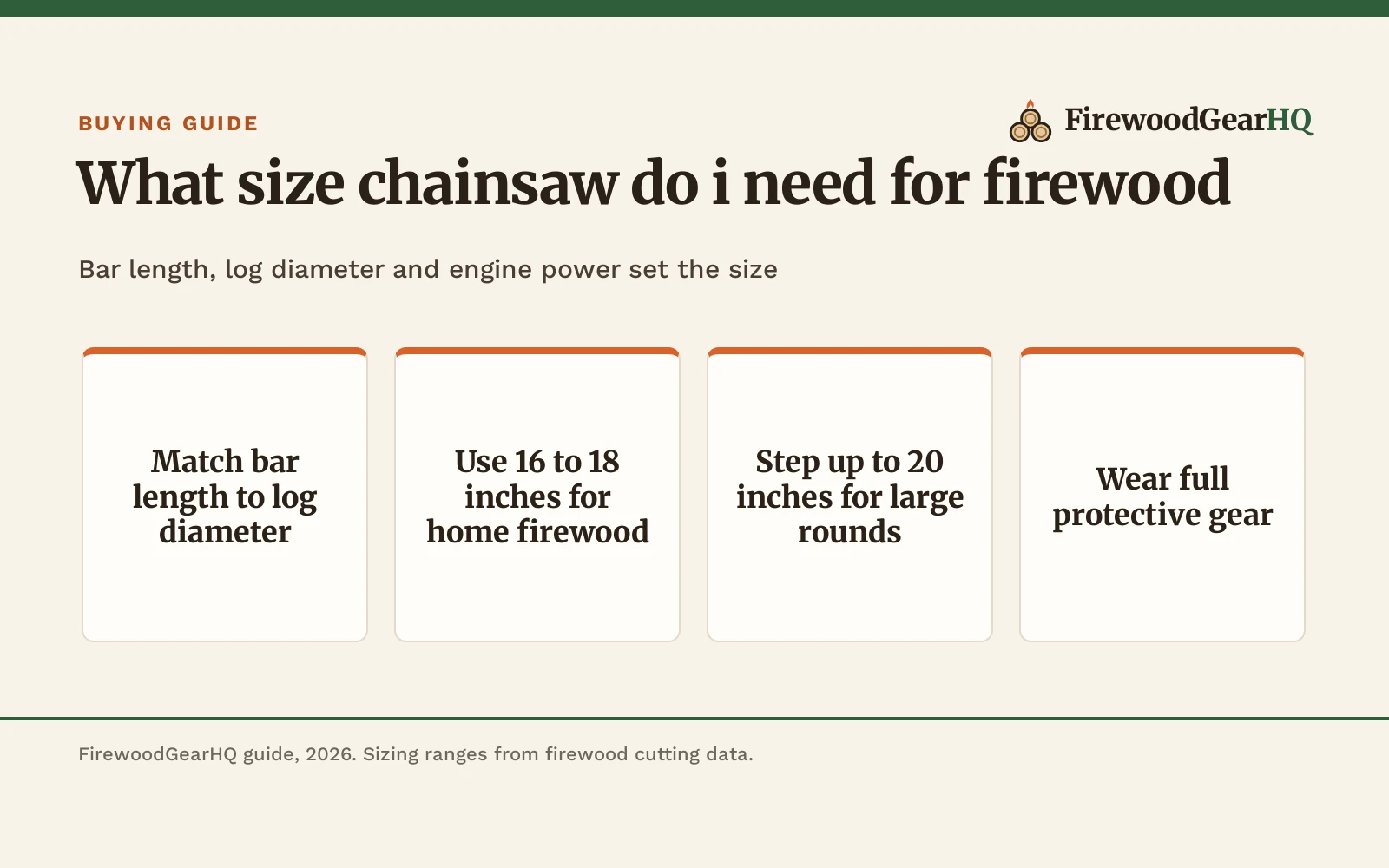
If you are wondering what size chainsaw do i need for firewood, the right choice for most homeowners cutting firewood is a saw with a 16-inch to 18-inch guide bar. For pruning branches under 10 inches across, a compact saw with a 10-inch bar handles the work with low fatigue. For bucking large hardwood logs measuring 18 to 24 inches in diameter, a gas saw with a 20-inch or 24-inch bar provides the reach and power needed to cut through thick rounds cleanly.
FirewoodGearHQ earns a commission when you buy through links on our product pages, at no extra cost to you. Read our affiliate disclosure.
The quick answer
For typical home firewood cutting, an 18-inch chainsaw bar combined with a gas engine or battery platform is the most versatile setup. An 18-inch bar cuts through logs up to 16 inches in diameter in a single pass without burying the bar tip. If your woodlot consists mainly of branches under 10 inches across, a 10-inch or 14-inch bar keeps the saw light and controllable. If you buck dense hardwood rounds measuring 18 to 24 inches across, step up to a 20-inch or 24-inch bar on a high-power gas saw to minimize making cuts from opposite sides.
What size chainsaw do i need for firewood
Chainsaw sizing depends on matching guide bar length and engine power. The bar determines the maximum log diameter you can cut in a single pass, while engine power determines how smoothly the chain pulls through dense wood. The table below compares common chainsaw bar sizes, practical wood diameters, and power setups.
| Bar Length | Practical Log Diameter | Typical Firewood Task | Power Platform |
|---|---|---|---|
| 10 inches | Under 10 inches | Limbing, pruning, and small branch cleanup | Battery or compact gas |
| 14 to 16 inches | 10 to 14 inches | Small firewood rounds and camp wood | Gas or battery |
| 16 to 18 inches | 14 to 16 inches | Standard home firewood cutting | Gas or high-voltage battery |
| 20 inches | 16 to 20 inches | Heavy bucking of dense hardwood rounds | Gas |
| 24 inches | 20 to 24 inches | Large tree trunks and oversized firewood logs | Gas |
Use the chart to match your bar length to the wood you cut most often, saving weight and reducing fatigue during long cutting sessions.
How to match chainsaw bar length to your firewood
Small wood and branch cleanup: 10 to 14-inch bars
When pruning limbs or cutting kindling, a chainsaw with a 10-inch or 14-inch bar is ideal. Small bars require less power, making cordless battery tools very effective. For example, Greenworks lists a 24V cordless chainsaw with a 10-inch bar, a 2.0Ah battery, and a 0.73 horsepower rating at a weight of 2.6 kg. A compact saw with a 10-inch bar easily manages branches and small logs placed on a cutting stand, such as the Oregon steel sawbuck which lists an adjustable width of 10.6-inch maximum log capacity and holds up to 176 lbs at a stand weight of 15 lbs. Saws in this size class start instantly and cause minimal arm fatigue.
Standard home firewood cutting: 16 to 18-inch bars
A 16-inch or 18-inch bar is the standard workhorse for home firewood. Firewood is typically bucked into 16-inch lengths to fit residential stoves and fireplaces. Dedicated markers help size these cuts: the OSROENE firewood marker uses a fixed 16-inch rod, while THE MINGO marking kit includes 14-inch, 16-inch, and 18-inch wheels. For rounds measuring 10 to 14 inches across, an adequate 16-inch chainsaw cuts through in a single pass. When log diameters reach 16 inches, an 18-inch bar provides the extra clearance needed to cut without the tip burying in bark. See our guide to the best 16-inch chainsaws or explore our roundup of the best chainsaws for firewood.
Large rounds and heavy bucking: 20 to 24-inch bars
When processing logs measuring 18, 20, 22, or 24 inches across, a longer bar is necessary. If log diameter exceeds the bar length, you must make a cut from one side, roll the log, and finish from the opposite side, which slows progress. For large timber, brands like PINKWAY, Baococo, and DOWILIN offer 62cc gas chainsaws paired with 20-inch or 24-inch bars. PINKWAY lists a 2-cycle 62cc gas saw with a 20-inch bar delivering 3.26 horsepower, while Baococo lists 62cc models with 18-inch, 20-inch, and 22-inch bars producing 3.5 horsepower. DOWILIN lists 62cc models with 20-inch and 24-inch bars delivering 3.5 horsepower. These longer bars span wide trunks in a single pass. Compare high-power options in our review of the best heavy-duty gas chainsaws.
Weight and operator fatigue
Longer bars and larger engines add substantial weight. While a 10-inch battery saw weighs around 2.6 kg, gas chainsaws weigh much more. DOWILIN lists a 20-inch gas saw at 16.5 pounds and Baococo lists a 20-inch model at 16.6 pounds. With a 24-inch bar, DOWILIN lists the saw weight at 18.9 pounds, while PINKWAY lists an engine weight of 8.5 kg. Carrying an 18.9-pound saw for hours causes fatigue, which increases accident risks. If logs under 16 inches make up your woodpile, buying a 24-inch saw adds unnecessary physical strain. Match your bar size to your common log diameter.
Gas compared with battery chainsaws for firewood
Choosing between gas and battery power depends on where you cut and your seasonal wood volume. See our guide on electric chainsaw vs gas for a detailed comparison.
Battery chainsaws eliminate fuel mixing, exhaust fumes, and pull cords. A cordless model like the Greenworks 24V saw starts at the touch of a button and runs quietly, making it convenient around homes or when cutting on a sawbuck. However, run time is limited by battery pack capacity, requiring extra charged packs for big jobs. See our guide to the best battery chainsaw for homeowners for top picks.
Gas chainsaws provide continuous power for large wood volumes in remote areas. A 2-cycle engine runs as long as you supply fuel and bar oil. Listings from makers like PINKWAY, Baococo, and DOWILIN feature 62cc engines that pull through dense oak and hickory. Gas saws require fuel stabilizer, carburetor tuning, and pull starts. If you are new to gas equipment, read our guide on how to start a gas chainsaw.
Essential chainsaw safety gear and cutting rules
Cutting firewood involves significant hazards from moving chains and heavy timber. Proper personal protective equipment is essential before starting the saw:
- Chainsaw chaps: Protective leg chaps contain fibers that bind the drive sprocket to stop the chain instantly upon contact. Read our guide on how chainsaw chaps work.
- Forestry helmet system: Wear a helmet with an integrated face screen and hearing protection to guard against wood chips and engine noise. See our review of the best chainsaw helmet with chin strap.
- Gloves: Heavy leather gloves protect hands from rough bark and sharp debris.
- Boots: Steel-toe boots with cut-resistant material protect feet and provide traction on uneven ground.
Follow basic cutting safety rules from the OSHA logging eTool. Kickback occurs when the upper tip of the bar strikes wood, driving the saw back toward the operator. Prevent kickback by keeping the bar tip clear of brush, maintaining a firm grip with both hands, and using a saw with an active chain brake and low-kickback chain. Never cut alone in the woods; always have a partner nearby.
This guide covers bucking logs on the ground or in a sawbuck. Tree felling introduces severe hazards from falling branches and trunk splits. For felling standing trees, hire certified professional arborists and consult official sources like the OSHA logging eTool rather than felling trees yourself.
Wear cut-resistant chaps, a helmet with face screen and hearing protection, gloves and sturdy boots. Know where the kickback zone is (the upper tip of the bar), keep the chain brake working and the chain sharp, and never cut alone in the woods. Felling trees is hazardous work: hire a professional for large, leaning or storm-damaged trees, especially near buildings or power lines. See OSHA logging safety for chain saw operators. Read our Safety Disclaimer.
Frequently Asked Questions
What size chainsaw do i need for firewood?
For most homeowners cutting firewood, a saw with a 16-inch or 18-inch bar is the best size. An 18-inch bar cuts through common 16-inch diameter logs in a single pass while remaining manageable in weight. For branches under 10 inches, a 10-inch or 14-inch saw provides easy handling, while logs measuring 20 to 24 inches across require a 20-inch or 24-inch bar on a high-power gas saw.
Is a 16-inch chainsaw big enough for cutting firewood?
Yes. A 16-inch bar cleanly cuts logs measuring 10 to 14 inches in diameter in a single pass, covering the majority of home firewood rounds. For logs up to 16 inches, you can complete the cut from opposite sides if the bar tip cannot clear the far edge in one stroke.
Can a 20-inch chainsaw cut through a 24-inch log?
Yes. When log diameter exceeds bar length, cut from one side, roll the log, and complete the cut from the opposite side. If you regularly process 24-inch logs, a 24-inch bar cuts through in a single pass.
What engine size do I need for a 20-inch chainsaw bar?
A 20-inch bar requires enough engine displacement to maintain chain speed in dense wood. Reference listings from makers like PINKWAY, Baococo, and DOWILIN pair 20-inch bars with 62cc 2-cycle gas engines producing 3.26 to 3.5 horsepower, providing the power needed to cut through thick hardwood rounds without stalling.
How do I measure firewood log length accurately?
Uniform log lengths ensure firewood fits your stove firebox. You can mark logs using dedicated tools like THE MINGO marker, which has wheels for 14, 16, 18, 20, and 24 inches, or a magnetic guide bar attachment from OSROENE setting lengths from 16 to 24 inches. See our guide on firewood measuring tools for chainsaws.
Should I buy a gas or battery chainsaw for firewood?
Choose a battery saw if you cut light firewood or work near your home where quiet operation and push-button starts are convenient. Choose a gas saw if you cut large volumes of firewood or buck thick hardwood rounds in remote woodlots.
Related guides
See the chainsaw hub, the best chainsaw for firewood and the best battery chainsaw for homeowners. Explore bar sizes in is a 16 inch chainsaw big enough and compare options in best 16 inch chainsaw. For heavy duty cutting, see the best heavy duty gas chainsaw and find small options in best small gas powered chainsaw. Learn starting technique with how to start a gas chainsaw and maintain sharp cutting teeth with the best chainsaw sharpener. Protect yourself with do chainsaw chaps work and a chainsaw helmet with chin strap. Also see our what is a sawbuck. Also see our firewood measuring tool for chainsaw. Also see our best chainsaw chain for hardwood. Also see our best 18 inch chainsaw chain. Also see our best 16 inch chainsaw chain. Also see our best electric chainsaw. Also see our electric chainsaw vs gas.
About the author
The FirewoodGearHQ editorial team researches firewood and wood heating equipment from published specifications, ratings and warranty terms, and scores every pick the same way. We do not run our own product trials.