Do Chainsaw Chaps Work? How Protective Leg Layers Stop a Chain
How chainsaw chaps work to stop a running saw chain, how cut-resistant fibers protect your legs, what safety standards matter and how to choose the right fit.
 By FirewoodGearHQ Editorial
Updated October 9, 2026
By FirewoodGearHQ Editorial
Updated October 9, 2026
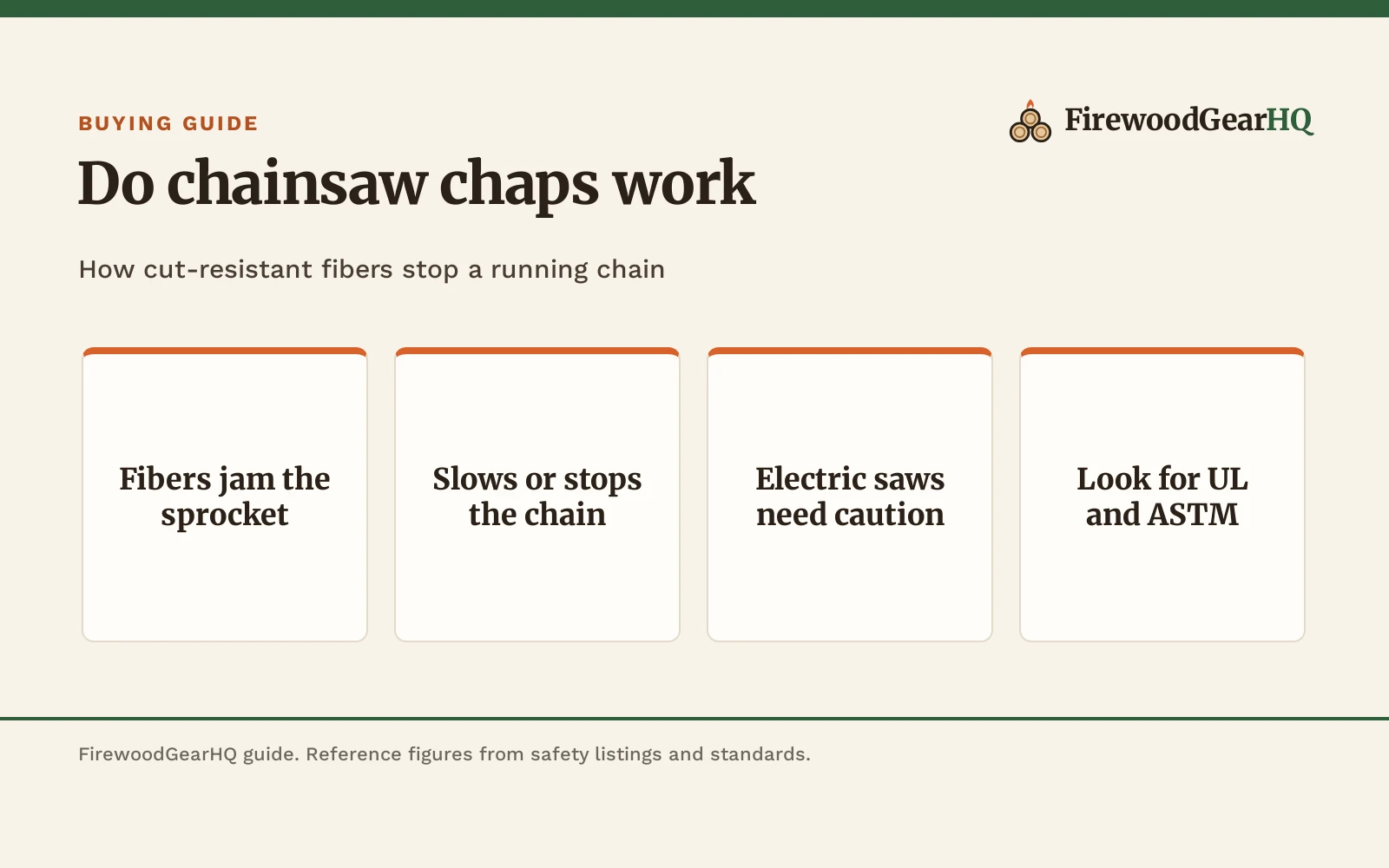
Do chainsaw chaps work? Yes, chainsaw chaps work, and wearing them is among the most effective ways to prevent severe leg injuries during woodcutting. Instead of deflecting a spinning chain like armor, chaps use loose, high-strength ballistic fibers that clog the drive sprocket system to slow or stop the chain. For anyone cutting firewood or clearing storm debris, certified chaps provide vital protection that helps halt a running chain before it causes deep lacerations.
FirewoodGearHQ earns a commission when you buy through links on our product pages, at no extra cost to you. Read our affiliate disclosure.
The quick answer: do chainsaw chaps work?
Chainsaw chaps work effectively by combining tough outer fabric with inner layers of cut-retardant fibers. When a spinning chain contacts the chaps, the cutters slice the shell and catch these fibers. The chain pulls strands into the drive sprocket system, where the tangled mass binds the sprocket and stops chain rotation. Certified chaps reduce injury severity, turning what could be a catastrophic laceration into a damaged garment.
Chainsaw chap specifications comparison
| Brand and model style | Protective layers and fabric | Safety standards | Stated weight and sizing |
|---|---|---|---|
| Husqvarna Functional Apron | 5 protective layers, 600 Denier polyester with Tek Warp layers | ASTM F1897, ANSI Z133.1, OSHA regulation 1910-266, UL certified | Waist up to 38 inches, 32-inch inseam |
| ZELARMAN Apron Wrap | 8-layer protective material, 1000 denier Oxford polyester | ASTM F1897-20, ASTM F3325-20, OSHA Regulation 1910.266, ANSI Z133.1, UL certified | Waist up to 48 inches or 49 inches, length 38 inches or 42 inches (shortens 2 inches with waistband buttons) |
| Notch Safety Apron | 5-layer chain-stopping protective fiber, polyester fabric | ASTM F1897-20, OSHA 1910-266, UL certified | 2.7 pounds (2.75 lb for size L), waist 28 to 48 inches, outseam length 32, 36, or 40 inches |
| FORESTER Apron Style | 100% Nylon fabric (protective layers not stated) | Not stated | 2.8 pounds (or 3 pounds), waist 30 to 48 inches, overall length 37 inches or 40 inches |
| Husqvarna Technical Apron Wrap | 1000 Denier Polyester fabric (protective layers not stated) | Not stated | 4 pounds, length 40 to 42 inches |
Use these stated specifications to compare protective designs. Listings report builds ranging from 5 protective layers to an 8-layer structure, while verified ASTM, ANSI and OSHA compliance confirms third-party certification.
How protective chainsaw chaps stop a chain
Outer shell resists abrasion
The outer shell is built from durable woven fabric. Husqvarna lists 600 Denier polyester on its functional chaps and 1000 Denier polyester on its technical wrap, ZELARMAN uses 1000 denier Oxford polyester, and FORESTER utilizes 100% Nylon. This outer shell does not stop the chain; its purpose is protecting the internal cut-retardant fibers from dirt, grit, moisture and chain oil during normal wood handling.
Internal fibers catch the cutting teeth
Beneath the shell lies the core safety material: multiple loosely woven layers of high-tensile fiber. Husqvarna lists 5 protective layers with Tek Warp material, Notch lists 5-layer chain-stopping protective fiber, and ZELARMAN builds an 8-layer protective structure. The spinning chain cutters cannot slice cleanly through these loose strands, instead hooking and pulling them from the garment.
Strands wrap around the drive sprocket
As the chain travels along the guide bar, it pulls the hooked strands into the sprocket housing. The tough synthetic fibers wrap around the drive sprocket, packing the clearances between sprocket teeth and chain links. This mechanical jamming creates rapid resistance that chokes the drive system and halts chain rotation.
Clutch slippage and engine stall
On a gas chainsaw, the engine powers the drive sprocket through a centrifugal clutch. When jammed fibers stop the sprocket and clutch drum, the clutch shoes slip against the stationary drum. This resistance can stall the engine while the chain remains stopped, halting cutters before they penetrate deep into tissue.
Energy dissipation and flesh protection
Stopping a high-speed chain requires absorbing kinetic energy. The friction generated as fibers pull out and bind the sprocket dissipates this energy over a short distance. While an operator may receive a surface graze, the chaps prevent deep penetration into muscle, arteries and bone.
Key safety certifications and standards to check
Official certifications confirm that leg protection meets established safety benchmarks. Look for these markings on the garment label:
- ASTM F1897 and ASTM F3325: Safety specifications for chainsaw leg protection. Notch and ZELARMAN list compliance with ASTM F1897-20, and ZELARMAN also lists ASTM F3325-20.
- OSHA Regulation 1910.266: The federal logging standard mandating ballistic leg protection from waist to boot tops for chainsaw operators. Husqvarna, Notch and ZELARMAN cite OSHA 1910-266 or 1910.266 compliance.
- ANSI Z133.1: Safety standards for arboricultural operations. Husqvarna and ZELARMAN reference ANSI Z133.1 across their safety listings.
- UL certification: Independent Underwriters Laboratories verification. Husqvarna, Notch and ZELARMAN specify UL certification on their labels.
- Sizing and length: ZELARMAN measures length from waist to instep, offering 38 inches and 42 inches that shorten by 2 inches via waistband buttons. Notch provides outseam lengths of 32, 36, and 40 inches.
- Care and inspection: Care rules vary across makers: ZELARMAN lists machine wash, Notch states hand wash only, and FORESTER listings show both hand wash only and machine wash across styles. Retire any chap after a chain strike.
The OSHA logging eTool emphasizes that chaps are essential personal protective equipment, alongside a forestry helmet with face screen and hearing protection, cut-resistant gloves, heavy boots and disciplined kickback awareness. OSHA rules also advise woodcutters never to cut alone in the woods. To protect your head and hearing, pair your chaps with a chainsaw helmet with chin strap.
When chainsaw chap protection has limits
Chainsaw chaps provide vital protection, but they have distinct operating limits:
Electric and battery saw torque
Electric and battery chainsaws deliver constant torque from the moment the trigger is pulled, lacking the centrifugal clutch slip found on gas saws. When fibers jam the drive sprocket of an electric saw, the motor may continue forcing the chain forward. While certified chaps still provide cut resistance to slow the chain, operators running battery equipment should choose chaps certified to recent standards like ASTM F3325 and rely strictly on the chain brake. Compare motor characteristics in electric chainsaw vs gas, or review cordless saws in our guide to the best battery chainsaw for homeowners.
Direct, full-throttle pressure
Chaps are designed to mitigate accidental slips, downward glances and kickback events. They are not engineered to withstand sustained, full-throttle cutting where an operator forces the bar into their leg. Maintain a stable stance and keep the guide bar clear of your body.
Upper body and foot vulnerability
Chaps shield only the legs. Complete personal protective equipment requires sturdy work boots, heavy gloves, eye protection and a forestry helmet. When cutting firewood logs with the best chainsaw for firewood, keep cutting teeth sharp using a file from the best chainsaw sharpener so you never force the saw.
Apron chaps versus full wrap chaps
Woodcutters can choose between open-back apron chaps and wraparound styles:
Apron-style chaps
Apron chaps shield the front of the legs from waist to boot tops while leaving the back open for airflow and reduced fatigue in warm weather. FORESTER lists apron chaps weighing 2.8 pounds (or 3 pounds for larger sizes), and Notch lists a medium apron chap weighing 2.7 pounds (2.75 lb for size L). These lighter weights suit firewood cutting and storm cleanup.
Full wrap chaps
Wrap-style chaps add protective fabric around the calves. ZELARMAN lists a wrap chap featuring 360 calf wrap protection, and Husqvarna lists a technical apron wrap weighing 4 pounds in 1000 Denier polyester. While wrap chaps run warmer, they guard against side glances and sharp brush.
Wear eye protection and gloves for cutting, splitting and handling, follow every tool's manual, install stoves to code, and have the chimney inspected and cleaned every year. See EPA Burn Wise and NFPA heating safety. Read our Safety Disclaimer.
Frequently Asked Questions
Do chainsaw chaps work on electric chainsaws?
Chaps provide cut resistance against electric saws, but electric motors produce continuous torque that does not stall as quickly as a gas clutch. Operators using battery saws should verify compliance with modern standards like ASTM F3325 and keep the chain brake engaged when not cutting.
Can you reuse chainsaw chaps after a chain strike?
No. Chainsaw chaps are sacrificial safety gear. A chain strike tears out the internal ballistic fibers to jam the sprocket, destroying the protective core in that spot. Replace struck chaps immediately.
Do chainsaw chaps stop the chain instantly?
Certified chaps slow or stop chain rotation by pulling fibers into the sprocket system. While this rapid deceleration prevents deep lacerations, operators may still experience bruising or surface scrapes from the impact.
How should chainsaw chaps fit?
Chaps must fit securely at the waist and extend to the boot instep. Sizing is based on overall outseam length rather than pants inseam. Fasten all leg buckles snugly so the protective pads cannot twist during a strike.
Can you wash chainsaw chaps in a washing machine?
Follow the garment label. ZELARMAN lists machine wash, Notch specifies hand wash only, and FORESTER listings state either hand wash only or machine wash depending on the style. Avoid bleach and harsh solvents that degrade ballistic fibers.
Why do woodcutters wear chaps instead of standard work pants?
Standard denim or canvas offers virtually zero resistance to a spinning chainsaw chain. Certified chaps contain loose, high-strength ballistic fibers specifically engineered to bind the sprocket and halt the chain.
Related guides
Explore our safety resources on the chainsaw gear hub, compare head protection in our guide to the chainsaw helmet with chin strap, and explore cutting gear in our review of the best chainsaw for firewood. You can also evaluate power systems in electric chainsaw vs gas, read our guide to the best battery chainsaw for homeowners, and learn maintenance fundamentals in best chainsaw sharpener.
About the author
The FirewoodGearHQ editorial team researches firewood and wood heating equipment from published specifications, ratings and warranty terms, and scores every pick the same way. We do not run our own product trials.