Cant Hook vs Peavey: Differences Explained
The differences between a cant hook and a peavey, how their tips and grips work on logs, and how to choose the right handling tool for your woodlot.
 By FirewoodGearHQ Editorial
Updated October 10, 2026
By FirewoodGearHQ Editorial
Updated October 10, 2026
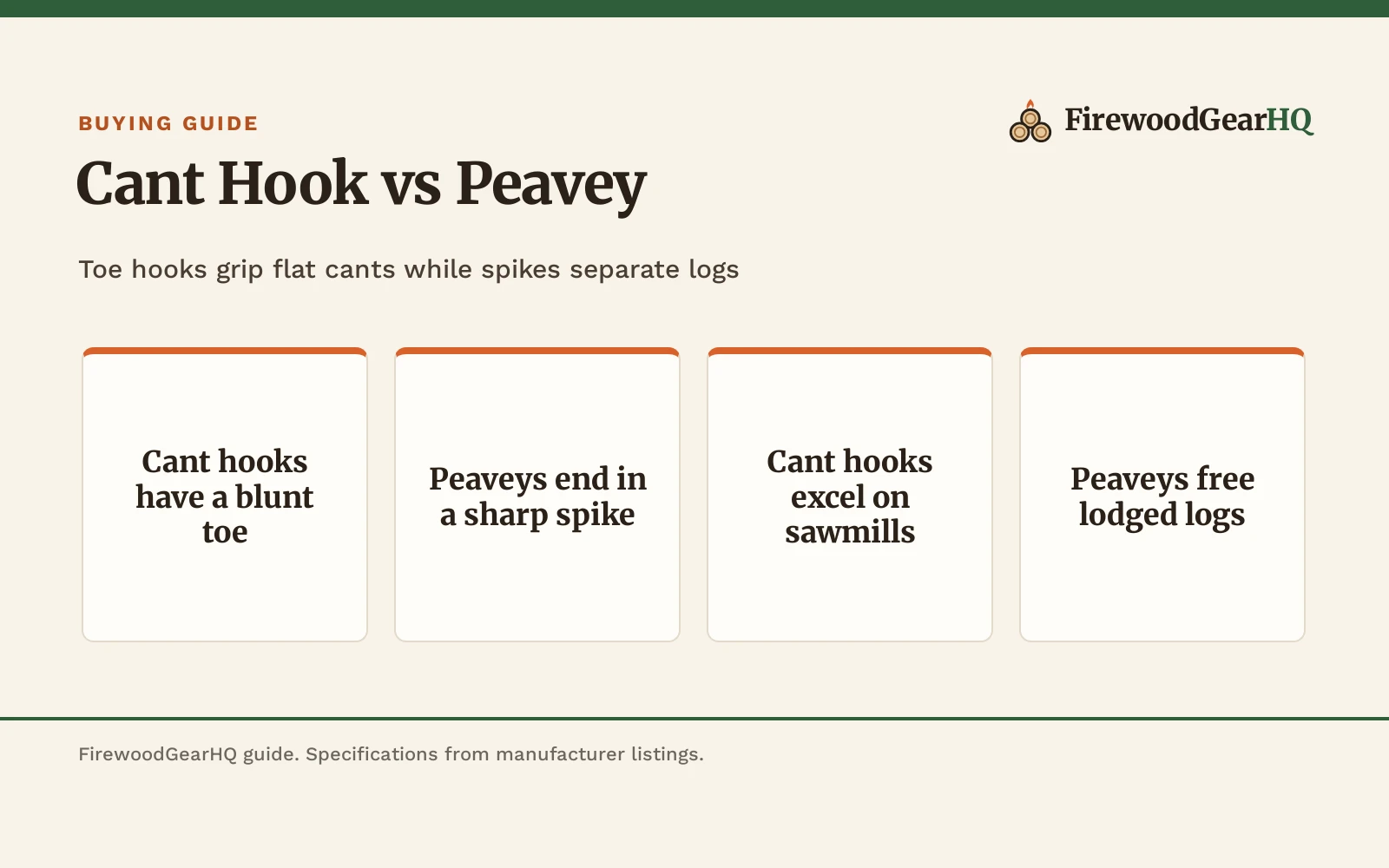
When comparing a cant hook vs peavey, the main difference lies in the tip at the end of the handle. A cant hook ends in a blunt steel toe with gripping teeth designed to turn squared timber and round logs without deep gouging. A peavey ends in a pointed steel spike designed to stab into soft ground, pry between lodged logs, and push tangled timber loose. Both tools use a curved swinging hook to grab the side of a log and multiply your leverage when rolling heavy wood.
FirewoodGearHQ earns a commission when you buy through links on our product pages, at no extra cost to you. Read our affiliate disclosure.
The quick answer
Choose a cant hook if you work around a sawmill, turn squared beams (called cants), roll logs on flat trailer beds, or move timber across firm woodlot ground. The blunt toe grips flat wood securely without puncturing deep holes that ruin valuable lumber. Choose a peavey if you work on rough woodland terrain, break apart tangled log piles, or need to roll logs across soft soil where driving a spike into the dirt provides a secure pivot point. Both tools eliminate back strain by letting mechanical leverage do the heavy work. Learning how to move heavy logs safely keeps you out of the path of rolling wood and protects your back from fatigue.
Cant hook vs peavey comparison chart
| Feature | Cant Hook | Peavey |
|---|---|---|
| End tip design | Blunt toe with gripping teeth | Pointed steel spike |
| Primary task | Rolling logs and turning cants | Prying, separating, and rolling logs |
| Best working ground | Sawmill carriages, decks, and trailers | Forest floor, soft dirt, and log piles |
| Grip on squared timber | Firm bite against flat faces | Can slip or gouge flat surfaces |
| Prying lodged logs | Limited reach between tight logs | Spike wedges between nested logs |
| Handle lengths in reference listings | 46.5 to 60 in (Wood-Mizer, VEVOR, XROPURR) | 49 in (OAOLOWF) |
| Item weights in reference listings | 6.83 to 10.98 lb (VEVOR, Wood-Mizer, XROPURR) | 7.7 lb (OAOLOWF) |
| Log capacities in reference listings | Up to 32 in (Wood-Mizer, VEVOR) | 16 in opening (OAOLOWF) |
Use the chart to match tool geometry to your workspace, whether you operate a stationary sawmill or clear timber in the woods.
How cant hooks and peaveys work
End tip design: blunt toe versus pointed spike
The end tip defines how each tool connects with wood. A cant hook features a heavy steel toe curved at roughly a right angle to the handle, lined with small teeth or a pronounced lip. When you pull the handle, the swinging hook bites into the upper curve of the log, while the blunt toe pushes against the lower edge. Because the toe spreads pressure across a flat surface, it rotates timber without driving deep holes into the grain. Sawyers rely on this blunt profile to protect lumber grade.
A peavey replaces the blunt toe with a heavy metal socket that tapers into a rigid steel spike. When working around natural timber, this pointed spike can spear into bark, lodge between two trunks, or pierce soft soil. The spike provides an instant pivot point when you lack a flat surface to press against, making it easier to pry logs apart.
Grip and bite on flat cants and rounded logs
A cant is a log that has been slabbed flat on one or more faces during milling. While rounded tree trunks offer curved bark for any hook to grab, squared cants require a tool that can seat against flat planes. A cant hook is purpose-built for this task. Wood-Mizer lists steel cant hooks featuring extra teeth for better log handling across an 8 to 32-inch log diameter capacity. The blunt toe rests firmly against the flat face of a cant, letting you turn the timber onto its next side cleanly.
A peavey struggles on flat lumber because its pointed spike offers only a single contact point. When you apply heavy pulling force to a flat cant, the spike can skate across the surface or gouge into the wood rather than holding firm. For sawmill decks, a cant hook provides superior control.
Leverage, handle lengths and materials
Both tools multiply muscle power through lever action. Longer handles generate greater leverage for massive logs, while shorter handles provide maneuverability in tight storage bays or sawmill sheds. For example, VEVOR lists a 46.5-inch felled cant hook weighing 6.83 pounds that handles logs up to 32 inches in diameter. When extra leverage is needed for stubborn trunks, VEVOR lists a 59-inch cant hook weighing 10.8 pounds with a 32-inch capacity, and Wood-Mizer lists a 60-inch steel cant hook weighing 10.5 pounds with an 8 to 32-inch capacity. For mid-range work, XROPURR lists 51-inch and 58-inch steel cant hooks weighing 9.93 pounds and 10.98 pounds, each featuring a 19-inch opening.
Handle material affects strength, weight, and comfort. Hardwood handles, such as the 2.2-inch diameter handle on the OAOLOWF 49-inch peavey weighing 7.7 pounds, absorb shock well and remain comfortable to hold during freezing winter work. Heavy-duty carbon steel handles, like those on Wood-Mizer and VEVOR models, deliver rigid strength under extreme force. Aluminum handles reduce carrying fatigue; SPEED FORCE lists a 47-inch aluminum timberjack weighing 11-1/2 pounds with a 1-1/2-inch handle diameter and a log capacity from 5 to 24 inches.
Moving logs on dirt, sawmills and log decks
Working conditions dictate tool selection. In the woods, tree trunks often rest on wet dirt, mud, or brush. A cant hook toe can dig into loose soil and pack with mud, losing its grip. A peavey spike drives through leaf litter and roots, allowing you to establish a secure fulcrum to pry sunken logs out of ruts.
Around sawmills, concrete ramps, and equipment trailers, a peavey spike can chip concrete, puncture wooden trailer decks, or slip unpredictably on steel rails. A cant hook rests flat on wood or metal decking, gripping cants without damaging work surfaces.
How to choose between a cant hook and a peavey
Select the tool that matches where you handle the majority of your timber:
- Choose a cant hook if: You run a portable sawmill, load logs onto trailers, or handle firewood rounds on firm yard soil. Reference models like the OAOLOWF 47-inch steel cant hook offer a 15-inch opening at 9.98 pounds, providing practical balance for yard chores.
- Choose a peavey if: You fell trees, cut firewood in the woods, or work with tangled log piles. The pointed spike on the OAOLOWF 49-inch hardwood peavey lets you wedge between stacked logs and pry them loose.
- Choose a timberjack if: You buck logs on the ground and want to prevent your chainsaw chain from hitting dirt. Timberjacks add a support foot to elevate logs above the soil.
When moving rounds from the woodlot to the splitting area, combining your log roller with log carriers for firewood with wheels minimizes strain on your lower back.
Common mistakes when rolling and moving logs
Handling heavy logs requires steady technique and attention to surroundings. Avoid these common mistakes:
- Standing downhill: Never position yourself on the downhill side of rolling logs. Always work from the uphill slope so timber rolls away from you.
- Lifting with your back: Use your legs and body weight to push or pull the handle. Keep your arms extended and let the lever multiply your force.
- Skipping safety gear: When operating near chainsaws and rolling logs, wear sturdy boots, heavy gloves, and proper PPE. Review our chainsaw safety gear checklist and wear chainsaw chaps whenever power equipment is active.
- Exceeding rated capacity: Do not overload tools beyond their intended design. Wood-Mizer lists a 35-pound maximum weight recommendation for wall-mount storage on its cant hook models, and attempting to pry immovable root balls can bend handles.
Timberjacks and log lifters for bucking
Cutting logs on the forest floor presents a constant hazard: running a chainsaw chain into dirt quickly dulls cutters and ruins bar rails. A timberjack solves this problem by adding a bottom foot to a cant hook or peavey handle.
When you hook a log and pull the handle backward, the trunk rolls onto the stand, elevating the wood above the ground. For example, the VEVOR 48-inch timberjack uses a carbon steel handle weighing 10.19 pounds to raise logs up to 15 inches in diameter for clean cutting. The SPEED FORCE 47-inch aluminum timberjack uses a wide dual-foot stand to keep the handle from sinking into soft ground while elevating logs from 5 to 24 inches in diameter. Raising logs off the dirt allows you to practice how to bucking firewood safely with a chainsaw without risking chain damage. After bucking your rounds, split them using the best splitting maul or the best log splitter for home use.
Lift with your legs, not your back, and get help or a mechanical aid for big rounds. Respect each tool's rated capacity, keep feet clear of rolling logs, and wear gloves against splinters. Read our Safety Disclaimer.
Frequently Asked Questions
Can a cant hook be used instead of a peavey?
Yes. For standard log rolling on flat or cleared ground, a cant hook performs the same core rolling task as a peavey. The main difference arises in dense woods or tangled brush, where the blunt toe cannot pry between tightly wedged trunks as effectively as a pointed peavey spike.
Why is the tool called a peavey?
The peavey was named after Joseph Peavey, a blacksmith who developed the combination of a rigid steel spike and a swinging hook to help river drivers maneuver floating logs and break up river log jams.
What handle length is best for a cant hook or peavey?
Handle lengths from 46.5 to 49 inches, such as the 46.5-inch VEVOR cant hook and the 49-inch OAOLOWF peavey, provide balanced leverage and control for typical firewood logs. For heavy saw logs, longer handles like the 58-inch XROPURR cant hook or the 60-inch Wood-Mizer cant hook yield maximum leverage, though they require more swinging room.
Can you convert a cant hook into a timberjack?
Many manufacturers provide bolt-on stand attachments that convert standard log rollers into timberjacks. Dedicated models include the stand as standard equipment, such as the VEVOR 48-inch carbon steel timberjack or the SPEED FORCE 47-inch aluminum timberjack.
Are steel handles more durable than wood handles?
Steel handles resist cracking and weathering when stored outdoors. Hardwood handles, like the 2.2-inch diameter handle on the OAOLOWF 49-inch peavey, absorb shock, remain warmer to the touch in freezing weather, and can be replaced if damaged.
Can a cant hook roll round logs on the ground?
Yes. Although designed originally for sawmill cants, the curved swinging hook bites securely into rounded bark, allowing the blunt toe to push against the round curvature and roll logs across the ground with ease.
Related guides
Explore our complete firewood handling hub for equipment advice and log management strategies. When cutting your own timber, see our guide on the best chainsaw for firewood and elevate rounds with a sawbuck. For manual processing, explore the best kindling splitter, drive stubborn rounds with the best splitting wedge, and learn how to split wood with an axe. If you operate hydraulic equipment, review essential log splitter safety rules to protect yourself and your crew.
About the author
The FirewoodGearHQ editorial team researches firewood and wood heating equipment from published specifications, ratings and warranty terms, and scores every pick the same way. We do not run our own product trials.