Best Wood Stove Fan for Small Stoves (2026): 4 Compact Picks Compared
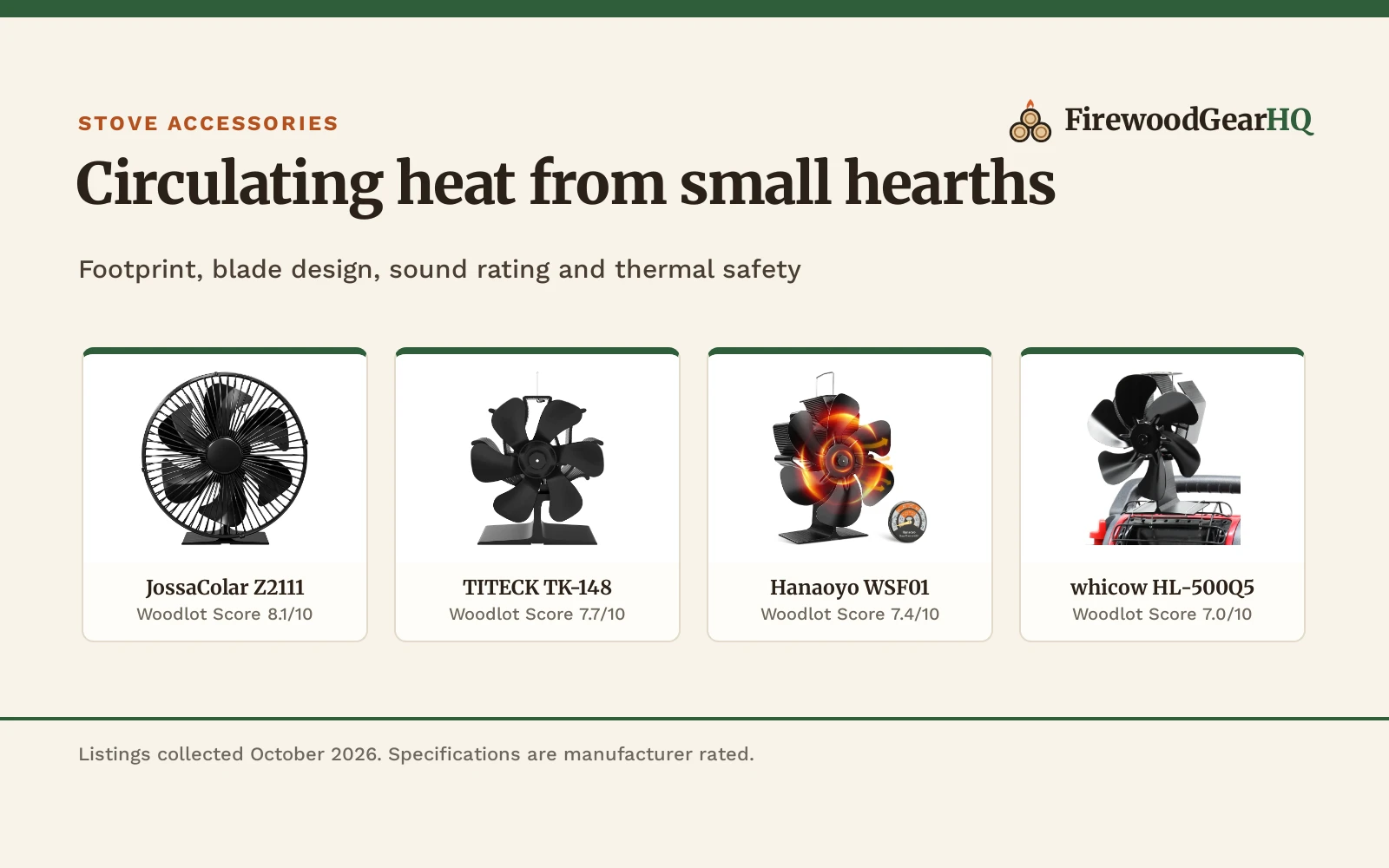
Four heat-powered wood stove fans for small stoves compared by dimensions, blade count, noise level, overheat protection and warranty, from ultra-compact tent models to bimetal safety designs.

On this page
Top picks at a glance
As an Amazon Associate we earn from qualifying purchases.
- 1
 Best OverallJossaColar Z21119.6/10View on Amazon
- 2
 Best for Tiny StovesTITECK TK-1489.6/10View on Amazon
- 3
 Best Overheat ProtectionHanaoyo WSF019.5/10View on Amazon
- 4
 Best Bracket Mountwhicow HL-500Q59.5/10View on Amazon
- 5
 Ecofan UltrAir Heat Powered Stove FanView on Amazon
- 6
 Ecofan AirDeco I Heat Powered Stove FanView on Amazon
- 7
 Criditpid CB36 Circulator Blower Fan for US StoveView on Amazon
- 8
 Quiet Wood Stove Blower Fan for England's StoveView on Amazon
- 9
 Tomersun Wood Stove Fan Heat Powered Stove Fan HeaterView on Amazon
- 10
 AC Infinity AXIAL S1238DView on Amazon
When winter burning is underway and the wood stove is keeping the room warm, small stoves often struggle to circulate that warmth beyond the hearth. Heated air rises directly toward the ceiling, leaving distant corners cool while the stove top radiates intense heat. Finding the best wood stove fan for small stoves comes down to matching a compact footprint to limited stove top surface area without sacrificing airflow. This guide compares four heat-powered stove fans by the numbers that matter for small wood stoves: dimensions, blade design, sound rating, overheat protection and stated warranty terms.
FirewoodGearHQ may earn a small commission if you buy through links on this page. The price you pay stays the same. Affiliate disclosure.
Quick picks
- Best Overall JossaColar Z2111: 6-blade anodized aluminum fan with bimetal overload lift protection, safety guard and a stated 1-year warranty. Check price on Amazon
- Best for Tiny Stoves TITECK TK-148: Ultra-compact 2.3 by 3.5 by 5.4 in footprint weighing 1 lb with 6 blades and a 10-12% fuel savings claim. Check price on Amazon
- Best Overheat Protection Hanaoyo WSF01: 6 blades with dual-metal base lift safety protection, 25 db sound rating and an included magnetic thermometer. Check price on Amazon
- Best Bracket Mount whicow HL-500Q5: 6 blades with a mounting bracket for heater attachment, 180 cfm listed airflow and an included thermometer. Check price on Amazon
The picks
| # | Product | Woodlot Score | Buy |
|---|---|---|---|
| 1 | JossaColar Heat Powered Wood Stove Fan with Safety | 9.6/10 | Buy on Amazon |
| 2 | Wood Stove Fan Heat Powered | 9.6/10 | Buy on Amazon |
| 3 | Hanaoyo Wood Stove Fan, 6 Blades Wood Stove Fan | 9.5/10 | Buy on Amazon |
| 4 | Wood Stove Fan Heat Powered | 9.5/10 | Buy on Amazon |

JossaColar Heat Powered Wood Stove Fan with Safety
A 6-blade heat-powered stove fan made of anodized aluminum with a safety guard, built-in bimetal overheat protection and a 1-year warranty.
Pros
- Promised 1-year warranty in listing bullets
- Overload safety device with bimetal shrapnel that pops up above 350 degrees Celsius
- Safety guard and metal carry handle included on the fan
- 6-blade anodized aluminum build rated under 25 decibels
Cons
- Spec table lists push button control despite heat-powered operation
- Thermometer noted in bullets is omitted from spec table components list
- Height of 7.9 in requires adequate clearance above the stove
- Does not include an aluminum tray

Wood Stove Fan Heat Powered
An ultra-compact 1 lb heat-powered stove fan with 6 blades, measuring 2.3 by 3.5 by 5.4 in for small stoves, tents and RVs.
Pros
- Ultra-compact footprint of 2.3 in deep by 3.5 in wide by 5.4 in high
- Weighs only 1 lb for easy placement on small stove tops
- Listing claims 25% faster heat distribution and 10-12% reduced fuel consumption
- 6-blade aluminum assembly with silent operation under 25 dB
Cons
- No warranty term is stated
- No bimetal overheat lift strip or thermal safety device described
- Spec table lists touch control despite thermoelectric operation
- Stove thermometer is not included

Hanaoyo Wood Stove Fan, 6 Blades Wood Stove Fan
A 6-blade anodized aluminum heat-powered stove fan with a dual-metal overheat protection base and an included magnetic thermometer.
Pros
- Bottom dual-metal safety device lifts fan edge at high temperatures
- Magnetic stove thermometer included in the box
- 6 blades provide claimed 55% air circulation efficiency improvement
- Anodized aluminum build with operational noise lower than 25 db
Cons
- No warranty term is stated
- Spec table contains contradictory entries including ceiling mount and remote control
- Spec table lists 6 rpm speed and push button switch
- Dimensions of 11 by 10 by 5 in require more horizontal stove top depth
Wood Stove Fan Heat Powered
A 6-blade aluminum heat-powered fan with a mounting bracket for heater attachment, 180 cfm listed airflow and an included thermometer.
Pros
- Mounting bracket allows attachment to heaters or freestanding stove use
- Spec table lists 180 cfm airflow and 1080 rpm operating speed
- Lightweight aluminum construction listed at 15.84 ounces
- Stove thermometer included in the package
Cons
- No warranty term is stated
- No overheat protection mechanism or bimetallic strip described
- Spec table lists 3 speeds and touch control despite heat-powered design
- Color listed with typographical error in spec table
More options to compare
 Ecofan UltrAir Heat Powered Stove FanCheck price on Amazon
 Ecofan AirDeco I Heat Powered Stove FanCheck price on Amazon
 Criditpid CB36 Circulator Blower Fan for US StoveCheck price on Amazon
 Quiet Wood Stove Blower Fan for England's StoveCheck price on Amazon
 Tomersun Wood Stove Fan Heat Powered Stove Fan HeaterCheck price on Amazon
 AC Infinity AXIAL S1238DCheck price on Amazon
Compare the picks
| Model | Woodlot Score | Dimensions | Blades | Noise (listed) | Overheat protection | Warranty (stated) |
|---|---|---|---|---|---|---|
| JossaColar Z2111 | 9.6/10 | 2.6 x 7.5 x 7.9 in | 6 | < 25 dB | Bimetal shrapnel (above 350 C) | 1 year |
| TITECK TK-148 | 9.6/10 | 2.3 x 3.5 x 5.4 in | 6 | < 25 dB | Not stated | Not stated |
| Hanaoyo WSF01 | 9.5/10 | 11 x 10 x 5 in | 6 | < 25 dB | Dual-metal safety base | Not stated |
| whicow HL-500Q5 | 9.5/10 | 4.4 x 7.3 x 6.3 in | 6 | 25 dB | Not stated | Not stated |
Specifications are manufacturer rated, collected 14 October 2026. Dimensions and weights are as listed. Only one of these listings states a warranty term.
How we scored them
Each fan is scored out of 10 on performance, build, value, safety and warranty, using only what the listing publishes. The scoring criteria are detailed on our How We Pick page.
| Product | Woodlot Score | Perf. /35 | Build /25 | Value /25 | Safety /10 | Warranty /5 |
|---|---|---|---|---|---|---|
| JossaColar Z2111 | 9.6 | 29 | 21 | 21 | 7 | 3 |
| TITECK TK-148 | 9.6 | 30 | 21 | 21 | 4 | 0 |
| Hanaoyo WSF01 | 9.5 | 28 | 20 | 20 | 6 | 0 |
| whicow HL-500Q5 | 9.5 | 28 | 19 | 20 | 3 | 0 |
Scores run from 9.2 to 9.8: each product’s point total is placed on that range, so more points always means a higher score.
Buying guide: choosing the best wood stove fan for small stoves
Stove top dimensions and clearances
Small wood stoves, cabin stoves, and portable tent stoves provide limited flat surface area on the top plate. Before selecting a fan, check the available depth and width beside or behind the flue pipe. The fan requires a level, flat surface to maintain thermal contact with the heated stove top while leaving enough surrounding space so the blades do not contact the chimney pipe or stove walls.
Comparing stated measurements across models illustrates how much footprints vary. The TITECK TK-148 features the smallest profile in this group at 2.3 in deep, 3.5 in wide, and 5.4 in high with a listed weight of 1 lb and blade length of 1.9 inches. This ultra-compact profile fits hot tents, tiny homes, and narrow camp stoves where surface space is severely restricted. In comparison, the whicow HL-500Q5 measures 4.4 in deep by 7.3 in wide by 6.3 in high at 15.84 ounces, while the JossaColar Z2111 stands 7.9 in tall on a 2.6 by 7.5 in footprint, demanding more vertical overhead clearance below mantels or recessed hearth walls. The Hanaoyo WSF01 lists dimensions of 11 in deep by 10 in wide by 5 in high, requiring a broad horizontal surface. Checking these dimensions against your stove ensures the blades spin freely without contacting stovepipes or backwalls.
Thermoelectric operation and heat circulation
All four models in this comparison rely on the thermoelectric Seebeck effect. The base of the fan conducts heat from the stove top to a thermoelectric module, while cooling fins above dissipate heat into the room air. The resulting temperature difference creates a low-voltage electrical current that drives a small motor, spinning the 6 blades without any household electricity, cords, or batteries. The fan starts automatically once the stove reaches operating temperature and adjusts speed as heat rises or falls.
The strength of air circulation generated by a thermoelectric fan depends directly on the temperature difference maintained across its central module. Cooler air drawn over the upper aluminum fins keeps the top heat sink chilled while the base absorbs conductive energy from the cast iron or steel below. In small rooms, horizontal air movement prevents warm air from stratifying near the ceiling. TITECK claims a 25% faster heat circulation rate along with a 10-12% reduction in fuel consumption, while Hanaoyo notes an air circulation efficiency boost exceeding 55%. whicow lists a specific airflow capacity of 180 cfm at 1080 rpm. These published figures illustrate how compact 6-blade fans can distribute heat throughout living quarters without electrical power cords or batteries.
Mounting configurations and bracket attachments
While most heat-activated fans rest directly on the flat iron or steel stove top, mounting options provide extra stability in specialized installations. The whicow HL-500Q5 stands out with a dual-purpose configuration, including a fixed mounting bracket designed to attach onto compatible propane heaters or stoves alongside its standalone base. This bracket helps prevent shifting or tipping in drafty workshops or mobile cabins. In contrast, the JossaColar Z2111, TITECK TK-148, and Hanaoyo WSF01 are dedicated freestanding designs that require a smooth, flat stove top to maintain consistent conductive contact. For standard hearths, a freestanding base is simple to set down and reposition, while bracket mounting provides added peace of mind in tight, high-traffic spaces.
Overheat protection and bimetal safety devices
Excessive heat can damage the sensitive thermoelectric module and internal motor. Some fans incorporate built-in protection: JossaColar states an overload device with bimetal shrapnel that pops up once temperatures exceed 350 degrees Celsius to lift the base and reduce heat transfer, while Hanaoyo equips its base with a dual-metal safety device designed to lift the edge near high temperatures. Models from TITECK and whicow do not describe a bimetallic lift strip, making active surface temperature monitoring especially critical.
Noise ratings and blade design
Every model compared here features 6 aluminum blades and publishes an operational noise rating of 25 dB or below. In compact living areas, bedrooms, small cabins, or hot tents, quiet operation keeps warm air circulating gently without distracting motor whine or blade vibration.
Monitoring stove surface temperatures
A dedicated stove thermometer allows wood burners to keep their stove in the optimal burning zone while safeguarding stove fans from overheating. Hanaoyo and whicow include a stove thermometer in the package, JossaColar references one in its listing bullets, and TITECK sells the fan as a standalone unit without an included thermometer.
Wear eye protection and gloves for cutting, splitting and handling, follow every tool's manual, install stoves to code, and have the chimney inspected and cleaned every year. See EPA Burn Wise and NFPA heating safety. Read our Safety Disclaimer.
Around the Woodpile
- Position the fan on a smooth, flat section of the stove top toward the rear or side edge, allowing cooler room air to draw across the cooling fins from behind rather than directly alongside the flue pipe.
- Observe stove surface temperatures with a magnetic thermometer, especially when operating compact fans that do not publish built-in bimetallic lift protection.
- Never handle an active stove fan with bare hands while the fire is burning; allow the unit to cool thoroughly after the fire dies down or use heavy hearth gloves and the integrated carry handle if repositioning is required.
- When the burning season concludes in spring, wipe dust from the 6 aluminum blades with a dry cloth and store the fan in a dry interior room to protect the motor and thermoelectric module until fall.
Frequently Asked Questions
How does a heat-powered wood stove fan work?
A heat-powered stove fan uses a thermoelectric module sandwiched between a heated base and an aluminum cooling fin array. The temperature difference between the hot stove top and the cooler room air produces an electric current that powers the motor, spinning the blades without cords or batteries.
Where should you place a fan on a small wood stove?
Place the fan toward the rear corner or side edge of the stove top where cooler air can circulate across the rear cooling fins. Avoid setting the fan directly in front of the flue pipe, which can block airflow and expose the motor to radiant chimney heat.
Do wood stove fans really move warm air?
Yes. Heat naturally rises directly toward the ceiling, leaving room floors cooler. A stove fan pushes that heated air horizontally across the living area, improving room warmth. Read our detailed guide on whether wood stove fans really work for an airflow breakdown.
Can a wood stove fan overheat?
Yes. Thermoelectric modules and small motors have maximum thermal thresholds. Operating a stove fan at excessive temperatures can shorten its working life. Look for models with bimetallic lift strips or use a magnetic stove thermometer to observe surface heat.
What is the difference between a stove fan and a stove blower?
A stove fan sits freely on the heated stove top and generates its own power through thermal energy. An electric stove blower mounts directly into a stove jacket or surround and plugs into a standard household electrical outlet to circulate air through internal heat channels. See our comparison on stove fan vs blower for complete differences.
Related guides
See the stove accessories hub and wood stoves, then browse our guide to the best wood stove fan and best wood burner fan. For heat observation, check the best wood stove thermometer. Ensure safe operation with our wood stove safety checklist and review wood burning stove problems and solutions. Protect your hands near the hearth with the best fireplace gloves for wood stoves, and keep the firebox tidy using the best ash vacuum for wood stoves. When lighting up, review how to start a fire in a wood stove and how to keep a wood stove burning all night. Sizing your hearth? Read what size wood stove do I need.