Log Splitter Comparison: Which One Should You Buy?
A practical log splitter comparison covering electric, gas, and kinetic models, tonnage sizing, cycle times, and vertical splitting for firewood piles.

On this page
Top picks at a glance
As an Amazon Associate we earn from qualifying purchases.
- 1
 KABIN Kindle Quick Log Splitter9.7/10View on Amazon
- 2
 Kindling Splitter L9.6/10View on Amazon
- 3
 Cast Iron Kindling Splitter with 3Lbs Sledge Hammer9.6/10View on Amazon
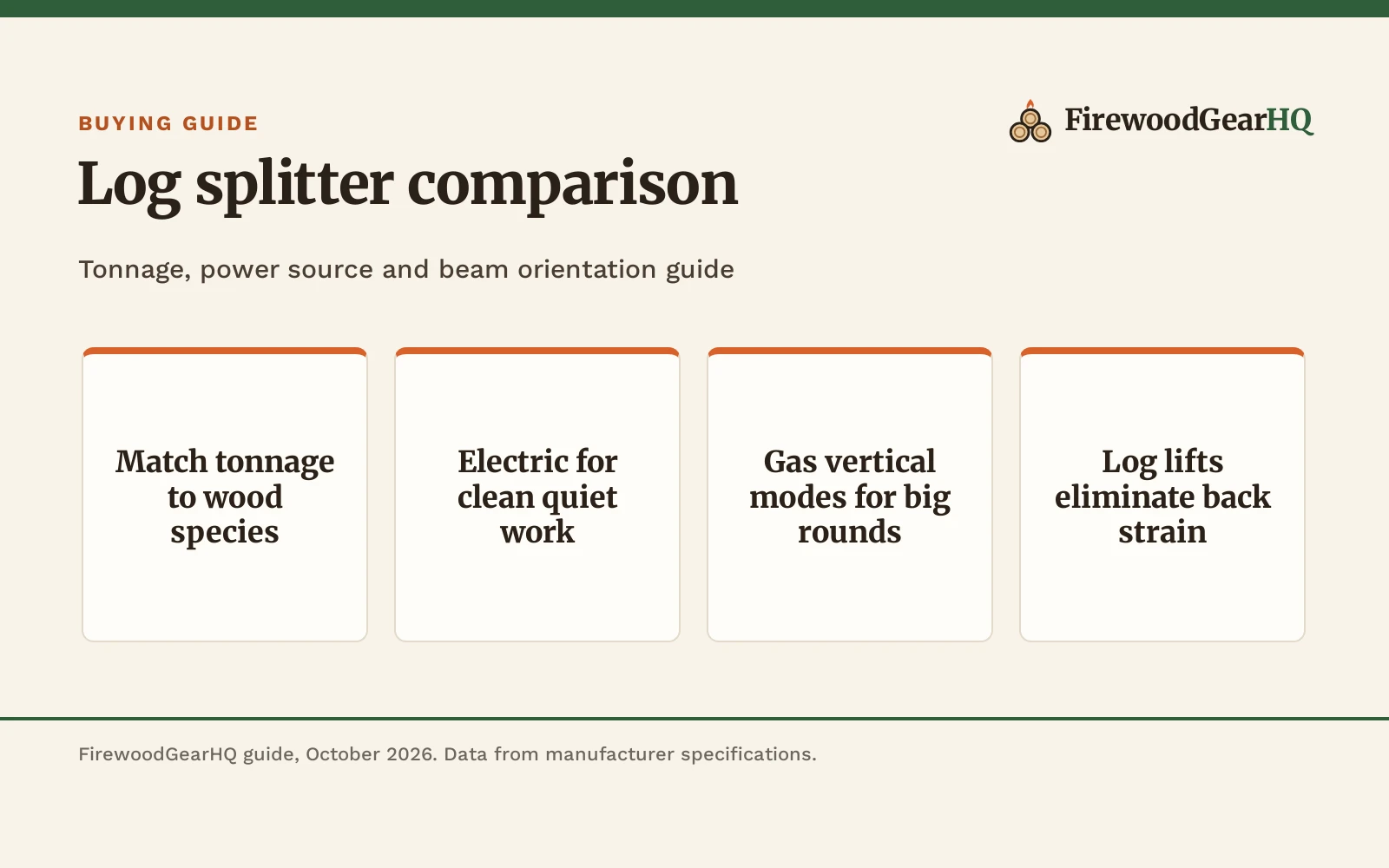
When autumn arrives and hardwood rounds pile up across the yard, getting them split and stacked before winter is the priority. A direct log splitter comparison comes down to matching machine tonnage, power source, and beam orientation to your wood volume and physical needs. For light hearth burning, an electric splitter offers quiet operation indoors or near a garage. For multiple cords of tough rounds, a gas hydraulic splitter provides necessary power and mobility. For oversized logs, choosing a vertical hydraulic log splitter or a model with a log lift saves your back by eliminating heavy lifting.
FirewoodGearHQ may earn a small commission if you buy through links on this page. The price you pay stays the same. Read our affiliate disclosure.
The quick answer
For a modest woodpile each season, an electric splitter is the simplest choice. It runs on household current, requires minimal maintenance, and stores easily. If you burn multiple cords to heat a home, a heavy-duty gas hydraulic splitter is necessary. Choose a convertible machine that pivots between horizontal and vertical positions, or a horizontal model with a dedicated hydraulic log lift so you never dead-lift heavy rounds. Always follow log splitter safety rules: run controls with a single operator, keep hands clear of the wedge, and wear eye protection.
Log splitter comparison chart by type
| Splitter type | Power source | Splitting position | Best fit for | Key advantage |
|---|---|---|---|---|
| Electric hydraulic | Corded electric motor | Horizontal | Small hearth piles, fire pits, indoor or garage splitting | Quiet operation, zero exhaust fumes, low maintenance |
| Compact gas hydraulic | Small four-stroke gas engine | Horizontal | Moderate seasonal woodpiles, remote woodshed cutting | Independent field mobility, compact storage footprint |
| Mid-tonnage gas hydraulic | Medium OHV gas engine | Horizontal and vertical | Mixed hardwoods, heavy seasonal home heating | Dual-position beam pivots to split heavy rounds on the ground |
| Heavy-duty gas hydraulic | Large OHV gas engine | Horizontal and vertical | Large-diameter hardwood trunks, multi-cord winter heating | Maximum splitting tonnage and wide wedge profile for knotty wood |
| Box-beam with hydraulic lift | Commercial-grade gas engine | Dedicated horizontal | Oversized trunk rounds, continuous high-volume production | Hydraulic log lift eliminates manual lifting and doubles as a work table |
| Kinetic flywheel | Gas engine or electric motor | Horizontal | Straight-grained rounds and clean seasoned cordwood | Rapid mechanical cycle speed driven by dual spinning flywheels |
Use this chart to match equipment to your workspace. Compare options in our guide to the best log splitter for home use or explore the best vertical log splitters.
What makes a log splitter faster and more capable
Tonnage and hydraulic cylinder force
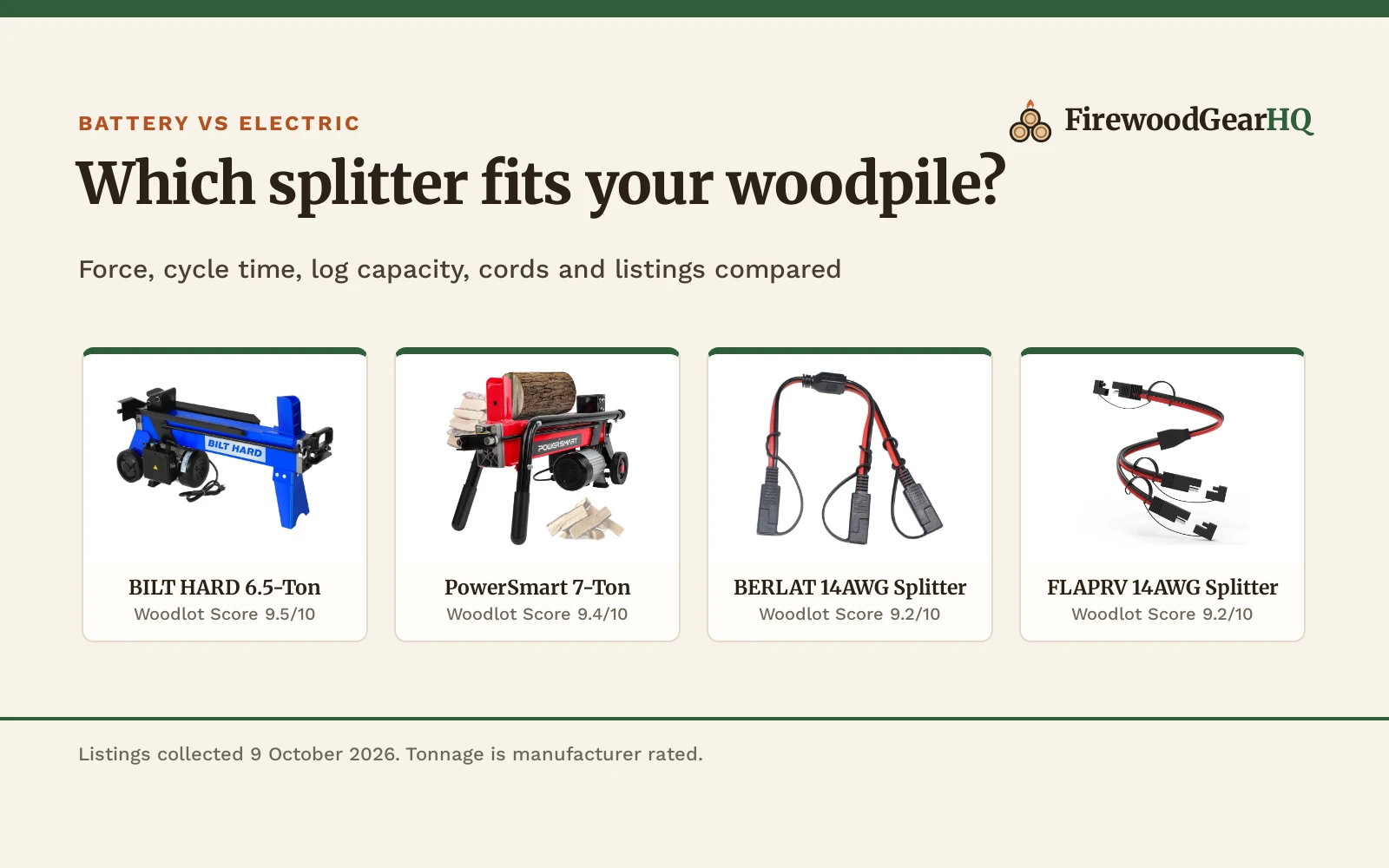
Splitting force is measured in tons of hydraulic pressure. Understanding how does a log splitter work helps in sizing. For residential tasks, the compact electric TECSPACE 7-ton splitter pairs a 15 Amp motor with hydraulics capable of clean rounds. Gas units scale through 20 tons, 25 tons, 35 tons, and 40 tons. SuperHandy lists a gas model at 25 tons. BILT HARD lists a 35-ton splitter with a 301cc, 10 HP engine and a 40-ton unit with a 389cc, 13 HP engine delivering 16.96 ft.-lb. of torque (though listing an erroneous 76 pounds in its spec table).
Horizontal versus vertical beam operation
Choosing beam orientation is critical. Our horizontal vs vertical log splitter guide explains that horizontal units work at waist height, but heavy logs cause strain. A vertical hydraulic log splitter pivots upright so the footplate rests near ground level, letting you roll rounds into place without lifting. BILT HARD uses this dual-position setup on its 35-ton and 40-ton splitters, switching modes in seconds for logs up to 24 inches in length.
Cycle time and two-stage hydraulic pumps
Cycle time is the seconds required to extend and retract the cylinder. As explained in what is cycle time on a log splitter, two-stage pumps advance rapidly under low pressure before kicking into high pressure. The FULL BOAR 20-ton gas splitter pairs a 209cc engine with a 10.5 GPM pump and a 45mm rod for an 8.5-second cycle time. BILT HARD 35-ton and 40-ton models use a 14 GPM pump and 7-gallon reservoir for 16 seconds on logs up to 24 inches in length. If speed drops, see why is my log splitter slow.
Multi-way wedges and box-beam designs
Standard splitters use a 2-way wedge that splits rounds in half. Adding a log splitter with box wedge or multi-blade setup accelerates work. FULL BOAR includes interchangeable 2-way, 4-way, and 6-way blades on its 35-ton model, splitting rounds into multiple pieces per stroke, with 3.55 inches of wedge adjustment on a 1045-pound box beam.
Hydraulic log lifts and work tables
A log splitter with lift uses hydraulics to hoist logs to beam height. For high-volume cords, log splitters with log lift systems prevent severe back fatigue. FULL BOAR equips its 35-ton splitter with a hydraulic lift rated to hoist logs up to 700 lbs, doubling as a staging table. In busy woodlots, pairing a vertical log splitter with conveyor equipment clears pieces quickly. While searchers look for a vertical log splitter with log lift, lifts belong on horizontal units where hoisting is needed.
How to choose the right log splitter tonnage
Evaluate wood species, diameter, and moisture before buying. Consult what size log splitter do I need and how many tons of log splitter do I need:
- Wood density: Softwoods split easily, but dense oak, hickory, and elm require high tonnage.
- Moisture: Review is it easier to split wood green or seasoned; green wood often splits along fault lines, but dry seasoned oak requires heavy tonnage.
- Mobility: Electric units require a 15 Amp circuit. Gas models tow with a 2-inch coupler, 24-inch chains, and 16-inch DOT tires rated for 45 MPH on BILT HARD splitters, or 10 In. tires on the FULL BOAR 20-ton model.
Per OSHA guidelines, operate controls with a single person; never let a helper hold logs during splitting.
What happens if your log splitter is undersized
Splitting dense wood with an undersized machine causes cylinder stalls. Holding the valve open while stalled bypasses oil through the relief valve, generating heat that breaks down seals and hydraulic fluid. Stalled logs often require manual wedges and a sledgehammer to free. If your machine stalls repeatedly, consult why wont my log splitter split to inspect hydraulic pressure and fluid levels.
Renting versus buying a log splitter
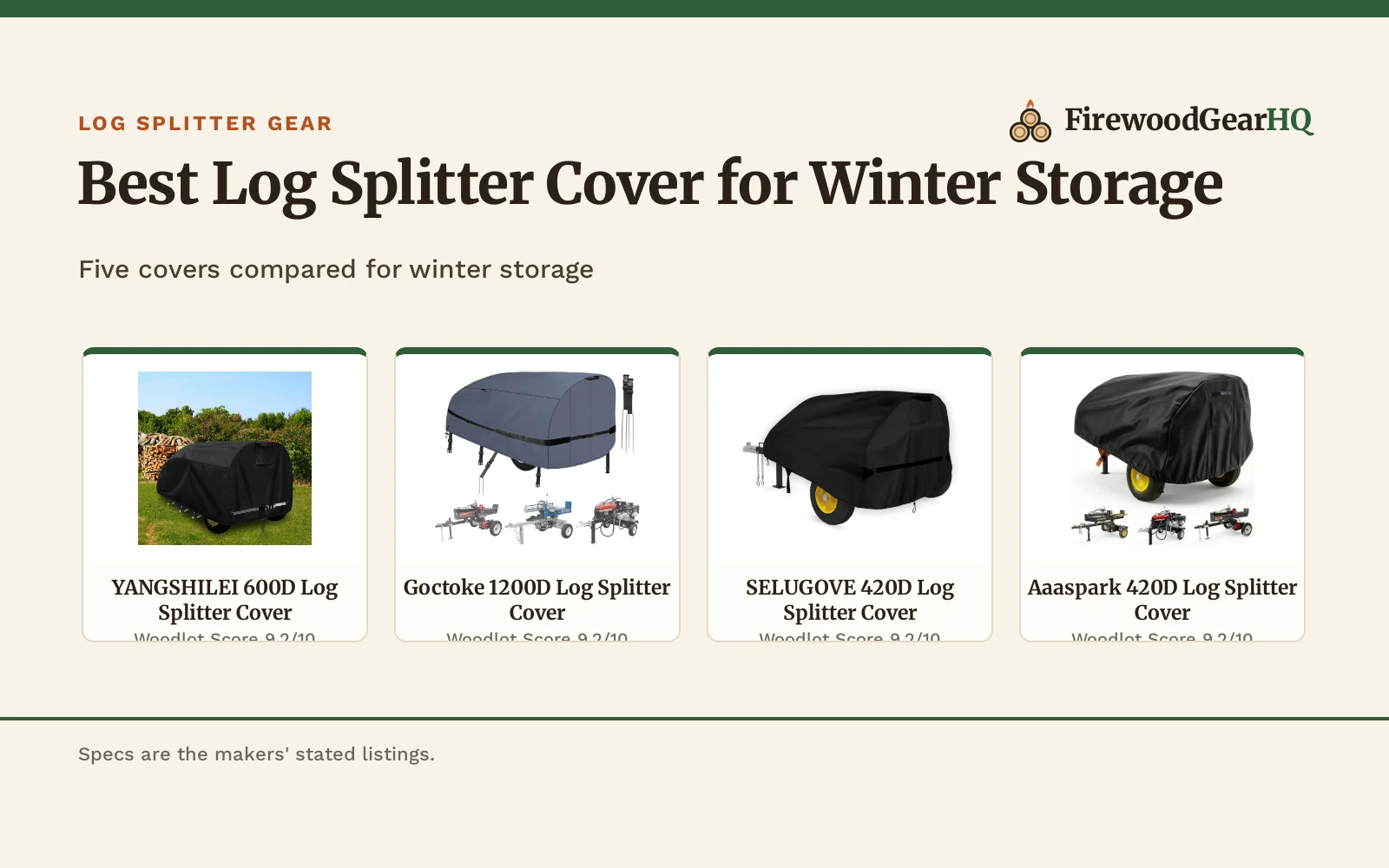
Owning a splitter lets you process wood at your own pace. Our guide on renting vs buying a log splitter compares rental logistics against ownership. If you buy, follow our log splitter maintenance checklist, use a best log splitter cover, check what hydraulic fluid for a log splitter, and explore a best kindling splitter.
Turn a stack's length, height and depth into full and face cords, and estimate how much wood a winter takes.
Frequently Asked Questions
What is the main difference in a log splitter comparison between gas and electric?
Electric splitters run quietly with zero exhaust, suited for garages and sheds, but deliver lower force like the 7-ton rating on the 15 Amp TECSPACE. Gas splitters reach 20 tons to 40 tons, cycle faster, and tow into remote woodlots without needing electrical outlets.
When should I choose a vertical hydraulic log splitter over a horizontal model?
Choose a vertical hydraulic log splitter when cutting large, heavy trunks. In vertical mode, the footplate rests on the ground so you roll rounds into position without lifting, preventing back strain during long sessions.
What does cycle time mean on a hydraulic log splitter?
Cycle time is the seconds needed for the ram to make a full stroke and return. Faster times, like 8.5 seconds on the FULL BOAR 20-ton or 16 seconds on BILT HARD units, boost hourly cord production.
Can a log splitter with lift handle large hardwood rounds?
Yes. A heavy log splitter with lift is built for large rounds. FULL BOAR equips its 35-ton model with a hydraulic lift rated to hoist logs up to 700 lbs, doubling as a work table.
How many tons of log splitter do I need for home firewood?
For light hearth wood, a compact 7-ton electric model suffices. For mixed firewood like ash or birch, a 20-ton or 25-ton gas splitter works well. For seasoned oak or knotty trunks, 35-ton or 40-ton gas units prevent stalls.
Is a 20-ton log splitter big enough for oak and hickory?
A 20-ton gas splitter handles straight-grained oak and hickory. However, if rounds are thoroughly seasoned, wide, or knotty, dense wood can stall a 20-ton cylinder, making a 35-ton or 40-ton machine with vertical operation the safer choice.
Related guides
Explore our complete log splitters hub to compare equipment across categories. If you are weighing power sources, see our comparison of gas vs electric log splitters and our guide on kinetic vs hydraulic log splitters. For orientation choices, read horizontal vs vertical log splitters and browse the best vertical log splitters. When sizing equipment for your woodpile, check what size log splitter do I need and how many tons of log splitter do I need. For home heating setups, review the best log splitter for home use, explore electric log splitters, and check gas log splitters. Also see our guide on renting vs buying a log splitter. Also see our cheap wood splitter guide. Also see our log splitter safety rules. Also see our what is cycle time on a log splitter. Also see our log splitter maintenance guide. Also see our guide on how does a log splitter work. Also see our review of can you tow a log splitter on the road. Also see our overview of what hydraulic fluid for a log splitter. Also see our troubleshooting guide on why is my log splitter slow. Also see our troubleshooting guide on why wont my log splitter split. Also see our guide on log splitter with box wedge. Also see our comparison of log splitter vs splitting maul. Also see our guide on how to move heavy logs safely. Also see our guide on how to stack firewood. Also see our how long to season firewood guide. Also see our best log splitter cover guide. Also see our best kindling splitter guide. Also see our best hand wood splitter guide.