Log Splitter with Box Wedge: 5 Splitting Tools Compared (2026)
Five log splitting tools compared by wedge design, steel construction, weight, safety features and warranty, from slip-on 4-way wedges to hydraulic splitters.
 By FirewoodGearHQ Editorial
Updated October 8, 2026
By FirewoodGearHQ Editorial
Updated October 8, 2026
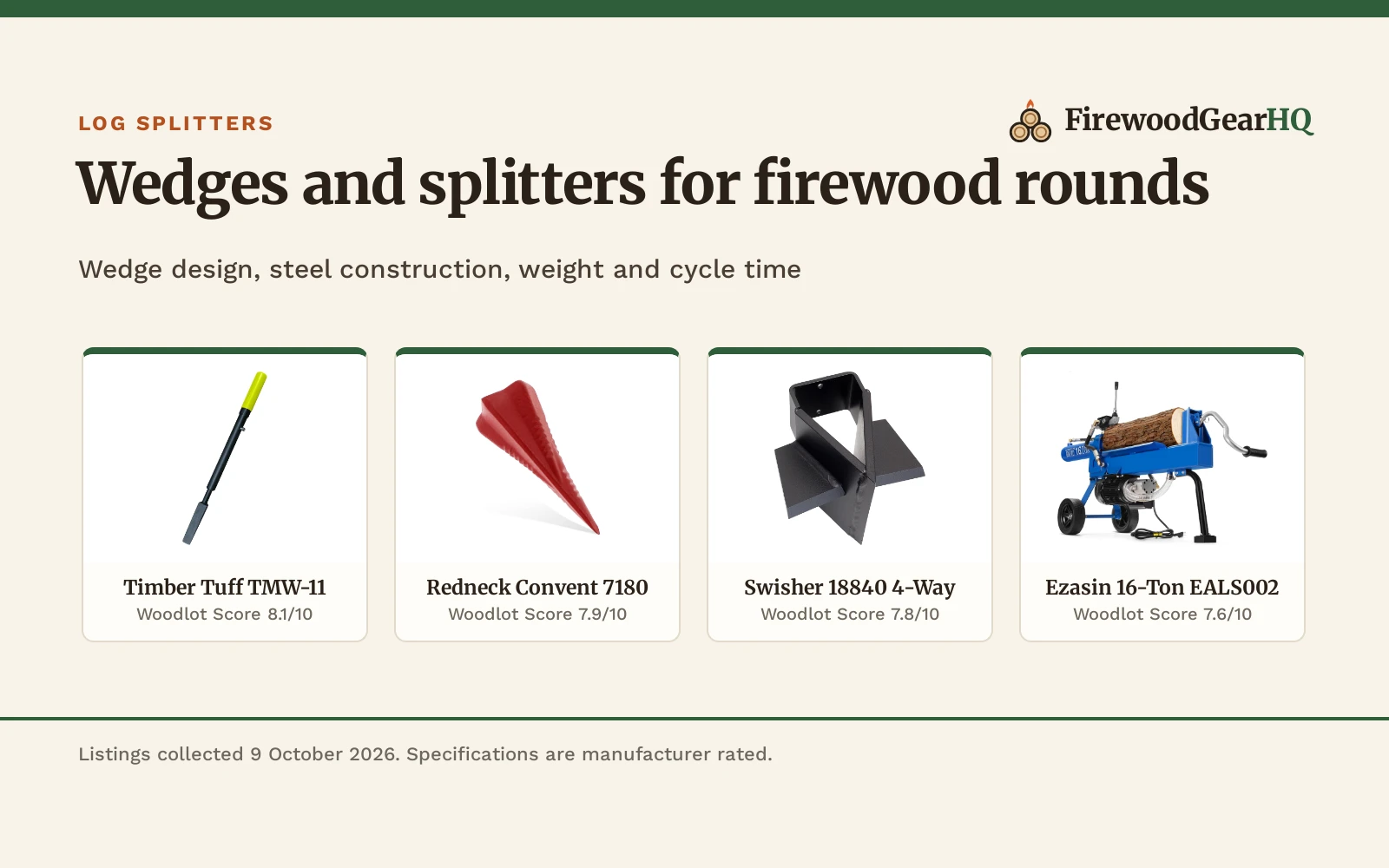
A log splitter with box wedge splits rounds into multiple pieces in a single stroke, significantly cutting the time required to work through a firewood pile. While traditional splitting wedges cleave a log in half, box wedges and 4-way splitting wings divide the wood or direct splitting force across multiple angles. This guide compares five splitting options by wedge design, steel construction, cycle time, listed weight, and stated warranty, covering slip-on 4-way wedges, manual slide hammers, and dedicated hydraulic splitters.
FirewoodGearHQ earns a commission when you buy through links on this page, at no extra cost to you. Affiliate disclosure.
Quick picks
- Best Overall Timber Tuff TMW-11: 44 in manual splitter with an 8.8 lb slide hammer and a stated 1 year warranty. Check price
- Best 4-Way Manual Wedge Redneck Convent 7180: 4-direction splitting wedge forged from railway steel with a stated 1 year warranty. Check price
- Best 4-Way Hydraulic Wedge Swisher 18840 4-Way: 19 lb slip-on 4-way wedge designed for Swisher 22, 28 and 34-ton splitters. Check price
- Best Electric Splitter Ezasin 16-Ton EALS002: 16-ton electric hydraulic splitter with an 18-second cycle time and 20.5 in capacity. Check price
Compare the picks
| Model | Woodlot Score | Tool type | Wedge style | Weight (listed) | Operation | Warranty (stated) |
|---|---|---|---|---|---|---|
| Timber Tuff TMW-11 | 8.1/10 | Slide hammer splitter | 2 in blade | 13.73 lb (8.8 lb head) | Manual slide hammer | 1 year |
| Redneck Convent 7180 | 7.9/10 | Splitting wedge | 4-direction diamond | 4.1 lb (listed) | Manual (8 lb hammer) | 1 year |
| Swisher 18840 | 7.8/10 | Slip-on wedge | 4-way cross wedge | 19 lb | Hydraulic (22 to 34 ton) | Not stated |
| Ezasin EALS002 | 7.6/10 | Electric splitter | Horizontal beam steel | 124 lb | Electric hydraulic (17.4A) | Not stated |
| KABIN Kindle Quick | 7.4/10 | Kindling splitter | Alternating teeth | 5.5 lb / 6.03 lb | Manual mallet | Not stated |
Specifications are manufacturer rated, collected 8 October 2026. Weights are as listed by each manufacturer and may reflect shipping weight or bare tool weight. Only two of these listings state a warranty term.
The picks
| Award | Product | Woodlot Score About the HQ ScoreThe Woodlot Score runs from 0 to 10 and weighs performance (35%), build (25%), value (25%), safety (10%, where it applies) and warranty (5%), using only what the manufacturer and the listing publish. How we pick › | |
|---|---|---|---|
 Timber Tuff Manual Log Splitter with Steel Slide
|
8.1/10 | Buy | |
 Manual Log Splitter Wedge 4-Direction Steel
|
7.9/10 | Buy | |
 Swisher 18840 4-Way Log Splitter Wedge
|
7.8/10 | Buy | |
 Electric Log Splitter 16 Ton
|
7.6/10 | Buy | |
 KABIN Kindle Quick Compact Log Splitter
|
7.4/10 | Buy |
Timber Tuff Manual Log Splitter with Steel Slide
A 44 in manual log splitter with an 8.8 lb slide hammer, heat-treated steel construction, cushion grip handle and a 2 in blade.
Pros
- Slide-hammer design keeps hands clear of the splitting wedge
- 8.8 lb weighted hammer delivers driving force without swinging an axe
- Heat-treated steel construction with powder coat finish
- 1 year warranty against manufacturer defects stated in listing table
Cons
- 13.73 lb total weight requires repeated manual lifting of the slide hammer
- 2 in blade length is built for straight-grained firewood and kindling, not large knotty rounds
- Dimensions list 44 in overall size but 33 x 2 x 3 in package dimensions
- Manual operation splits in a single line rather than multi-way splitting
Manual Log Splitter Wedge 4-Direction Steel
A 4-direction manual log splitting wedge forged from heat-treated railway steel with a diamond cross section and spherical striking face.
Pros
- Diamond cross section splits logs in up to 4 directions
- Forged from heat-treated and hardened railway steel
- Spherical striking face centers hammer blows and notches resist popping out
- 1 year manufacturer warranty stated in the listing table
Cons
- Requires a separate 8 lb hammer for operation
- Listing specifically notes it is not recommended for knotty woods or large diameter hardwoods
- Weight listed as 4 lbs in title, 4.1 lb in bullets, and 1.79 kg in spec table
- Warranty text in spec table is truncated after stating ONE (1) YEAR
Swisher 18840 4-Way Log Splitter Wedge
A 19 lb steel 4-way slip-on wedge engineered for Swisher 22, 28 and 34-ton log splitters in horizontal splitting mode.
Pros
- Splits logs into 4 pieces in a single stroke to boost firewood production
- Slides directly over the factory wedge with no machine modifications
- Constructed from 19 lb high-grade steel for impact durability
- Designed specifically for 22, 28 and 34-ton splitters
Cons
- Compatible only with Swisher splitters; listing notes it has not been verified on other brands
- Restricted strictly to horizontal-split operation
- Weighs 19 lb, adding significant weight when mounting or removing
- No warranty term is stated on this listing
Electric Log Splitter 16 Ton
A 16-ton electric hydraulic log splitter featuring a 17.4A motor, 18-second cycle time, horizontal steel beam wedge, and 20.5 in log capacity.
Pros
- 16 ton manufacturer rated hydraulic splitting force powered by a 17.4A motor
- 18-second cycle time with automatic ram return
- Accommodates log lengths up to 20.5 in on a horizontal full-beam frame
- Quiet 65 dB operation with temperature sensor and motor overload protection
Cons
- Weighs 124 lb, requiring use of its 8 in wheels for relocation
- Listing repeats its hydraulic pump bullet verbatim under two different headings
- No safety certifications like UL, ETL, or CSA are stated
- No warranty term is stated on this listing
KABIN Kindle Quick Compact Log Splitter
A compact manual kindling splitter cast from steel with slanted alternating teeth, anchor bolt holes and carrying handles.
Pros
- Cast steel construction with black all-weather coating resists rust better than cast iron
- Slanted alternating teeth split kindling at an angle to prevent wood jams
- Base includes bolt holes for secure mounting to a splitting stump
- Built-in handles allow easy transport to campsites or fire pits
Cons
- Weight contradiction: bullets state 5.5 pounds while spec table lists 6.03 pounds
- Designed for kindling and small firewood, not large splitting logs
- Requires a manual mallet or club hammer (not included)
- No warranty term is stated on this listing
How we scored them
Each tool is scored out of 100 on performance, build, value, safety and warranty, using only what the listing publishes. The weights are on our How We Pick page.
| Product | Woodlot Score | Perf. /35 | Build /25 | Value /25 | Safety /10 | Warranty /5 |
|---|---|---|---|---|---|---|
| Timber Tuff TMW-11 | 8.1 | 28 | 22 | 22 | 5 | 3 |
| Redneck Convent 7180 | 7.9 | 27 | 22 | 22 | 5 | 3 |
| Swisher 18840 4-Way | 7.8 | 30 | 22 | 21 | 4 | 0 |
| Ezasin 16-Ton EALS002 | 7.6 | 30 | 20 | 21 | 5 | 0 |
| KABIN Kindle Quick | 7.4 | 27 | 21 | 21 | 5 | 0 |
Buying guide: choosing a log splitter with box wedge
Box wedges and 4-way splitting wings
A box wedge or 4-way splitting attachment fits onto a splitter or forms the primary cutting head, dividing logs into 4 pieces in a single stroke instead of requiring multiple passes. Slip-on attachments like the Swisher 18840 fit over an existing vertical blade, designed specifically for splitters rated from 22 to 34 tons. In manual tools, diamond-profile wedges like the Redneck Convent 7180 weaken wood fibers along multiple angles, splitting in up to 4 directions when struck with an 8 lb hammer.
Hydraulic power vs manual splitting tools
Hydraulic splitters use mechanical force to push logs against a wedge. The Ezasin EALS002 provides a manufacturer-rated 16 tons of hydraulic splitting force with an 18-second cycle time and 20.5 in log capacity, operating on a 17.4A electric supply. In contrast, manual tools like the Timber Tuff TMW-11 rely on a slide-hammer design with an 8.8 lb head on a 44 in frame, eliminating the need to swing a maul while keeping the operator’s hands clear of the blade. Small kindling splitters like the KABIN Kindle Quick hold wood upright against cast-steel alternating teeth, built for kindling rather than full logs.
Steel selection and construction
Splitting wedges encounter immense pressure and impact. Heat-treated and hardened steel is standard across durable tools. Redneck Convent uses hardened railway alloy steel to withstand repeated sledgehammer blows. Swisher utilizes heavy-grade steel plate resulting in a 19 lb attachment designed for commercial-tonnage hydraulic pressure. Timber Tuff uses heat-treated steel with a powder coat finish. KABIN uses cast steel with an all-weather coating, which the listing notes provides better resistance to rust than cast iron.
Splitter safety: single-operator control and hand clearance
Log splitting involves high compressive force and flying wood fragments. Splitters must always be operated by a single person: never have one person position wood while another operates the controls. Keep hands clear of the wedge and ram at all times. Always wear ANSI-compliant eye protection and heavy work boots to guard against shifting logs and debris. For manual wedge work, inspect striking faces for mushrooming, and clear a designated work zone before swinging a hammer. For recalled equipment, check official consumer safety notices or review our guide on how to check if your chainsaw or log splitter is recalled.
Wedge maintenance and sharpening
A splitting wedge should have a clean, beveled profile rather than a razor edge. Very sharp knife edges can chip or roll under heavy tonnage or against dense knots. Maintain wedges using a flat hand file to remove burrs, smooth mushroomed striking edges, and restore the factory bevel. For painted steel tools, touch up bare metal after seasonal use to prevent surface corrosion during damp storage.
Plan how much wood you need before you start splitting: the firewood cord calculator estimates cords per winter from your home and wood species.
Turn a stack's length, height and depth into full and face cords, and estimate how much wood a winter takes.
One operator only, with hands well clear of the wedge and the ram. Wear eye protection and gloves, set the splitter on stable, level ground, and keep kids and pets away from the work area. Run gas splitters outdoors only, and never reach in to clear a jammed log while the ram can move. Read our Safety Disclaimer.
Frequently Asked Questions
How does a box wedge work on a log splitter?
A box wedge or 4-way wedge divides a firewood round into multiple pieces in a single hydraulic stroke. The central vertical blade splits the round, while horizontal or angled wings simultaneously shear the wood along perpendicular angles, eliminating the need to re-split individual chunks.
Can you put a 4-way wedge on any log splitter?
No. Slip-on wedges must match the exact dimensions and tonnage rating of the host machine. For example, the Swisher 18840 is engineered specifically for Swisher 22, 28, and 34-ton splitters in horizontal position and is not verified for other brands. Adding a multi-way wedge to an underpowered machine can cause stalling or structural binding.
How to use a log splitting wedge safely?
Place the log on a flat, stable surface or secure chopping block. Position the pointed tip of the wedge into an existing radial check or grain line near the edge rather than dead center. Tap the wedge with a mallet or hammer to set it firmly, remove your guiding hand, and drive it through using centered blows from an 8 lb hammer. Always wear protective eyewear.
How to sharpen a log splitter wedge?
Use a hand file to hone the beveled cutting edge, keeping the factory angle consistent across both sides. Do not grind the edge to a fine knife sharpness, as very thin edges roll or chip under hydraulic tonnage. Smooth out nicks, remove metal burrs from the striking head or blade, and apply light oil to prevent rust.
What steel is used for log splitter wedges?
Manufacturers typically use hardened high-carbon steel, alloy steel, or repurposed railway steel. Redneck Convent uses heat-treated railway steel for impact resistance, while Swisher uses high-grade steel plate to withstand up to 34 tons of hydraulic splitting pressure.
Related guides
Explore our complete log splitter hub to compare machines across every woodpile requirement. If you are deciding between fuel types or machine sizes, read our comparison on gas vs electric log splitters and our sizing guide on how many tons of log splitter you need. For residential properties, see the best log splitters for home use. If you prefer splitting by hand, explore our reviews of the best splitting wedges and the best splitting mauls, or view no-swing options in our guide to the best kindling splitters. Before operating hydraulic equipment, review safety notices in our overview of log splitter recalls.
About the author
The FirewoodGearHQ editorial team researches firewood and wood heating equipment from published specifications, ratings and warranty terms, and scores every pick the same way. We do not run our own product trials.