Log Splitter Alternative: Which One Should You Buy?
Discover practical log splitter alternative options, including splitting axes, mauls, steel wedges, and manual splitters for processing firewood.

On this page
Top picks at a glance
As an Amazon Associate we earn from qualifying purchases.
- 1
 KABIN Kindle Quick Log Splitter9.7/10View on Amazon
- 2
 Kindling Splitter L9.6/10View on Amazon
- 3
 Cast Iron Kindling Splitter with 3Lbs Sledge Hammer9.6/10View on Amazon
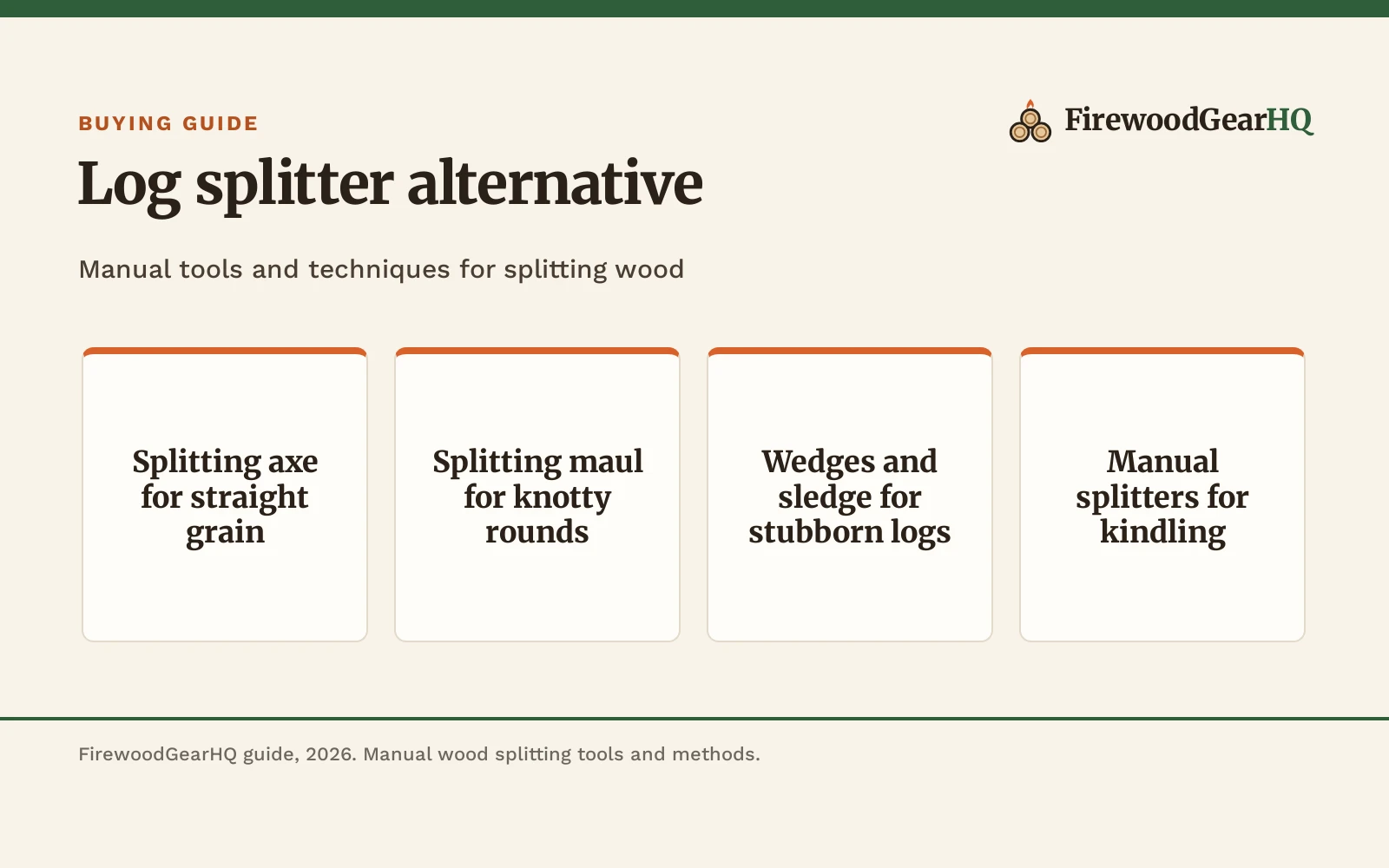
As late autumn settles over the woodlot and freshly cut rounds sit stacked beside the shed waiting for winter burning, finding a practical log splitter alternative comes down to matching wood species with the proper manual tool. The most effective alternatives to a mechanical log splitter are the heavy splitting maul for stubborn, knotty rounds, a sharp splitting axe for straight-grained hardwoods, and steel splitting wedges driven by a sledgehammer for oversized trunk sections. For hearth kindling and smaller branch wood, stationary cast-iron splitters provide controlled splitting without gas engines, hydraulic pumps, or electric power cords.
FirewoodGearHQ may earn a small commission if you buy through links on this page. The price you pay stays the same. Read our affiliate disclosure.
The quick answer
A motorized log splitter is convenient for large operations, but manual tools remain reliable, quiet, and inexpensive to maintain for heating a home with wood. Choosing between a splitting maul, a splitting axe, or a set of splitting wedges depends primarily on the diameter of your logs and grain structure. Straight-grained green wood yields readily to an axe, while twisted rounds and wide crotches demand the blunt force of a maul or wedges. For hearth tenders who only need stove kindling, a hand wood splitter or a stationary kindling splitter delivers safe, consistent splits without swinging a blade.
Choosing a log splitter alternative for your woodpile
Before deciding to park a hydraulic machine on your property, evaluating your annual firewood volume and physical comfort helps determine whether hand tools fit your routine. Many rural property owners find that splitting firewood by hand offers enjoyable seasonal exercise and avoids mechanical hassles like oil changes, fouled spark plugs, blown hydraulic hoses, and carburetor gum. Using the right tool for each log diameter makes manual splitting surprisingly fast.
| Alternative tool | Best suited wood | Key advantage | Limitation |
|---|---|---|---|
| Splitting maul | Dense hardwoods, knotty trunk rounds | Broad wedge forces stubborn grain apart | Heavy weight requires sustained upper-body effort |
| Splitting axe | Straight softwoods, seasoned branch wood | Fast swing speed cleanly parts straight grain | Can become stuck in twisted or knotty rounds |
| Splitting wedges and sledgehammer | Massive trunk rounds, gnarly crotches | Delivers maximum mechanical advantage | Requires driving multiple wedges in sequence |
| Stationary kindling splitter | Small dry splits, hearth kindling | Eliminates swinging a blade near fingers | Limited to small-diameter pre-split firewood |
| Slide-hammer manual splitter | Medium rounds, backyard fire pit logs | Guided impact stroke reduces strain | Slower working pace on stringy wood species |
Selecting the right option from the table allows you to tackle your woodpile efficiently without relying on motorized machinery.
Manual log splitter alternative tools explained
Splitting mauls for heavy rounds
A heavy splitting maul serves as the primary backbone of manual firewood splitting. Combining the head weight of a sledgehammer with the cutting edge of an axe, a maul relies on downward momentum rather than blazing blade speed. The wide, flared cheeks act as an expanding wedge that pops wood fibers apart before the cutting edge can bury itself deep in the block. When comparing a log splitter vs splitting maul, the maul delivers immediate splitting action without setup time, engine noise, or fuel expenses. For knotty maple, twisted birch, and dense red oak rounds, swinging a maul downward into existing stress checks remains the standard approach among rural wood burners.
Splitting axes for straight-grained firewood
Where a maul relies on brute mass, a splitting axe depends on velocity and balance. Featuring a thinner profile and lighter overall weight, a splitting axe enables a fast, clean swing that slices through clean firewood rounds with minimal fatigue. Understanding the difference in splitting axe vs maul design helps you grab the proper handle from the shed: save the axe for straight-grained ash, cedar, and pine, where a crisp strike along the grain line splits the round immediately. Learning how to split wood with an axe properly involves using gravity and shoulder snap rather than arm strain, allowing you to work steadily through seasoned firewood.
Splitting wedges and sledgehammers for knotty trunks
Even a heavy maul encounters massive trunk wood that refuses to yield. In those situations, steel splitting wedges paired with a heavy sledgehammer provide tremendous mechanical advantage. By positioning a wedge near the outer perimeter of a round and driving it deep with a sledge, you initiate a controlled crack that travels straight through the center. Keeping an extra wedge handy allows you to insert another wedge further along the crack if the initial wedge becomes submerged. Reviewing our guide on how to use a splitting wedge outlines safe striking techniques and prevents metal mushrooming on striking faces.
Stationary manual splitters and kindling splitters
For hearth tenders preparing daily fire-starting fuel, swinging an axe near fingers inside a woodshed poses unnecessary risks. A stationary cast-iron kindling splitter features an upward-facing blade enclosed inside a protective steel safety ring. Placing a small firewood piece inside the ring and striking the top with a wooden mallet or small hammer pops clean kindling safely and rapidly. Similarly, manual slide-hammer splitters use a weighted steel cylinder sliding along a central guide shaft to drive a wedge into stationary rounds, providing a controlled splitting motion that protects backs and knees from twisting motions.
How to split wood efficiently without a hydraulic splitter
Splitting wood with manual tools requires technique rather than raw muscle. Seasoned firewood cutters rely on reading the end grain of each round before swinging. Looking closely at the cut face reveals radial drying checks where the wood has naturally begun to separate as moisture left the fibers. Aiming your initial strike directly into a prominent check reduces the resistance of the wood dramatically.
Always place your rounds atop a broad, sturdy chopping block rather than on soft soil or gravel. A solid hardwood chopping block absorbs no energy, reflecting the full momentum of your strike directly into the workpiece while keeping your blade from striking hidden stones. Work from the outside sapwood inward toward the heartwood on large rounds rather than trying to split the piece directly through the exact center. Slicing off outer slabs around the perimeter reduces the core down to a manageable size that parts cleanly under a strike.
Wood condition also influences your effort. Checking whether it is easier to split wood green or seasoned helps you schedule your splitting calendar: straight-grained red oak and maple often split cleanest when fresh cut in winter, while stringy species like elm become far more brittle after drying off the ground. After splitting, inspect your stacks and learn how to tell if firewood is seasoned to ensure your firewood reaches clean-burning condition before loading your firebox.
Safety rules for manual wood splitting
Manual firewood tools demand strict respect for basic woodlot safety standards. Before taking a swing with an axe or maul, always inspect your environment and maintain a clear swing zone. Clear away stray branches, overhead clotheslines, tripping hazards, and loose split wood around your chopping block. Ensure bystanders, family members, and pets remain well outside your swinging perimeter.
Personal protective equipment is essential whenever steel meets wood. Always wear impact-rated eye protection to shield against flying wood chips and steel splinters from wedges, sturdy leather work gloves to protect against rough bark and splinters, and steel-toe work boots with non-slip soles. Stand with feet planted wider than shoulder-width, bending your knees as the tool descends so an errant swing follows an arc toward the ground between your boots rather than into your shins. If you are operating a mechanical splitter alongside manual tools, follow established log splitter safety rules: enforce a strict single-operator zone, keep hands completely clear of the wedge and push block, and never reach across the splitting beam while equipment runs. When moving heavy trunk sections onto blocks, review techniques for how to move heavy logs safely or use a cant hook to roll logs without straining your lower back.
When a powered log splitter makes sense
While manual alternatives handle seasonal home firewood needs admirably, certain woodpile demands make motorized equipment practical. Property owners heating large farmhouses through harsh winters who process heavy amounts of firewood annually may find manual swinging too demanding over long sessions. Likewise, dealing with twisted tree crotches, gnarly elm, or massive knot clusters can exhaust even experienced wood splitters using wedges.
For high-volume operations, commercial machinery often includes features like a log splitter with lift table to hoist heavy rounds without back strain, a log splitter with conveyor to move split firewood directly into storage piles, or auto-return control valves that speed cycle times. If you decide that manual tools no longer keep pace with your woodpile, reading our guide on the best log splitter for home use or comparing a gas vs electric log splitter helps you choose an appropriate machine. If you only face an oversized pile following a seasonal storm, exploring renting vs buying a log splitter offers a temporary mechanical boost without permanent storage commitments.
Frequently Asked Questions
Are manual log splitters any good?
Yes. Manual log splitters and hand tools provide reliable splitting performance for modest firewood supplies without fuel, engine noise, or mechanical breakdowns. A heavy splitting maul or steel wedge splits straight-grained firewood as quickly as a budget hydraulic machine while offering dependable operation year after year.
Are hydraulic log splitters worth it compared to manual alternatives?
Hydraulic splitters become worthwhile when you process large volumes of firewood each season or regularly handle gnarly, knotty hardwood rounds that resist hand splitting. For homeowners burning occasional fireplace logs or heating with straight-grained ash and oak, manual hand tools remain far simpler and cheaper to own.
Can you split large logs without a log splitter?
Yes. Large trunk rounds can be split by driving steel wedges into the outer sapwood using a heavy sledgehammer. Working around the circumference and driving wedges along natural grain checks fractures even massive hardwood rounds into manageable sections without a powered machine.
Is a splitting axe or a splitting maul better for firewood?
It depends on the wood species and round diameter. A splitting maul is better for large, dense, or knotty hardwood rounds because its broad wedge-shaped head forces fibers apart. A splitting axe is better for medium, straight-grained wood because its lighter head allows faster swings with less fatigue.
How do you split twisted or knotty rounds by hand?
Avoid striking directly into large knots, which hold wood fibers together like iron nails. Instead, place your wedge or maul strike alongside or behind the knot where the grain runs straight, or use a sledgehammer to drive multiple steel wedges sequentially along the weakest radial checks.
Related guides
Explore our complete log splitters hub and axes and mauls category for more firewood tools. Compare the best splitting maul, the best splitting axe, and the best hand wood splitter for your woodpile. If you need kindling tools, see our reviews of the best kindling splitter and learn safe techniques in how to split wood with an axe. For stubborn trunk rounds, check the best splitting wedge and read our tutorial on how to use a splitting wedge. Moving heavy rounds across the yard is easier with the best cant hook and our guide on how to move heavy logs safely. If you eventually decide to invest in powered machinery, consult the best log splitter for home use, compare gas vs electric log splitter options, weigh renting vs buying a log splitter, and review mandatory log splitter safety rules.