Best Type of Fireplace Fireback (2026)
How to choose the best type of fireplace fireback, comparing cast iron and steel plates for heat reflection, masonry protection and proper hearth sizing.

On this page
Top picks at a glance
As an Amazon Associate we earn from qualifying purchases.
- 1
 Grate Wall of Fire Model RF-5 Reflective FirebackView on Amazon
- 2
 INNO STAGE 22 Inch Iron Fireback with Support FeetView on Amazon
- 3
 INNO STAGE 26 Inch Iron Fireback with Support FeetView on Amazon
- 4
 Grate Wall of Fire Model RF-6 Reflective FirebackView on Amazon
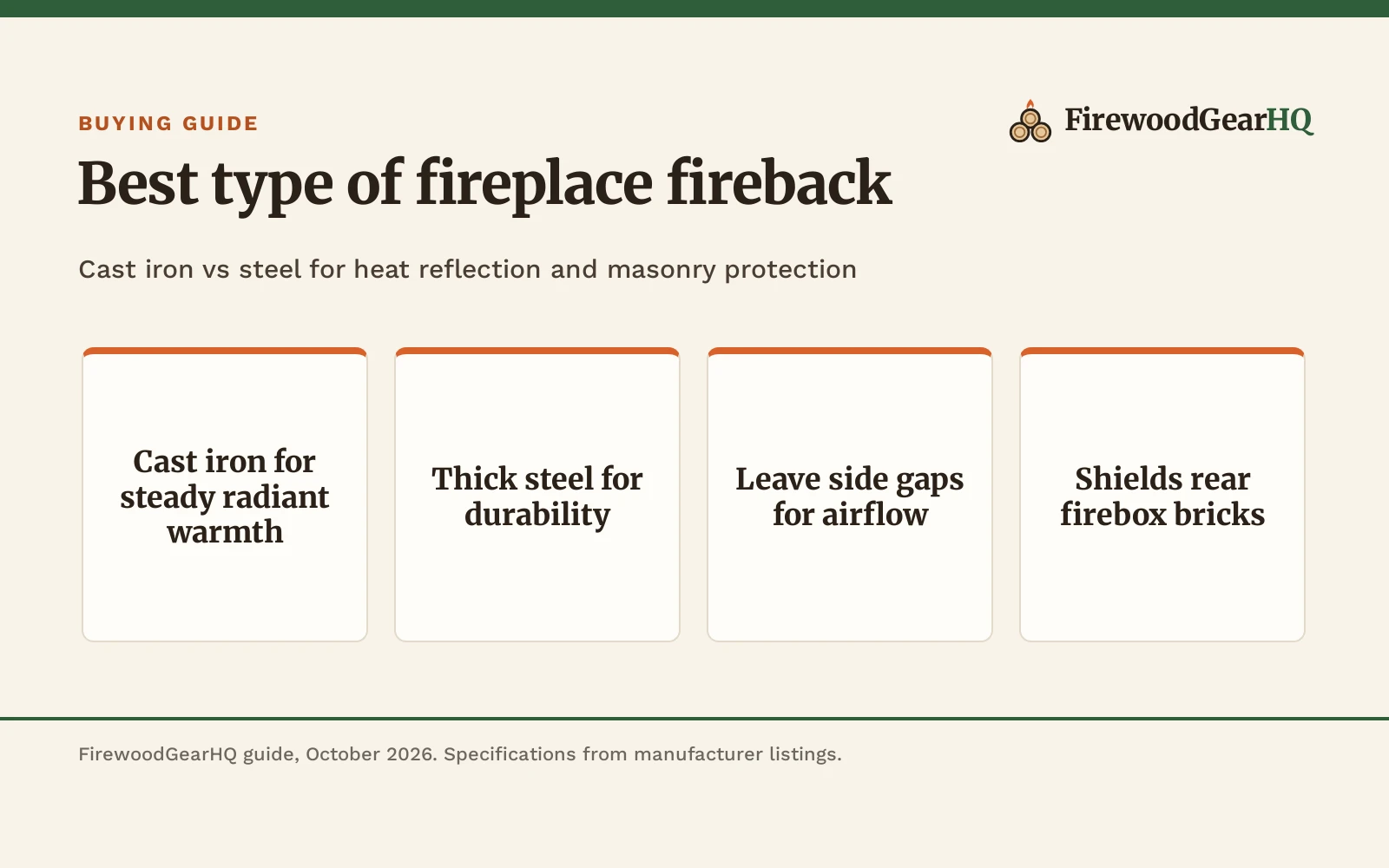
When cold winter weather arrives and dry firewood burns on the hearth, much of the heat escapes straight up the chimney flue or soaks into the rear firebox brickwork. Installing a heavy metal fireback at the back of the hearth, standing upright just forward of the rear masonry, changes how a fireplace performs. If you are looking for the best type of fireplace fireback, heavy cast iron is the traditional choice for steady, long-lasting radiant heat, while heavy steel plate is the best alternative for hearths where falling firewood logs could strike the rear plate. Cast iron absorbs heat from the fire and radiates warmth into the room after flames die down, whereas thick steel offers durable construction that is less prone to damage from mechanical impact.
More options to compare
 Grate Wall of Fire Model RF-5 Reflective FirebackCheck price on Amazon
 INNO STAGE 22 Inch Iron Fireback with Support FeetCheck price on Amazon
 INNO STAGE 26 Inch Iron Fireback with Support FeetCheck price on Amazon
 Grate Wall of Fire Model RF-6 Reflective FirebackCheck price on Amazon
FirewoodGearHQ may earn a small commission if you buy through links on this page. The price you pay stays the same. Read our affiliate disclosure.
The quick answer
Choosing between cast iron and steel comes down to how your hearth is used and whether you prioritize long-lasting radiant warmth or durability against log impacts. Cast iron functions as a dense heat reservoir: it absorbs warmth from burning coals and emits steady radiant heat into the room long after firewood burns down.
Heavy steel plates emphasize impact strength alongside heat reflection. When loading heavy hardwood splits onto a fireplace grate for wood burning, a shifting or rolling log can bump the rear plate. Cast iron is brittle and can crack if struck hard by heavy wood. Steel plates provide durable construction that is less prone to impact damage during active loading. Both materials serve as an effective thermal shield for the firebox, preventing direct flame contact from deteriorating rear firebrick and mortar joints.
Fireback comparison by material
| Fireback material | Stated thickness | Heat characteristics | Key advantages |
|---|---|---|---|
| Cast iron | Not stated | Absorbs flame heat and radiates sustained warmth into the room | Traditional decorative motifs and prolonged heat output |
| Alloy steel plate | 1/2″ (Model RF-5) | Reflects radiant heat forward while absorbing warmth | Durable construction less prone to damage than brittle cast iron |
| Iron plate | 8mm to 0.4 inch | Reflects radiant heat into the living space and protects brick | Flat utilitarian sizing with adjustable support feet |
This comparison highlights the practical distinctions between cast iron and fabricated plates. Cast iron delivers classic hearth aesthetics and steady warmth, though listings such as WILLOW WEAVE and TwentyNext do not publish plate thickness. Fabricated alloy steel, featured on the Grate Wall of Fire Model RF-5 in a 1/2″ thickness, emphasizes durability that is less prone to damage than brittle cast iron. Heavy iron plates from Permade, INNO STAGE, and IGOHEALS publish thicknesses of 8mm or 0.4 inch, pairing radiant heat reflection with adjustable support hardware.
Choosing the best type of fireplace fireback
Cast iron firebacks for steady radiant warmth
Cast iron is a classic hearth material known for dense thermal storage capacity. When wood burns against bare firebrick, the masonry absorbs heat and conducts warmth into the chimney structure or exterior wall. A cast iron plate placed at the rear of the firebox absorbs this heat and radiates it forward into the living area, continuing to provide warmth as the fire dies down.
Makers frequently cast decorative scenes into the metal face. WILLOW WEAVE produces a cast iron fireback featuring a decorative bear pattern measuring 20″ W x 17″ H, although its spec table states 20″L x 20″W. TwentyNext lists a decorative cast iron model measuring 21 inches wide by 16 inches high in its bullets, while its title states 20 inch and its spec table notes 21″L x 21″W. The primary limitation of cast iron is its brittle nature: sharp impacts from heavy firewood splits or sudden temperature shocks can cause cast plates to crack.
Solid steel firebacks for impact resistance
Heavy steel plates focus on structural resilience alongside radiant reflection. A steel fireback reflects radiant heat waves into the room while absorbing thermal energy to protect the rear wall. The Grate Wall of Fire Model RF-5 is constructed from 1/2″ thick alloy steel and weighs 48 pounds. The maker notes that its durable steel construction endures high temperatures and continuous use while remaining less prone to damage compared to brittle cast iron.
Heavy iron plates with support feet
Heavy iron plates combine flat, minimalist styling with versatile sizing. Permade lists 0.4 inch thick iron firebacks across several dimensions, including a 16.5in W x 15.5in H plate weighing 11.93 kg, a 19.5in W x 15.6in H plate weighing 28.6 pounds, a 25.5in W x 17.5in H plate, and a 28in W x 17.5in H plate weighing 21.12 kg. INNO STAGE provides 8mm thick iron plates measuring 22 in W x 16.9 in H (weighing 14.67 kg) and 26 in W x 16.9 in H (weighing 40 pounds). IGOHEALS lists an 8mm thick plate measuring 19*18 inch. These plates use matte black or powder coated finishes to withstand firebox conditions.
One-piece design versus separate support feet
Stability inside the firebox depends on the base design. The Grate Wall of Fire Model RF-5 features an integrated one-piece construction that rests securely on the hearth floor without separate brackets. Other models, including those from Permade, INNO STAGE, and WILLOW WEAVE, rely on 2 support feet to hold the plate upright. Permade and INNO STAGE supply adjustable supports that allow you to set the spacing between the plate and the rear firebox wall.
How a fireback works in a fireplace
An open fireplace loses considerable heat through chimney draft and masonry conduction. As firewood burns on a steel fireplace grate, flames heat the firebox air, pulling warmth up the flue. Bare firebrick absorbs heat and slowly conducts it outward through chimney masonry.
Installing a fireback alters this process through radiant reflection and thermal emission. Heat waves hitting the dense metal barrier bounce forward into the living area rather than soaking into brick. When the fire settles into coals, the heated plate continues emitting stored warmth.
A fireback also acts as a physical shield. Repeated exposure to direct flame causes firebrick to spall and mortar joints to crumble. A heavy fireback absorbs flame contact, preventing masonry deterioration and saving repair costs. Pair the fireback with a sturdy fireplace screen to prevent popping sparks from reaching the living room floor.
How to size a fireplace fireback
Measuring your firebox before purchasing ensures proper clearance and heat reflection. Fireplace fireboxes typically taper toward the rear, so the back wall is narrower than the front hearth opening. Measure the width across the flat rear wall, the height from the floor to the damper throat, and the depth from front to back. Comparing these dimensions against a fireplace grate size chart ensures your grate and fireback fit together comfortably on the hearth floor.
The fireback should be narrower than the rear wall, leaving room on both sides for expansion and airflow. The plate must be tall enough to shield brick from flames without blocking the damper throat. Standard sizing includes compact plates like the 16.5in W x 15.5in H Permade model, mid-range sizes such as the 19.5in W x 15.6in H Permade, 19*18 inch IGOHEALS, 20″ W x 17″ H WILLOW WEAVE, 21″ W x 15.5″ H Grate Wall of Fire Model RF-5, and 22 in W x 16.9 in H INNO STAGE, and wide options like the 25.5in W x 17.5in H Permade, 26 in W x 16.9 in H INNO STAGE, and 28in W x 17.5in H Permade plates.
Installing and caring for a fireback
Freestanding firebacks require no masonry drilling or fasteners. Clean the hearth floor before installation, clearing cold ash with tools from a fireplace tool set and depositing debris into an ash bucket for fireplace maintenance.
Set the support feet on the hearth floor, slide the plate into the support channels, and push the assembly toward the rear wall. Maintain an air space between the plate and the brick to protect the wall and support airflow. If using a one-piece plate like the Grate Wall of Fire Model RF-5, rest the integral base flat on the firebox floor behind the grate. Wear fireplace gloves to protect your hands from rough edges.
For seasonal maintenance, brush away dry ash before humid summer months to avoid corrosive moisture buildup. Never toss cold water onto a hot plate, as sudden thermal shock can crack cast iron or warp steel.
Wood fireplace vs gas fireplace firebacks
Firebacks serve effectively in both wood-burning and vented gas fireplaces. In a wood fireplace, the plate faces intense direct flames, shifting firewood logs, and ash. Heavy steel plate, such as the 1/2″ thick alloy steel on the Grate Wall of Fire Model RF-5, or heavy cast iron plates provide the physical mass needed to withstand log contact and heat exposure.
In a gas fireplace, logs remain stationary, but heat reflection and rear wall protection remain valuable. Permade states that its iron fireback models are suitable for both wood-burning and gas fireplaces. Placing a fireback behind a gas burner reflects radiant heat forward and shields rear refractory panels from flame scorch marks. Ensure the plate does not obstruct the gas burner tube or safety controls.
Wear eye protection and gloves for cutting, splitting and handling, follow every tool's manual, install stoves to code, and have the chimney inspected and cleaned every year. See EPA Burn Wise and NFPA heating safety. Read our Safety Disclaimer.
Frequently Asked Questions
What is a fireback in a fireplace?
A fireback is a heavy plate of cast iron, alloy steel, or iron positioned at the rear of a firebox, standing upright just forward of the back masonry wall. It protects rear brickwork from flame heat and reflects radiant warmth forward into the room instead of letting it escape up the flue.
Do fireplace firebacks work?
Yes. Firebacks work by reflecting radiant heat waves forward and radiating stored warmth back into the living space. They also shield firebrick and mortar from direct flame erosion, extending the lifespan of the fireplace masonry.
How do you install a fireback in a fireplace?
Most firebacks stand freely on the hearth floor. Flat plates sit in 2 support feet, such as the supports provided with INNO STAGE, Permade, and WILLOW WEAVE models, which hold the plate upright slightly off the back wall. One-piece plates like the Grate Wall of Fire Model RF-5 feature an integrated base that rests directly on the firebox floor behind the grate.
Do I need a fireback in my fireplace?
A fireback is not required by code, but it is highly recommended for wood-burning fireplaces. If your firebox displays crumbling mortar, loose firebricks, or heat damage, a fireback shields the brick from further degradation while boosting radiant heat output.
Can you use a fireback in a gas fireplace?
Yes. Brands like Permade state their iron firebacks can be used in wood-burning and gas fireplaces. A fireback in a gas hearth shields rear refractory panels and reflects radiant heat, provided it does not block the burner or pilot assembly.
Related guides
Explore our complete hearth collection on the stove accessories hub. Pair your fireback with the best cast iron fireplace grate, find heavy options in our best fireplace grate for wood burning guide, or compare metal types in our guide to the best steel for fireplace grate construction. Check dimensions before buying with our fireplace grate size chart. Keep hearth sparks contained using the best fireplace screen or a freestanding fireplace screen with doors. For daily hearth tending, equip your fireside with the best fireplace tool set, protect your hands with the best fireplace gloves, and safely collect cold debris with the best ash bucket for fireplace care. Also see our guide on what is creosote and how to prevent it.