Wood Burning Stove Chimney Parts You May Need
Wood burning stove chimney parts, from connector pipe to cap: what each piece does, the sizes the listings state, and how the parts fit together in a venting system.

On this page
Top picks at a glance
As an Amazon Associate I earn from qualifying purchases.
- 1
 BLFIRE 90°Adjustable Wood Stove Fan9.6/10View on Amazon
- 2
 Miaton Wood Stove Fan Heat Powered9.5/10View on Amazon
- 3
 Thermoelectric Wood Stove Blower 180CFM9.4/10View on Amazon
By late fall the woodpile is stacked, the stove is swept, and the cold nights are coming on. Before the opening fire of the season, it pays to know the venting above the stove by name, because each piece has a job, and a wrong piece can mean smoke in the room. Wood burning stove chimney parts run from the stove collar to the cap on top.
FirewoodGearHQ earns a small commission if you buy through links on this page. The price you pay stays the same.
Wood burning stove chimney parts, from the stove to the cap
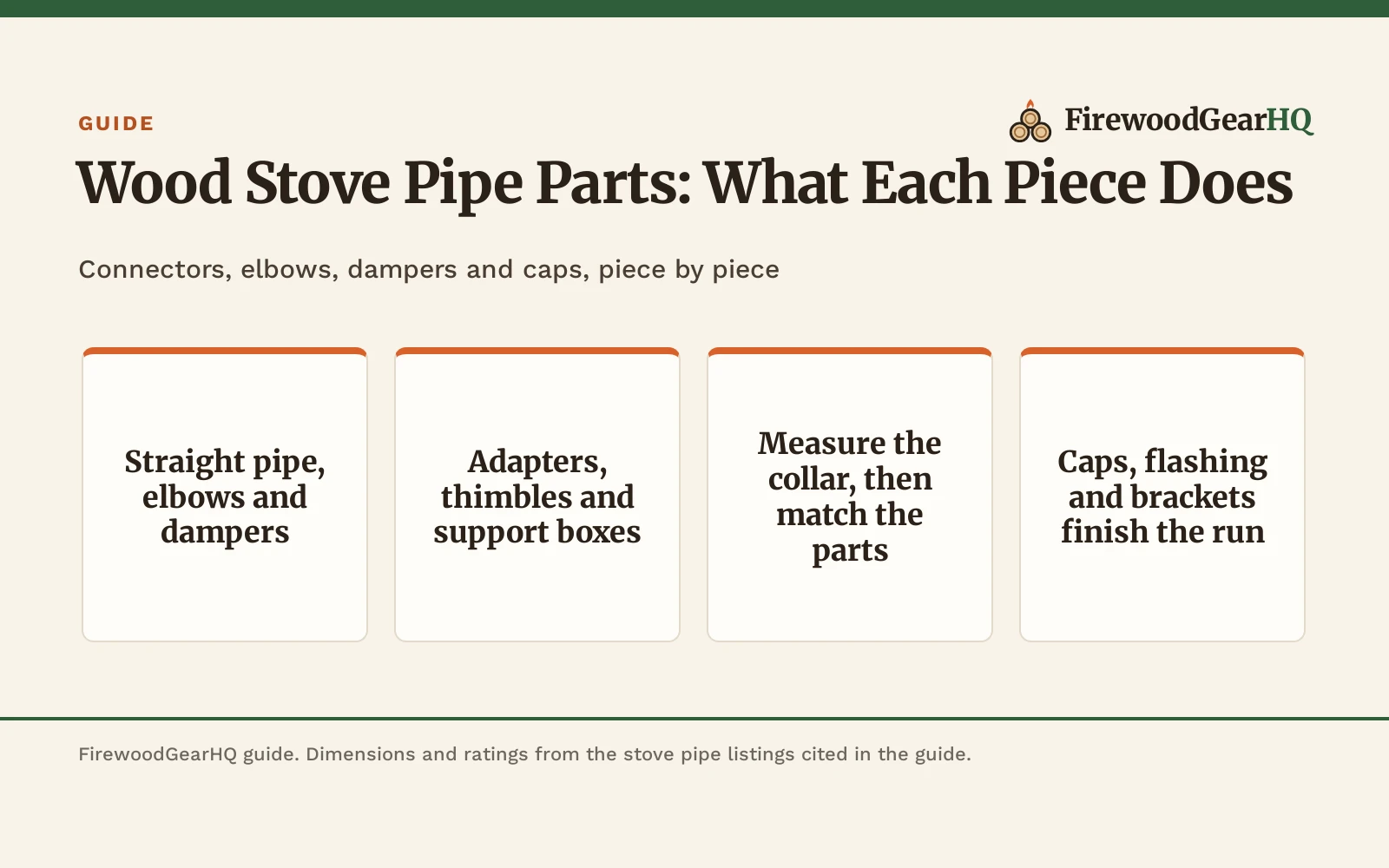
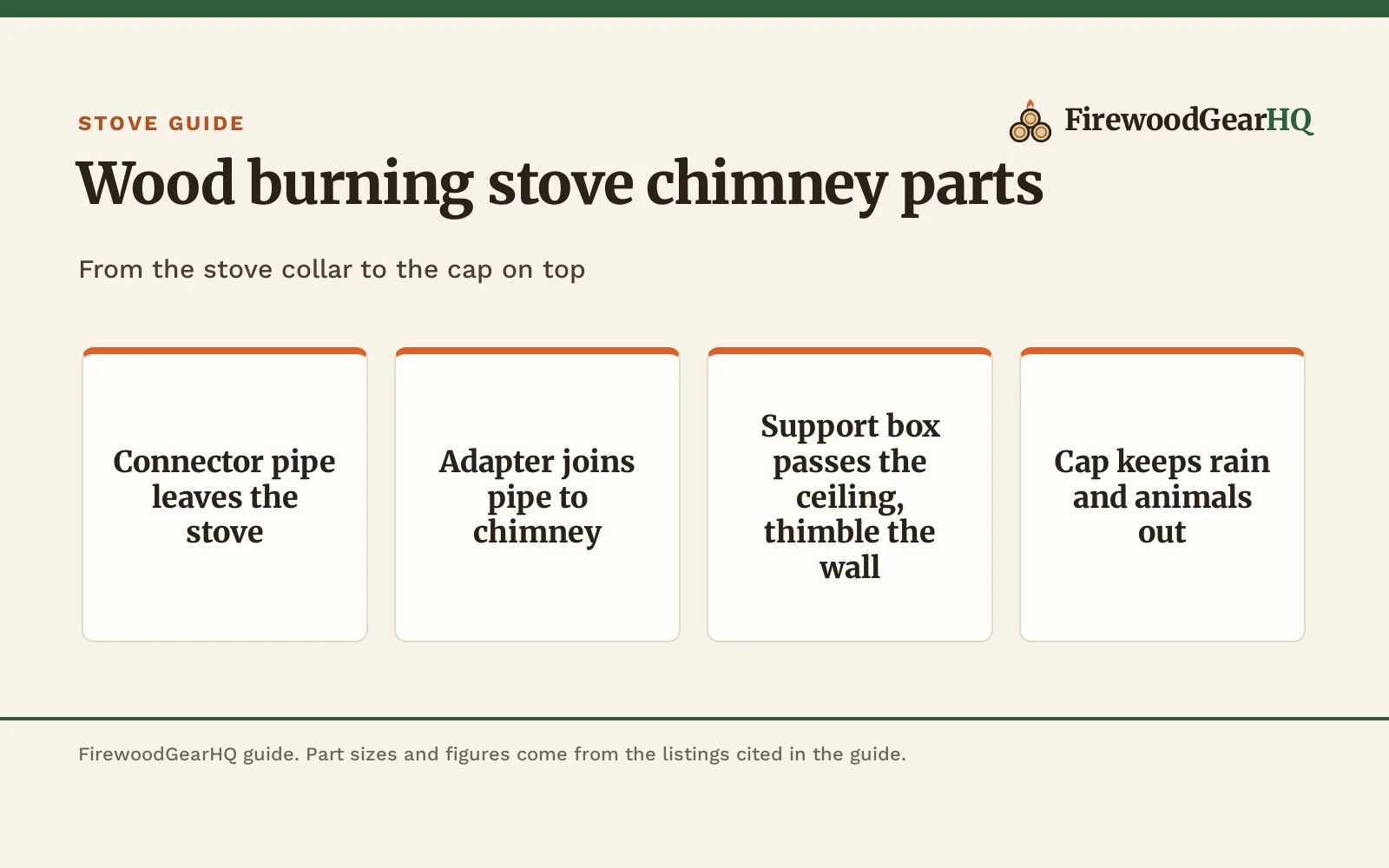
The venting system has three stretches. Stove pipe, also called connector pipe, runs from the stove to the wall or ceiling. Chimney pipe runs from there to above the roof, capped at the top. Between those stretches sit adapters, support boxes or thimbles, flashing, storm collars and brackets.
| Part | What it does | Check the listing for |
|---|---|---|
| Stove pipe (connector pipe) | Smoke from the stove to the wall or ceiling | Diameter: 6 inch or 2.36 inch |
| Adapter | Joins connector pipe to insulated chimney pipe | A match for both pipe types |
| Ceiling support box | Carries the chimney through a ceiling | Size: 24 inch square box |
| Wall thimble | Lets pipe pass through a wall | Fits 6 to 10 inch walls |
| Chimney pipe sections | Smoke from wall or ceiling to above the roof | Length: 24 inch sections |
| Wall bracket and base support | Hold the chimney stack to the wall | Carries up to 50 feet of chimney |
| Roof flashing | Seals the chimney at the roof | Fits 0/12 to 6/12 pitch |
| Storm collar | Sheds rain from the flashing joint | Fits the pipe diameter |
| Chimney cap | Keeps rain, snow, leaves, debris and animals out | Flat top or spark guard |
Connector pipe and the adapter
Connector pipe is the pipe that leaves the stove. The DuraVent listing states a 6 inch diameter double-wall close clearance connector kit, and the small YRenZ kit (on Amazon) states a 2.36 inch diameter pipe for tent stoves and other small stoves. Diameter matters most here, so measure the stove collar.
Where single-wall stove pipe meets insulated chimney pipe, an adapter makes the joint. The DuraVent DuraPlus kit includes a DVL/DuraBlack adapter for that changeover, the AllFuel HST kit (on Amazon) states that its stove pipe adapter connects the single wall stove pipe to the Class-A double wall insulated short pipe, and the Selkirk kit (on Amazon) includes a smoke pipe adapter for the same job.
The YRenZ kit adds a damper pipe and a 90 degree elbow. Its listing states 7 pieces in 1.0mm carbon steel, thicker than ordinary 0.6-0.8mm flue tubes, with full continuous seamless welding to prevent flue gas leakage. Note a mismatch inside that listing: the title calls the pipe stainless steel while the bullets call it carbon steel, so check the material with the maker.
Through the ceiling or through the wall
Most chimneys leave the house through the ceiling or through a wall. The DuraVent DuraPlus manufactured home kit is a through-the-roof kit: a 24 inch square ceiling support box with trim, adjustable roof flashing for 0/12 to 6/12 pitch, a storm collar, a chimney cap, and two 24 inch galvanized DuraPlus chimney pipe sections. The Selkirk kit covers the same job for 6 inch diameter SureTemp pipe.
The AllFuel HST kit takes the through-the-wall route for 6 inch inner diameter chimney pipe. Its wall thimble lets the short pipe pass through the wall and adjusts to fit walls from 6 to 10 inch thick. A base wall support mounts to the exterior wall and carries the chimney stack, up to a maximum of 50 feet as the listing states. A tee turns the run vertical, and pipe lengths stack on top of it to clear the roof. The AllFuel Class-A chimney pipe is listed to UL 103HT for high temperature chimney applications.
Chimney pipe, supports and brackets
Chimney pipe is the insulated pipe that runs from the wall or ceiling to above the roof. The DuraVent DuraPlus pipe uses a triple-wall design with a locked-in ceramic refractory blanket and an air space insulation layer, and the listing states it meets UL standards for continuous 1,000 degree F flue gas operation. The DuraPlus kit carries a limited lifetime warranty, and the AllFuel pipe is Class-A double wall insulated pipe, listed to UL 103HT.
The AllFuel kit includes a base wall support and a standard wall bracket, and the listing states that a wall bracket is required a minimum of every 8 feet of vertical run above the base wall support. The standard wall bracket holds the pipe at a 2 inch clearance to the exterior wall, while an adjustable wall bracket adjusts from 2 to 7 inch clearance.
Flashing, storm collar and cap
At the roof, flashing seals the opening and a storm collar sheds rain away from the joint. The DuraVent DuraPlus kit includes adjustable roof flashing for 0/12 to 6/12 pitch with a storm collar, and the Selkirk kit includes flashing and a storm collar as well. Match the flashing to the roof pitch and the pipe diameter, and have a certified pro fit the roof joint.
The DuraVent DuraPlus kit includes a chimney cap, the Selkirk kit includes a round top, and the AllFuel kit includes a flat top spark guard chimney cap. The AllFuel listing states that its flat top cap keeps out rain, snow, leaves, debris and animals, and that the flat top allows for the best air flow without the restriction of a spark guard. Check local codes before ordering.
What is not a chimney part
Searches for stove parts also turn up flexible gas line kits, and those are not chimney parts. The listings show 48 inch and 72 inch flexible gas lines with 5/8 inch outside diameter and 1/2 inch inside diameter, in coated corrugated stainless steel. They connect gas dryers, gas ranges, water heaters and other gas appliances. A gas connector carries gas to an appliance; it does not carry smoke from a wood stove, and it has no place in a wood stove venting system.
Matching parts to your stove
Start from the stove collar. The kits in the listings are built around 6 inch diameter pipe, which suits full-size stoves, while the YRenZ kit at 2.36 inch diameter suits tent stoves. Keep the diameter the same through the whole run, and use the adapter the kit includes for the change from connector pipe to insulated chimney pipe. Check the wall thickness, roof pitch and run height against the figures the kit states, and have a certified pro confirm the plan.
Safety checks before you burn
Have the chimney inspected annually, and burn seasoned wood only, as the EPA Burn Wise program advises. Fit smoke and CO alarms in the house. Keep the area around the stove clear. If the stove smokes back into the room or the fire will not climb into its normal range, stop burning and have the venting checked by a certified pro. A stove thermometer shows whether the stove is running in its normal range, and a carbon monoxide detector belongs in the house.
FAQ: wood, fire and gear
What diameter chimney pipe does a wood stove need?
Match the pipe to the stove collar and keep that diameter through the run. The kits in the listings are built around 6 inch diameter pipe, while the small YRenZ kit states a 2.36 inch diameter for tent stoves and other small stoves.
What is the difference between stove pipe and chimney pipe?
Stove pipe, or connector pipe, is the pipe that runs from the stove to the wall or ceiling. Chimney pipe is the insulated pipe, such as Class-A double wall pipe, that runs to above the roof. An adapter joins the two where they meet.
What does a chimney cap do?
A cap keeps rain, snow, leaves, debris and animals out of the flue. The AllFuel flat top cap also allows for the best air flow without the restriction of a spark guard.
Can a flexible gas line be used as stove pipe?
No. Flexible gas line kits connect gas dryers, gas ranges, water heaters and other gas appliances. They carry gas, not smoke, and they have no place in a wood stove venting system.
How often should a chimney be inspected?
Have the chimney inspected annually and swept when the inspection calls for it. A chimney brush for a wood stove suits routine cleaning between pro visits, and a creosote remover for a wood stove helps with buildup in the pipe.
What holds a through-the-wall chimney to the house?
A base wall support carries the weight of the stack, and wall brackets give lateral stability. The AllFuel listing states a wall bracket is required a minimum of every 8 feet of vertical run, and its base wall support can carry up to a maximum of 50 feet of chimney.
More firewood guides
See the stove accessories hub, the best chimney pipe and the best chimney cap for a wood stove. For the stove itself, see the best wood stove for heating a house, and for liners see the best chimney liner kit for a wood stove.