Wood Stove Pipe Parts: What Each Piece Does
Wood stove pipe parts carry smoke from the stove to the chimney. This guide explains what each connector, elbow, damper, thimble and cap does, and how to match the pieces.

On this page
Top picks at a glance
As an Amazon Associate I earn from qualifying purchases.
- 1
 DuraVent DuraPlus 6" Diameter 24" Length DuraVent DuraPlus9.8/10View on Amazon
- 2
 Guide Gear Outdoor Wood Stove Pipe Extension Accessories9.2/10View on Amazon
- 3
 UNITED STATES HDW BM0113 8" x 24" Stove Pipe9.1/10View on Amazon
Fall prep ends at the stove, not at the woodpile. The splits are stacked and the stove stands ready, but the smoke still needs a clear, sealed path out of the house. That path is made of wood stove pipe parts, each with its own job: carry hot flue gas from the stove collar to the chimney.
FirewoodGearHQ earns a small commission if you buy through links on this page. The price you pay stays the same. Read our affiliate disclosure.
The quick answer
Wood stove pipe parts form the connector run between the stove and the chimney. Straight pipe carries the gas, elbows turn it, a damper controls the draught, an adapter joins pipe of different kinds, a thimble guards the wall pass-through, and a cap keeps rain and animals out of the top. Match the diameter to the stove collar and use the pipe kind the listing states for each section of the run.
Wood stove pipe parts at a glance
| Part | What it does | What the listings show |
|---|---|---|
| Straight pipe | Carries flue gas in a straight run | 6-inch diameter; 24-inch sections |
| Telescoping pipe | Bridges a gap without cutting | 6-inch diameter; 38 to 70 inches |
| Elbow | Turns the run around an obstruction | 90-degree bend; in 2.36-inch tent kits |
| Damper | Controls airflow and burn rate | 6-inch cast iron; horizontal closes, vertical opens |
| Adapter | Joins stove pipe to chimney pipe | Single-wall to Class-A insulated pipe |
| Wall thimble | Guards the pipe through a wall | Walls from 6 to 10 inches thick |
| Wall bracket | Holds the outside stack steady | 2-inch clearance; adjustable 2 to 7 inches |
| Chimney cap | Keeps rain, snow, leaves and animals out | Flat top cap; spark arrestor caps |
What each part does
Straight pipe and telescoping pipe
Straight pipe is the main length of the run, carrying flue gas from the stove collar toward the chimney. Listings here show 6-inch diameter pipe for home stoves and 2.36-inch pipe for tent stoves. DuraVent lists 24-inch chimney pipe sections, and Ventylis lists a 24-inch triple-wall pipe, 6-inch inner diameter and 8-inch outer diameter. A telescoping pipe covers the gap between a fixed length and the ceiling or wall: the AllFuel HST telescoping pipe adjusts from 38 to 70 inches, and the listing states that single-wall pipe cannot be cut down and cannot be run through walls or ceilings.
Elbows
An elbow turns the run where a straight line will not work, around a beam or other obstruction. The YRenZ 7-piece kit includes a 90-degree elbow beside its damper pipe, and the LEIFIDE kit includes 4 straight pipes and an elbow, with each straight pipe about 12 inches long. Every bend adds a joint. The YRenZ listing notes that slight looseness when cold is normal, and the pipes lock tightly once the stove is lit. The Frienda 8-piece (on Amazon) set shows the same idea at tent scale, with 7 sections of 11.8 inches.
Dampers
A damper sits in the pipe and controls how much air moves through the stove, setting the burn rate. The Pelopy 6-inch damper (on Amazon) kit has a cast iron damper with double-wall stainless steel construction, and the listing states that the double-wall design reduces clearance to combustibles. Handle horizontal closes the damper and reduces combustion; handle vertical leaves it fully open.
Adapters
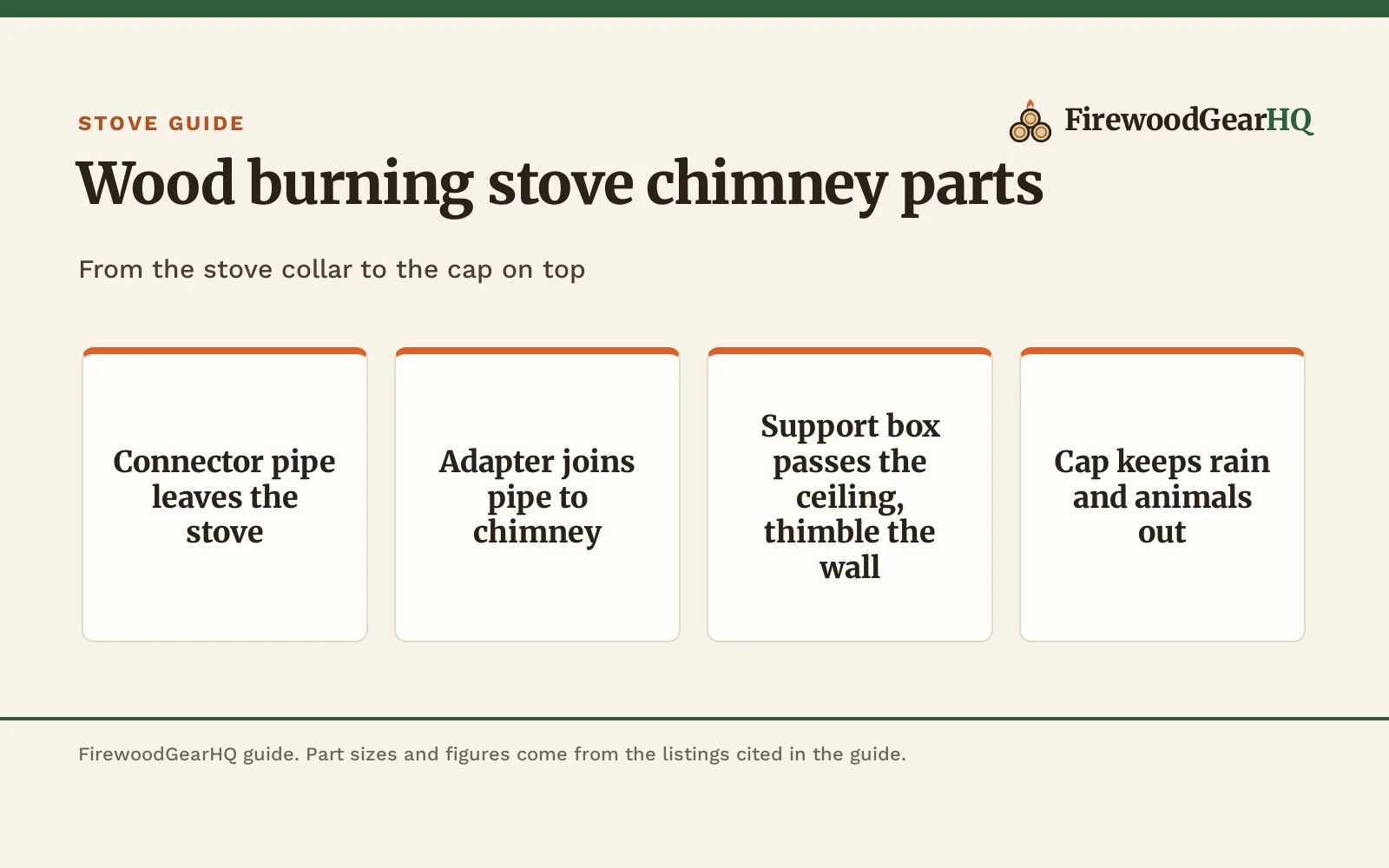
An adapter is the transition piece between pipe kinds. In the AllFuel HST through-the-wall kit, the stove pipe adapter connects single-wall stove pipe to Class-A double-wall insulated short pipe before the wall. The Selkirk ceiling support kit (on Amazon) includes a smoke pipe adapter beside its storm collar, flashing, attic insulation shield and finish support. Match the adapter to the pipe on each side.
Wall thimbles and ceiling support boxes
A wall thimble lets pipe pass through a wall safely, while a ceiling support box does the same job where the chimney passes through a ceiling. The AllFuel HST kit states that its wall thimble adjusts to walls from 6 to 10 inches thick, and that for thicker walls a shield can be fabricated on site from galvanized steel no less than .019 inches thick. The DuraVent manufactured home kit includes a 24-inch square ceiling support box with trim, beside its adapter, flashing, storm collar, chimney cap and 2 24-inch galvanized chimney pipe sections.
Brackets, flashing, storm collars and caps
A base wall support mounts to the exterior wall and carries the weight of the chimney stack, and the AllFuel HST listing states that its base wall support can carry up to a maximum of 50 feet of chimney. A wall bracket gives lateral stability at a 2-inch clearance to the exterior wall, and the adjustable wall bracket adjusts from 2 to 7 inches of clearance to bypass a gutter or other obstruction. A wall bracket is required a minimum of every 8 feet of vertical run above the base wall support. A flat top chimney cap tops off the system to keep out rain, snow, leaves, debris and animals, and the listing states that it allows for the best air flow without the restriction of a spark guard.
How to measure and match the pieces
Start at the stove collar and work outward, matching its diameter. The listings here use 6-inch pipe for a 6-inch collar and 2.36-inch pipe for a 2.36-inch tent stove collar. Measure the run from the collar to the ceiling or wall, then to the chimney, and use a telescoping section from 38 to 70 inches to take up the slack. The AllFuel HST single-wall pipe requires 18 inches of clearance to combustible materials, while the Pelopy double-wall damper kit lists reduced clearance to combustibles.
What goes wrong when a piece is missing or mismatched
A missing cap lets rain and snow into the flue, and a missing spark arrestor lets sparks out onto a dry roof or tent. A damper that does not fit its pipe cannot control the draught, and a joint that does not seal lets smoke into the room. A thimble left out leaves hot pipe against wall framing, and a bracket left out leaves a tall outside stack to sway in the wind. Check local codes before ordering, as the AllFuel HST listing advises.
Single-wall, double-wall and insulated pipe
Single-wall pipe is a single layer of steel: the AllFuel HST listing states that its single-wall pipe is made of 21 gauge steel, 9 percent thicker than 22 gauge steel and 27 percent thicker than 24 gauge steel, and that it requires 18 inches of clearance to combustible materials. Double-wall pipe adds an extra layer, and the Pelopy damper kit states that its double-wall stainless steel construction provides heat retention and reduces clearance. Insulated chimney pipe adds a layer of insulation between walls: the Ventylis triple-wall pipe (on Amazon) lists a 304 stainless steel inner layer, a 1-inch to 1.25-inch thick ceramic fiber insulation layer, and a galvanized outer layer, 6-inch inner diameter, 8-inch outer diameter and 24-inch length, and the listing states that its insulation withstands high temperatures of 2100 degrees Fahrenheit and above. The DuraVent DuraPlus kit meets UL standards for continuous 1,000 degrees Fahrenheit flue gas operation. Single-wall pipe belongs inside, from stove to chimney; Class-A insulated pipe passes through walls and ceilings and runs outside.
FAQ: wood, fire and gear
What diameter stove pipe do I need?
Match the pipe to the stove collar. The listings here use 6-inch diameter pipe on home-stove kits and 2.36-inch pipe on tent-stove kits. A pipe of the wrong diameter will not seat on the collar or on the next section.
Can single-wall stove pipe go through a wall?
No. The AllFuel HST listing states that single-wall pipe cannot be run through walls or ceilings and should not be used outside where it is exposed to the elements. A through-the-wall run uses an adapter to join the single-wall pipe to Class-A insulated pipe, a wall thimble at the wall, and a tee and base wall support outside.
What does a stove pipe damper do?
A damper controls airflow through the stove and sets the burn rate. The Pelopy listing states that it lets the operator vary the amount of air drawn through the ventilation system, extending burn times and maintaining a steady fire. Handle horizontal closes the damper; handle vertical leaves it fully open.
How far apart should wall brackets be on an outside chimney?
The AllFuel HST listing states that a wall bracket is required a minimum of every 8 feet of vertical run above the base wall support. The standard bracket maintains a 2-inch clearance to the exterior wall, and the adjustable bracket adjusts from 2 to 7 inches.
Do I need a chimney cap?
Yes. A cap keeps rain, snow, leaves, debris and animals out of the flue, and the AllFuel HST listing states that its flat top chimney cap allows for the best air flow without the restriction of a spark guard. The Frienda listing notes that its spark arrestor only blocks a portion of the sparks.
More firewood guides
See the stove accessories hub, the wood burning stove chimney parts guide and the best stove pipe for a wood stove picks. For fitting and upkeep, see the best stove pipe crimper, the best stove pipe sealant, the best 4 inch stove pipe brush and the best stove pipe cap.