What Is a Pulaski Tool and How Is It Used
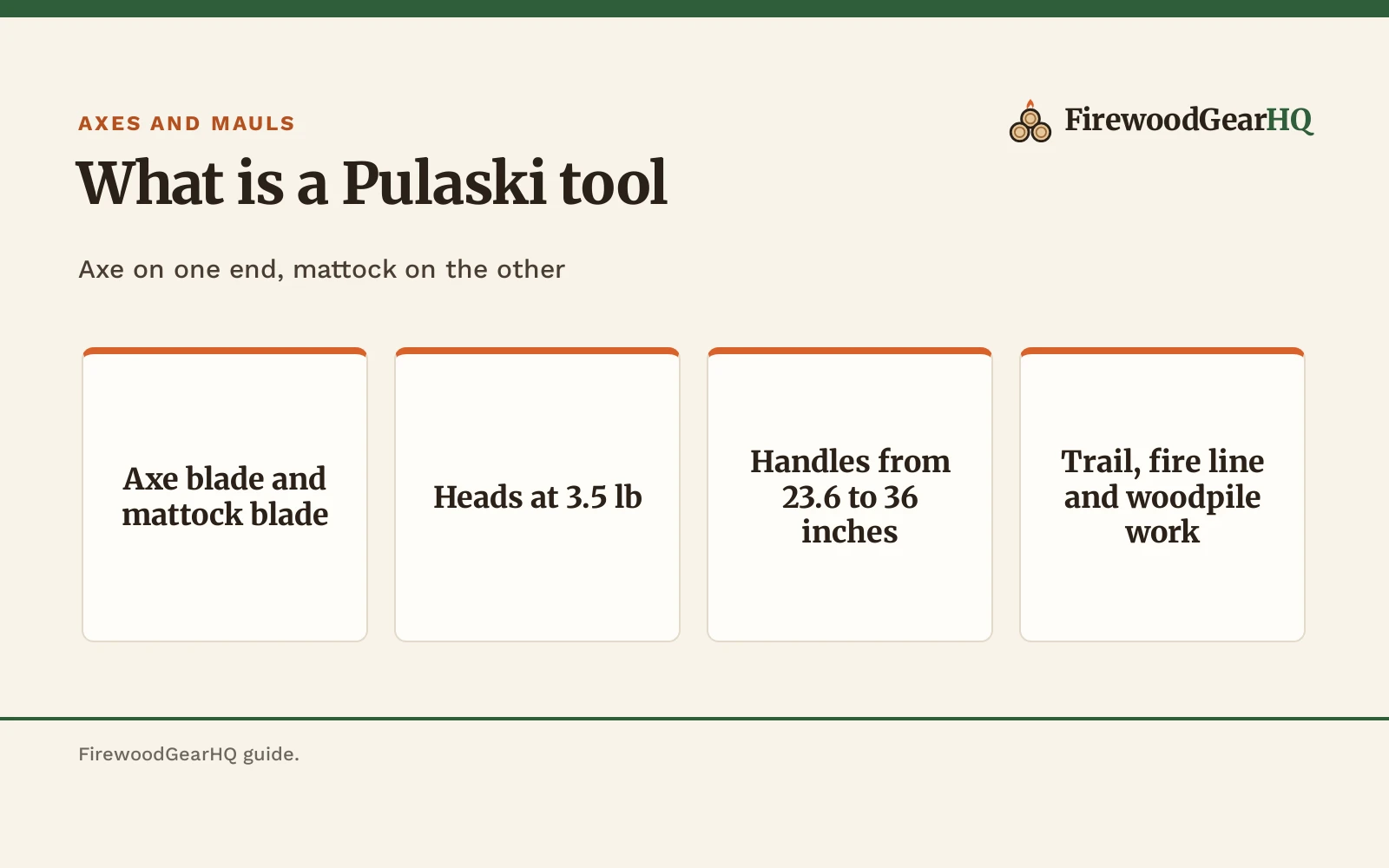
A Pulaski pairs an axe blade with a mattock blade on one head, so a single tool chops, digs and clears roots on the trail and around the woodpile.

On this page
By the time the cutting is done and the rounds are stacked, the ground around the woodpile is a mess of limbs, roots and half-buried brush, and that is where a Pulaski earns its place. What is a Pulaski tool? It is a hand tool with an axe blade on one end of the head and a mattock blade on the other, so one tool chops and digs. Trail crews and wildland firefighters carry it because it clears a path and breaks ground without a tool change, and the same two ends serve a woodpile owner clearing brush and roots around the stack.
As an Amazon Associate I earn from qualifying purchases. FirewoodGearHQ earns a small commission if you buy through links on this page. The price you pay stays the same. Read our affiliate disclosure.
What is a Pulaski tool
A Pulaski is a dual-head hand tool: a sharp axe bit for chopping and a horizontal mattock blade for digging, grubbing and clearing roots. The two ends share one handle, and the listings for the tool describe it the same way across brands: an axe and hoe hybrid, a dual-purpose grub hoe and chopping blade, and a traditional axe bit on one end with a mattock blade on the other. The Council Tool listing says the tool was developed in the early 1900s by Ranger Edward Pulaski, and says it meets US Forest Service specification 5100-355E.
Pulaski sizes in the listings
| Listed tool | Head | Handle |
|---|---|---|
| Adler Pulaski Compact (A7) | 3.5 lb | 23.6 in |
| Adler Pulaski Full Size (A8) | 3.5 lb | 27.5 in |
| Truper PU-3-1/2M | 3.5 lb | 35 in |
| Truper HP-3 1/2H | 3.5 lb | 34 in |
| Council Tool 38PE136 | 3.75 lb | 36 in |
| Collins HP-3 1/2FD-C | 3-3/4 lb | 36 in |
| Nupla PA375-36 | 3.5 lb | 36 in |
| Westward 20C889 | Not stated | 36 in |
The Adler compact listing gives 24 inches in its title and 23.6 inches in its bullets and dimensions; the table uses 23.6 inches. The Westward listing states an item weight of 8.0 pounds but no head weight, so its head is listed as not stated.
The two ends of the tool
The axe end is the chopping end. Listings describe a sharp axe blade for chopping and splitting, and the Truper PU-3-1/2M listing pairs it with a horizontal mattock blade for digging and clearing roots. The mattock end is the digging end: the listings call it a grub hoe or hoe-style side, and they list digging, trail clearing, root removal and excavation among its jobs. One tool does both, so a crew clears a trail and breaks ground without carrying an axe and a mattock separately.
Where a Pulaski earns its keep
Trail crews use it for trail maintenance and clearing, and wildland firefighters use it for fire line work. The listings name forestry, land clearing, root removal, excavation, camping, landscaping, trail work and trail maintenance among its uses. Around a woodpile, the same jobs show up on a smaller scale: clearing brush from a cutting area, grubbing roots out of a path, and opening ground for a stack.
How to use the two ends
Work with a clear swing zone: no one standing close, no overhead limbs in the way, and solid footing. Chop with the axe bit first, using short, controlled swings, and let the head do the work. When the ground needs breaking, turn the tool over and use the mattock blade to grub roots and loosen soil, pulling the loosened material clear before the next swing. Keep both edges covered with their sheaths when the tool is carried or stored; the Adler listings include two vegetable-tanned leather sheaths, one for each end.
What to look for in a Pulaski
Head weight runs 3.5 lb on most of the listings here, with the Council Tool head at 3.75 lb and the Collins head at 3-3/4 lb. Total weight varies more: the Adler compact lists 5 lb total, the Adler full size 5.5 lb, the Collins 5.6 lb, and the Westward 8.0 lb. Handle length runs from 23.6 inches on the Adler compact to 36 inches on the Collins, Nupla and Westward listings, with the Truper PU-3-1/2M at 35 inches, the Truper HP-3 1/2H at 34 inches and the Adler full size at 27.5 inches. Handles are American hickory on most listings, fiberglass on the Collins, and the Nupla handle (on Amazon) has a molded grip. Steel varies by maker: the Adler listings state C60 carbon steel at 50-55 HRC, and the Council Tool listing states 1080 steel tempered to Rc 53-58. The Truper PU-3-1/2M listing notes an elliptical eye for the head-to-handle connection.
FAQ: wood, fire and gear
Is a Pulaski an axe?
Half of one. A Pulaski has an axe bit on one end of the head and a mattock blade on the other, so it chops like an axe and digs like a mattock. An axe alone has no digging end.
What is a Pulaski tool used for?
Chopping and digging in the same tool: trail maintenance, clearing roots, grubbing, excavation and fire line work, per the listings. Around a woodpile it clears brush and roots from cutting areas and paths.
How heavy is a Pulaski?
Most heads here list 3.5 lb, with the Council Tool head at 3.75 lb and the Collins head at 3-3/4 lb. Total weights listed run 5 lb on the Adler compact, 5.5 lb on the Adler full size, 5.6 lb on the Collins and 8.0 lb on the Westward.
What handle length should a Pulaski have?
The listings here run 23.6 inches to 36 inches. The Adler compact lists the smallest handle here at 23.6 inches, and four listings give a 36-inch handle.
Who invented the Pulaski?
Ranger Edward Pulaski, in the early 1900s. The Council Tool listing says his leadership during the 1910 fire helped save 45 men, and the tool meets US Forest Service specification 5100-355E.
Is a Pulaski the same as a mattock?
No. A Pulaski pairs an axe blade with a mattock blade on one head, so it chops and digs; a mattock alone has no axe end. The mattock end of a Pulaski does the grubbing and digging, and the axe end does the chopping.
More firewood guides
See the axes and mauls hub for the rest of the category, the best splitting axes and the best splitting mauls for splitting tools, and how to sharpen an axe with a stone to keep the axe end keen. Also see water stone vs oil stone for axes and splitting axe vs splitting wedge.